How to check if a contractor is licensed
By Kiss János 14 min read

Why verifying a license matters
A cheap bid from an unlicensed contractor can become the most expensive decision on your project.
If the work fails, you may have no legal recourse through the licensing board, no bond to claim against, and little leverage in court. In some states, an unlicensed contractor can’t even be held to the same standards as a licensed one because the board has no jurisdiction over them.
The risk goes beyond bad workmanship.
Your homeowner’s or commercial insurer may deny a claim tied to unpermitted or unlicensed work.
And if a worker falls off your roof and the contractor carries no coverage, that injury claim can land on you.
Here’s what most people miss.
Learning how to check if a contractor is licensed isn’t a one-time database search. It’s a repeatable process, and it changes depending on the state, the county, the city, and the trade involved.
This guide walks through the full verification workflow:
- Finding the right state contractor licensing board or local authority for your project.
- Matching the official record to the person and business actually bidding on your job.
- Reading license status codes and classifications correctly.
- Confirming insurance, bonding, and complaint history as separate checks.
It applies whether you’re a homeowner hiring one roofer, a landlord maintaining several rental units, a property manager juggling vendors, or a small business coordinating a general contractor and a string of subcontractors.
The steps are the same.
Only the volume changes.
A license check takes about ten minutes. Recovering from a bad hire can take years.
There is no one national database
Most people assume there’s a single federal site where you type in a name and get an answer.
There isn’t.
Contractor licensing in the United States is handled state by state, and often county by county, which means your first job is figuring out who actually issues the license for your project.
Get this wrong and you’ll search the wrong database, find nothing, and either panic or assume the contractor is fine.
Neither is helpful.
States that license vs states that register
Some states run full licensing programs.
California’s Contractors State License Board (CSLB) requires contractors to pass trade and law exams, prove experience, and post a surety bond before they can bid on most jobs. Florida’s Department of Business and Professional Regulation issues certified licenses that allow statewide work.
Other states use contractor registration instead.
Registration usually means the contractor filed paperwork, paid a fee, and sometimes showed proof of insurance or a bond.
No competency exam required.
Pennsylvania is a good example.
Home improvement contractors register with the Attorney General’s office, but that registration doesn’t test their skills. Washington State registers contractors through its Department of Labor and Industries, which requires a bond and insurance but isn’t the same as a skills-based license.
Florida actually uses both models.
A “certified” contractor holds a state license valid everywhere in Florida, while a “registered” contractor holds local competency and can only work in the specific jurisdictions where they qualified.
Same state, two very different credentials.
County and city licensing rules
Then there are states with no statewide general contractor license at all.
Texas and New York fall into this group for general building work. In those places, licensing (if it exists) happens at the local level.
New York City, for instance, requires home improvement contractors to be licensed through its Department of Consumer and Worker Protection.
A contractor working just outside city limits may face completely different rules.
Many counties and cities also tie contractor requirements to building permits, so the permit office becomes your verification source.
The takeaway? A contractor can be perfectly legal in one town and unlicensed ten miles away.
Trade-specific licenses explained
Electricians, plumbers, HVAC technicians, and sometimes roofers carry their own trade licenses, separate from any general contractor license. These are often issued by a different agency entirely.
Texas shows this split clearly.
There’s no statewide general contractor license, yet electricians and HVAC contractors are licensed by the Texas Department of Licensing and Regulation, and plumbers by the Texas State Board of Plumbing Examiners.
Three trades, two agencies, zero general license.
So before you open any lookup tool, answer two questions.
What type of work is this (general construction, electrical, plumbing, roofing)? And which level of government governs that work where your property sits?
Your search starts there, not with a random web query.
The verification workflow, step by step
Think of verification like checking an ID at the door.
You’re not just confirming that a license exists.
You’re confirming it belongs to the person in front of you, it’s valid today, and it covers what they’re about to do.
Follow these four steps in order, then use the fallback process if a record doesn’t show up.
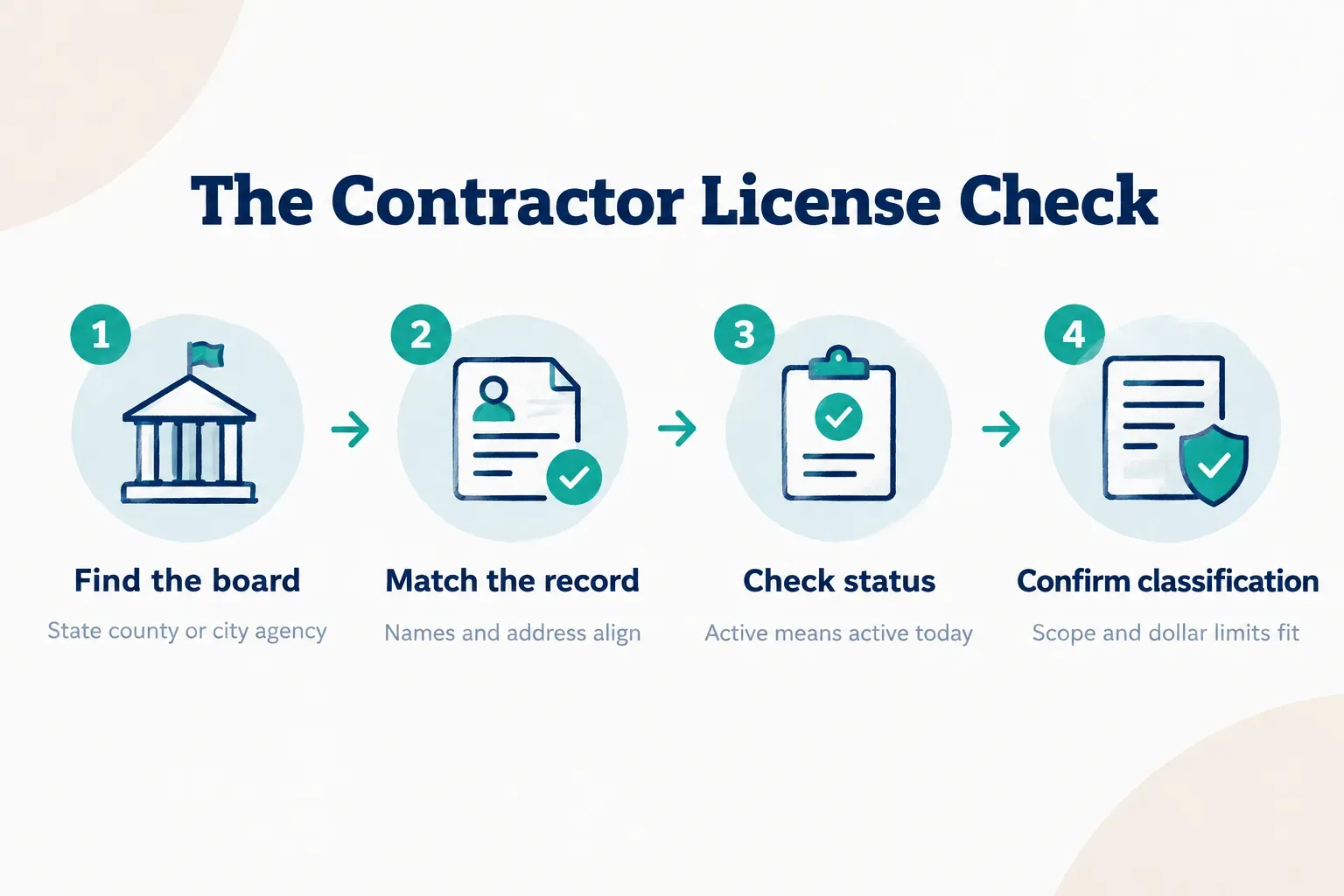
Find the right licensing board
- Identify every relevant authority, then search by license number first. List the state board, county office, and city office that may govern your trade and location, including separate trade boards for electrical or plumbing work. Ask the contractor for their license number and search the official license lookup with it before trying a business name, because a number returns one exact record while a name search can return dozens of near-matches.
Always use the government site directly.
Type the agency name into a search engine and confirm the URL ends in .gov or the state’s official domain. Third-party “license check” sites often show outdated data.
Match the record to the contractor
- Cross-check every identifying detail against the official record. Compare the legal business entity name, the license holder or qualifying individual, the business address, and the name printed on your written estimate. If the estimate says “Smith Home Services” but the license belongs to “J. Smith Construction LLC” at a different address, get an explanation in writing before moving forward.
The qualifying individual matters more than people realize.
In many states, a company’s license is tied to one person (the “qualifier”) who passed the exams. If that person left the company, the license may no longer be valid for the business, even if the company name still appears in the system.
Watch for business name and DBA differences too. A “doing business as” name is legal, but it should connect clearly to a licensed entity on file.
Interpret status and classification
- Read the status code carefully, because each one carries different legal weight. An active license status is the only one that means the contractor can legally work today, and you should also note the license expiration date so you know whether it will lapse mid-project.
Here’s how the common status labels typically break down:
- Active: Valid and in good standing on the date you checked.
- Expired: The contractor didn’t renew. They can’t legally contract until they do.
- Suspended: Temporarily blocked, often for unpaid judgments, lapsed bonds, or missing insurance.
- Revoked: Permanently cancelled, usually after serious violations. A suspended or revoked license is an immediate stop sign.
- Inactive: The license exists but the holder has voluntarily paused it and cannot currently take jobs.
- Pending: An application or renewal is in process. Not yet valid for contracting.
- Registration only: Paperwork is filed, but no competency license was issued. Legal where registration is the requirement, meaningless where a license is.
- Confirm the classification and monetary limit fit your job. A license’s trade classification defines what work the holder may perform, and some states also cap the dollar value of projects they can take on. A contractor licensed only for drywall shouldn’t be rewiring your kitchen, and in states like North Carolina and Nevada, a license tier with a lower monetary limit can’t legally cover a larger contract.
If the record doesn’t appear, don’t assume the worst yet. Work through this fallback sequence:
- Search for DBA names, the owner’s personal name, and spelling variants (LLC vs Inc., “and” vs ”&”).
- Consider whether a recent renewal hasn’t posted yet. Some boards update weekly rather than daily.
- Check whether the trade is licensed purely at the city or county level where you live.
- Call the board directly. Staff can often confirm status by phone and explain what they’re seeing.
If you still can’t find a match after all that… treat it as unlicensed until the contractor proves otherwise.
What a license doesn’t tell you
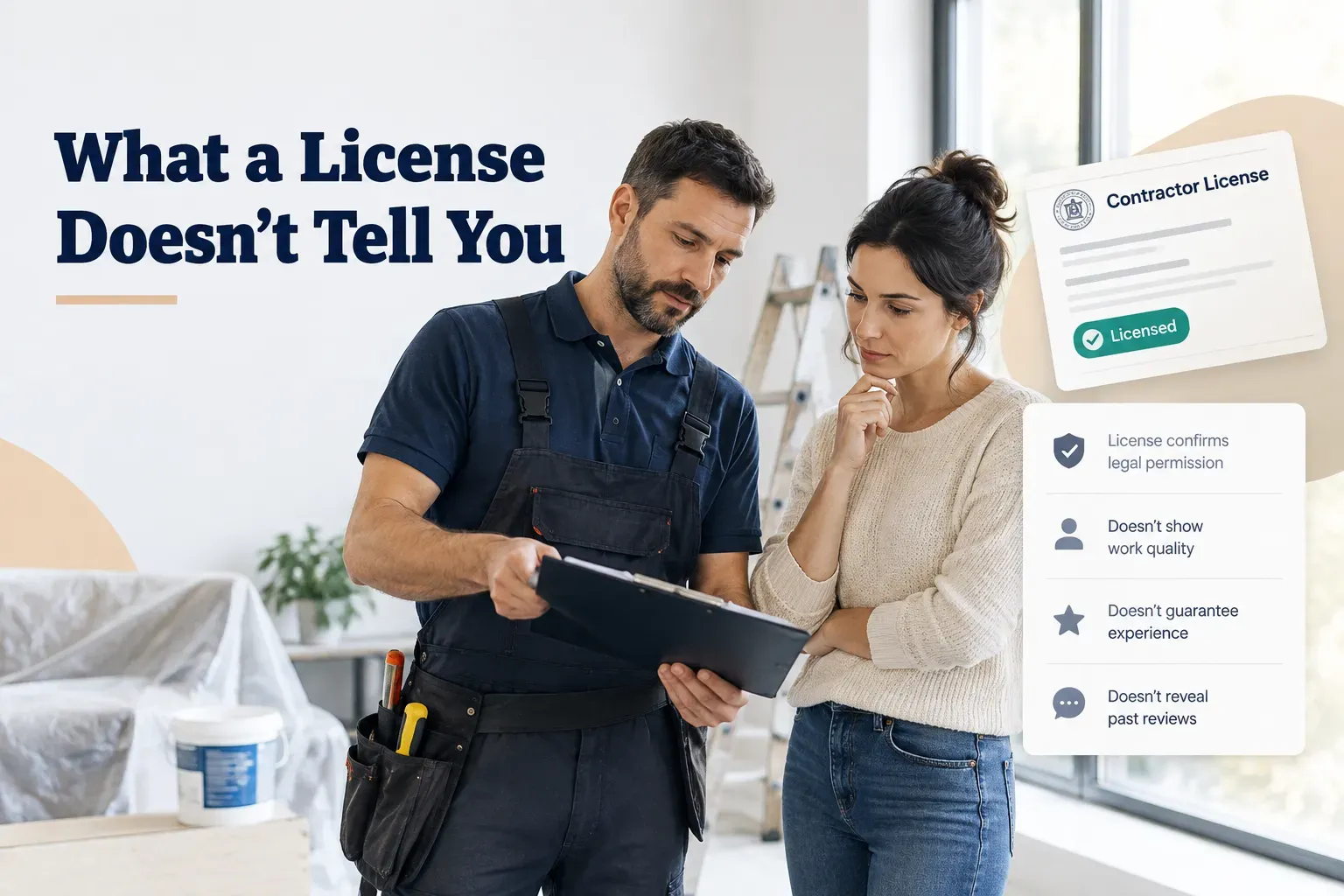
A clean license is a floor, not a ceiling.
It tells you the contractor met a minimum legal threshold on the day you checked, and that’s roughly where its promises end.
Several of the protections homeowners care about most live outside the license record entirely.
Insurance and bonding are separate checks
A license lookup and an insurance certificate are two different verifications.
Some boards display insurance or bond information, but many don’t, and even when they do, the data may lag behind reality.
Ask for a certificate of insurance showing general liability insurance, then call the issuing insurer or agent listed on it.
Confirm the policy is active, the coverage dates span your project, and the named insured matches the licensed business.
Certificates are easy to alter and easy to let lapse the week after they’re issued.
Workers’ compensation coverage deserves its own call.
It pays for medical costs and lost wages if a contractor’s employee is injured on the job. Without it, an injured worker may look to the property owner, and depending on your state, that claim can hit your homeowner’s policy or leave you exposed to a lawsuit.
Some sole proprietors are legally exempt from carrying workers’ comp if they have no employees.
That’s fine, as long as they truly work alone.
If three helpers show up on day one, the exemption doesn’t cover them.
A surety bond is also different from insurance. It’s a financial guarantee, typically payable to consumers harmed by license law violations.
But bonds are often small.
California’s contractor license bond is $25,000, which won’t go far on a failed $150,000 remodel, especially if multiple claimants file against the same bond.
Complaints, bonds, and disciplinary records
Licensing boards can reveal a lot about a contractor’s track record. Depending on the state, the record may show:
- Formal complaints that led to action or were substantiated.
- Citations and fines issued by the board.
- Bond claims paid out to consumers.
- Disciplinary actions such as probation, suspension, or revocation.
Review the full license complaints and disciplinary history, not just the status line. A contractor with an active license and four paid bond claims in two years tells a different story than one with a spotless record.
What boards usually don’t capture is just as important.
Civil lawsuits, small claims judgments, mechanics’ liens, and informal disputes resolved with a refund rarely appear. Many boards also withhold complaints that are still under investigation or were closed without action.
For a fuller picture, search your county court records by the business and owner names.
A valid, clean license does not guarantee good workmanship, punctuality, solvency, or a dispute-free project. It guarantees legal eligibility. Everything else you verify separately.
That’s why references, recent project photos, a detailed written contract, and a payment schedule tied to completed milestones still matter.
The license check tells you who’s allowed to play.
It doesn’t tell you who plays well.
Special cases worth knowing
Most verification mistakes happen at the edges.
The general contractor checks out, so nobody looks at the electrician. The business license is framed on the office wall, so nobody asks about the contractor license.
These gaps are where problems hide.
Subcontractors and trade licenses
Your general contractor’s license doesn’t automatically cover the people they bring in. Electricians, plumbers, HVAC installers, and roofers working under a GC typically need their own trade licenses, checked separately.
This is subcontractor verification, and it’s where property managers and small businesses often get caught.
Ask your GC for a list of subcontractors and their license numbers before work begins. Then run each one through the same workflow: right board, matching name, active status, correct classification.
Why bother if the GC is responsible? Because an unlicensed electrician can cause a failed inspection, a permit problem, or a fire, and “my contractor hired him” won’t fix any of those.
Many permit offices require the licensed trade contractor to pull their own permit for electrical or plumbing work, which gives you another checkpoint.
Business license isn’t a contractor license
A contractor may proudly show you a city business license or an occupational tax certificate. Those documents mean they registered to operate a business and pay local taxes.
They say nothing about construction competency.
Trade certifications from manufacturers or industry associations are also separate. A roofer certified by a shingle manufacturer may qualify for extended warranties, but that certification isn’t a government license.
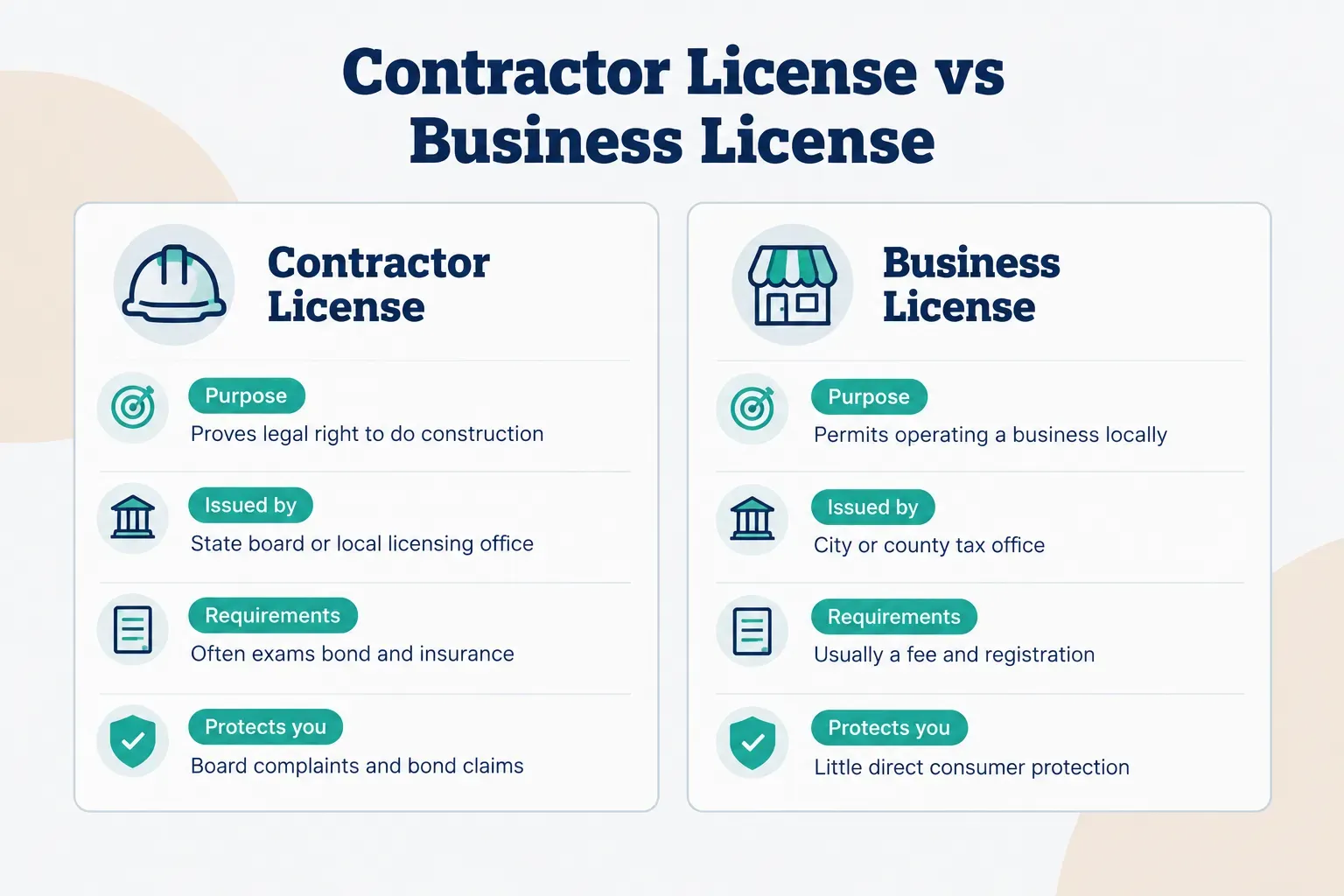
Different agencies, different purposes.
Ask specifically for the contractor license number, not just “a license.”
Marketplace profiles aren’t verification
Licenses also stop at state lines.
A contractor licensed in Nevada generally can’t legally work in California without holding a California license, even for identical work. Some states offer reciprocity that waives certain exams, but the contractor still needs to apply for and receive the second state’s license.
Service marketplaces add another layer.
Platforms help you discover local pros, compare reviews, and gauge responsiveness. Frendex’s Verified badge, for example, signals that a provider has gone through the platform’s own review process, which is a useful trust signal when you’re building a shortlist.
But a platform badge, a star rating, or a glowing review isn’t a legal credential.
Use marketplace profiles to find and filter contractors, then confirm licensing through the official government record.
The state contractor licensing board or local authority remains the authoritative source, every time.
Verify first, then book
Here’s the decision rule.
If the name, status, classification, and monetary limit all match your project, proceed.
If any single element is mismatched, expired, or missing, pause and ask questions before you sign anything or hand over a deposit.
Legitimate contractors expect this.
Most will happily explain a DBA, send an updated insurance certificate, or point you to a local license.
Hesitation or vague answers?
That’s your answer.
Build a simple evidence trail for every project:
- A screenshot or PDF of the license record.
- The date you verified it.
- The insurance certificate and notes from your call to the insurer.
- The written estimate and signed contract.
Store it in one folder per project.
If a dispute comes up in 2026 or five years from now, you’ll have proof of what you checked and when.
No single lookup protects you completely.
A consistent, documented verification habit does.
Whether you found your contractor through a neighbor, a yard sign, or a marketplace listing, run the same checks every time.
Ten minutes now beats ten months of cleanup later.
Frequently asked questions
How do I verify a contractor's license online?
You verify a contractor's license online through the official lookup tool on your state contractor licensing board's website, or your county or city licensing office if your area licenses locally. Search by license number first for an exact match. Then confirm the name, address, status, and classification match the contractor bidding on your job.
How can I check if a contractor is licensed and insured?
Checking license and insurance requires two separate verifications. Confirm the license through the official board lookup, then request a certificate of insurance and call the insurer or agent listed on it. Verify both general liability insurance and workers' compensation coverage, and make sure policy dates cover your entire project.
What happens if a contractor is not licensed?
Hiring an unlicensed contractor usually leaves you with far less legal protection. You typically can't file a board complaint or claim against a license bond, and your insurer may deny related claims. The contractor may face fines or criminal penalties, and you may run into trouble pulling building permits, passing inspections, or selling the property later with unpermitted work on record.
Can a contractor be licensed in one state and work in another?
A contractor generally cannot work in another state using only their home-state license. Some states have limited reciprocity agreements; California, for example, can waive the trade exam for certain classifications from Arizona, Louisiana, and Nevada. Even then, the contractor must apply for and hold the new state's license or registration before starting work.
How do I check a contractor's license by name?
You can check a contractor's license by name using the business name or owner name search on the licensing board's lookup tool. Try the legal entity name, any DBA, and the qualifying individual's personal name. Test spelling variants, since "Smith & Sons LLC" and "Smith and Sons Inc" may return different results or none at all.
What is the difference between a contractor license and a business license?
A contractor license proves legal authorization to perform construction work, while a business license only permits a company to operate in a city or county. Contractor licenses often require exams, experience, a bond, and insurance. Business licenses usually require a fee and registration, and they offer little direct protection if the work goes wrong.
Need a hand with something?
The Frendex map shows you who is available near you, in real time.
Get the app free Get the app freeFree, no card needed
Related articles

The contractor contract: A complete guide for 2026
See exactly what a contractor contract must cover in 2026, from scope to payment terms. Avoid the disputes that start over vague wording.

How to spot fake reviews before you get fooled
Learn the real patterns behind fake reviews: language clues, timing red flags, and reviewer history checks. No single signal is proof, here's what is.
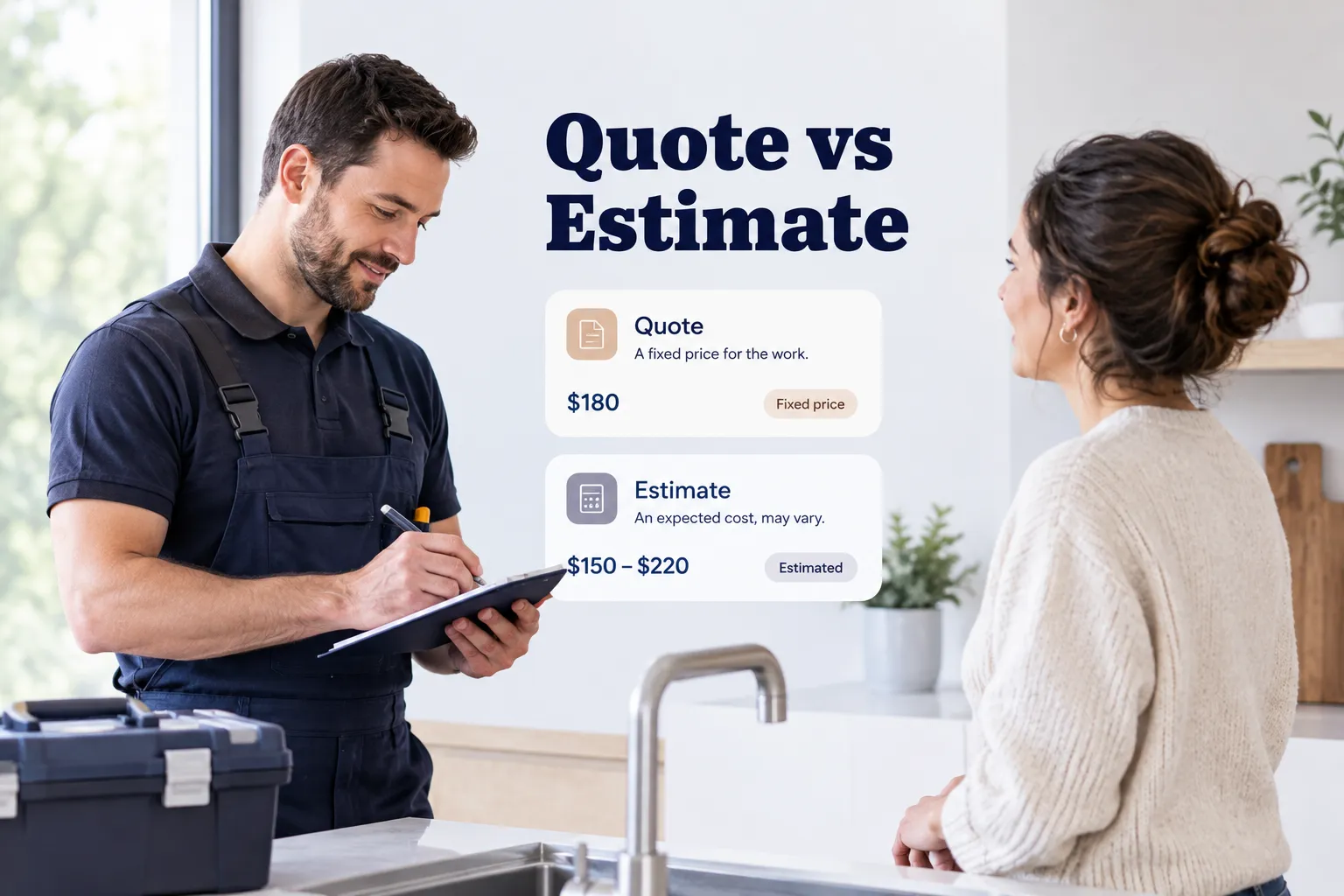
Quote vs estimate: Which do you actually need?
Quotes vs estimates explained in plain terms, plus the document checklist that actually protects your money. See when you can skip the paperwork entirely.