How to spot fake reviews before you get fooled
By Kiss János 12 min read
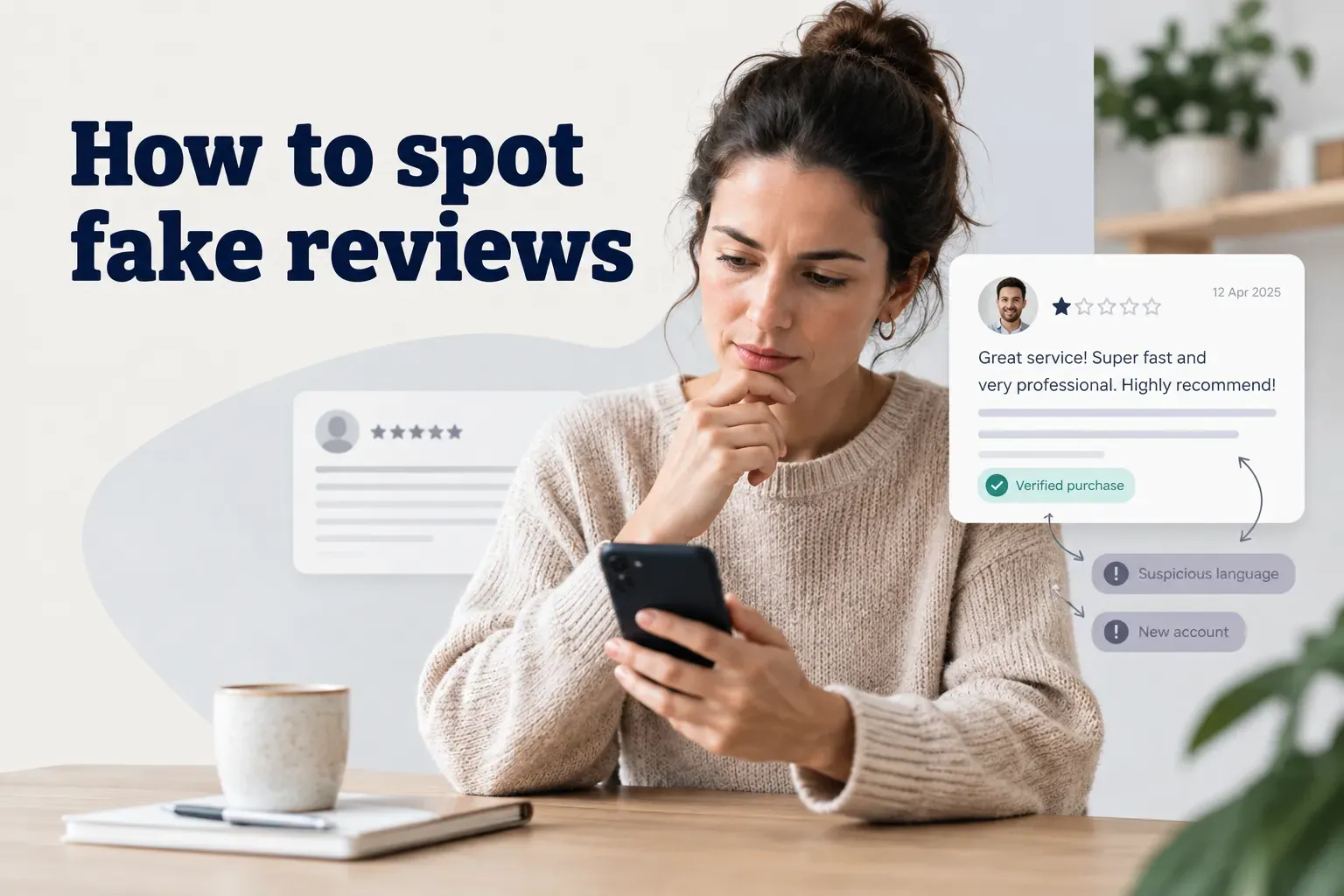
The trust problem nobody talks about
Most shoppers follow a quiet rule: be suspicious of five-star raves, trust the one-star rants. It feels like street smarts.
It’s half right at best.
The real problem is that review manipulation runs in both directions. Businesses buy glowing praise, but competitors and angry ex-employees post fake complaints too. And some businesses quietly bury the honest criticism they don’t like.
A page that looks balanced can be just as engineered as one that looks perfect.
Learning how to spot fake reviews isn’t about finding a single smoking gun.
No single signal proves anything.
What works is pattern recognition: combining clues from language, timing, reviewer history, and cross-platform evidence until the picture becomes clear.
One more distinction matters.
Reviews for cleaners, tutors, contractors, and other service providers need different scrutiny than reviews for a phone charger. With services, the “product” is a person’s work, delivered differently every time.
That changes what an honest review looks like, and what a fake one gets wrong.
Why one red flag isn’t proof
Here’s an uncomfortable truth: plenty of real customers write reviews that look fake. A retiree who types “Great service, very happy, would recommend!” isn’t a bot.
She’s just brief.
That’s why weak signals such as perfect grammar, short length, or enthusiastic praise can’t carry a verdict on their own. Authentic reviewers write tidy sentences. They leave one-line comments. They get genuinely excited.
Treating any one of these as proof produces a lot of false accusations and very little review authenticity insight.
The same caution applies to badges. A verified purchase or verified booking label confirms that a transaction happened.
That’s all.
It doesn’t confirm the review is detailed, unbiased, or representative of what most customers experienced. A verified buyer can still be paid, pressured, or simply having an unusually good day.
It also helps to stop treating “fake” as one category. At least five different things get lumped together:
Fabricated reviews are written by people who never used the product or service, often purchased in bulk. Incentivized reviews come from real customers who received a discount, refund, or freebie in exchange for feedback, which tilts the tone positive even when nobody explicitly asked for five stars.
Friends, family, and employee reviews are written by real people with an obvious stake in the outcome. Competitor sabotage involves rivals posting negative reviews to drag down a business’s average. And genuine-but-biased reviews are honest accounts of a single experience that happened to be unusually good or unusually bad.
Only the first four are manipulation. The fifth is just noise, and every honest review page contains some.
Then there’s the flip side most guides skip.
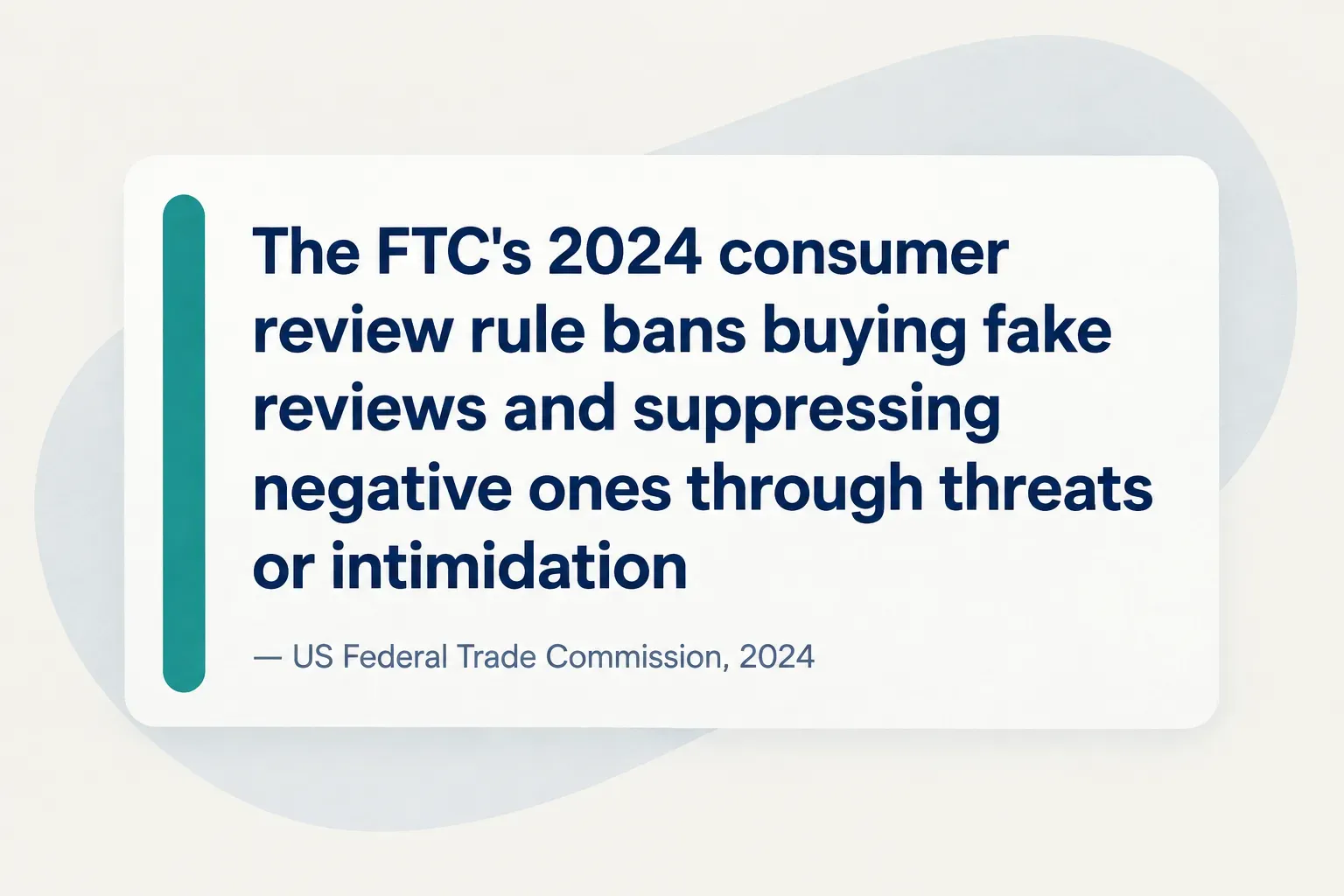
Review bombing happens when a coordinated group floods a business with negative ratings, often over something unrelated to the actual service, such as a viral social media post or a political stance. The reviews pile up within hours, many from people who were never customers.
Suppression is the quieter version. Some businesses only invite happy customers to leave reviews, pressure unhappy ones to delete theirs, or use legal threats to silence critics.
The result is a page with no fake reviews on it at all, just missing ones.
Patterns that expose fake reviews
Fake reviews rarely give themselves away individually.
They give themselves away in groups.
The tells below work best when you spot two or three of them pointing in the same direction.
Language and AI giveaways
The old advice was to look for broken English.
That advice is outdated.
AI-generated reviews are usually grammatically flawless, and that polish is part of the problem: they read smooth, generic, and strangely empty.
- Vague praise with no concrete nouns. “This product exceeded my expectations and delivered outstanding quality” tells you nothing. Real users mention the zipper, the battery after three weeks, the technician’s name, or the stain that finally came out.
- Uniformly positive sentiment. Genuine reviews usually include a small gripe, even in five-star ratings (“shipping took a while, but…”). Review sentiment that never wavers across hundreds of reviews is a pattern worth noticing.
- Marketing vocabulary. Phrases like “game-changing solution” or “premium experience” sound like ad copy because they often are. Customers describe outcomes; marketers describe positioning.
- Full product names repeated. Real people say “this blender.” Reviews written for search visibility say “the VortexPro 3000 High-Speed Blender” three times in four sentences.
- Balanced-sounding filler. Newer AI text sometimes adds a token “only downside” that’s actually a compliment in disguise, such as “the only downside is I wish I’d bought it sooner.”
Timing and coordinated bursts
Timing is one of the hardest things for manipulators to hide. Real reviews trickle in at a pace that roughly matches sales or bookings.
Purchased reviews arrive in batches.
- The review burst. A business that averaged four reviews a month suddenly gains 40 in a week. Check whether the spike lines up with a product launch, a rebrand, or a wave of bad press, all common moments for coordinated campaigns.
- Synchronized posting dates. Multiple reviews posted on the same day, sometimes within the same hour, with similar star ratings and length suggest a single source.
- Repeated phrasing across accounts. High text similarity between reviews from different names (same adjectives, same sentence structure, same odd typo) points to a template or a shared writer.
- Repeated reviewer locations. If a neighborhood bakery’s five-star reviews come disproportionately from accounts based in another country, ask why.
- Lopsided rating distribution. Healthy businesses usually show a curve weighted toward four and five stars with a tail of lower ratings. A “J-shaped” spread of almost all fives and a cluster of ones, with nothing in between, often signals manipulation on both ends.
Reviewer history checks
Clicking on a reviewer’s name takes ten seconds and often settles the question. Reviewer profile history reveals behavior that a single review can’t.
- One-company accounts. A profile that has reviewed exactly one business, ever, isn’t automatically fake, but several of them clustered on the same page is a warning sign.
- Extreme-only ratings. Accounts that post nothing but five-star or nothing but one-star reviews behave more like paid agents than ordinary customers.
- Fresh account, instant review. An account created the same day it posted, with no profile photo and no other activity, deserves skepticism.
- Overlapping histories. When several reviewers have all reviewed the same unrelated set of businesses (a dentist in Ohio, a phone case, a roofing company in Florida), you’re likely looking at a review spam network.
Judging reviews for local pros and freelancers
A fake review for a toaster and a fake review for a plumber fail in different ways.
Product reviewers all received the same object. Service clients each received a different job, from a different day, with a different set of problems.
That makes service reviews harder to fake convincingly, and easier to judge, once you know what to look for.
What a genuine review includes
Credible service reviews tend to share a recognizable anatomy.
They describe the scope of work (“deep clean of a two-bedroom apartment before move-out”). They mention communication style (“texted the night before to confirm”). They name specific outcomes and, often, realistic limitations.
That last part is telling.
A real client might write, “She couldn’t get the grout fully white, but she warned us upfront that it was decades old.” That’s balanced criticism, and it’s one of the strongest authenticity signals there is.
Fabricated reviews almost never admit a limitation, because nobody pays for nuance.
Context clues matter too. Look for dates, location references, and seasonal details that make sense (“fixed our heating in January”). Then read how the provider responded to criticism.
A professional reply that acknowledges the issue and explains what happened suggests a real business handling real feedback.
A defensive, insulting reply tells you something as well… just not what the provider intended.
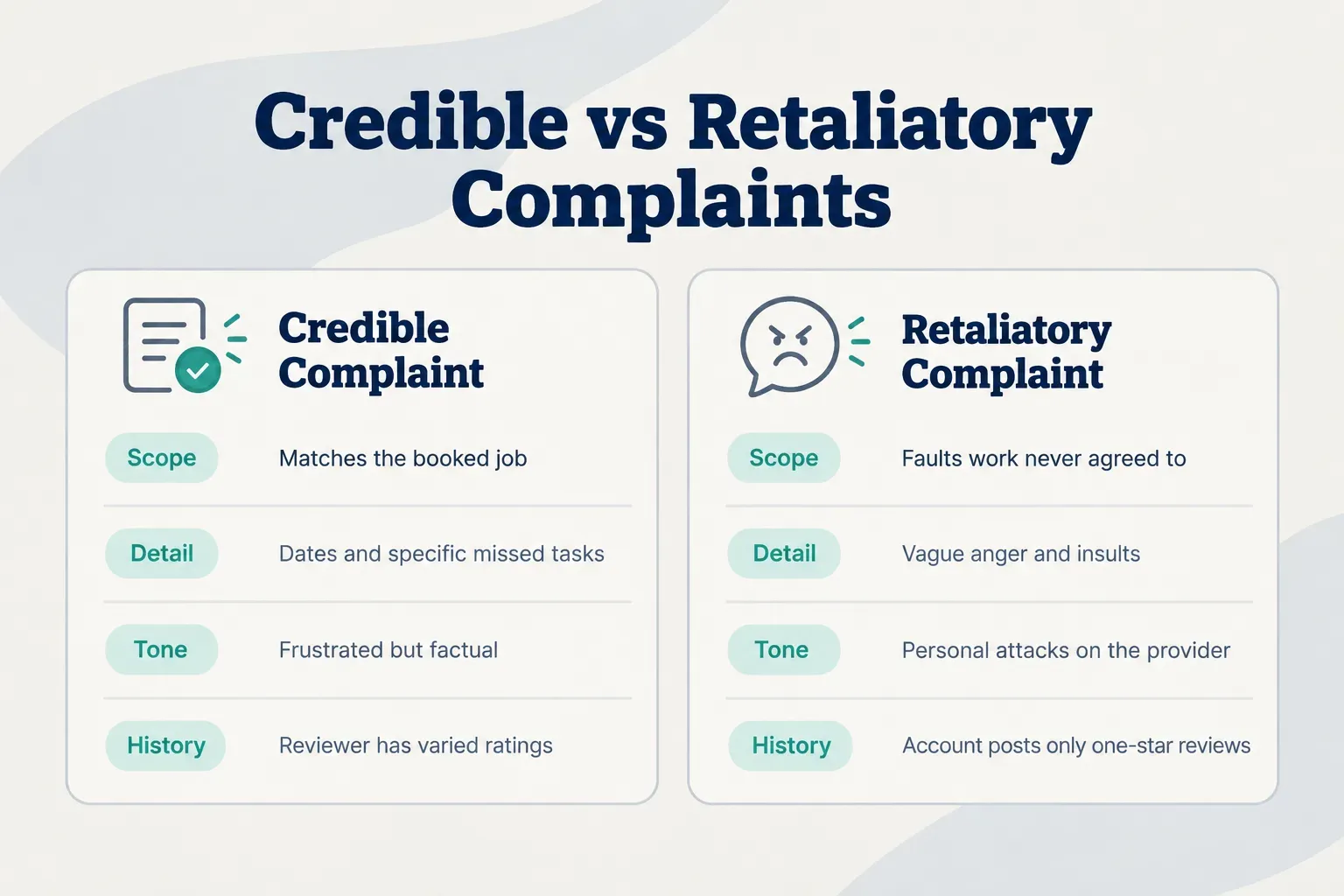
Negative reviews need their own filter.
A credible complaint usually matches the stated scope of work: the tutor missed sessions, the contractor left debris, the cleaner skipped rooms that were booked. An unreasonable or retaliatory complaint often criticizes something outside the agreement, like a one-star review for a house cleaner who wouldn’t also wash the car.
Checking across platforms
One glowing profile proves very little.
Cross-platform review comparison proves a lot more.
If a contractor holds 4.9 stars on their own website, 4.7 on Google, and 4.6 on a local trade directory, with similar praise themes on each, that consistency is strong evidence. Independent sources are hard to manipulate simultaneously.
But if the website shows 4.9 and every outside platform hovers around 3.2, the website is probably curated.
Booking-verified rating systems offer a practical safeguard here. Platforms like Frendex only allow a rating after a completed booking through the platform, which removes bought stars and anonymous testimonials from the equation.
Nobody can rate a cleaner they never hired.
Still, verification solves only part of the problem.
A verified rating confirms the job happened; it doesn’t tell you whether the job matched your needs. Read the actual text, not just the star average, and look for clients whose situation resembles yours.
Your fake-review checklist
You don’t need special software or an hour of research. This six-step process takes about ten minutes and catches the majority of manipulation patterns covered above.
- Sort by newest and lowest rating first. The default “most helpful” sort often surfaces older, upvoted praise and hides recent manipulation, so start with the newest reviews to catch fresh bursts and with the lowest-rated ones to find genuine complaints. If the recent one-star reviews all describe the same problem, that pattern matters more than any average.
- Read at least 10 to 15 reviews. Two or three reviews are an anecdote, while 10 to 15 start to reveal repeated themes like “always late” or “great with kids.” Scan for consistency across reviews rather than the intensity of any single one.
- Spot-check 2 to 3 reviewer profiles. Click on a handful of names, especially from five-star and one-star reviews posted close together, and look for one-note histories, extreme-only ratings, or accounts created right before posting.
- Cross-check on a second platform. Search the business or provider’s name on Google, a directory, or a booking platform you trust. Consistent ratings and similar themes across independent sources build real confidence.
- Treat detection tools as a hint, not proof. AI-detection and review-analysis browser extensions can flag suspicious text similarity or timing patterns, but they produce false positives and often can’t access full review data on every platform. Use their output as a reason to look closer, never as a verdict.
- Report suspicious patterns the right way. Use the platform’s built-in reporting tool and save screenshots that document the pattern, such as dates, repeated phrasing, and reviewer profiles. Avoid publicly accusing a named reviewer of lying, since you could be wrong and public accusations can carry defamation risk.
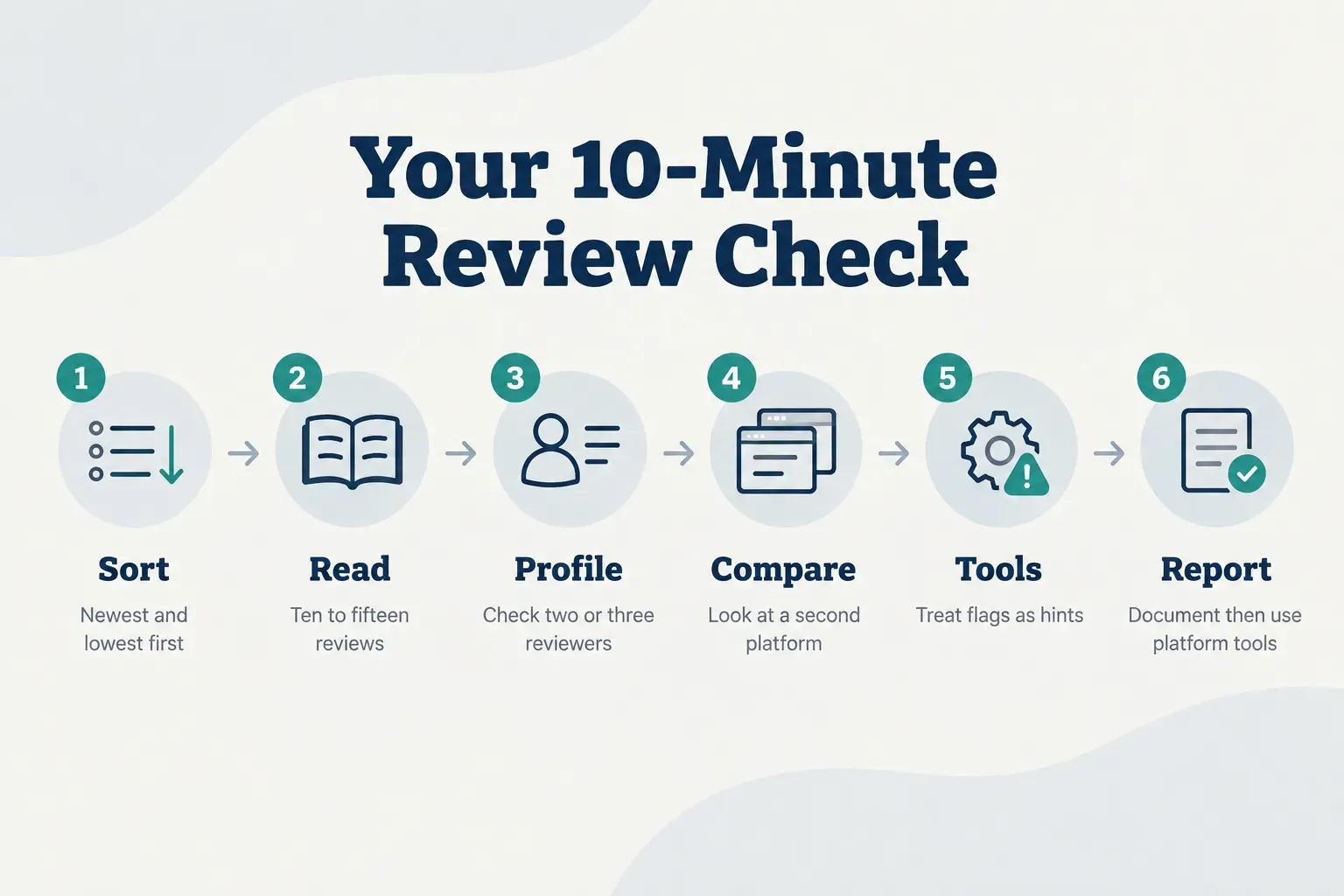
The order matters.
Steps one through three often answer the question on their own, and steps four through six confirm what you already suspect.
Trust the pattern, not the star rating
A 4.8 average tells you surprisingly little.
The pattern behind it tells you almost everything.
So here’s the one habit worth building in 2026: before you book or buy, spend five extra minutes reading the lowest-rated reviews and checking one reviewer’s profile history.
That small step catches more manipulation than any star average ever will.
Remember that no single clue proves fakery.
A short review is just short.
A perfect review is just perfect.
But when timing, language, reviewer history, and cross-platform consistency all point the same way, you can act with real confidence.
The goal isn’t to distrust every review you read. That’s exhausting, and it means ignoring genuinely useful advice from real customers.
The goal is to read like an investigator rather than a scroller.
Fake reviews are built to survive a glance. They rarely survive five minutes of attention.
Frequently asked questions
What are the red flags of a fake online review?
The strongest red flags are generic AI-style praise, burst timing, repeated phrasing across different reviewers, and one-note reviewer histories. Each is weak alone but meaningful in combination. A vague five-star review means little. A vague five-star review posted the same day as 20 similar ones, from an account that has never reviewed anything else, is a much stronger signal of fake review detection done right.
How do you know if a Google review is real?
A real Google review usually comes from a reviewer with a varied history and mentions specific, checkable details. Tap the reviewer's name to see their other reviews: a mix of restaurants, shops, and services with varied ratings looks normal. Local Guide status and a long review history add credibility, though they aren't guarantees. Also check whether the review mentions details you could verify, such as a staff member's name, a specific menu item, or the layout of the shop.
Can fake reviews be verified?
Platforms can sometimes verify fake reviews using internal data, but public readers cannot verify them with certainty. Companies can check IP addresses, payment records, device fingerprints, and account links that ordinary users never see. Google says it blocked or removed more than 170 million policy-violating reviews in 2023 using these kinds of signals. For the rest of us, the tool is pattern analysis: building confidence through multiple clues rather than reaching proof.
Are verified reviews always trustworthy?
No, verified reviews are not always trustworthy. A verified label confirms a purchase or booking occurred, not that the content is honest, detailed, or unbiased. Incentivized reviewers are often verified buyers. So are friends of the owner who were sent a discount code. Verification raises the floor by removing reviews from people who never transacted, but you still need to read what they actually wrote.
How do you spot fake Amazon reviews?
Fake Amazon reviews often show up as clusters of unverified reviews, near-identical text across unrelated product listings, and reviewer accounts with extreme review velocity. Watch for a run of reviews missing the "Verified Purchase" badge posted around the same dates. Clicking through a reviewer's profile helps here. An account that reviewed 15 unrelated products in two days, all with five stars and similar wording, is behaving like a paid reviewer. Also check for review hijacking, where a new product inherits reviews from an older, unrelated listing.
What percentage of online reviews are fake?
Independent estimates place fake or manipulated reviews anywhere from a few percent to over 30%, depending on the category and platform. There is no single reliable figure. Estimates vary for clear reasons. Researchers use different definitions (some count incentivized reviews, some don't), study different product categories, and can't see the reviews platforms already removed. Competitive categories like electronics, supplements, and some local services tend to sit at the high end.
Need a hand with something?
The Frendex map shows you who is available near you, in real time.
Get the app free Get the app freeFree, no card needed
Related articles

The contractor contract: A complete guide for 2026
See exactly what a contractor contract must cover in 2026, from scope to payment terms. Avoid the disputes that start over vague wording.
Quote vs estimate: Which do you actually need?
Quotes vs estimates explained in plain terms, plus the document checklist that actually protects your money. See when you can skip the paperwork entirely.
Your 2026 playbook for home repair estimates
A formula, sample itemized estimate, and bid-comparison checklist to budget home repairs right. See why that $1,200 quote became $3,400.