A service business's guide to bad reviews
By Kiss János 14 min read
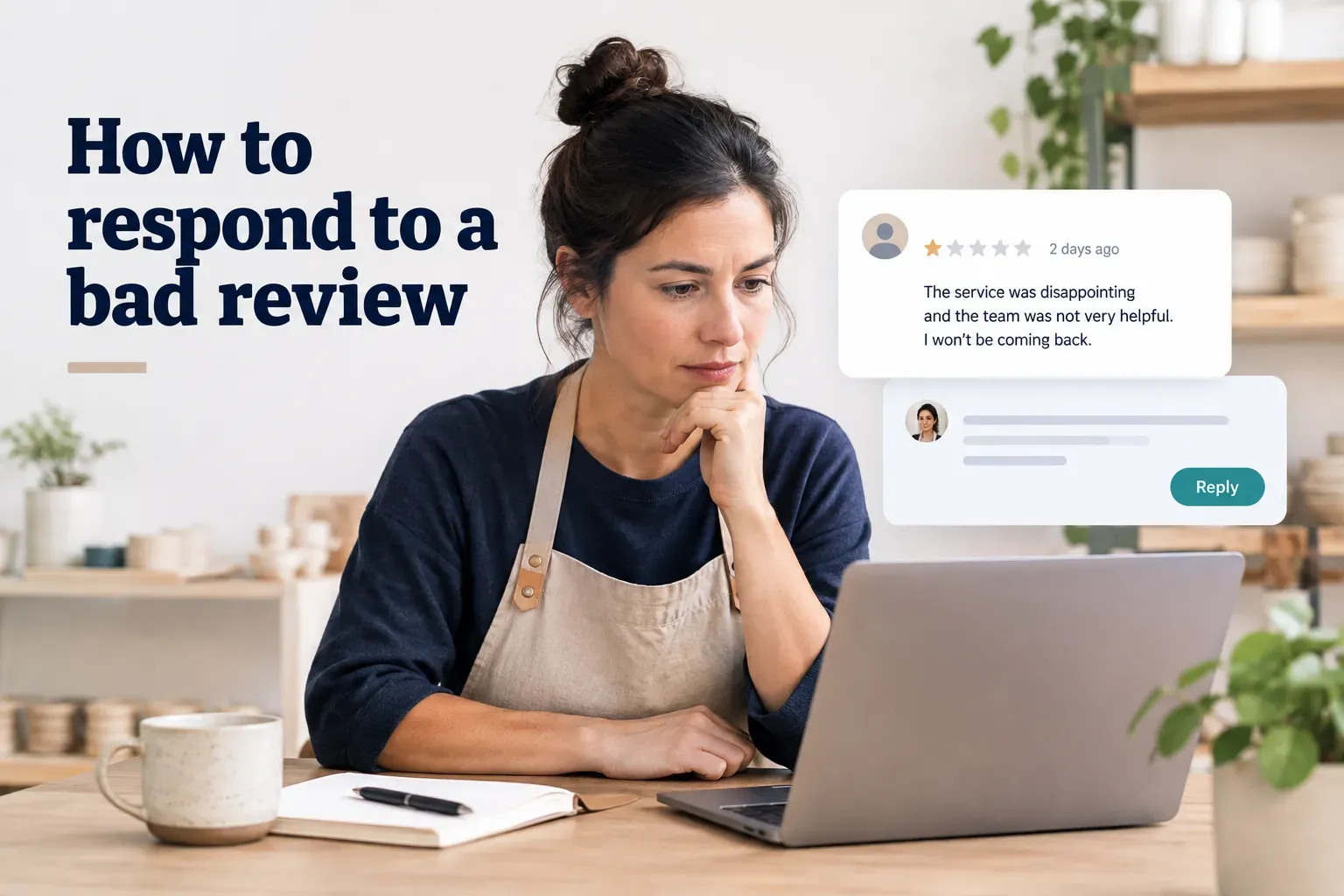
The reply everyone else will read
Here’s the uncomfortable truth about your reply to that one-star review: the person who wrote it may never read it.
Everyone considering booking you next month will.
That single fact should reshape how you write.
A public response is doing two jobs at the same time. It’s service recovery for one unhappy customer, and it’s a trust signal broadcast to hundreds of prospects scanning your Google Business Profile at 9pm on a Tuesday, deciding whether to call you or the plumber down the road.
Most advice collapses those two jobs into one script: apologize, offer to take it offline, done.
That advice works for roughly one kind of review.
Research on customer complaint handling consistently shows that response effectiveness depends on the type of complaint, not on a universal formula. Studies in service marketing have found that accommodative responses (apology plus remedy) outperform defensive ones for legitimate failures, while the same apologetic language reads as an admission of guilt when the complaint is factually wrong or fabricated.
Apologizing for something that didn’t happen doesn’t make you look gracious. It makes you look guilty to the next hundred people who read it.
So this guide uses a decision tree instead.
First you classify the review. Then you pick the response pattern that matches.
Six categories, six different moves, and a clear rule about what you never put in a public reply.
Speed matters more than most owners assume.
For local service businesses, a review sits at the top of your profile for weeks, and an unanswered one-star sits there looking unanswered. Industry data on review response time repeatedly points to the same benchmark: reply within 24 to 48 hours.
Responsiveness itself reads as competence, even before anyone parses your words.
Tone carries the rest.
Calm beats clever. Specific beats sweeping. And short, almost always, beats long.
Know what kind of review you have
Before you write a single word, answer one question: which of these six is sitting in front of you?
Pull the booking record first. Check the name, the date, the job.
Only then open the reply box.
Each type needs a different opening move. Get the classification wrong and even a well-written reply lands badly.
| Review Type | How to Identify It | Your Action | What to Avoid |
|---|---|---|---|
| Legitimate complaint | Details match your records: real booking, real date, a service failure you can verify internally (technician arrived late, job left incomplete, damage caused). | Acknowledge the experience, take ownership in general terms, offer a specific path to make it right offline within a stated timeframe. | Excuses, blaming staff by name, or a vague “we’ll look into it” with no contact route. |
| Misunderstanding | Expectations and delivery diverged, but no policy was broken and no error occurred. Often involves scope, timing windows, or what was quoted versus what was included. | Polite, non-blaming clarification. Restate the standard in neutral terms and invite a conversation to resolve the gap. | ”As we clearly explained…” Any phrasing that makes the customer look careless in public. |
| Unfair or subjective review | The complaint is about price, personal preference, or something outside your control (weather delay, manufacturer part shortage, parking). | Brief factual context, delivered warmly. Thank them for the customer feedback, state the fact, stop. | Apologizing for your own pricing. Arguing. Writing more than three sentences. |
| Reviewer not in your system | No matching booking, invoice, or chat history under that name, address, or contact detail. Possible alias, wrong business, or fabrication. | Neutral inquiry. Ask them to confirm booking details through a private channel so you can locate the job. | Publicly declaring the review fake. You may be wrong, and it reads as hostile either way. |
| Policy violation | Hate speech, profanity, personal attacks on staff, obvious competitor sabotage, off-topic content, or a review posting someone’s private data. | Flag it through the platform’s reporting flow, citing the specific guideline breached. Reply briefly or not at all while the report is open. | Engaging with the content. Responding in kind. Deleting your own evidence before screenshotting. |
| Extortion attempt | The reviewer demands a refund, discount, or free service in exchange for removing an existing review or not posting a threatened one. | Screenshot everything with timestamps, document the demand, escalate to platform trust and safety. Handle any refund decision entirely on its own merits. | Negotiating in public. Agreeing to pay for a review change, which violates every major platform’s rules and yours. |
Two of these six categories do not get a standard apology. Two of them are primarily reporting tasks, not writing tasks.
That’s the whole argument for classifying first.
Write a reply that builds trust

Once you know the category, the writing gets easier. There are three things to get right: what you apologize for, what you leave out, and how the sentence is structured.
Apologize for the experience not the facts
This is the single distinction that protects you legally, operationally, and reputationally. You can always acknowledge how someone felt.
You cannot confirm claims you haven’t checked.
- Safe, empathetic, non-committal: “I’m genuinely sorry this visit didn’t meet your expectations, and I’d like to understand what happened.” You’ve validated the experience without endorsing any specific allegation.
- Unsafe, unverified admission: “I’m sorry our technician arrived two hours late on the 14th and damaged your flooring.” If your job log shows a 20-minute delay and no damage report, you’ve just published a false confession that competitors, insurers, and future claimants can screenshot.
- The working rule: never confirm dates, dollar amounts, technician names, or event specifics in a public reply unless you have personally checked them against internal booking, dispatch, or invoicing records. Not “I think that’s right.” Checked.
- If you need the detail to respond well, ask for it privately. “So I can pull the right job file, could you send your booking reference to [contact]?” is both reasonable and neutral.
Empathy costs you nothing.
Unverified facts can cost you plenty.
What to leave out for privacy
Plenty of owners lose the plot here by trying to “set the record straight” with receipts. Posting the customer’s invoice total, address, or medical detail feels like winning.
It isn’t.
- Personal identifiers. No full names the reviewer didn’t use, no street addresses, no phone numbers, no email addresses, no photos of the property.
- Appointment specifics. Avoid publishing exact times, crew names, or what was found inside someone’s home. It’s a privacy risk and it makes future customers wonder what you’d say about them.
- Payment information. Never post amounts paid, outstanding balances, refund figures, or payment method details. Billing disputes belong in a private channel, always.
- Platform rules back this up. Google’s policies prohibit publishing confidential or personally identifying customer information in responses, and Yelp business reviews, Trustpilot, and Facebook carry equivalent restrictions. A reply that violates them can be removed, leaving the complaint standing alone with no answer.
- The practical test: if the sentence would embarrass you in front of a regulator or a journalist, it doesn’t go in a public reply. Privacy-safe customer service is not just compliance, it’s a visible signal of professionalism.
Templates for seven common failures
Every one of these follows the same shape: acknowledge the experience, signal action without admitting unverified specifics, invite the conversation offline. Rewrite them in your own voice before you use them.
- Missed appointment: “Missing a scheduled visit is not the standard we hold ourselves to, and I’d like to make this right. Could you contact me directly at [channel] so I can look into the scheduling and get you rebooked?”
- Poor communication: “Thank you for flagging this. Keeping customers updated is something we take seriously, and it sounds like we fell short on that. I’d welcome a call at [channel] to hear the full picture.”
- Late arrival: “I’m sorry the arrival window didn’t work out as planned. Our dispatch records will show exactly what happened, and I’d like to review them with you. Please reach me at [channel].”
- Billing dispute: “I understand a charge you weren’t expecting is frustrating. I’d rather not discuss invoice details publicly, so please contact me at [channel] and I’ll walk through the quote and the final bill line by line.”
- Workmanship issue: “Quality is the one thing we don’t compromise on, so I take this seriously. I’d like to arrange an inspection of the work at no cost to you. Please get in touch at [channel].”
- Cancellation: “I’m sorry your booking was disrupted. Cancellations are rare for us and there’s usually a specific reason behind them, which I’m happy to explain directly. You can reach me at [channel].”
- Unmet expectations: “Thank you for the honest feedback. It sounds like what you expected and what we delivered weren’t aligned, and I’d like to understand where that gap opened up. I’m at [channel] whenever suits you.”
One warning about templates.
Research on review responses consistently finds that readers detect and penalize canned language. Identical replies stacked down a profile page read as automated indifference, and adding promotional lines (“check out our summer offers!”) to an apology is worse still.
So vary your openings. Reference one specific, non-sensitive detail from their review.
Change the length.
If you have fifteen negative reviews and fifteen identical replies, prospects notice before they finish scrolling.
When a review crosses a line
Some reviews aren’t feedback at all. They’re sabotage, mistaken identity, or a shakedown.
Different problem, different playbook.
Reviewer you can’t find in your records
You search every field. Name, phone, postcode, invoice range.
Nothing.
The temptation is to write “we have no record of this customer and believe this review is fake.”
Resist it.
You may be dealing with a spouse’s account name, a maiden name, a corporate booking, or a genuine customer whose details were entered wrong. Publicly accusing a real customer of fraud is a reputational grenade with the pin already out.
Use neutral inquiry language instead: “Thank you for taking the time to write. We aren’t able to locate a booking matching these details in our system, so we may have it filed under a different name. Could you email [channel] with a booking reference or service date? We’d like to look into this properly.”
That phrasing does something useful.
It signals to every future reader that you checked, while giving a genuine customer an easy route back. And if no one ever replies, that silence sits visibly under your calm, reasonable response.
Review threats and extortion
Review extortion follows a recognizable pattern: a customer, or someone claiming to be one, demands a refund, discount, or free service in exchange for removing a posted review or not posting a threatened one.
Sometimes it arrives as a text. Sometimes it’s in the review itself: “Refund me and I’ll take this down.”
The response is procedural, not emotional.
Screenshot the message with a visible timestamp. Save the original in whatever channel it arrived through. Log it in your complaints tracker with the date, the platform, and the exact demand.
Then report it to the platform’s trust and safety team, which every major review site maintains for precisely this.
Never make a deal in public. The moment you write “we’ll refund you if you remove this,” you’ve published evidence that your ratings are for sale.
Google’s policies explicitly prohibit incentivizing review changes, and offering payment for removal or modification breaches them on your side, not just theirs. Yelp, Tripadvisor, and Trustpilot maintain comparable rules, and Trustpilot has publicly removed business accounts for soliciting review manipulation.
If a refund is genuinely warranted, issue it on the merits of the complaint.
Separately.
With no mention of the review in the same conversation.
Reporting or requesting removal
Here’s the legal reality most owners find frustrating: you generally cannot force removal of a genuine negative opinion.
Not through the platform, not through a lawyer’s letter.
Defamation claims require a false statement of fact, not an unflattering one. “The work was sloppy and overpriced” is opinion.
“They aren’t licensed and they stole from my house” is a factual assertion, and if provably false, that’s a different conversation with an actual solicitor.
In the US, the Consumer Review Fairness Act also voids contract clauses that penalize customers for honest reviews, so gag clauses in your terms are not the answer.
Run every removal request through this checklist first:
- Does it name a specific guideline breach? Hate speech, harassment, profanity, sexually explicit content, personal information, or off-topic rants qualify under most platform review removal policy documents.
- Is there evidence of a conflict of interest? Competitor reviews, ex-employee reviews, and reviews from people with no transaction history are reportable under fake review detection rules.
- Is it about a different business or location? Misdirected reviews are among the most reliably removed.
- Is it part of a coordinated attack? Multiple one-star reviews within hours, similar phrasing, new accounts. Report them together with dates and screenshots.
- Or is it simply negative? If so, the answer is a good public reply, not a removal request. Platforms reject these, and repeated invalid flags waste your credibility.
Turn complaints into better service
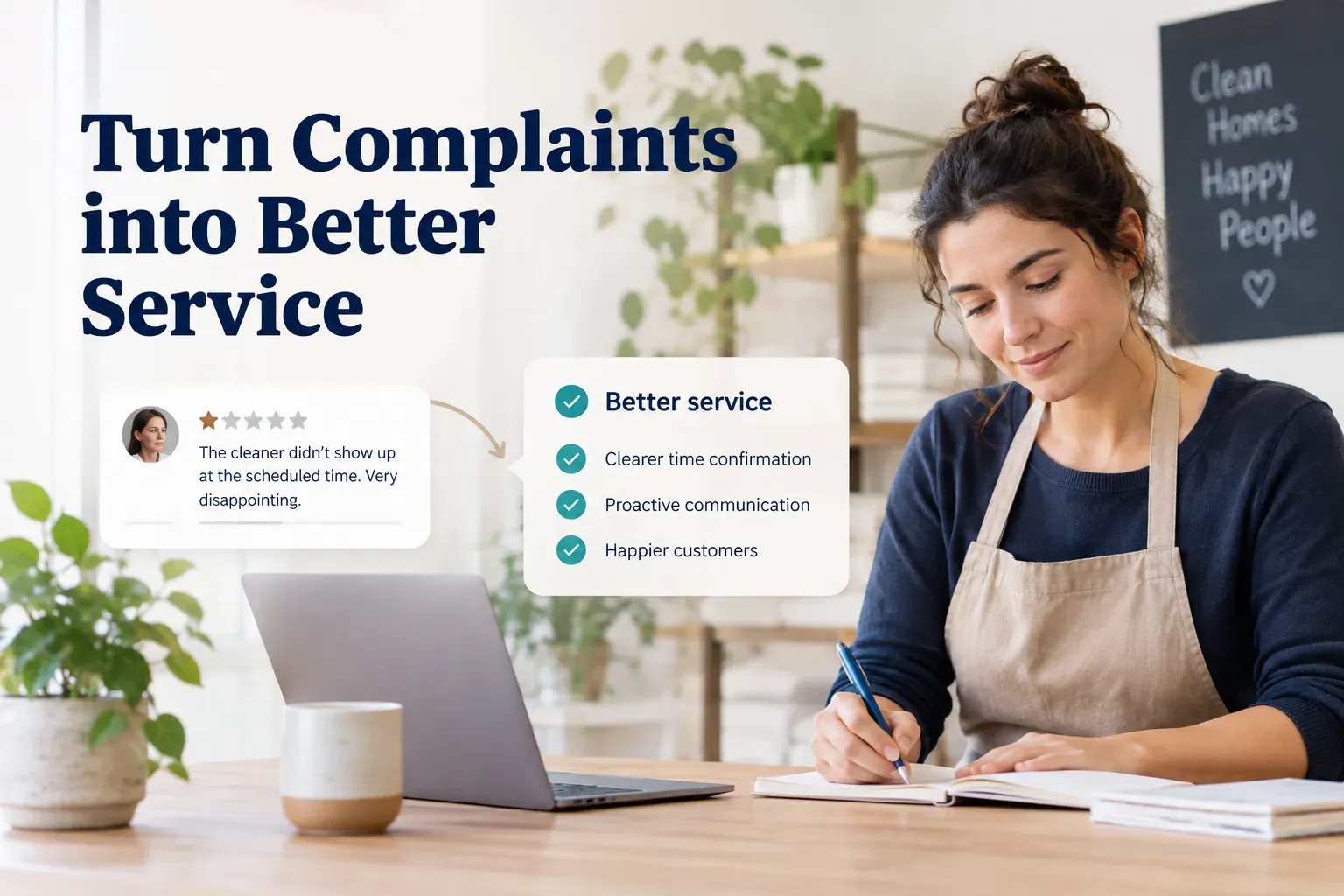
Replying is triage.
Fixing the cause is the actual work, and it’s where most service businesses quietly lose the plot.
Start with a shared tracker. Every negative review gets logged with the date, platform, star rating, complaint category, assigned owner, and resolution status.
Assign the owner within 24 hours, before the reply goes out.
Without a named owner, “we’ll look into it” evaporates by Thursday.
Then review the log monthly, not annually.
You’re looking for clusters, not incidents.
Three late-arrival complaints in a quarter is noise. Three late-arrival complaints all naming the same crew, or all falling in the 4pm to 6pm slot, is a root-cause analysis finding: your routing is over-optimistic on the last job of the day.
Fix the schedule and the complaint category disappears.
Reply to each one individually and it never does.
Track these five metrics and your online reputation management stops being guesswork:
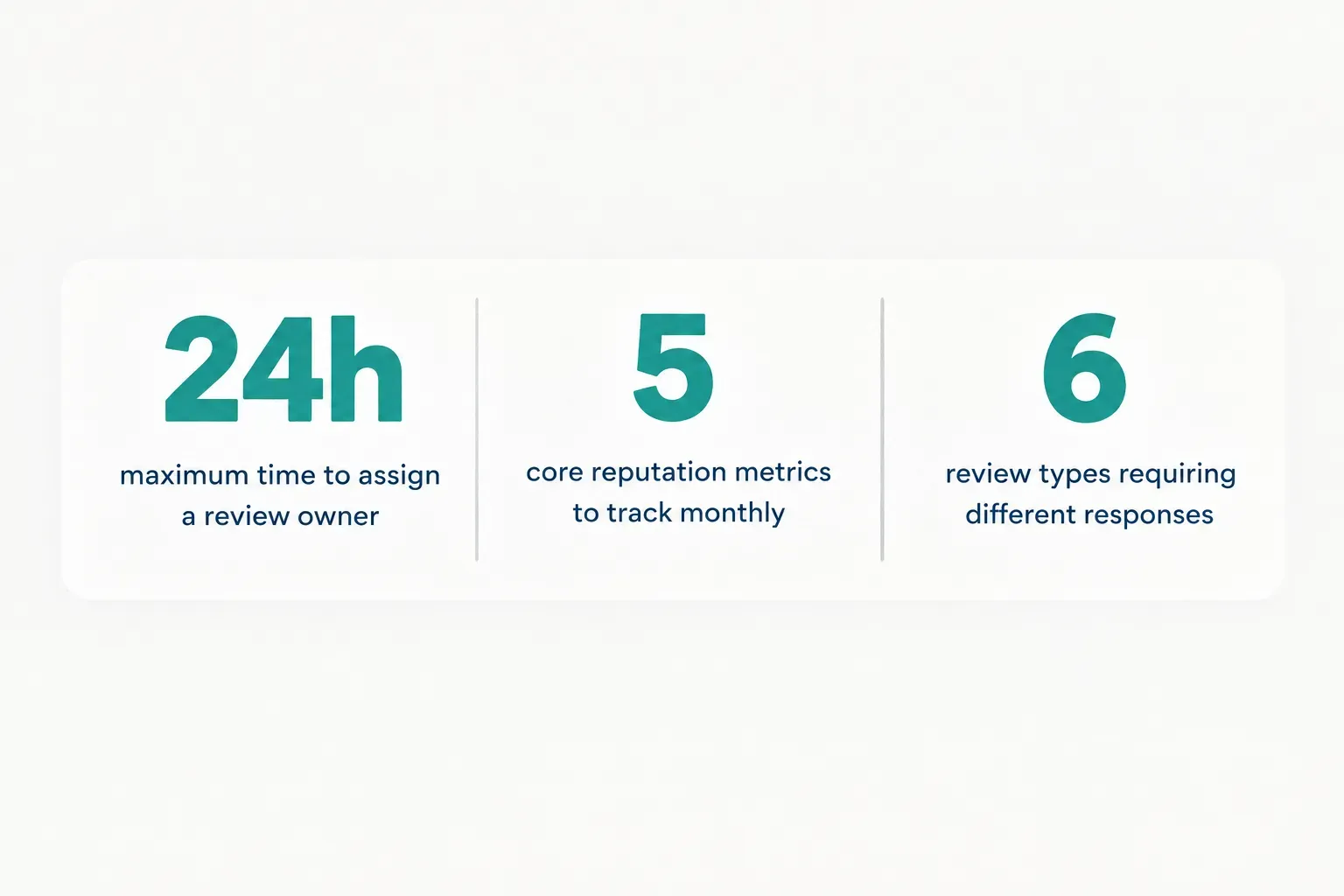
- Average review response time, measured in hours from post to reply. Target under 48.
- Resolution rate: the percentage of negative reviews that reach a documented outcome, not just a reply.
- Repeat complaint themes: how many of this month’s complaints match a category you saw last month.
- Review sentiment trend, tracked quarterly. Basic sentiment analysis tools inside most reputation monitoring platforms will do this automatically.
- Percentage of personalized replies: how many responses were genuinely tailored rather than pasted. Aim for 100%, measure honestly.
One structural advantage worth building toward: verified booking records.
Platforms where ratings attach only to completed jobs, such as Frendex, give you an agreed price, a confirmed time, and a full chat history attached to every review.
That record is your own factual reference before you reply, and it settles the “is this person even a customer” question in seconds rather than days.
The fewer disputes you have about what was actually agreed, the fewer reviews you have to defend.
Your next review starts now
Do this today.
Open your Google Business Profile, find the oldest negative review you never answered, and run it through the six categories before you write a word.
Pull the booking record.
Confirm what you actually know.
Then write four sentences: acknowledge, own what you can verify, invite them offline, sign your name.
Ten minutes, start to finish.
The reviewer may never see it.
That was never really the point.
Every reply you write is a small public demonstration of how your business behaves when something goes wrong, and that’s exactly what the next customer is trying to work out while they scroll.
Write it for them.
Frequently asked questions
How do you professionally respond to a bad review?
Classify the review first, then acknowledge the customer's experience, avoid confirming any detail you haven't verified against your records, and invite the conversation into a private channel. Keep it under four sentences and reply within 24 to 48 hours. Sign it with a real name and a direct contact route.
What is an example of a good response to a negative review?
"Thank you for the feedback, and I'm sorry the job didn't meet your expectations. That's not the standard we work to, and I'd like to understand exactly what happened. Please reach me directly at [email or phone] and I'll look into it personally." It acknowledges without admitting unverified facts, offers ownership, and moves the detail offline.
How do you respond to a 1-star review when the customer is wrong?
Correct the record once, factually and warmly, without apologizing for something that didn't happen. State the relevant policy or fact in one neutral sentence, thank them for raising it, and offer a private conversation. Then stop replying, because a public back-and-forth damages you more than the original review does.
Is it better to respond to a bad review or ignore it?
Responding is almost always better, even when you cannot resolve the issue publicly. An unanswered one-star review tells every prospective customer that complaints go nowhere, while a brief, calm reply demonstrates accountability to an audience of hundreds. The only exception is content under active platform review for a guideline breach, where a short holding response or silence may be appropriate.
Can a business legally ask a customer to remove a negative review?
You can politely ask, but you cannot compel removal of a genuine opinion, and you must never offer payment, refunds, or discounts in exchange. Defamation action requires proving a false statement of fact, not merely an unflattering assessment. In the US, the Consumer Review Fairness Act also makes contract clauses penalizing honest reviews unenforceable.
How do you respond to a fake Google review?
Report it through Google Business Profile using the specific policy it violates, such as conflict of interest, spam, or off-topic content, and include screenshots and dates. Alongside the report, post one neutral public reply noting that you cannot locate a matching booking and inviting the reviewer to confirm details privately. Never call the review fake in your public response, because you may be wrong and the accusation reads badly either way.
Need a hand with something?
The Frendex map shows you who is available near you, in real time.
Get the app free Get the app freeFree, no card needed
Related articles
A no-show policy that protects your business
A 5-part no-show policy framework, not a copy-paste template. Learn what to charge, when to waive it, and how to cut missed appointments fast.

Your practical roadmap to becoming self-employed
A step-by-step path to going self-employed: testing your idea, setting rates, and handling tax, without quitting your job on day one.
The small business owner's guide to online booking
See how to pick and set up a booking system for small business in under a month, cut no-shows, and stop losing hours to phone tag. No spreadsheet required.