How Thumbtack works: A clear guide for customers
By Kiss János Updated 16 min read

What Thumbtack actually is
Here’s the thing most people get wrong on day one: Thumbtack does not fix your roof, paint your kitchen, or clean your gutters.
It never has.
Thumbtack is a local services marketplace, a digital introduction layer between homeowners and independent local professionals.
Plumbers, tutors, wedding photographers, landscapers, personal trainers.
The platform handles discovery and messaging.
The actual work is done by an independent contractor who runs their own business, sets their own prices, and carries their own insurance.
That distinction matters more than it sounds.
It shapes who you pay, who’s accountable when something goes sideways, and how much verification you should expect from the platform versus do yourself.
By the end of this guide you’ll understand three things clearly.
First, how the matching process works, from the moment you submit a project brief to the moment quotes land in your inbox.
Second, the money flow: who pays whom, when, and why that structure changes how professionals behave.
Third, how to read badges, reviews, and guarantees without mistaking a design element for a background check.
Once you understand the incentive structure of one service marketplace, you can decode almost any of them in about five minutes.
And that’s the broader point.
Thumbtack, Angi, Bark, Houzz, TaskRabbit, and the newer flat-fee platforms all run variations on the same handful of business models. The questions worth asking stay identical across every one of them: Who profits from this introduction? What’s actually been verified? Who is accountable if the job goes wrong?
Answer those three and you’re no longer a passive user of any marketplace.
You’re evaluating it.
How the matching process works
Most customers assume Thumbtack picks the best professional for their job and sends them over.
It doesn’t work like that at all.
Submitting a project request
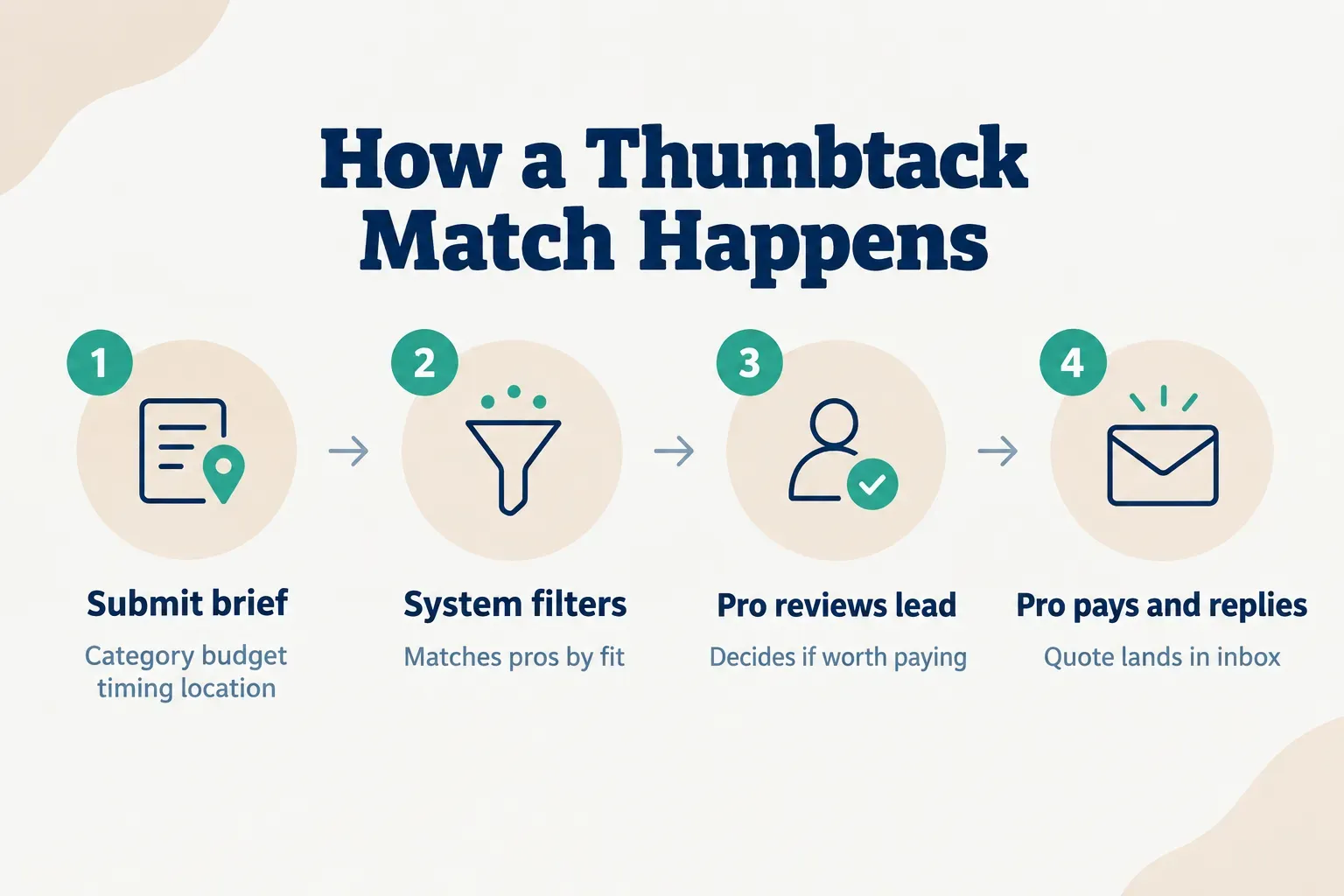
Everything starts with a customer request, sometimes called a project brief. You choose a service category (say, interior painting), then answer a short series of structured questions.
Those questions typically cover the scope of work, your location or ZIP code, your rough budget range, your preferred timing, and whether the property is residential or commercial. Most categories also let you upload photos and add free-text notes.
That free-text box and the photo upload are the two most underused tools on the entire platform. A brief that says “need painting” and a brief that says “three bedrooms, 12x14 each, 9-foot ceilings, walls only, existing color is dark navy, needs primer, occupied home, weekday access after 9am” will produce dramatically different results.
Here’s the part that surprises people: your request is typically visible to multiple professionals at once, not routed to a single hand-picked expert.
You’re broadcasting, not dialing.
How pros get matched to you
Thumbtack’s matching engine filters your brief against every pro profile in the area and surfaces it to the ones who fit. Four main filters do the heavy lifting.
Service category comes first.
A pro who lists “kitchen remodeling” but not “deck building” won’t see your deck request.
Location-based matching comes second, based on the service radius each pro defines, which might be five miles or fifty.
Price range is the third filter.
Pros set the job sizes they want, so a $400 handyman job may never reach a contractor whose minimum is $5,000.
The fourth is profile standing, which includes ratings, review volume, and responsiveness history.
Then there’s the layer most customers never see.
Professionals set their own targeting preferences and a weekly or monthly budget for lead generation.
When that budget is exhausted, they stop receiving your kind of request entirely, no matter how well matched they are.
So the pros who contact you are not “the best available.”
They’re the ones who fit your filters, were online, had budget remaining, and decided your specific brief was worth paying to respond to.
Why you get multiple quotes
Within minutes to a few hours, you’ll usually hear from somewhere between two and five professionals. Some categories move faster than others; emergency plumbing responses often arrive in under fifteen minutes, while niche specialties like piano restoration can take a day or two.
The reason responses vary so wildly in quality comes back to money. Each pro pays for the privilege of contacting you, which means they’re making a quick judgment call before they spend.
Faced with a vague, three-word brief, a smart pro has two options: skip it entirely, or send a generic template and hope.
That’s where the copy-paste replies come from.
“Hi! I’d love to help with your project. When can we chat?”
Faced with a detailed brief containing photos, square footage, access constraints, and a realistic budget, that same pro can produce a genuine price estimate before ever picking up the phone.
Detail earns detail.
Getting several responses is genuinely useful.
You can compare not just numbers but approach: one painter quotes two coats over primer, another quotes one coat and a “spot prime as needed,” and suddenly you understand why their prices differ by $900.
But comparison only works when the quotes describe the same job.
If you gave four pros four different mental pictures of your project, you’re comparing fiction.
The quality of your comparison is capped by the quality of your brief.
Every time.
Who pays for the platform
Follow the money and the whole system makes sense.
Thumbtack generates revenue from one side of the marketplace only, and it isn’t yours.
What it costs customers
Thumbtack is free for customers.
Browsing profiles, submitting a project brief, messaging professionals, and receiving quotes all cost nothing. There’s no membership tier, no unlock fee, no commission skimmed off your final bill.
When you hire someone, you pay that professional directly for the work.
Cash, check, card, invoice, whatever terms they use for their own business.
Thumbtack does not sit in the middle of that transaction in most categories, and it does not take a cut of what you pay.
Some categories offer in-app booking and scheduling or instant-book pricing, where the pro publishes fixed rates and you reserve a slot. Even then, the price you see is the pro’s price, not a marked-up platform price.
How professionals pay for leads
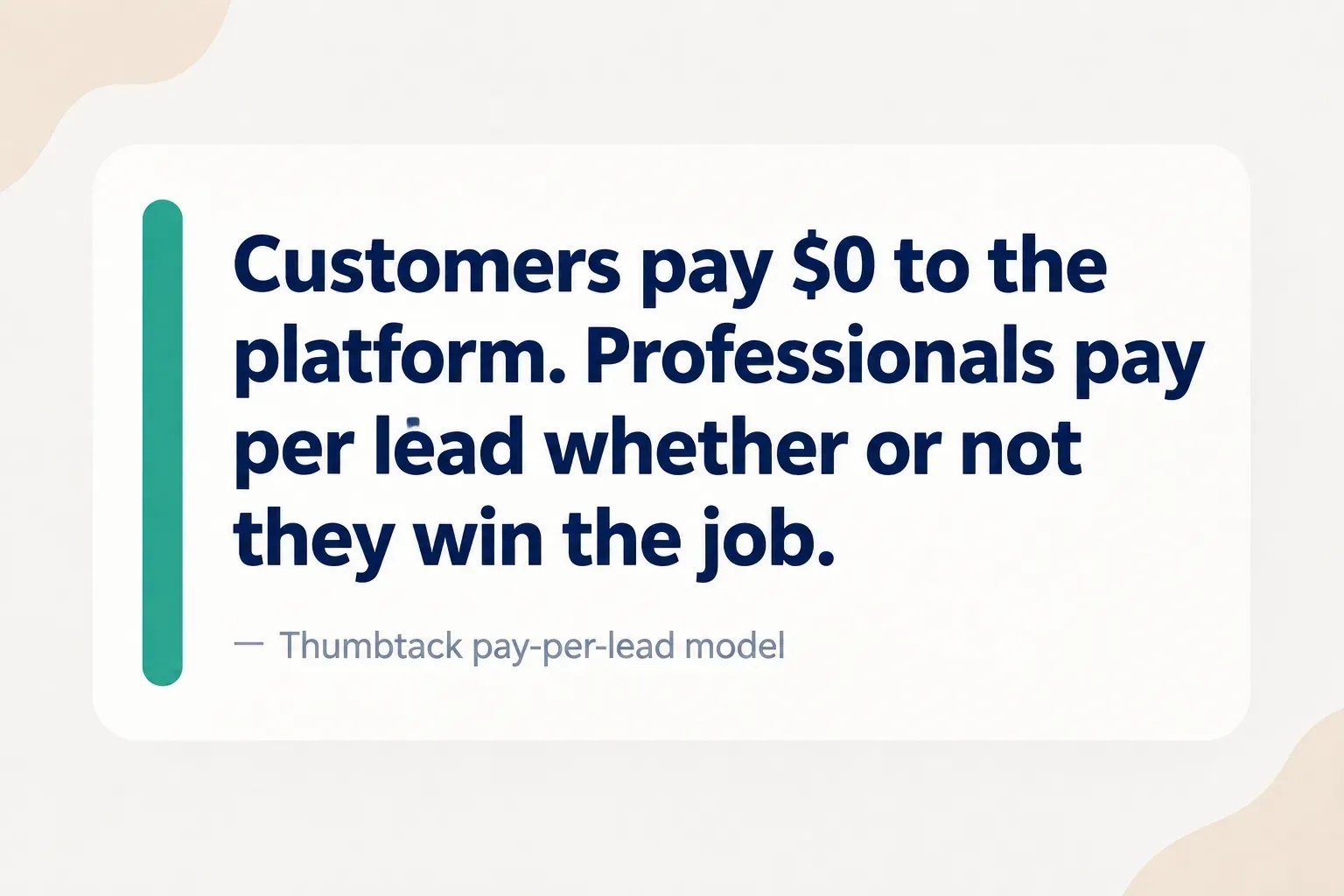
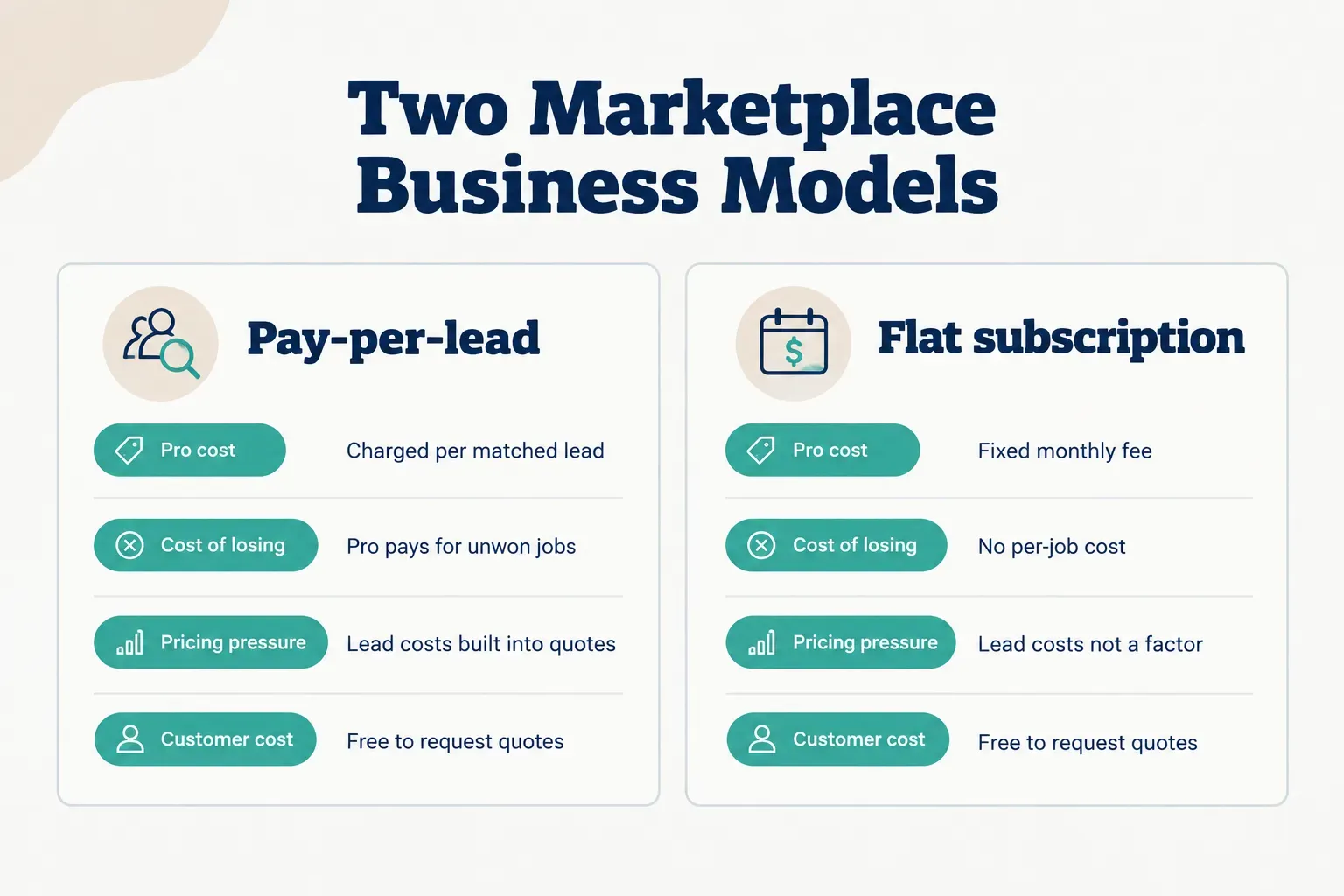
Professionals operate under a pay-per-lead model.
When a pro responds to your request, or in some cases when you contact them directly, Thumbtack charges their account a fee for that lead.
Lead prices are not fixed.
They flex with service category, geography, job size, and how many competitors are bidding for the same customer.
A small cleaning job lead in a rural market might run a few dollars. A kitchen remodel or roof replacement lead in a dense metro area can run $80 to $100 or more.
Now the part most guides skip entirely: that charge applies whether or not the pro ever wins the job.
A contractor might pay for eight leads in a week, send eight thoughtful quotes, and book two.
Those six unsuccessful leads still cost money.
Industry-typical conversion for competitive home service categories often sits somewhere between one in four and one in ten, depending on category and how fast the pro responds.
That math drives behavior you’ve probably already noticed.
Pros reply fast because speed wins jobs.
Pros sometimes send templates because a personalized quote for a vague brief is a bad bet.
And pros bake their lead acquisition costs into the price they quote you, because those costs are a real line item in their business.
None of that is a scandal.
It’s just economics.
But knowing it explains why the same plumber might quote you $340 through a marketplace and $290 through a neighbor’s referral.
Flat-fee alternatives to lead marketplaces
Pay-per-lead is not the only model in the market, and as of 2026 the alternatives have gotten more serious.
A growing set of platforms, Frendex among them, charge professionals a flat monthly subscription with no per-lead charge and no commission on completed jobs. The pro pays one predictable fee and keeps 100% of what the customer pays.
That shift changes incentives on both sides of the marketplace.
A pro paying per lead has a reason to bid on marginal jobs and recover costs through pricing. A pro paying a flat fee has no per-contact cost at all, so responding to a small or uncertain job carries no downside.
Neither model is universally better.
Pay-per-lead platforms tend to have deeper professional inventory in more categories, because they’ve been at it longer and have enormous marketing budgets. Flat-fee platforms tend to have smaller rosters but less quote inflation and less template spam.
What matters is that you recognize which model you’re standing in. It tells you why the messages read the way they do.
Badges, reviews, and what they really mean
A green checkmark is not an inspection.
This is the single most expensive misunderstanding customers make on any service marketplace, and it’s worth unpacking item by item.
Badge, license, insurance, or guarantee?
These four things look similar on a profile page and mean radically different things. Here’s what each one actually represents.
- Platform identity badge. Confirms that a real person or business entity registered the account, usually via email, phone, and sometimes a business record check. It says nothing about skill, licensing, or job history. Think of it as an ID check at the door, not a performance review.
- Self-reported license claim. In many categories, a pro types their license number into a profile field. Some platforms cross-check it against state databases; many do not verify status, expiration, or disciplinary history. Treat a displayed license number as a lead to verify, not proof.
- Self-reported insurance. A profile line reading “insured” typically means the pro said they’re insured. It rarely means a current certificate of liability insurance was reviewed, and it almost never tells you the coverage limits or whether the policy is still active today.
- Opt-in background check. Where available, a background check screens an individual for criminal records at a point in time. It is usually run on the account owner, not on every employee or subcontractor who shows up at your door, and it is not re-run continuously.
- Platform guarantee. The Thumbtack Guarantee and similar programs offer limited protection in specific circumstances, subject to eligibility rules, caps, deadlines, and exclusions. A guarantee is an insurance-style backstop with fine print, not a promise the work will be good.
Thumbtack does not perform the service, supervise the work, or vouch for outcomes.
It facilitates an introduction and layers on some verification. Accountability for the actual job stays with the individual professional, exactly as it would if you’d found them in a phone book.
Reading reviews like a pro
A 4.9-star average across 200 reviews sounds conclusive.
It usually isn’t, because the average flattens everything that matters.
Read for signal instead.
- Check recency first. A pro with glowing reviews from 2021 and silence since may have sold the business, expanded past their capacity, or lost their best crew. Weight the last six to twelve months far more heavily than lifetime average.
- Match the project type. Twenty five-star reviews for faucet repairs tell you very little about a whole-bathroom renovation. Filter mentally for reviews describing jobs at similar scope, budget, and complexity to yours.
- Prioritize detailed reviews. “Great job, highly recommend” is nearly worthless. A verified review that names the specific work, the timeline, how a problem was handled, and the final cost versus the quote is worth thirty generic ones.
- Hunt for repeated complaints. One angry review is noise; anyone who’s worked with the public has one. Three separate reviews mentioning missed appointments, or four mentioning surprise charges at the end, is a pattern. Patterns predict.
- Read how the pro responds. A calm, specific, non-defensive reply to criticism tells you how they’ll behave when your job hits a snag. Hostility or blame-shifting in public is a preview of private behavior.
- Watch the review curve. Twelve five-star reviews posted within the same week, all short and similarly phrased, deserves skepticism. Organic review flow is uneven and spread out.
What to verify yourself
Fifteen minutes of independent checking eliminates the overwhelming majority of bad outcomes. This is the short list a cautious customer confirms before money changes hands.
- Active state license number. Look up the number on your state licensing board’s public search tool. Confirm the status reads active, the name matches the business you’re hiring, and there are no open complaints or disciplinary actions. This is license verification, and it takes about three minutes.
- Current certificate of insurance. Ask for a COI showing general liability and, where the pro has employees, workers’ compensation. Check the expiration date and, for larger jobs, request that the certificate be issued directly from the insurer or agent.
- Permit requirements. Call your local building department and ask whether your project needs a permit. Then confirm in writing who is pulling it. A pro who suggests skipping permits on permit-required work is telling you something important about how they operate.
- References from similar jobs. Ask for two recent customers with projects like yours and actually call them. Ask what went wrong and how it was resolved, because something always goes slightly wrong.
- Written contract terms. Get scope, materials, total price, payment schedule, start and completion dates, warranty terms, and the process for a change order in writing before work starts.
Estimates, contracts, and disputes
Three documents, three completely different levels of legal weight.
Confuse them and you’ll discover the difference at the worst possible moment.
Estimate, quote, or contract?
An estimate is a ballpark.
It’s the number a pro gives you over chat or after a two-minute look at your photos, based on typical jobs of that description. Estimates move, sometimes a lot, and they’re not designed to be held to.
A written quote is a serious step up.
It should itemize labor, materials, scope boundaries, and timeline after the pro has actually assessed your site. Good quotes state what’s excluded, which is often more useful than what’s included.
A service contract is the only one of the three that’s genuinely enforceable.
Signed by both parties, it fixes the scope, the price, the payment schedule, the dates, and the remedies. If a disagreement ends up in small claims court, this is the document that decides it.
If it isn’t in the signed contract, assume it doesn’t exist. Verbal promises made in a driveway carry almost no weight six weeks later.
Every one of those negotiations happens between you and the professional.
Pricing, scheduling, scope changes, permit responsibility, material grades, warranty length, cleanup obligations.
The platform introduced you.
It is not a party to your agreement, does not set the terms, and does not supervise performance.
Payments, cancellations, and when things go wrong
Payment terms are set by the professional, not the marketplace. Common structures include a deposit of 10% to 30% at signing, progress payments at defined milestones, and a final balance on completion.
Be cautious with anything that front-loads heavily. A request for 100% upfront on a multi-week project, or pressure to pay by wire, gift card, or a peer-to-peer app to a personal account, is a widely recognized warning sign.
Cancellation policies also belong to the pro.
Some charge nothing with 24 or 48 hours’ notice; others keep a deposit that covers materials already ordered. Ask before you sign, because “we’ll figure it out” always favors whoever is holding the money.
When something goes wrong, the platform’s role in customer dispute resolution is mediation support, not adjudication.
Support teams can contact the professional, review in-platform message history, act on policy violations, and in limited cases apply a guarantee program.
What they generally cannot do is force a refund or compel a contractor to return and finish.
Here’s a practical response plan that works for no-shows, unfinished work, property damage, disputed charges, or suspicious payment requests:
- Document immediately. Photograph the site, save invoices and receipts, and write a dated timeline of what was promised and what happened while it’s fresh.
- Move the conversation in-platform. Recap any phone call in a platform message: “Confirming our call, you’ll return Thursday to finish the trim.” That creates a timestamped paper trail you can’t get from a phone conversation.
- Request a specific remedy in writing. Name the fix, the amount, and a deadline. Vague complaints get vague responses.
- Escalate to platform support. Open a case with your documentation attached, and ask directly whether any guarantee or protection program applies to your situation and what the filing deadline is.
- Pursue outside remedies if needed. Options include a credit card chargeback, a claim against the pro’s liability insurance, a complaint to your state licensing board, or small claims court. Licensing board complaints carry real weight with licensed trades.
Notice how much of that plan depends on documentation you create before there’s a problem.
That’s the whole game.
Deciding if it’s right for you
The choice comes down to how you prefer to shop.
If you want several competing quotes for a one-off project, enjoy comparing approaches, and don’t mind doing your own vetting, a lead marketplace like Thumbtack fits well. You’ll get fast responses, real price discovery, and broad category coverage in most metros.
If you’d rather have a single trusted app for ongoing bookings across many service types, with less template spam and no lead-cost markup baked into quotes, a flat-fee platform is worth a look.
Smaller rosters, cleaner incentives.
Either way, the badges are a starting point. They are not a substitute for pulling up your state licensing board’s website, asking for a current certificate of insurance, and putting the scope and price in a signed contract before anyone picks up a tool.
And keep the three questions handy, because you’ll need them again. Who profits from this introduction? What has actually been verified, and by whom? Who is accountable when the job goes wrong?
Ask those of any marketplace you encounter next.
The logos change constantly.
The economics don’t.
Frequently asked questions
Is Thumbtack free to use?
Yes, Thumbtack is completely free for customers. Submitting a project brief, messaging professionals, and receiving quotes cost nothing, and there's no commission added to the price you pay the pro. You pay the service professional directly for the work they complete. The platform's revenue comes entirely from the professional side.
How does Thumbtack charge professionals?
Thumbtack charges professionals a fee per lead, not a percentage of the job. A lead is triggered when a pro responds to a matched customer request or when a customer contacts them directly. Lead prices vary by service category, location, job size, and local competition, ranging from a few dollars to well over $80 in high-value categories. Critically, the fee applies whether or not the pro ever books the job.
Is Thumbtack trustworthy?
Thumbtack is a legitimate, established marketplace, but trustworthiness depends on the individual professional you hire rather than the platform itself. Thumbtack facilitates introductions and provides some verification; it does not perform, supervise, or guarantee the quality of the work. Your real protection comes from verifying licenses and insurance independently, reading recent detailed reviews, and signing a written contract before work begins.
Are Thumbtack reviews real?
Most reviews come from genuine customers, and the platform removes reviews that violate its policies. No large review system is perfectly clean, though, and single-sentence five-star reviews posted in clusters deserve skepticism. Judge a pro by recent, detailed reviews describing projects similar to yours, and pay special attention to complaints that repeat across multiple reviewers.
Does Thumbtack do background checks?
Thumbtack offers background checks in certain categories, but they are not universal and not continuously updated. A check typically screens the account owner at a single point in time, not every employee, helper, or subcontractor who may show up at your property. Treat a background check badge as one small data point, not as clearance. It says nothing about workmanship, licensing status, or insurance coverage.
What percentage does Thumbtack take from a job?
Thumbtack takes zero percent of the job value. It does not charge customers a commission and does not take a cut of what the professional earns. Its revenue model is pay-per-lead: the pro pays a flat fee for each customer contact. This differs from commission marketplaces that take 10% to 20% of each completed job, and from flat-fee platforms like Frendex where pros pay one monthly subscription and keep everything they bill.
Need a hand with something?
The Frendex map shows you who is available near you, in real time.
Get the app free Get the app freeFree, no card needed
Related articles

Do you tip contractors? A clear answer for homeowners
No, tipping contractors isn't required. Get the 4-factor rule to decide when it's worth it and how much makes sense for your project.

How to hire a contractor without getting burned
A step-by-step process for vetting bids, licenses, and contracts, plus the one paper trail habit most homeowners skip until it costs them.

How does TaskRabbit actually work?
See exactly how TaskRabbit's booking flow, real fees, and cancellation rules work in 2026, plus why Taskers set their own rates. No surprises at checkout.