How much to tip in 2026: A clear decision guide
By Kiss János 14 min read

Why tipping feels harder than ever
You grab a bottle of water at an airport kiosk, tap your card, and the screen asks for 20%, 25%, or 30%.
Nobody poured anything.
Nobody carried anything.
Yet there it is, waiting for your answer while the line behind you grows.
That moment captures why tipping feels so confusing in 2026.
Digital tipping prompts have spread from sit-down restaurants to self-checkout kiosks, retail counters, takeout windows, and even car washes with no attendant in sight. According to a 2023 Pew Research Center survey, 72% of U.S. adults said tipping is expected in more places than it was five years earlier, and that trend has only accelerated since.
The bigger problem is the advice itself.
Most tipping guides hand you a single percentage chart and call it a day. But a plumber, a barista, and a three-person moving crew are paid in completely different ways, so one number can’t possibly fit all three.
This guide uses a better framework.
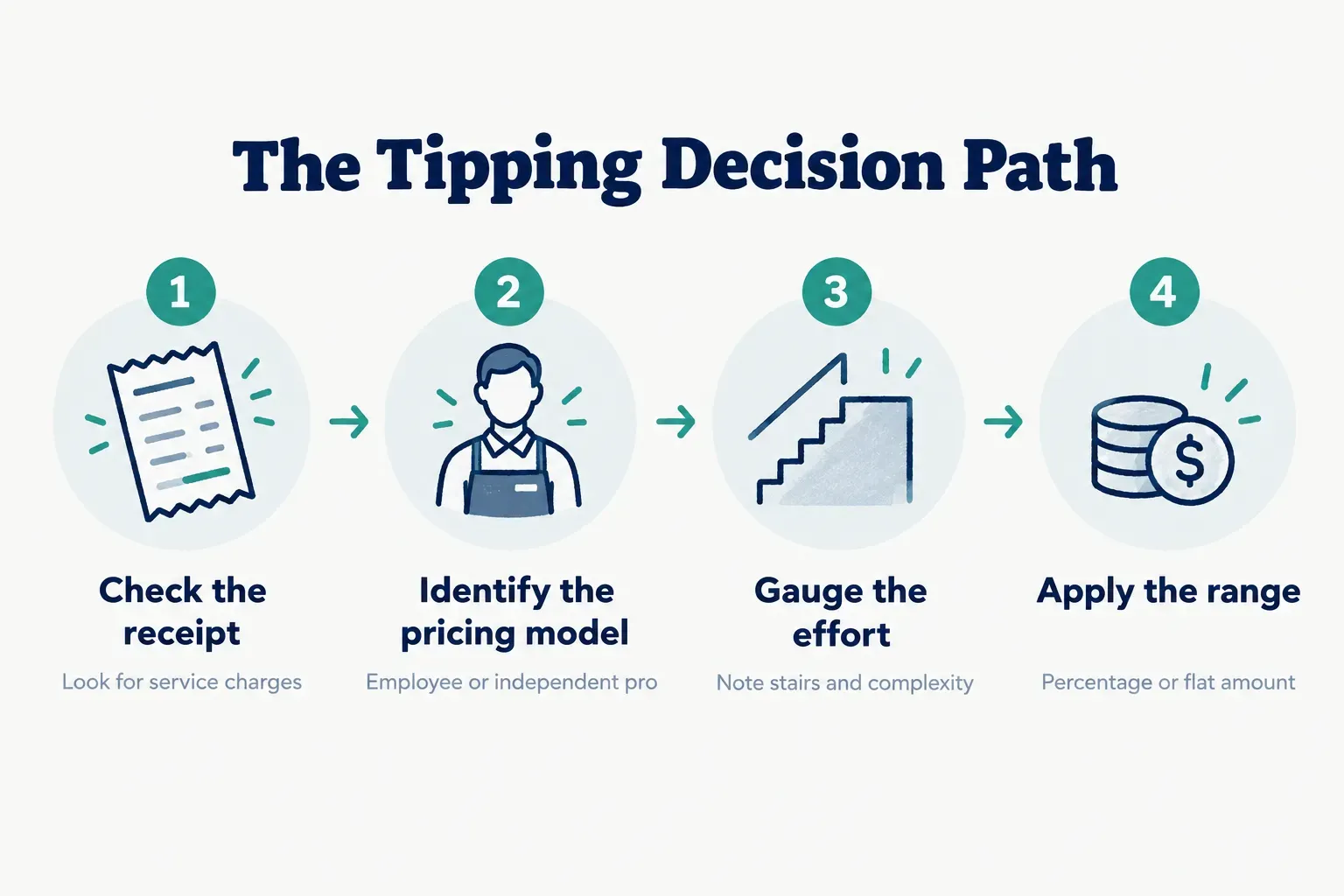
First, look at the provider’s pricing model and the effort involved. Then apply either a tip percentage or a flat-dollar range that matches that situation.
The goal is simple.
You should be able to decide how much to tip with confidence, without guilt, without social pressure, and without accidentally paying twice when a service charge is already built into the bill.
Start with the pricing model
The first question isn’t “How good was the service?” It’s “Who set this price, and does it already pay the person in front of me?”
Answer that, and most tipping decisions make themselves.
Employees who rely on tips
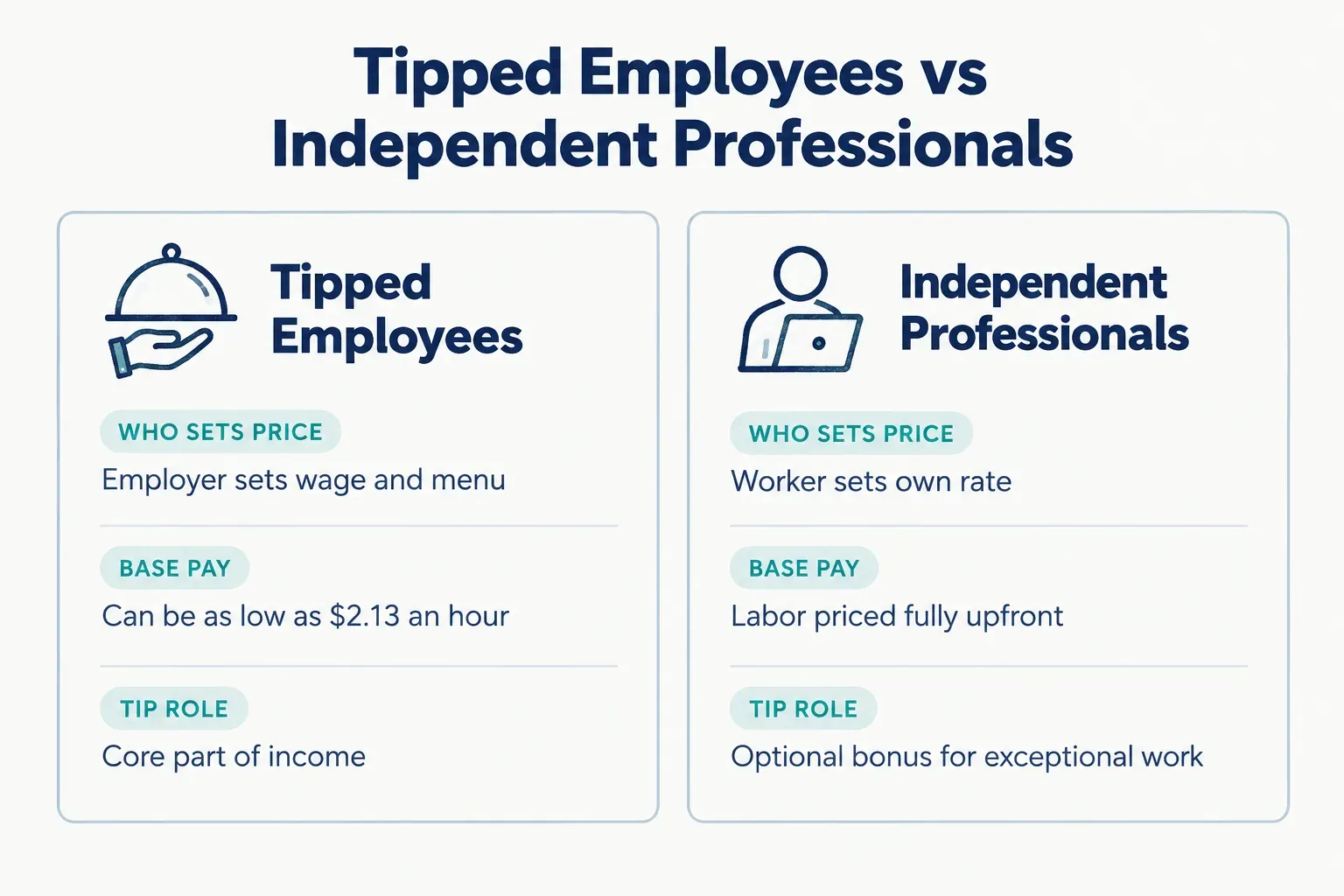
Tipped employees include servers, bartenders, and delivery drivers. In the United States, federal law still allows employers to pay these workers a base wage as low as $2.13 per hour, as long as tips bring them up to the $7.25 federal minimum.
This arrangement is called a tip credit, and it’s the reason tipping exists in its current form.
Some states, including California, Washington, Oregon, and Minnesota, require employers to pay the full state minimum wage before tips.
Even there, tips often make up a large share of take-home pay. Many restaurants also use tip pooling, where gratuities are shared among servers, bussers, bartenders, and sometimes kitchen staff.
For these workers, a tip isn’t a bonus.
It’s part of the wage the menu price was designed around.
Independent professionals
An independent contractor or small business owner works differently. They set their own rates, and those rates already account for their time, skill, travel, and overhead.
Nobody is subsidizing their paycheck with a tip credit.
Think of a self-employed handyman, a mobile mechanic, or a tutor booked through a marketplace like Frendex. These providers typically price their labor fully upfront, so the quoted rate is the full price of the work.
A tip here is a bonus for exceptional work, not an expected top-up to make their wage livable.
That doesn’t mean you can never tip an independent pro.
It means you shouldn’t feel obligated to.
Service charges aren’t tips
Here’s where a lot of people overpay.
Automatic gratuity, service charges, resort fees, and platform booking fees are mandatory charges, and they go to the business first.
Whether any of that money reaches the worker depends entirely on the company’s policy.
The IRS actually treats mandatory automatic gratuities as service charges rather than tips, which is why they’re taxed as regular wages when distributed.
Some restaurants pass the full amount to staff. Others use it to cover rising labor costs, health benefits, or general operations.
Either way, the charge is already on your bill. Tipping again on top is optional and should be reserved for genuinely standout service.
Quick rule: if the receipt already shows “service charge” or “gratuity included,” no further tip is required unless you want to reward specific effort.
If you’re unsure where the money goes, ask. A good server or manager will tell you plainly, and that answer should guide whether you add anything extra.
Restaurants, bars and coffee shops
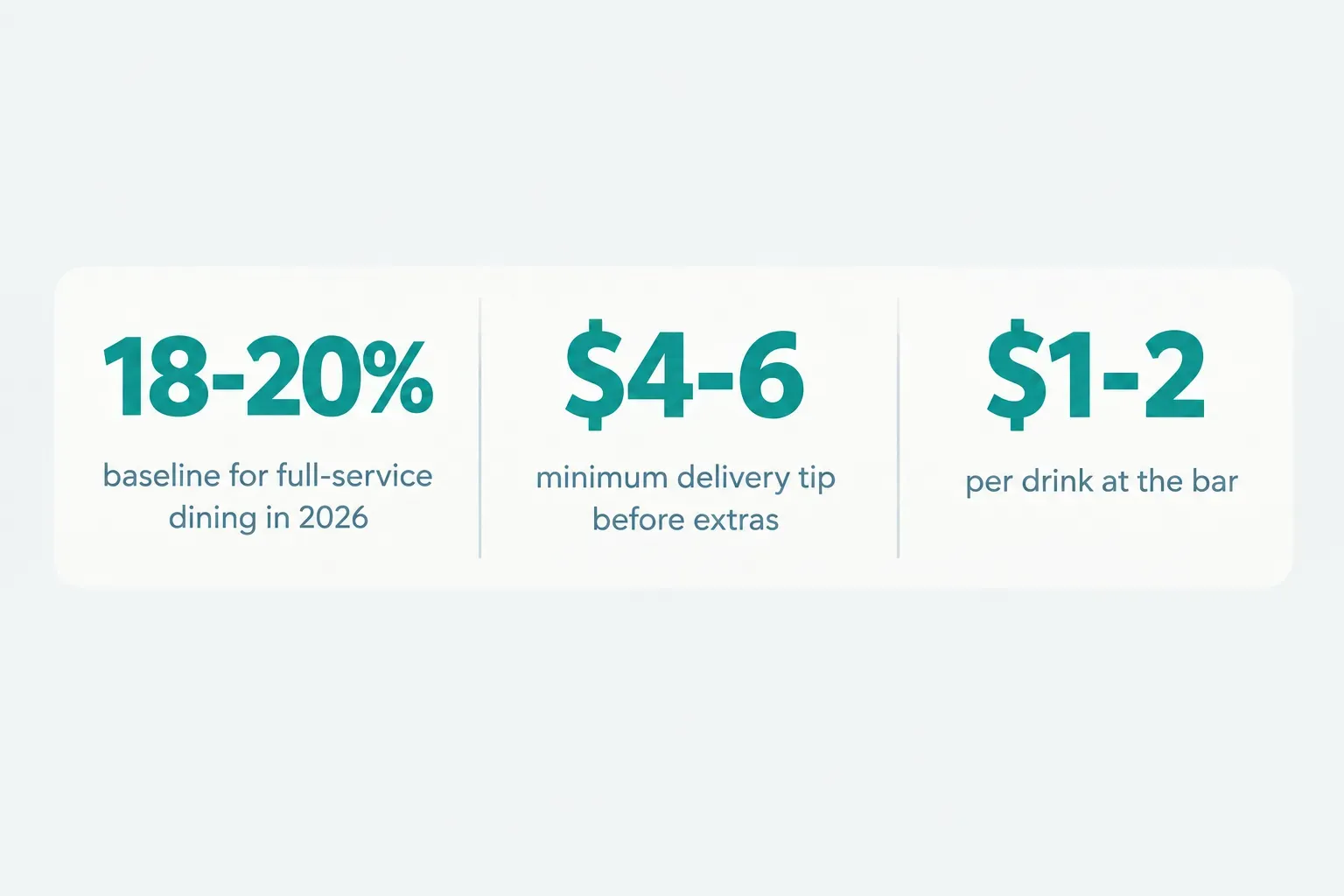
Food service is where tipping norms are clearest, and also where they’ve crept upward the fastest. As of 2026, the realistic baseline for full-service dining sits at 18-20%, with 20-25% for exceptional or complex orders and 10-15% still acceptable for basic or slow service.
Here’s how that breaks down across the most common food and drink situations:
| Situation | Standard Tip | Go Higher When | Acceptable Minimum |
|---|---|---|---|
| Full-service dine-in | 18-20% of pre-tax subtotal | Service is attentive, personal, or anticipates needs | 10-15% for slow or basic service |
| Large party or complex order | 20-25% | Many custom modifications, split checks, long stays | 18% (often added automatically for 6+ guests) |
| Simple takeout pickup | $1-3 or 5-10% | Large order, careful packing, special requests | $0 (optional when you carry it yourself) |
| Made-to-order counter service | 10-15% | Custom builds, big group orders, catering trays | $1-2 |
| Food delivery | $4-6 minimum or 15-20% | Bad weather, many stairs, long distance (+$2-5) | $4 |
| Bartender | $1-2 per drink or 15-20% of tab | Craft cocktails, busy nights, running a tab | $1 per drink |
| Barista | Round up or $1 on specialty drinks | Large or complicated orders | $0 on a quick drip coffee |
Dine-in, takeout and counter service
Tips should be calculated on the pre-tax subtotal, not the post-tax total.
Sales tax goes to the government, not the restaurant, and it has nothing to do with the service you received. On a $100 meal with 8% tax, 20% of the subtotal is $20, while 20% of the total is $21.60.
So why do so many receipts pre-calculate the tip on the total?
Usually it’s the point-of-sale system’s default setting. Some businesses leave it that way deliberately, since a larger base means larger suggested tips, and most people never check the math.
Takeout and counter service follow a different logic.
When you walk in, pick up a bag, and carry it out yourself, a nominal $1-3 or 5-10% is generous but optional. Made-to-order counter meals, custom bowls, or a large group order deserve a real tip, because someone spent genuine effort assembling it.
Delivery drivers
Delivery drivers are among the most tip-dependent workers in food service. Plan on a $4-6 minimum or 15-20% of the order for a typical distance, whichever is higher.
A $12 sandwich still requires the same drive as a $60 dinner.
Add $2-5 more for bad weather, many flights of stairs, or long distances.
And don’t assume the delivery fee covers it. On most apps, that fee goes to the platform to cover operating costs, not directly to the driver.
Bartenders and baristas
At the bar, $1-2 per drink works for beer, wine, and simple mixed drinks. If you’re running a tab or ordering elaborate cocktails, switch to 15-20% of the total.
Bartenders remember good tippers, and it shows in how quickly you get served on a crowded Friday.
Baristas sit in a gray zone.
Rounding up or leaving $1 on a specialty latte is a kind gesture, but a tip on a quick black coffee isn’t required.
The tip jar (or the screen) is an invitation, not an obligation.
Personal care and home services
Personal care and home services are where most people second-guess themselves.
Do you tip the salon owner? The plumber? Each mover or just the crew leader?
The answers depend, once again, on the pricing model and the effort involved.
Salons, spas and barbers
For hairdressers, barbers, nail techs, and massage therapists, 15-20% of the service price is the standard range in 2026. Go toward 20% for a complicated cut, a long color session, or a stylist who fits you in at the last minute.
Stay near 15% for a routine trim.
When multiple people work on one visit, tip each person separately.
A colorist and a stylist should each receive 15-20% of their portion of the service. A shampoo assistant typically gets $3-5, handed over directly if possible.
The old rule that you never tip a salon owner is fading.
Many owners now work the chair like any other stylist, so tipping them is normal. One exception: massage delivered in a clinical or physical therapy setting usually doesn’t call for a tip, and many spas now add an 18-20% service charge automatically, so check your bill first.
Cleaners and movers
Home services work better with a flat-rate tip than a percentage. A standard house cleaning might cost $150 or $400 depending on square footage, but the effort per person doesn’t scale the same way.
Flat amounts keep things fair.
For a single cleaner on a standard visit, $20-50 is the typical range.
Lean toward the higher end for a deep clean, a post-party mess, or a home with pets. If a crew of three cleans your house, tip each person individually rather than splitting one amount.
Movers follow a similar pattern.
Plan on $20-40 per mover for a half-day job, and roughly double that for a full day. Add more for multiple flights of stairs, heavy furniture like pianos or gun safes, or extreme heat and cold.
Moving is brutal physical work, and the tip reflects that.
Plumbers, electricians and handymen
Licensed trade professionals like plumbers, electricians, and appliance repair techs typically run their own businesses. They quote jobs that already cover labor, parts, travel, and expertise.
A tip is not expected, and most won’t think twice if you don’t offer one.
That said, a small gesture can land well.
If someone handles an emergency at 11 p.m., finishes a job in half the expected time, or goes out of their way to explain a fix, $10-20 or rounding up the invoice is generous. A cold drink on a hot day or a strong online review often means just as much to a small business owner.
Booking through a transparent pricing marketplace such as Frendex removes much of the uncertainty.
The upfront listed price already reflects the job scope, so you know before the work starts that the price is the full price. There’s no guessing afterward about whether a tip is baked in or quietly expected.
For independent service providers, the best “tip” is often repeat business and a detailed review. Both directly grow their income.
Handling the awkward cases
The percentages are the easy part.
The hard part is the moment when service falls short, a screen demands 30% for a muffin, or five people carry your couch and you’re holding one envelope. Here’s how to handle each without overthinking it.
When service is poor
Bad service happens.
The question is whether the tip is the right tool to respond to it, and usually it’s a blunt one. Use these guidelines to keep your response fair and proportional.
- Reduce, don’t eliminate, for mediocre service. If your server was slow, forgetful, or inattentive, aim for 10-12% instead of 18-20%. Tipped employees may still be earning a reduced base wage, and a zero tip can wipe out their earnings for that table entirely.
- Separate the server from the kitchen. A cold entrée or a 40-minute wait for food is often a kitchen or staffing problem, not the server’s fault. Judge the person on what they actually controlled, such as communication, refills, and fixing mistakes.
- Skip the tip only for serious problems. Rude behavior, unsafe food handling, or clearly negligent service are the rare situations where no tip is justified. These are exceptions, not a response to a forgotten side of fries.
- Talk to a manager instead of silently punishing. A low tip sends a vague message that the worker may never understand. A calm conversation with a manager actually fixes the problem, and you may even get a comped item or discount.
- Consider the context. A packed holiday brunch with two servers covering twenty tables is different from an empty Tuesday lunch. Service quality should be measured against realistic conditions.
Screen prompts and cash vs app
Checkout screens have turned tipping into a public performance, with the cashier often watching as you choose.
But the defaults on that screen are a business decision, not a wage requirement.
Here’s how to handle prompts, group jobs, and payment methods with confidence.
- Treat the screen as a suggestion, not a rule. When a payment screen suggests 20-30% on a $6 coffee, you can select “no tip” or “custom” without guilt. Those presets were chosen by the business to maximize revenue, not calculated from any real tipping etiquette standard.
- Use “custom” to match the actual norm. If the service deserves something, enter a flat $1 or round up. A tip calculator isn’t necessary here; simple rounding works fine for counter purchases.
- Tip each worker individually on group jobs. For movers, cleaning crews, or salon teams, hand each person their own amount when possible. If you can only give one lump sum, ask the lead worker how tips are split so you know it reaches everyone.
- Remember holiday tipping for recurring providers. A $20-50 gift or cash tip in December is customary for people you see regularly, like a weekly cleaner, a longtime hairdresser, or a dog walker. This is separate from your normal per-visit tip, a once-a-year thank-you for ongoing service.
- Choose cash when app tips might not reach the worker. A cash tip goes straight into the worker’s hand, with no platform fees or delays. It’s the safest choice when you’re unsure how a business handles digital tips.
- Use app tipping when it’s confirmed to go direct. Many delivery and booking platforms now pass 100% of tips to the individual. If the app says so clearly, tipping digitally is perfectly fine and often more convenient… especially since fewer people carry cash in 2026.
The one rule worth remembering
Every tipping decision in this guide comes down to one sentence: identify who set the price and how much effort went in, then tip a percentage for tipped employees and a flat, effort-based amount for everyone else.
That’s it.
Everything else is detail.
If you want a shortcut you can use at any counter or doorstep, here it is.
When in doubt, tip employees 18-20%.
Tip independent professionals 0-15%, and only for exceptional work.
And never tip twice on top of a disclosed service charge.
That single habit will save you more money over a year than any tip calculator ever could.
But the bigger shift is in how you think about tipping altogether.
The current system asks customers to guess, on the spot, whether a price is complete or whether a worker’s income depends on their generosity.
That guessing is exactly what creates the guilt and pressure.
Transparent, upfront pricing is meant to remove the guesswork, so a tip becomes a genuine thank-you rather than a required guess.
That’s the idea behind the clear rates shown on marketplace profiles like those on Frendex.
When the listed price already covers the job, you pay what was agreed and nothing is hidden.
Any tip you add after that means exactly what a tip should mean: great work, noticed and appreciated.
Frequently asked questions
How much should you tip for good service?
For good service from tipped employees, tip 18-20% of the pre-tax subtotal. That applies to servers, bartenders running a tab, and salon professionals (where 15-20% is standard). For home services like cleaners or movers, use flat amounts instead: $20-50 per cleaner or $20-40 per mover for a half-day job.
Is 20% still the standard tip?
Yes, 20% remains a standard tip for great service, but 18-20% has become the realistic median for full-service dining in 2026. Reserve 20% or more for attentive, personal service, and go to 20-25% for large parties or complex orders. For basic or slow service, 10-15% is still acceptable.
Do you tip before or after tax?
You should tip on the pre-tax subtotal. Sales tax isn't part of the service, so it shouldn't raise the tip amount. Many receipts calculate suggested tips on the post-tax total by default, so check the math before selecting a preset percentage.
Do you tip if there is already a service charge?
No, you don't need to tip when a service charge or automatic gratuity is already on the bill. These charges are mandatory and cover the gratuity, even though they go to the business first. You can add a small extra amount for truly standout service, but it's entirely optional.
How much do you tip a delivery driver?
Tip a delivery driver $4-6 minimum or 15-20% of the order, whichever is higher. Add $2-5 more for bad weather, lots of stairs, or long distances. The delivery fee on most apps goes to the platform, not the driver, so it doesn't replace a tip.
What services do you not need to tip for?
You don't need to tip for retail purchases, self-checkout, or simple grab-and-go counter transactions. Independent professionals who set full-service pricing, such as plumbers, electricians, tutors, and many handymen, don't expect tips either. And any situation where a mandatory service charge already covers gratuity requires no additional tip.
Need a hand with something?
The Frendex map shows you who is available near you, in real time.
Get the app free Get the app freeFree, no card needed
Related articles

Do you tip contractors? A clear answer for homeowners
No, tipping contractors isn't required. Get the 4-factor rule to decide when it's worth it and how much makes sense for your project.

How to hire a contractor without getting burned
A step-by-step process for vetting bids, licenses, and contracts, plus the one paper trail habit most homeowners skip until it costs them.
How does TaskRabbit actually work?
See exactly how TaskRabbit's booking flow, real fees, and cancellation rules work in 2026, plus why Taskers set their own rates. No surprises at checkout.