How to calculate your hourly rate (the right way)
By Kiss János 14 min read

Why most rate calculators fail you
Type “how to calculate your hourly rate” into any search bar and you’ll get the same answer within ten seconds: take your desired salary, divide by 2,080, done. A $70,000 target becomes $33.65 an hour.
That number is wrong for almost everyone who isn’t a salaried employee.
And it’s misleading even for those who are.
The 2,080 figure assumes 40 paid hours a week, 52 weeks a year, with zero unpaid gaps.
No unbilled admin. No quoting time. No slow February. No self-funded health insurance or self-employment tax.
For a freelancer or a local service provider, dividing by 2,080 doesn’t produce a rate.
It produces a slow-motion pay cut.
This guide walks the full path instead: set an income target, subtract non-billable time to find real billable hours, layer in taxes and an income tax reserve, add business overhead, add profit, then test the result against what you actually earn on real jobs.
It’s written for three groups.
Employees converting an annual salary conversion into an hourly wage so they can compare offers. Freelancers and contractors setting a client-facing rate. And on-location service providers, cleaners, tutors, photographers, trades, who quote jobs rather than hours and need to know whether those quotes pay.
Here’s the core problem with most pricing advice.
It hands you a number and walks away.
A rate is a hypothesis. It only becomes a fact once tracked hours, real expenses, and paid invoices confirm it.
So this article gives you a system, not a figure: how to build the rate, how to translate it into quotes, and how to check quarterly whether it survived contact with actual clients.
What your rate actually represents
Most underpricing starts with a vocabulary problem. People say “I make $60 an hour” and “I make $60 an hour in profit” as if those describe the same reality.
They’re separated by thousands of dollars.
Salary, revenue, and profit
Five terms get used interchangeably, and conflating them is how freelancers end up working full-time for part-time money.
Gross revenue is every dollar a client pays you before anything is deducted.
It is the largest and least meaningful number in your business.
Business profit is what remains after operating costs: software, insurance, equipment, mileage, marketing, accounting fees.
Owner compensation is what you pay yourself out of that. Take-home pay is what lands in your personal account after income tax and self-employment tax are reserved.
An employee salary sits at the far end of that chain.
It’s already net of the employer’s overhead, payroll taxes, and benefit costs. When a job posting says $70,000, the company is actually spending closer to $88,000 to employ that person once payroll taxes, insurance, equipment, and paid leave are counted.
Charge $34 an hour as a freelancer because that’s what a $70,000 salary works out to, and you’ve handed the client the employer’s entire savings.
For free.
Employee pay vs contractor rates
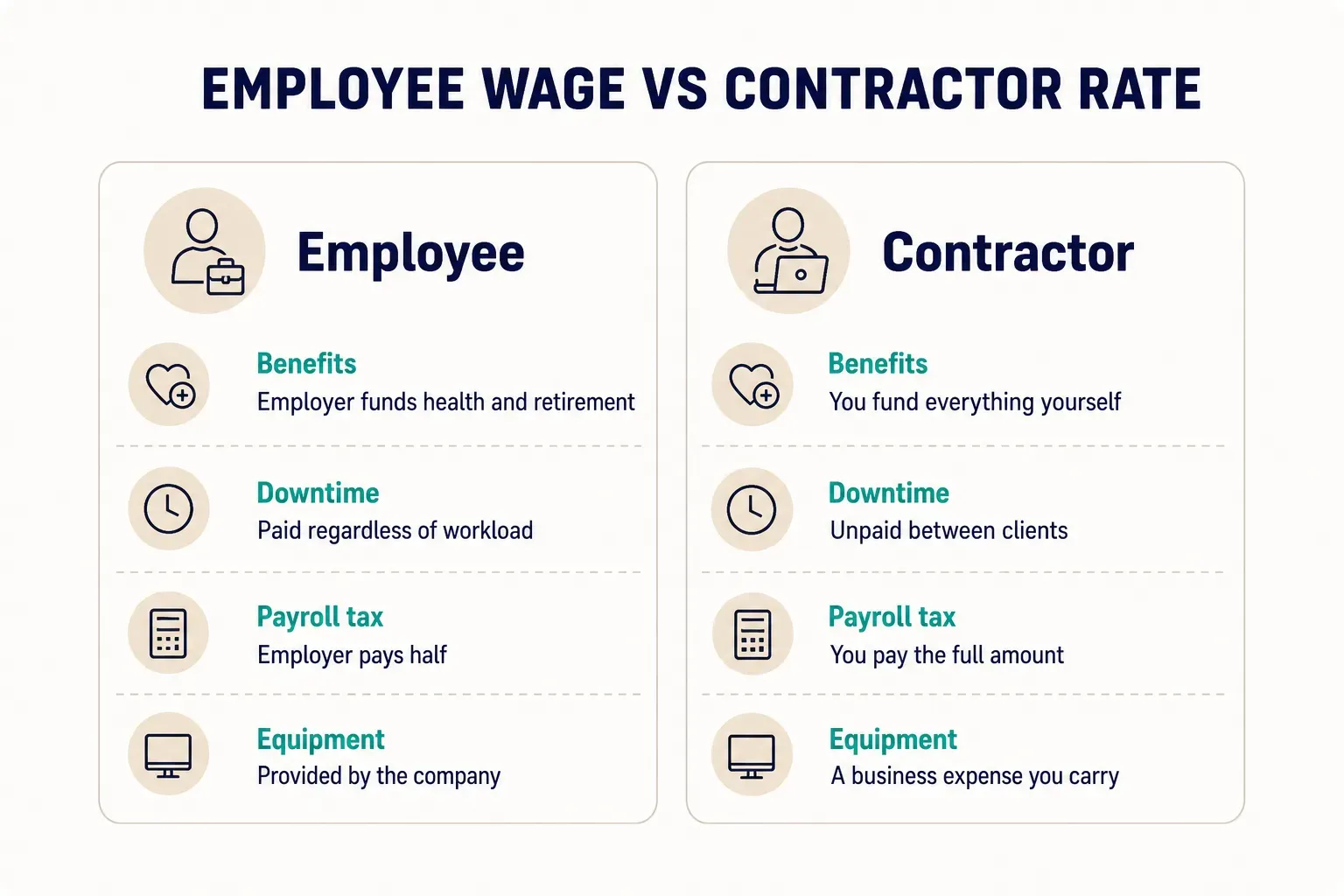
An employee’s hourly wage and a contractor’s quoted rate measure completely different things.
The employee’s number covers labor only. Someone else absorbs the downtime, the training, the dead weeks, half the payroll tax, and the cost of the laptop.
A contractor’s rate has to cover all of that plus the hours spent finding the next client.
That’s why published salary surveys cannot be dropped into a freelance quote without adjustment. They describe the cost of labor inside a company that already carries the overhead.
Throughout the rest of this guide, three tiers do the work.
Your break-even rate is the minimum that covers costs and a survivable income. Your sustainable target rate adds profit, retirement contributions, and a buffer for slow periods. Your market-facing quoted rate is what appears on proposals, usually 10 to 25 percent above target so you have room to discount without dipping below sustainable.
Know all three and negotiation stops being guesswork.
You know exactly where your floor is.
Build your rate step by step
The arithmetic here is simple.
The honesty required is not.
Most people inflate billable hours and understate expenses, which is precisely how a $95 rate quietly becomes $58.
- Set your income target first, not your rate. Decide what you need to pay yourself before tax for the year. Cover living costs, debt, savings, and retirement. For this example we’ll use $70,000 in take-home pay, which is a different and much larger requirement than $70,000 in revenue.
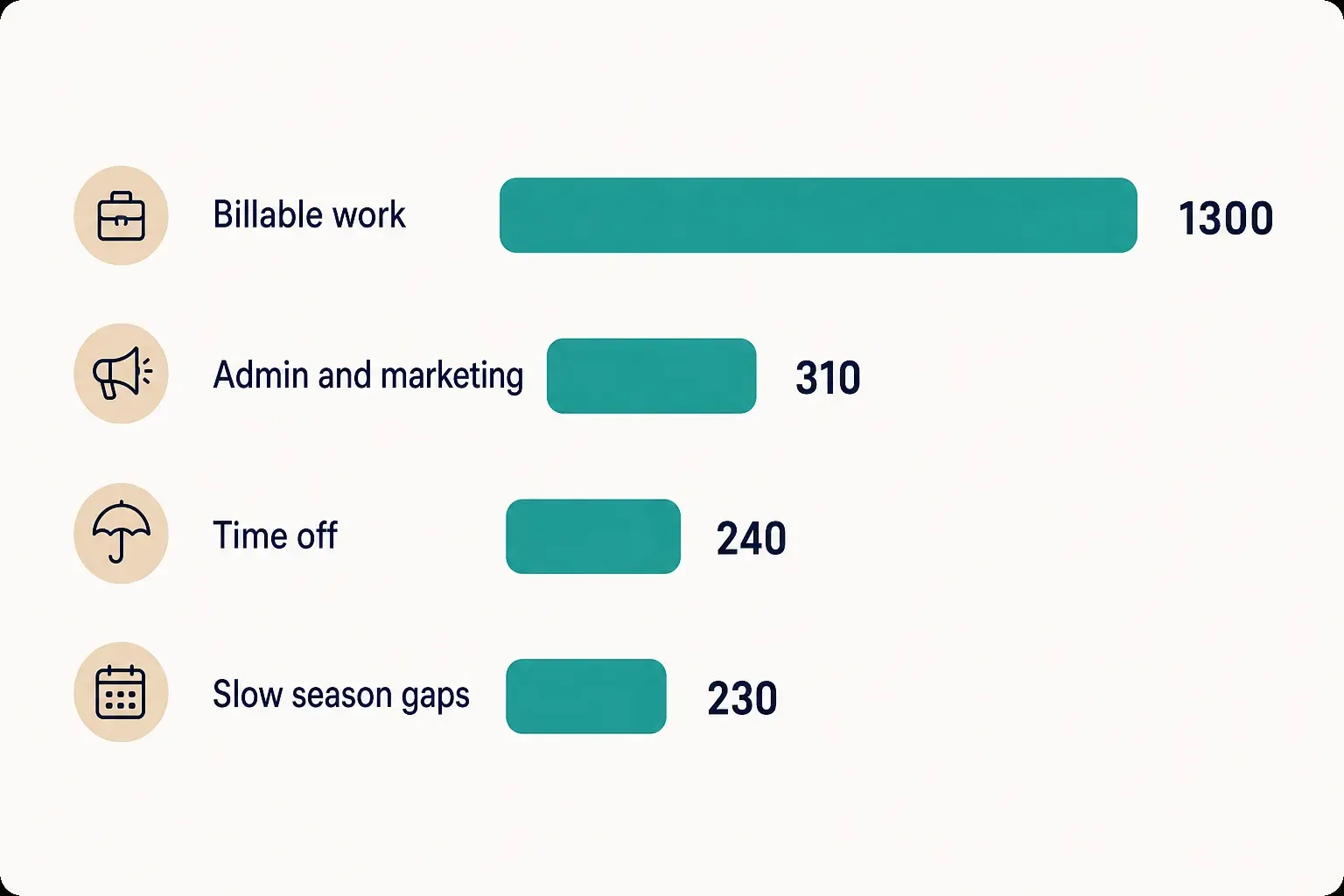
- Count total available work hours. Start at 2,080, which is 40 hours across 52 weeks. Then subtract time off: three weeks of vacation (120 hours), ten public holidays (80 hours), and five sick days (40 hours). You’re at roughly 1,840 hours before a single client is served.
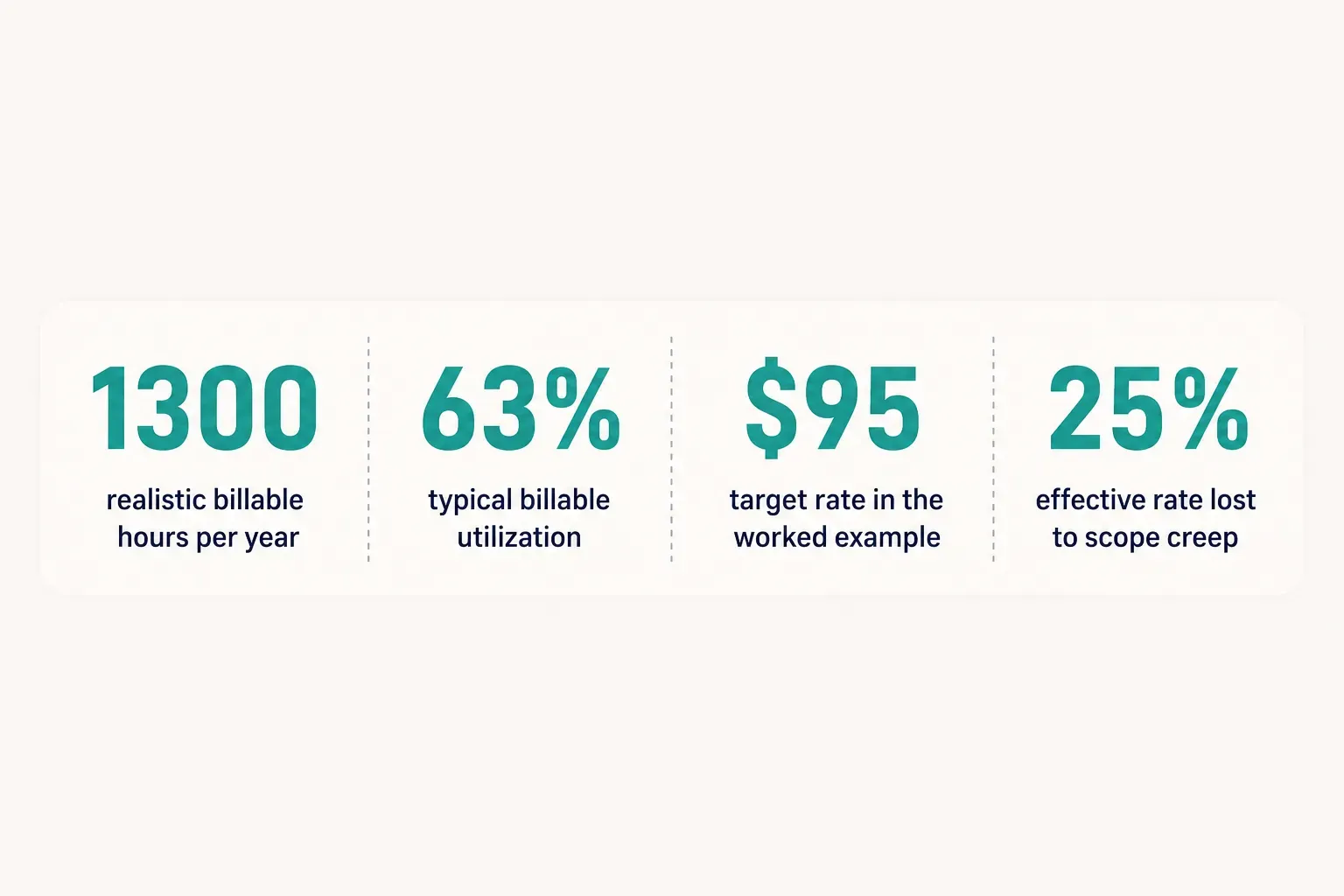
- Subtract non-billable time to find real billable hours. Marketing, quoting, invoicing, bookkeeping, scheduling, email, software updates, professional development, and unpaid revisions typically consume 25 to 40 percent of a working year. That leaves most independents with 1,200 to 1,500 billable hours. We’ll use 1,300, a billable utilization of about 63 percent.
- Add a slow-season adjustment. If your work has a seasonal dip, a landscaper in January, a wedding photographer in November, subtract those weeks explicitly rather than hoping they average out. A four-week gap between contracts costs roughly 100 billable hours.
- Model taxes as a transparent percentage. Self-employment tax runs 15.3 percent on net earnings (12.4 percent Social Security, 2.9 percent Medicare). Add federal and state income tax on top. A combined reserve of 25 to 32 percent is realistic for most mid-income independents; we’ll use 27 percent. To take home $70,000 you need pre-tax owner compensation of $70,000 ÷ 0.73 = $95,890.
- Total your business expenses. Separate fixed costs (insurance, software subscriptions, phone, accounting, licensing, workspace) from variable costs (materials, mileage, subcontractors, per-job supplies). Our example carries $9,000 in annual operating expenses.
- Calculate the break-even rate. Add pre-tax owner compensation to expenses: $95,890 + $9,000 = $104,890. Divide by 1,300 billable hours. Break-even is $80.68 per hour. Below that, you are subsidizing your clients.
- Layer in profit. Profit is not your salary; it’s the buffer that funds equipment replacement, a bad quarter, and growth. Add a 15 percent margin: $104,890 ÷ 0.85 = $123,400. Divided by 1,300 hours, your target rate is $94.92. Call it $95.
- Set your quoted rate above target. Publish $105 to $110 so a 10 percent discount for a good long-term client still lands above $95. Discounting from your floor is how margin disappears.
Count your billable hours
Don’t guess this number.
Track two typical weeks with a timer, tagging everything as billable or not, then extrapolate. Nearly everyone who does this discovers their utilization is 10 to 15 points lower than assumed.
Add taxes and time off
Keep taxes as a visible line in the formula rather than folding them into a vague markup.
Vague markups get negotiated away; a documented 27 percent reserve does not. Move that percentage into a separate account every time an invoice clears.
Layer in expenses and profit
Annualize irregular costs before dividing.
A $2,400 laptop replaced every three years is $800 a year, or $0.62 per billable hour at 1,300 hours.
Small on its own.
Multiply it across insurance renewals, certifications, and vehicle maintenance and it becomes a meaningful slice of your rate.
Employee, contractor, and part-time math
The same $70,000 income target produces three very different hourly figures depending on who carries the risk.
Here’s what each path actually requires.
| Factor | Full-Time Employee | Full-Time Contractor | Part-Time Freelancer |
|---|---|---|---|
| Hours used in the formula | 2,080 paid hours | 1,300 billable hours | 600 billable hours |
| Income target (take-home) | $70,000 gross salary | $70,000 net after tax | $32,000 net after tax |
| Tax burden | Employer pays half of FICA | Full 15.3% self-employment tax plus income tax | Full self-employment tax plus income tax |
| Annual business expenses | $0 (employer funded) | $9,000 | $6,500 (fixed costs barely shrink) |
| Overhead per billable hour | $0 | $6.92 | $10.83 |
| Paid leave and holidays | ~25 paid days included | Unpaid; built into the rate | Unpaid; built into the rate |
| Resulting hourly figure | $33.65 per hour | $95 target rate | $84 target rate |
Converting salary to hourly
For a salaried employee, the formula is genuinely straightforward: annual salary ÷ 2,080 = hourly wage. A $70,000 salary equals $33.65 an hour, and $52,000 equals $25.00.
Adjust the divisor if your schedule isn’t standard.
At 32 hours a week, use 1,664. At 35 hours, use 1,820.
One caveat matters more than the math.
If you routinely work 48 hours for 40 hours of pay, your true rate is $70,000 ÷ 2,496 = $28.04. That’s a 17 percent gap, and it’s the number to use when comparing a salaried offer against contract work.
Setting a contractor rate
Contractor rates typically run 1.5x to 2x the equivalent employee wage, and the multiplier isn’t padding. It replaces employer-funded health insurance, retirement matching, the employer half of payroll taxes, paid leave, equipment, software, and the unpaid hours spent winning work.
Our $33.65 employee wage maps to $50 to $67 as a straight benefits-replacement conversion. The full build in Section 3 landed at $95 because it also priced in profit and a realistic 63 percent utilization.
The multiplier is a sanity check; the full calculation is the answer.
Adjusting for part-time work
Halving your hours does not halve your rate.
It raises it.
Fixed costs barely move when you work less.
Insurance, accounting, licensing, phone, and core software still cost roughly the same whether you bill 600 hours or 1,300. Spread $6,500 across 600 hours and overhead alone is $10.83 per hour, up from $6.92.
Part-time utilization is usually worse too.
Marketing and admin don’t scale down proportionally, so a 20-hour week might yield only 11 or 12 billable hours. Recalculate the whole formula with your real numbers instead of scaling the full-time rate down.
Turning your rate into profit
A calculated rate is theory.
What you actually earn per hour, after scope creep, unpaid travel, and three rounds of “just one small change,” is the only figure that pays your rent.
Quoting fixed-price projects
Most clients want a project price, not an hourly meter. Converting your rate into a quote means estimating every hour the job will consume, not just the visible ones.
Build the estimate in layers.
Core production time, then communication (kickoff calls, status updates, feedback review), then travel, then setup and teardown, then materials handling. A four-hour on-site job often carries 90 minutes of invisible time before anyone touches a tool.
Then add contingency.
A 15 to 20 percent buffer on estimated hours covers the revisions and surprises that appear on roughly every third project. A 12-hour job at $95 becomes 14 hours, or $1,330, and you quote $1,350.
For on-location providers, three decisions need answers before the next quote goes out.
Is travel time billable, billed at a reduced rate, or built into a zone-based minimum? Is mileage charged separately at a per-mile figure? Is there a minimum call-out charge that makes short jobs viable?
Materials deserve their own line with a markup of 10 to 20 percent, which covers sourcing time, delivery, and the risk of price changes between quote and purchase.
Bury materials inside the labor price and your margin disappears the moment supplier costs rise.
Tracking effective hourly earnings
Your effective hourly rate is total project payment divided by the hours you actually logged. It’s the single most revealing number in a service business, and most providers have never calculated it.
Quote $1,350 for a 14-hour estimate and you’ve priced at $96 an hour. Spend 19 hours because the client changed the brief twice and added an unpaid revision, and your effective rate is $71.
You billed at target and earned 25 percent below it.
Track it on every job.
Log estimated hours, actual hours, final payment, and a one-line note on what went over. After ten projects, the pattern is unmistakable: either a specific job type consistently underperforms, or a specific client does.
This is where record-keeping stops being administrative and starts being strategic. Logging every booking, price, and job status in one place, the way a provider calendar and stats dashboard in Frendex does, turns rate review into arithmetic instead of memory.
You cannot fix a margin leak you never measured.
When to raise your rate
Raise your rate on evidence, not on vibes.
Five signals, reviewed quarterly or after any major change in scope or costs, tell you when.
First, booked capacity. If you’re above 85 percent booked for two consecutive months with a waiting list, demand exceeds supply and price is the correct lever.
Second, close rate on quotes. Winning more than 80 percent of proposals usually means you’re priced under market; a healthy close rate sits between 40 and 60 percent.
Third, recorded profit margin. If it has slipped below 10 percent after a year of cost increases, your rate hasn’t kept pace with your expenses.
Fourth, skill and outcome changes: new certification, faster delivery, better results, all of which justify repricing. Fifth, a straightforward cost recalculation, since insurance, software, and fuel rarely move downward.
A 5 to 10 percent annual increase applied to new clients first, with 60 days’ notice to existing ones, is the standard approach.
It’s rarely contested.
Sitting at the same rate for three years, by contrast, is a real pay cut once inflation is counted.
Your rate is only as good as your data
Here’s the one thing worth doing tonight.
Pull your last three months of work, count the hours you actually billed, and rerun the formula with that real number instead of the one you assumed. Most people find their utilization is closer to 55 percent than 70, and the rate that follows is 15 to 25 percent higher than what they’ve been quoting.
Your rate stays a hypothesis until tracked hours, recorded expenses, and paid invoices confirm it holds on real jobs. Calculate it, quote it, then measure the effective hourly rate on every project for a quarter.
And one decision rule to keep: if your effective hourly earnings consistently land below target, fix scope definition and non-billable time before touching your quoted rate.
Raising the price on a leaky process just raises the size of the leak.
Frequently asked questions
How do you calculate your hourly rate from your salary?
Divide your annual salary by 2,080, the number of paid hours in a standard full-time year. A $60,000 salary equals $28.85 per hour, and $85,000 equals $40.87. Adjust the divisor for non-standard schedules: 1,664 hours for a four-day week, 1,820 for a 35-hour week. And if you regularly work unpaid overtime, divide by the hours you actually work. Someone at $60,000 putting in 47-hour weeks is earning $24.55, not $28.85.
What is a good hourly rate for a freelancer?
A good freelance rate is any rate that covers your full costs, your tax reserve, your target income, and a profit margin, which for most independents in 2026 lands somewhere between $60 and $150 per hour. Quoting an industry average without running your own numbers is guesswork. Two freelancers doing identical work can justifiably charge $65 and $130. The difference comes from overhead, utilization, specialization, and market position. Build the number from your cost base first, then compare it against what your market pays and adjust your positioning if there's a large gap.
How do I calculate my hourly rate as a self-employed person?
Add your target take-home pay, your tax reserve, your annual business expenses, and your profit margin, then divide the total by your realistic billable hours. The step a salaried conversion skips entirely is tax: self-employed people owe the full 15.3 percent self-employment tax on net earnings plus income tax, so reserve 25 to 32 percent of profit. You also self-fund everything an employer would otherwise provide: health insurance, retirement contributions, paid leave, equipment, and training. Price those as line items in the expense total rather than hoping revenue covers them.
How many hours should I use to calculate a freelance hourly rate?
Use 1,200 to 1,500 billable hours per year, not 2,080. That range reflects a realistic billable utilization of roughly 58 to 72 percent after time off, marketing, admin, quoting, bookkeeping, and gaps between clients are removed. The difference is not cosmetic. A $110,000 revenue requirement divided by 2,080 gives $52.88 an hour. The same requirement divided by 1,300 gives $84.62. Use the wrong denominator and you undercharge by 37 percent for an entire year.
How do you calculate a billable hourly rate?
The formula is: (total annual costs + desired profit) ÷ annual billable hours = billable hourly rate. Total costs include your pre-tax owner compensation, your tax reserve, and all fixed and variable business expenses. Using the worked example: $95,890 pre-tax owner compensation plus $9,000 in expenses equals $104,890. Add a 15 percent profit margin and the revenue requirement is $123,400. Divided by 1,300 billable hours, the billable hourly rate is $94.92. Round up and quote $105 so you have negotiating room above your floor.
How much should I charge per hour to make $100,000 a year?
Charge roughly $85 per hour to earn $100,000 in pre-tax owner compensation, or about $113 per hour if you want $100,000 in take-home pay after tax. The naive answer of $48.08 ($100,000 ÷ 2,080) only applies to a salaried employee whose employer absorbs every other cost. The arithmetic: with $10,000 in annual expenses and 1,300 billable hours, $110,000 in revenue divided by 1,300 equals $84.62 per hour. If $100,000 is your target take-home, gross it up at a 27 percent tax reserve to $136,986, add $10,000 in expenses, and divide by 1,300 for $113.07 per hour. That's a 135 percent difference from the 2,080-hour shortcut. Which explains a lot of burned-out freelancers.
Need a hand with something?
The Frendex map shows you who is available near you, in real time.
Get the app free Get the app freeFree, no card needed
Related articles

A no-show policy that protects your business
A 5-part no-show policy framework, not a copy-paste template. Learn what to charge, when to waive it, and how to cut missed appointments fast.

A service business's guide to bad reviews
Not every 1-star review deserves an apology. Get the 6-category decision tree for replying to bad reviews without looking guilty or defensive.

Your practical roadmap to becoming self-employed
A step-by-step path to going self-employed: testing your idea, setting rates, and handling tax, without quitting your job on day one.