How freelancers actually land their first clients
By Kiss János Updated 15 min read
Why most freelancers struggle to find work
Most freelancers don’t have a talent problem.
They have a distribution problem.
The typical pattern looks like this: sign up for a marketplace, send twelve proposals in a weekend, hear nothing, post once on LinkedIn, then wait. When that fails, they try a different random channel and repeat the cycle.
No system, no data, no idea which part broke.
Landing clients consistently is a process, not a lucky break. It has six moving parts: positioning (who you help and with what result), channels (where those people are), outreach (how you start conversations), qualifying (deciding who’s worth your time), closing (turning a call into a signed project), and retention (turning one project into three).
Skip any one of them and the whole thing leaks.
Great positioning with no outreach produces silence. Heavy outreach with vague positioning produces polite rejections.
And if you’re reading this with no portfolio, no professional network, and no reputation, that’s the normal starting point.
Nearly every full-time freelancer began there.
The difference is that they built a repeatable client acquisition funnel instead of hoping the right person would stumble across them.
This guide walks through that system in the order you should actually build it.
Position yourself before you pitch
Here’s a test.
If a stranger asks what you do and your answer could describe 40,000 other people, you haven’t positioned yourself.
You’ve just named a skill.
“I’m a web designer” is a category. “I build conversion-focused websites for local service businesses like plumbers, dentists, and law firms” is a value proposition.
One gets a nod. The other gets a follow-up question.
Service positioning matters more when you’re new than when you’re established, because a specific claim is easier to believe from an unknown person.
Nobody trusts a beginner generalist.
Plenty of people will take a chance on a beginner specialist who clearly understands their exact situation.
Turn a skill into an outcome
Use a three-part formula: skill + audience + measurable result.
Your skill is what you do. Your audience is your ideal client profile. The result is what changes in their business after you’re done.
Worked example one. Skill: copywriting. Audience: B2B SaaS companies with 10 to 50 employees. Result: email sequences that recover abandoned trial signups.
That becomes “I write trial-recovery email sequences for small B2B SaaS teams.”
Worked example two. Skill: bookkeeping. Audience: independent restaurant owners. Result: month-end close in five days instead of twenty.
That becomes “I get restaurant owners clean monthly numbers by the fifth of the month.”
Notice that neither example locks you in forever.
A freelance niche is a marketing decision, not a life sentence.
You can change it once you’ve earned the right to be picky.
The narrower your positioning, the shorter your sales conversation. Specificity does the persuading before you ever get on a call.
Proof without paying clients
You need evidence, and you don’t need permission to create it.
Three reliable routes exist for building social proof before anyone has paid you.
- Spec projects on real businesses. Pick three companies in your target niche, identify a genuine weakness (a slow landing page, an unreadable menu, a broken onboarding email), and rebuild that one piece. Real business, real problem, real work sample.
- Pro-bono work for a friend’s company. Do one paid-quality project for free in exchange for two things: permission to publish results and a written testimonial. Agree on both before you start, in writing.
- Nonprofit volunteer projects. Small charities almost always need design, writing, or web help and will happily give you a named reference. The work is genuine, the constraints are real, and the testimonial carries a logo.
Your first portfolio needs three to five samples.
Not twenty.
Each one should be structured as a portfolio case study: the problem, what you did, and the result or intended outcome.
Label self-initiated work honestly.
Write “self-initiated concept redesign” and nobody blinks.
Imply it was a paid client engagement and you’ll get caught in the discovery call, which is the worst possible moment to lose trust.
Choosing channels that fit your situation
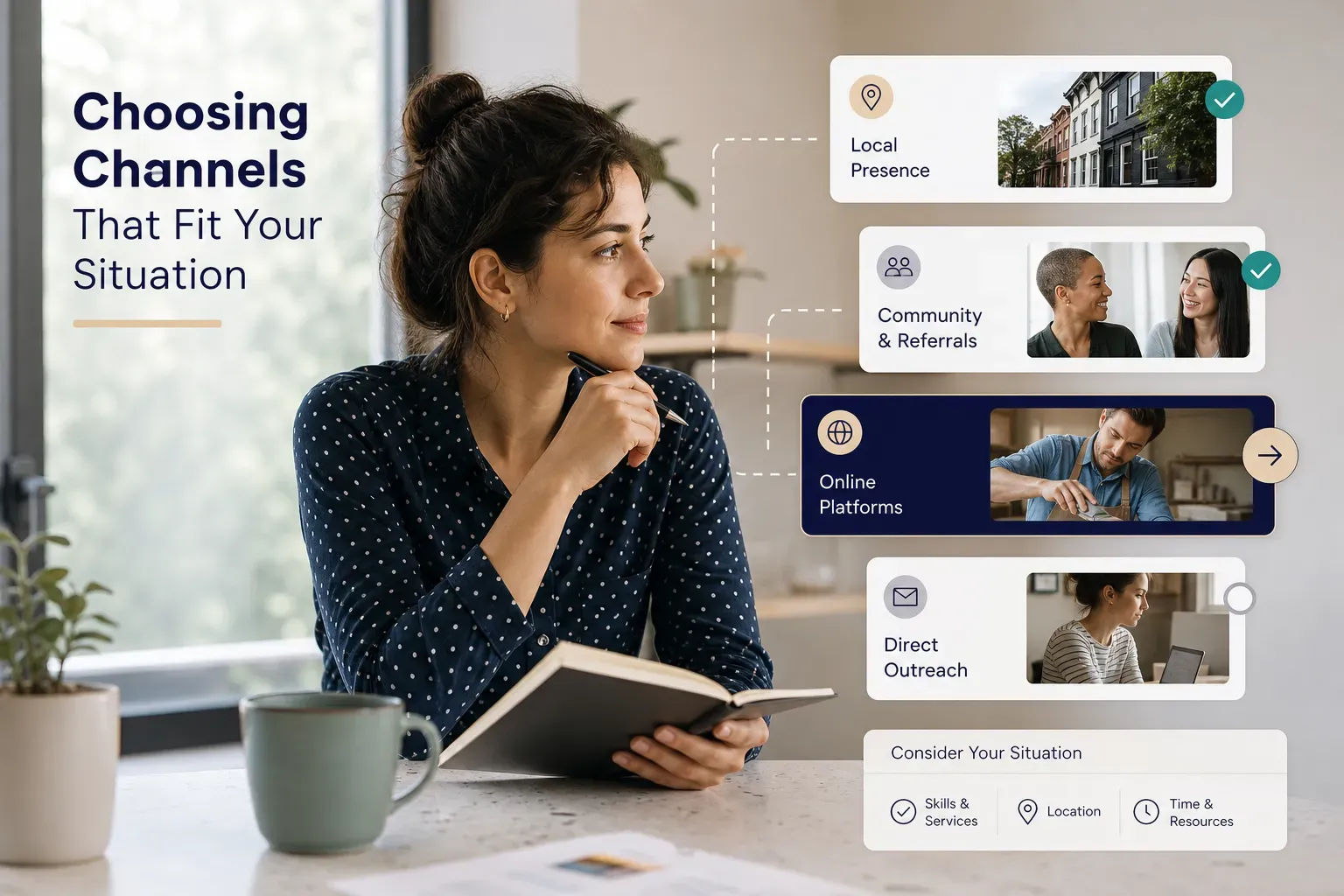
Ask ten freelancers where to find clients and you’ll get ten different answers, all of them confident and all of them incomplete. The right channel depends on two variables: how much experience you can demonstrate, and how fast you need money.
Those two questions matter more than any channel’s theoretical quality.
A perfect long-term pipeline is useless if rent is due in three weeks.
| Channel | Best-fit experience level | Typical speed to first client | Independence | Geography fit |
|---|---|---|---|---|
| Freelance marketplace (Upwork, Fiverr) | Complete beginner to early career | 1 to 4 weeks | Low: platform owns the client relationship and takes 5 to 20 percent | Fully remote, global |
| LinkedIn (content plus direct outreach) | Beginner with a clear niche through senior | 4 to 12 weeks | Medium: you own the relationship, the platform owns the reach | Remote, strongest in B2B and professional services |
| Cold email | Intermediate: needs at least one credible case study | 2 to 8 weeks | High: fully owned list and messaging | Remote or local, best for niches with findable contact data |
| Warm network and referrals | Any level, including day one | Days to 3 weeks | High: no gatekeeper, no fees | Follows wherever your existing contacts already are |
| Direct local outreach (walk-ins, chambers, meetups) | Beginner to intermediate | 2 to 6 weeks | High: direct relationship, low competition | Local only: service businesses, trades, hospitality, clinics |
Treat marketplaces as a proof-building phase, not a home.
They solve the cold-start problem brilliantly because buyers there have already decided to hire someone.
What they don’t solve is rate compression and platform dependency.
Run three to five marketplace projects, collect the reviews, convert those into case studies, then shift your energy to owned channels.
Freelancers who stay on marketplaces for three years usually earn the same in year three as year one.
Urgency changes everything.
If you need income this month, your ranking is warm network first, marketplaces second, local outreach third. If you’re building over six months while employed, invert it: cold email and LinkedIn content compound, marketplaces don’t.
Geography is the last filter.
A dental clinic in your city will meet you for coffee but ignore a cold LinkedIn message. A SaaS company three time zones away will read a well-researched email and never care where you live.
Match the channel to how your buyers already prefer to be reached.
Build a repeatable outreach system
Outreach fails for a boring reason: most people send messages that require the recipient to do the thinking.
Vague asks get vague responses, or none at all.
A working system has three layers.
Warm contacts, cold contacts, and a follow-up sequence that runs whether you feel like it or not.
Warm contacts and referrals first
Your existing network is the highest-conversion channel you will ever have, and almost everyone underuses it because they ask badly.
“Let me know if you hear of anything” puts the entire cognitive load on your friend.
They won’t do it.
Not out of malice, just because it’s a vague task with no deadline.
Ask for a specific introduction instead.
Here’s a script that works on former coworkers, classmates, and friends:
- Open with context, not an apology. “Hey Sam, hope the new role’s going well. Quick update: I’ve gone freelance and I’m building landing pages for B2B SaaS teams.”
- Name the exact person you want to reach. “I noticed you’re connected to Priya at Northwind. She’s the kind of marketing lead I work best with.” Naming a person converts far better than describing a category.
- Make the intro effortless. “If you think it makes sense, would you be open to a quick intro? Happy to write the blurb so you just forward it.” Then actually write the blurb.
- Give them an easy exit. “And no stress at all if it’s not a fit.” This raises response rates because it removes social pressure.
- Work through the list in batches. Ten to fifteen warm messages in one sitting, personalized individually. Expect roughly one in four to reply and one in ten to produce a real conversation.
Warm outreach also includes dormant contacts: old clients from a previous job, vendors you worked alongside, people you studied with.
Five years of silence is not a barrier.
A specific, friendly ask reopens most doors.
Cold email that gets replies
Cold email works when it’s research first and writing second.
The email is just the delivery mechanism for something you noticed.
- Build a narrow prospect list. Twenty to forty companies that match your ideal client profile on industry, size, and one buying signal (hiring for a related role, recently funded, just launched a product, actively running ads).
- Find one observable problem per prospect. Load their site on mobile. Sign up for their newsletter. Read their last three job posts. You’re looking for something concrete you could name in one sentence.
- Lead with that observation. “Your booking page loads in 6.4 seconds on mobile, and your Google Ads are pointing straight at it.” That is cold email personalization that proves effort. “I loved your website!” proves nothing.
- Make exactly one ask. “Worth a 15-minute call Thursday?” One question, one decision. Multiple asks split attention and reduce replies.
- Keep it under 120 words. Cold emails are read on phones between meetings. Anything longer gets archived.
- Stay compliant. Use honest subject lines that match the body, include a real physical address and a working opt-out in commercial email, honor unsubscribes within ten business days, and never buy a list. That’s CAN-SPAM in the US. Under GDPR in the EU and UK, B2B outreach generally requires a legitimate-interest basis, relevance to the recipient’s actual job, and a clear way to object. Research contacts individually and document why you contacted them.
Your follow-up cadence
Most replies arrive after the first message, but a meaningful share come from follow-ups two and three.
Most freelancers send one email and quit.
- Day 3: a short bump that adds something new. A relevant example, a screenshot, a one-line idea. Never “just checking in.”
- Day 7: reframe the offer or shrink the ask. Swap a 30-minute call for a two-line reply: “Is this even on your radar this quarter?”
- Day 14: the polite close-out. “I’ll stop here so I’m not cluttering your inbox. If timing changes, I’m around.” This message alone recovers a surprising number of conversations.
- Then move them to a quarterly nurture list. One useful, low-pressure touch every three months. No pitch required.
- Cap the sequence at 3 to 4 touches total. Beyond that, response rates flatten and complaint rates climb.
Volume target for beginners: 15 to 20 new prospects per week, split roughly one third warm and two thirds cold.
That’s three or four per working day, which is genuinely sustainable alongside client work.
Once referrals start producing one or two qualified conversations a month, you can cut cold volume to 5 to 8 new prospects weekly and reinvest the time into delivery and content marketing.
Never drop to zero.
The freelancers who go quiet during busy months are the ones scrambling eight weeks later.
From first reply to repeat client

A reply is not a client.
Treating it like one is how deals die.
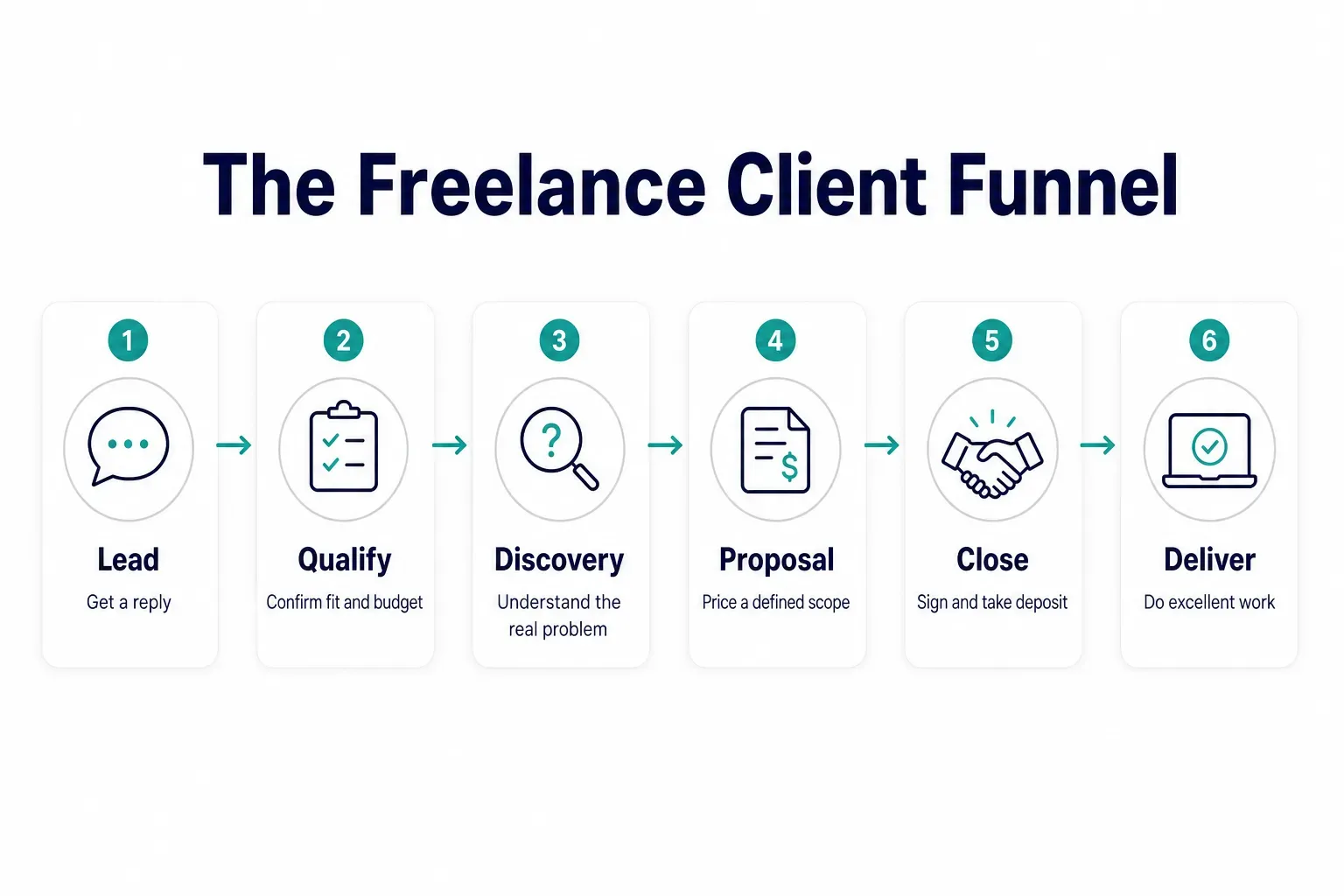
Your client acquisition funnel has seven distinct stages, and each has a different job: lead generation, lead qualification, discovery call, proposal, close, delivery, and retention.
Conflating them is the single most common cause of lost deals.
What does conflating look like in practice?
Someone replies with mild interest and you immediately send a price.
You’ve skipped qualification and discovery, which means you priced a project you don’t understand for a buyer whose budget you never confirmed.
They ghost.
You assume you were too expensive.
You weren’t.
You just guessed.
Each stage should end with a clear next step scheduled before the conversation closes.
Is this prospect worth it?
Not every interested person deserves a proposal.
Writing a freelance proposal takes one to three hours, and unqualified proposals are the biggest hidden cost in a freelance business.
Run every prospect through six checks before you commit time:
- Budget fit. Have they named a range, or at least confirmed the project has approved funding? “We’ll figure it out” is a red flag.
- Urgency. Is there a real deadline or driving event? Projects without a date slip forever.
- Decision-maker access. Are you talking to the person who signs, or a coordinator relaying messages? Two degrees of separation roughly halves your close rate.
- Scope clarity. Can they describe what “done” looks like? If not, either run a paid discovery phase or walk.
- Payment risk. Any public signals of trouble, late-payment complaints, or resistance to a deposit? Take 30 to 50 percent up front, always.
- Repeat potential. Is this a one-off or the entry point to ongoing work? A prospect with high customer lifetime value justifies more effort than a single small project.
Score each as yes, maybe, or no.
Two or more hard nos and you should politely decline or park them in your nurture list.
Why replies don’t become clients
Getting replies but closing nothing is a diagnosable problem, not bad luck.
There are five likely culprits, and they show up at different points in the conversation.
Positioning problem. People reply, but they’re the wrong people asking about services you don’t want to sell.
Symptom: every conversation starts with you explaining what you actually do.
Trust problem. Interest is real, then it fades after they see your portfolio or check your profile.
Symptom: enthusiasm drops between first reply and the call.
Fix it with stronger case studies and named testimonials.
Pricing problem. Deals die at the number, every time, across different client types.
Symptom: consistent sticker shock.
Either your price is genuinely misaligned with the segment, or you’re presenting a price without a value case.
Weak proposal. Good call, then silence.
Symptom: your proposal lists deliverables and hours instead of the outcome, the timeline, and what happens if they do nothing.
Shaky discovery call. The most common one.
Symptom: you talked more than they did.
A good discovery call is 70 percent listening, ends with you restating their problem in their own words, and closes with a scheduled next step.
Track where deals die for ten prospects.
The pattern will be obvious and it will be one of these five.
Turn delivery into your next lead
Finishing a project is the highest-leverage marketing moment you will ever have, and most freelancers waste it by sending an invoice and disappearing.
The client is happy right now.
Goodwill has a short half-life.
Run this loop within 48 hours of delivery:
- Request the testimonial immediately. Ask three specific questions (what was the problem, what changed, what surprised you) and offer to draft it for their approval. Same-day requests convert far better than same-month.
- Propose the retainer. “The site’s live. The next 90 days of iteration is where most of the gains come from. Want me to handle that at a fixed monthly rate?” A retainer agreement converts unpredictable project income into a baseline.
- Ask directly for a referral. Not “keep me in mind.” Say: “Is there anyone in your network dealing with the same problem you had three months ago?”
- Request an adjacent introduction. Their accountant, their supplier, their industry peer group. Adjacent businesses share the same problems and already trust the person introducing you.
Referral marketing works because it collapses the trust stage entirely.
Referred prospects typically close faster, negotiate less, and produce more repeat clients than any cold channel.
None of this survives without tracking.
Maintain seven fields per prospect: source, date of first contact, next follow-up date, pipeline stage, estimated value, close probability, and next action.
A spreadsheet is fine on day one.
What kills momentum is scattering that information across four inboxes, two messaging apps, a notes file, and your memory.
Conversations get buried, follow-ups get missed, and a warm lead goes cold because a message sat unread for nine days.
Centralizing client chats, bookings, and follow-ups in one place solves this.
Tools built for service providers, like Frendex, exist specifically so inquiries and scheduled follow-ups live in a single view instead of being spread across tools that don’t talk to each other.
Review your sales pipeline once a week for twenty minutes.
Update stages, clear overdue follow-ups, add new prospects.
That review is where your conversion rate and your marketing return on investment actually become visible.
Your next move
Close this article and message five warm contacts.
Today, before you redesign your website or rewrite your bio.
Use the script from earlier: brief context, your niche in one sentence, a named person you’d like an introduction to, and an easy way to say no.
Five messages takes about twenty minutes.
It will teach you more about your positioning than a week of planning.
Then build the rhythm.
Fifteen to twenty new prospects a week, a follow-up sequence you actually run, and a twenty-minute pipeline review every Friday.
The freelancers who stay booked in 2026 aren’t the ones who found a clever tactic. They’re the ones who kept doing unglamorous outreach during the months they were already busy.
That’s the whole difference.
Start with five messages.
Everything else builds on top of that.
Frequently asked questions
How do freelancers find their first clients?
Most freelancers land their first client through their existing network, not through a platform or an ad. Message 10 to 15 former coworkers, classmates, and friends with a clear description of your niche and a request for a specific introduction. Pair that with a freelance marketplace to generate reviews while your warm outreach develops.
How do I get freelance clients with no portfolio?
Create three to five self-initiated samples that solve real problems for real businesses. Spec redesigns, a pro-bono project for a friend's company in exchange for a written testimonial, and nonprofit volunteer work all produce legitimate case studies. Structure each as problem, solution, result, and label self-initiated work honestly.
What is the fastest way to get freelance clients?
Warm network outreach is the fastest route, typically producing conversations within days rather than weeks. Marketplaces are the second fastest because the buyers there have already decided to hire. Cold email, LinkedIn content, and referral systems take four to twelve weeks to produce results but build an owned pipeline you keep forever.
How do I find high-paying freelance clients?
High-paying clients buy business outcomes, not hours, so your positioning has to name a measurable result. Target companies where your work touches revenue directly, such as conversion, retention, or lead generation, and qualify for budget before writing a proposal. Referrals and LinkedIn consistently produce higher-budget clients than marketplaces.
Is LinkedIn good for finding freelance clients?
LinkedIn is one of the strongest channels for B2B and professional services freelancers, though it rewards patience over speed. Combine a profile written as a value proposition rather than a job history with two or three useful posts per week and targeted direct outreach. Expect meaningful results in one to three months of consistent activity.
How do I ask a client for a freelance referral?
Ask immediately after a client expresses satisfaction or within 48 hours of project completion, while the result is fresh. Use a specific script: "Really glad this worked out. Is there anyone in your network dealing with the same problem you had before we started? Happy to have a quick no-pressure chat with them." Specificity beats "keep me in mind" every time.
Need a hand with something?
The Frendex map shows you who is available near you, in real time.
Get the app free Get the app freeFree, no card needed
Related articles
A no-show policy that protects your business
A 5-part no-show policy framework, not a copy-paste template. Learn what to charge, when to waive it, and how to cut missed appointments fast.
A service business's guide to bad reviews
Not every 1-star review deserves an apology. Get the 6-category decision tree for replying to bad reviews without looking guilty or defensive.

Your practical roadmap to becoming self-employed
A step-by-step path to going self-employed: testing your idea, setting rates, and handling tax, without quitting your job on day one.