How to get leads: A local service provider's guide
By Kiss János 16 min read
Why most lead advice falls short
Search “how to get leads” and you’ll get the same list every time. SEO. Social media. Paid ads. Referrals. Cold outreach. Maybe a podcast recommendation thrown in for good measure.
What none of those lists tell you is which channel actually fits your business. A plumber and a math tutor and a freelance bookkeeper have almost nothing in common in how their customers find them.
One gets found at 11pm during a pipe burst. One gets found in September when report cards land. One gets found through an accountant’s offhand recommendation.
Same advice, wildly different outcomes.
The second problem is the metric. Most lead generation advice optimises for volume: more form fills, more inquiries, more “interest.”
But inquiries don’t pay your rent.
Booked, completed, paid jobs do.
Fifty inquiries that produce three bookings is a worse month than twelve inquiries that produce nine. Volume feels like progress. Revenue is progress.
This guide walks through a complete system instead of a channel menu. You’ll learn what actually counts as a qualified lead, how to pick the one or two channels that match your service type, how to capture and respond to inquiries fast enough to win them, how to qualify people without killing the conversation, and how to measure everything against booked revenue rather than clicks.
A note on who this is for.
If you’re a solo provider or a team of two to five, working with a marketing budget somewhere between zero and a few hundred a month, you’re in the right place. Nothing here requires an agency retainer, a marketing hire, or expensive customer relationship management software.
Most of it requires attention and a spreadsheet.
What actually counts as a lead
Ask ten service providers to define a lead and you’ll get ten answers. Someone who filled out a form. Someone who called. Someone who followed on Instagram. Someone who “seemed interested.”
That vagueness is expensive.
If you can’t define a lead, you can’t count one, and you certainly can’t tell which channel produces good ones.
The lead lifecycle
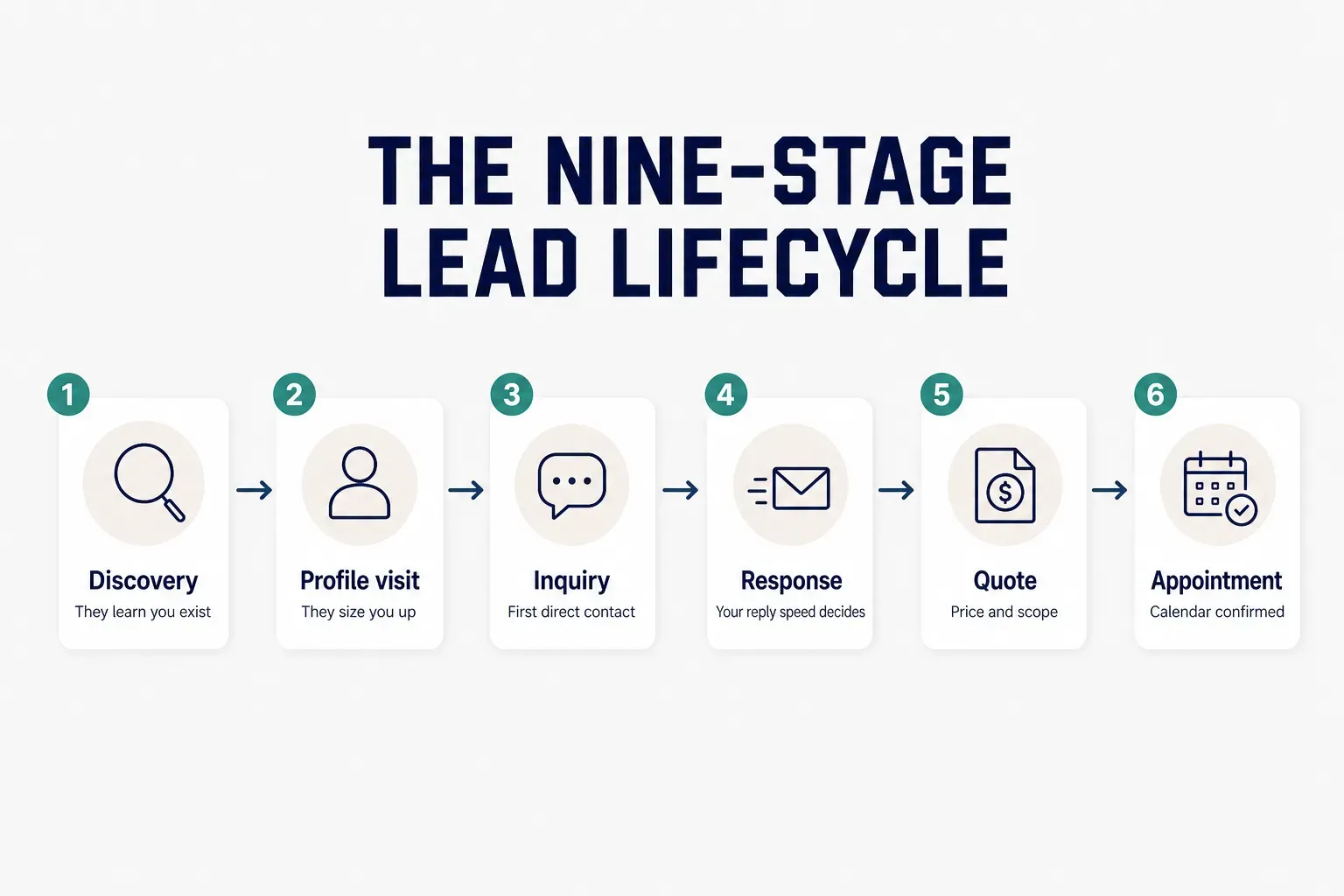
Every paid job travels the same path. Understanding each stage tells you exactly where you’re losing money.
Discovery is the first moment someone becomes aware you exist. A Google search, a marketplace listing, a neighbour’s recommendation, a van with your logo on it.
Profile visit is when they look closer. Your Google Business Profile, your website, your listing in a booking app. This is where most providers lose people silently, because nothing on the page answers the questions a nervous buyer is asking.
Inquiry is the first direct contact. A call, a message, a booking request. This is what most people mean when they say “lead,” and it’s only stage three of nine.
Response is your reply. Speed here matters more than almost anything else you’ll read in this article.
Quote is the number and scope you put in front of them.
Appointment is a confirmed date on the calendar.
Completed job is money in the bank.
Then two stages nobody tracks properly.
Review is the public proof that feeds your next twenty leads.
Referral is the same customer sending someone else your way at zero acquisition cost.
Defining a qualified lead
A qualified lead matches you on five dimensions, not one. Need, location, budget, timing, and service fit.
Need means they have a real problem right now, not a “maybe next year” idea. Location means they sit inside your service area without a ninety-minute drive eating your margin.
Budget means their expectation and your pricing live in the same neighbourhood.
Timing means they can actually book within a window you can serve. Service fit means the thing they want is a thing you do well, not a thing you could theoretically attempt.
Miss any one of those and you have an inquiry, not a lead.
Here’s why this distinction matters financially.
Chasing raw inquiry count pulls you toward tire-kickers, price shoppers collecting five quotes for sport, people outside your radius, and no-shows. Each one costs you twenty to forty minutes of unpaid time.
Twenty of those a month is a full working day gone.
Use a single qualifying test: can this person book a service I actually offer, inside their stated timeframe, at a price range I can work with?
If yes, it’s a qualified lead and deserves your best effort. If no, answer politely, refer them elsewhere if you can, and move on fast.
Politeness costs nothing.
Pursuit costs everything.
This is also how you build an honest ideal customer profile. Look at your last ten profitable jobs.
What did those people have in common in terms of urgency, postcode, job size, and how they found you? That pattern is your target, and it should shape which channels you invest in next.
Picking channels that fit your service
Here’s the decision that determines whether your effort pays off: are you capturing demand that already exists, or creating demand that doesn’t?
Demand capture vs demand creation
Demand capture means putting yourself in front of people actively searching right now. Google searches with high buyer intent (“emergency locksmith near me”), marketplace and booking app listings, local map results.
The person already knows they have a problem. Your only job is to be findable and fast.
Urgent local services live and die here.
Plumbing, locksmiths, electrical faults, towing, pest control, emergency cleaning. Nobody develops a slow appreciation for your plumbing brand over six months of helpful content. They search, they call the first three results, and they book whoever answers.
Demand creation means generating interest that wasn’t there yet. Content, workshops, partnerships, social proof, community presence.
This fits high-consideration services (business coaching, interior design, financial planning) and newer service categories people don’t yet know to search for.
The mistake is running demand creation tactics for an urgent service, or expecting demand capture to work for something nobody searches for.
A locksmith writing blog posts is wasting weeks. A new-category consultant bidding on nonexistent search terms is wasting money.
Matching channels to service type
Compare channels on the numbers that matter: qualified-lead rate, booking rate, customer acquisition cost, expected response window, and average revenue per job.
Not impressions. Not followers.
The figures below are realistic working benchmarks for solo and small-team local providers. Your own numbers will differ, which is exactly why you track them.
| Channel | Best fit service type | Qualified-lead rate | Typical booking rate | Cost per booked job | Response window needed |
|---|---|---|---|---|---|
| Google Business Profile and local SEO | Urgent local, any trade with a service area | 50 to 70% | 25 to 40% | $0 to $30 (time cost) | Under 10 minutes |
| Booking apps and service marketplaces | Home services, cleaning, beauty, tutoring | 60 to 80% | 30 to 50% | $15 to $60 or commission | Under 5 minutes |
| Paid search ads | Emergency and high-ticket urgent jobs | 35 to 55% | 15 to 30% | $80 to $400 | Under 5 minutes |
| Referrals from past customers | Recurring services, coaching, cleaning, care | 75 to 90% | 50 to 70% | $0 to $25 (incentive) | Same day |
| Partner referrals (complementary trades) | Specialist and high-consideration work | 65 to 85% | 40 to 60% | $0 to revenue share | Within 24 hours |
| Organic social and community groups | Visual services, local trust-driven niches | 20 to 40% | 10 to 25% | Time-heavy, low cash | Within a few hours |
| Content and email follow-up sequence | Remote, consultative, long sales cycle | 30 to 50% | 10 to 20% | Time-heavy, compounding | Within 24 hours |
Two patterns are worth pulling out.
Recurring services (cleaning, lawn care, coaching, personal training) get their best returns from referral loops and repeat-booking tools, because customer lifetime value is high and every retained client removes a future acquisition cost. Online or remote services need discoverability beyond a single postcode, which shifts weight toward content, marketplaces, and search rather than local map listings.
Now the part most people skip.
Run one channel at a time.
Pick the single channel that best matches your service type.
Commit to two weeks.
Set up proper tracking before you start, log every inquiry with its source, and measure bookings rather than interest. If you get qualified leads booking at a cost you can live with, deepen that channel before touching another.
Three half-run channels produce nothing you can learn from.
One properly-run channel gives you a baseline to beat.
From inquiry to booked job
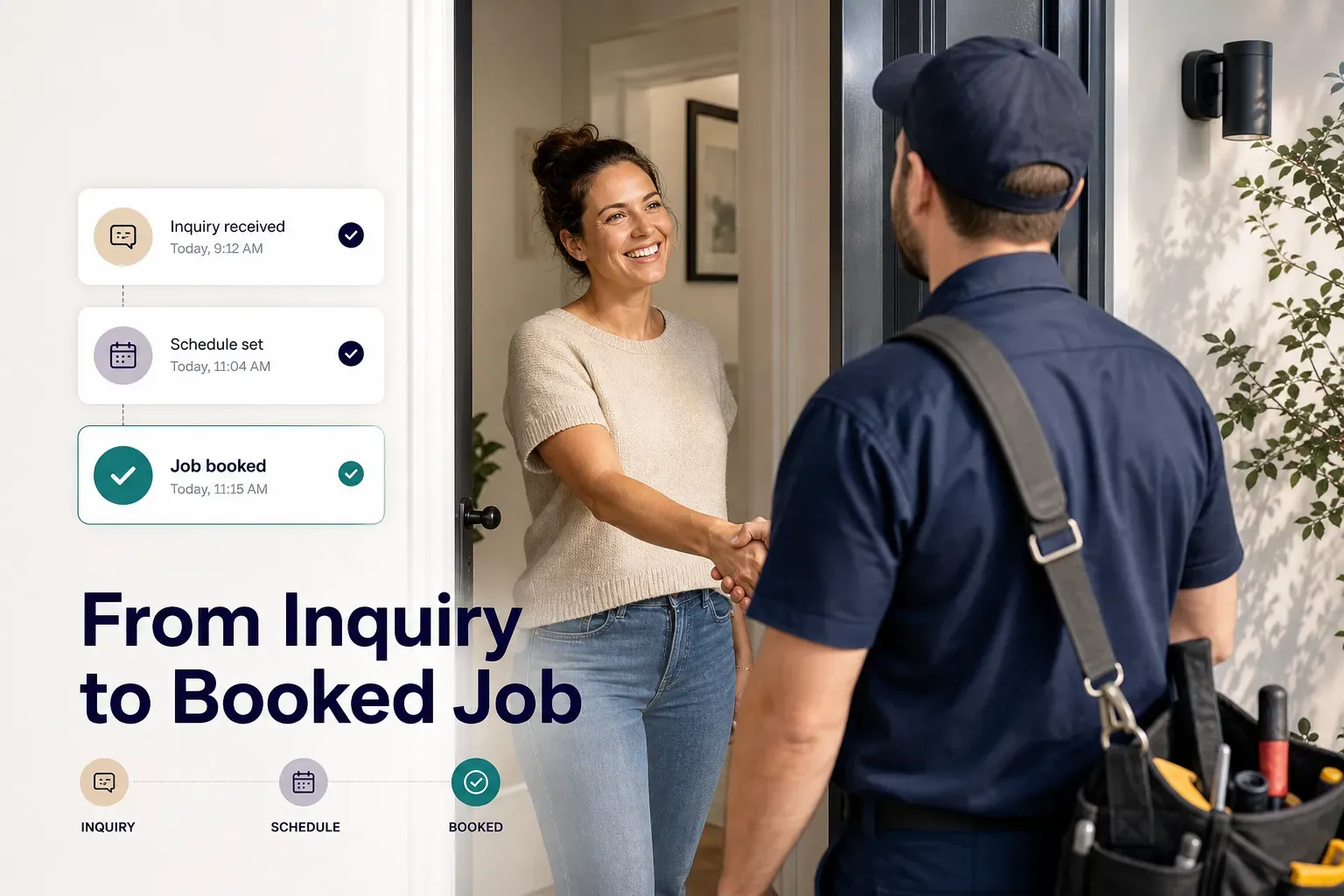
Most providers don’t have a lead problem.
They have a conversion problem hiding inside a lead problem.
People find you, look at your profile, feel uncertain, and go book someone else.
The lead-capture checklist
Whether it’s a Google Business Profile, a marketplace listing, or a landing page, the same elements decide whether a visitor becomes an inquiry. Work through this list and fix every gap.
- Specific service descriptions. “Plumbing services” tells nobody anything. “Blocked drains, leaking taps, hot water system replacement, bathroom refits” matches what people actually type and think.
- Clearly stated service area. Name suburbs, postcodes, or a radius. Vague coverage produces out-of-area inquiries you’ll decline and in-area customers who never ask.
- Real-time availability. The single biggest friction remover. “Next available: today 2pm” converts far better than “contact us for availability.”
- Starting prices or ranges. You don’t have to publish a full price list. “Callout from $95, most jobs $150 to $400” filters budget mismatches before they cost you a site visit.
- Real photos of real work. Before-and-afters, your van, your face. Stock imagery reads as a red flag to anyone deciding whether to let you into their home.
- Credentials and verification. Licence numbers, insurance, background checks, verified-profile badges. These directly address the biggest trust barrier in local services.
- Recent online reviews. Recency beats volume. Forty reviews from 2022 look worse than eight from the last three months. Active reputation management is lead generation.
- A short FAQ. Answer the three questions you get every week. What’s included, how long it takes, what happens if something goes wrong.
- One obvious call to action. Book now, or message now. Not four competing options. Choice paralysis at the decision point is a silent killer of conversion rate.
The trust barriers here are unique to local services and worth naming directly.
You’re asking a stranger to let an unfamiliar professional into their home, often at a price they can’t verify, on a schedule they can’t confirm.
Every item above removes one layer of that uncertainty.
Winning with speed to lead
Speed to lead is the highest-leverage variable in local service lead generation, and it costs nothing to improve.
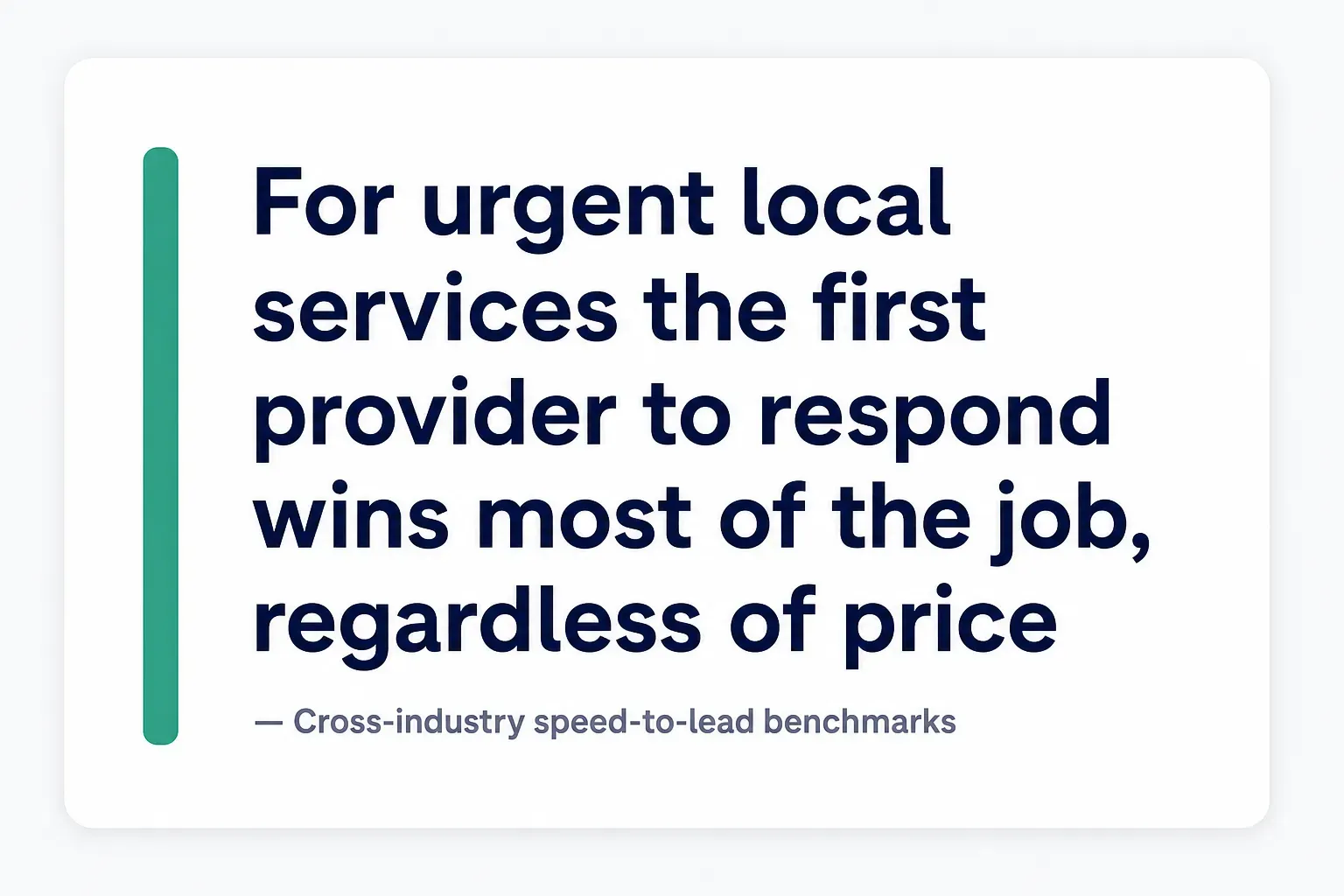
Research across service industries consistently shows that responding within five minutes dramatically outperforms responding within an hour, and that the first provider to respond wins the majority of jobs where multiple quotes were requested.
For urgent services, the window is brutal: many customers have already booked someone else within fifteen minutes.
Set two benchmarks.
Under five to ten minutes for urgent work (leaks, lockouts, breakdowns). Under two hours for planned work (tutoring, cleaning schedules, renovations, consulting).
Here’s a first-response template that works because it does four jobs at once:
“Hi Sarah, thanks for getting in touch about the blocked drain in Northcote. I’m available today between 2 and 5pm or tomorrow morning. Most blocked drains run $150 to $280 depending on what we find. Which window suits you better?”
Name recognised. Availability offered. Price framed. One simple question to answer. No form to fill, no phone tag, no waiting.
For follow-up, use restraint.
A single nudge at 24 hours, one more at day four, then stop. A three-touch follow-up sequence recovers a meaningful share of non-responders without making you the person who won’t take a hint.
This is where the tooling genuinely matters. Live availability, verified profiles, in-app chat, and instant or scheduled booking (the model used in apps like Frendex) compress the whole inquiry-to-confirmation gap into a couple of taps.
Compare that to a contact form that lands in an inbox you check between jobs, or a phone number that goes to voicemail while you’re under a sink.
Same lead, completely different outcome.
Qualifying without scaring off the lead
Lead qualification goes wrong when it feels like an interrogation. Four questions, woven into a normal reply, is all you need.
- Timing. “Are you looking to get this sorted this week, or planning further ahead?” Separates urgent from browsing in one sentence.
- Location. “Whereabouts are you based?” Confirms service area and lets you factor travel into the quote.
- Scope. “Can you send a quick photo, or tell me roughly how big the area is?” Prevents the quote-then-renegotiate spiral.
- Budget range. “Most jobs like this land between $X and $Y. Does that work for what you had in mind?” Frame your range first so they respond to your anchor instead of inventing one.
Ask these inside a helpful message that already offers availability and a price range. Qualification stops feeling like a barrier and starts feeling like competence.
Tracking cost and compounding growth
Ask most solo providers where their last ten jobs came from and you’ll get an educated guess. That guess is why they keep spending on the wrong channel.
Metrics that matter beyond clicks
Five numbers per channel.
That’s the whole system.
Source tells you where the inquiry originated.
Qualified-lead rate is the percentage of inquiries that pass your five-point test.
Booking rate is qualified leads that turn into confirmed appointments.
Cost per booked job is total channel spend, including a fair value on your own time, divided by jobs booked. And average job value tells you whether a channel brings $120 jobs or $1,200 jobs.
Those last two together beat cost per lead every time. A channel with a $60 cost per lead and a $900 average job is far better than a $12 cost per lead producing $150 jobs at a 12% booking rate.
Cheap leads that don’t book are the most expensive thing in small business marketing.
You don’t need paid software for this. One spreadsheet, seven columns: date, name, source, qualified yes/no, quoted amount, booked yes/no, final invoice. Add a row every time someone contacts you.
Takes fifteen seconds.
If you already use a booking app or lightweight customer relationship management tool, tag every contact with its source at intake.
Two minutes a week of tagging discipline gives you a clear channel ranking within a single month. Review the totals on the first of every month and shift effort toward whatever produced the highest revenue per hour invested.
One warning about retargeting and paid channels: don’t scale them until your booking rate from organic and referral inquiries is above 30%. Paid traffic amplifies whatever your conversion process already does, including its failures.
The review-to-referral loop
The best lead generation system you’ll ever build is the one that runs on jobs you’ve already completed.
Here’s the mechanism.
A completed job earns a review. Reviews feed social proof and improve your visibility in local search and marketplace rankings, which brings more discovery at zero extra cost.
Those new customers convert at a higher rate because strangers vouched for you. Some become repeat customers, and repeat customers cost nothing to acquire.
Some refer friends, which is the highest-converting referral marketing you can get.
Each turn of that loop pushes your average customer acquisition cost down. Providers who work this loop hard often reach a point where half their monthly work arrives without any active marketing at all.
The trigger is a request, timed properly. Send it 24 to 48 hours after completion, while the relief of a solved problem is still fresh.
“Hi Marcus, glad the hot water’s back on. If you’ve got 30 seconds, a quick review would genuinely help other people in the area find me. And if anyone you know needs the same sorted, feel free to pass my number along. Thanks again.”
Short. No incentive required. Two asks, one message, sent once.
Ask every single customer.
Roughly a quarter to a third will leave a review, which is plenty to keep your profile fresh and your recency signals strong.
Your next move
One action, and it’s smaller than you’d like it to be.
Pick the single channel that best fits your service type from the comparison table above.
Set up your tracking spreadsheet.
Run that one channel for two weeks, logging source and booking outcome for every inquiry.
Don’t add a second channel until you have fourteen days of real data.
While that runs, spend your energy on the gap between inquiry and booking rather than on getting more inquiries.
Tighten your response time to under ten minutes. Add live availability and starting prices to your profile. Write your four qualifying questions into a saved message template so replying takes seconds.
That gap is where the money is.
Most providers could double their booked revenue without a single additional lead, just by answering faster and being clearer about what they cost and when they’re free.
Leads aren’t won by being everywhere.
There is no prize for having a presence on seven platforms while your voicemail fills up.
They’re won by being the fastest, clearest, most obviously trustworthy option in the one place your customers are already looking.
Pick that place.
Own it.
Frequently asked questions
How do I get my first ten customers?
Start with your existing network and one demand-capture channel, in that order. Message everyone who already knows and trusts you (friends, former colleagues, local community groups) with a specific offer, then set up a complete Google Business Profile and a listing on a service marketplace where people already search for what you do. Your first ten jobs exist to generate reviews, not profit. Price competitively, over-deliver, and ask for a review 24 to 48 hours after each one.
What is the fastest way to get leads?
Referrals and marketplace listings produce qualified leads fastest, often within 24 to 48 hours. Both skip the slow build of SEO and content because the demand already exists and the trust is either borrowed (a referral) or built into the platform (verified profiles and reviews). Pair either one with a sub-ten-minute response time and you'll book jobs the same week you start.
How do small businesses generate leads?
Small businesses generate leads by dominating one or two channels that match their service type rather than spreading thin across six. For urgent local services that means local SEO and marketplace discoverability; for high-consideration or recurring services it means partner referrals and past-customer referral loops. The differentiator is rarely budget. It's response speed and profile completeness.
How do I get leads for my service business?
Match your channel to your buyer's behaviour, then remove every point of friction between discovery and booking. If customers search in a moment of urgency, be findable in local search with live availability and instant booking. If they research for weeks, invest in reviews, partner relationships, and a follow-up sequence. Then track source and booking rate for every inquiry so you know which channel to double down on next month.
What is the cheapest way to generate leads?
Asking every completed customer for a review and a referral is the cheapest lead generation method available, with a cost per booked job close to zero. Referred leads also convert at 50 to 70%, roughly double most paid channels, because trust arrives before you do. A fully optimised Google Business Profile is the second cheapest, costing only the time it takes to complete properly and keep current.
How do I get quality leads online?
Quality comes from filtering before the conversation starts, not after. Publish your service area, starting prices, specific service list, and real availability so people who don't fit self-select out, and people who do arrive already half-sold. Then apply the five-point qualification test (need, location, budget, timing, service fit) on first contact. Complete profiles with recent reviews consistently produce qualified-lead rates of 60% or higher.
Need a hand with something?
The Frendex map shows you who is available near you, in real time.
Get the app free Get the app freeFree, no card needed
Related articles
A no-show policy that protects your business
A 5-part no-show policy framework, not a copy-paste template. Learn what to charge, when to waive it, and how to cut missed appointments fast.
A service business's guide to bad reviews
Not every 1-star review deserves an apology. Get the 6-category decision tree for replying to bad reviews without looking guilty or defensive.
Your practical roadmap to becoming self-employed
A step-by-step path to going self-employed: testing your idea, setting rates, and handling tax, without quitting your job on day one.