Your practical roadmap to becoming self-employed
By Kiss János 17 min read

Trading a paycheck for independence
Most people picture self-employment as a single dramatic moment. You hand in your notice, walk out of the building, and start Monday as your own boss.
That is almost never how it actually happens.
Self-employment is a change in how money reaches you, not a leap off a cliff. Instead of an employer withholding tax and depositing a fixed salary, you invoice clients, collect payment, and handle the tax yourself.
The work might be identical.
The financial plumbing is completely different.
Research on new business formation consistently shows the same pattern: the majority of successful solo operators tested their idea on the side first. They kept the salary, took a few paid jobs on evenings and weekends, and only cut the cord once the numbers made the decision obvious.
The safest way to become self-employed is to already be partly self-employed before you quit.
This guide walks through the full sequence. You will define a sellable offer, sort out the legal and tax basics, set a rate that actually covers your costs, find your first clients, and turn one-off jobs into repeat bookings.
One honest caveat before we start.
Registration requirements, tax rates, and what counts as a deductible business expense vary enormously by country, and often by state or province. What follows covers general principles that hold nearly everywhere, and flags the moments when you need to check your own tax authority’s guidance.
Treat the specifics as prompts for your own research, not as legal advice.
Self-employed, freelancer, or contractor?
These four words get used interchangeably in conversation, and that causes real problems when you are filling in tax forms or signing a client agreement.
They mean different things.
Four terms, four meanings
- Self-employed is the umbrella term. It describes anyone who earns income without an employer withholding taxes on their behalf. A plumber with three vans, a freelance copywriter, and a weekend dog walker are all self-employed. It is a tax status, not a business model.
- Freelancer describes a working pattern: project-based work, usually for several clients at once, invoiced per project or per hour. Freelancers typically own their tools, set their own hours, and can turn work down. Designers, translators, photographers, and consultants tend to fall here.
- Independent contractor usually means a longer engagement with one hiring business under a written contract. A contractor might work forty hours a week for a single company for six months. The legal line matters: if that company controls your hours, supplies your equipment, and forbids you from working elsewhere, tax authorities may reclassify you as an employee, with back taxes attached.
- Company owner means you have registered a separate legal entity, such as a limited liability company or a limited company. The business exists independently of you. It can own assets, hold contracts, and be sued without your personal savings automatically being on the line. You may be both a company owner and self-employed for tax purposes, depending on your jurisdiction.
Which path fits you?
The right starting point depends on three things: how much time you can commit now, how much capital you can risk, and how comfortable you are with uneven income. Here are five realistic entry routes.
- Side hustle alongside a job. Lowest risk, slowest growth. You keep the salary and test demand with 5 to 10 hours a week. Ideal if you have dependents, a mortgage, or genuine uncertainty about whether anyone will pay for your skill. Capital needed: often under $200.
- Freelance service. Selling a professional skill you already have, such as writing, bookkeeping, design, or marketing. Startup cost is near zero if you own a laptop. Income can reach replacement level within 6 to 12 months, but the first three months are usually thin.
- Local trade or hands-on service. Cleaning, gardening, mobile beauty, handyman work, tutoring, moving help. Demand is steady and local, and customers are easier to reach than online clients. Expect $500 to $3,000 in tools, transport, and insurance before your first job.
- Online service business. Virtual assistance, social media management, online coaching, remote tech support. No geographic ceiling, but also no geographic moat, which means more competition. Requires stronger positioning and a sharper value proposition than a local trade.
- Product-based business. Making, sourcing, or reselling physical goods. Highest capital requirement and slowest path to profit because you buy inventory before you earn anything. Only sensible if you have savings you can genuinely afford to lose, or if you can start with made-to-order production.
Validate your idea first
Test demand while employed
Before you accept a single pound or dollar for side work, read your employment contract. Look specifically for non-compete clauses, moonlighting restrictions, and intellectual property terms that might claim ownership of anything you create while employed.
Plenty of people have lost jobs over clauses they never read. A ten-minute check now avoids a legal mess later.
Once you are clear, run three to five paid test jobs through your existing network.
Paid is the operative word.
Free work tells you people like you; paid work tells you your offer has commercial value. Charge something even if it is discounted, because a customer who hands over money behaves completely differently from one who does not.
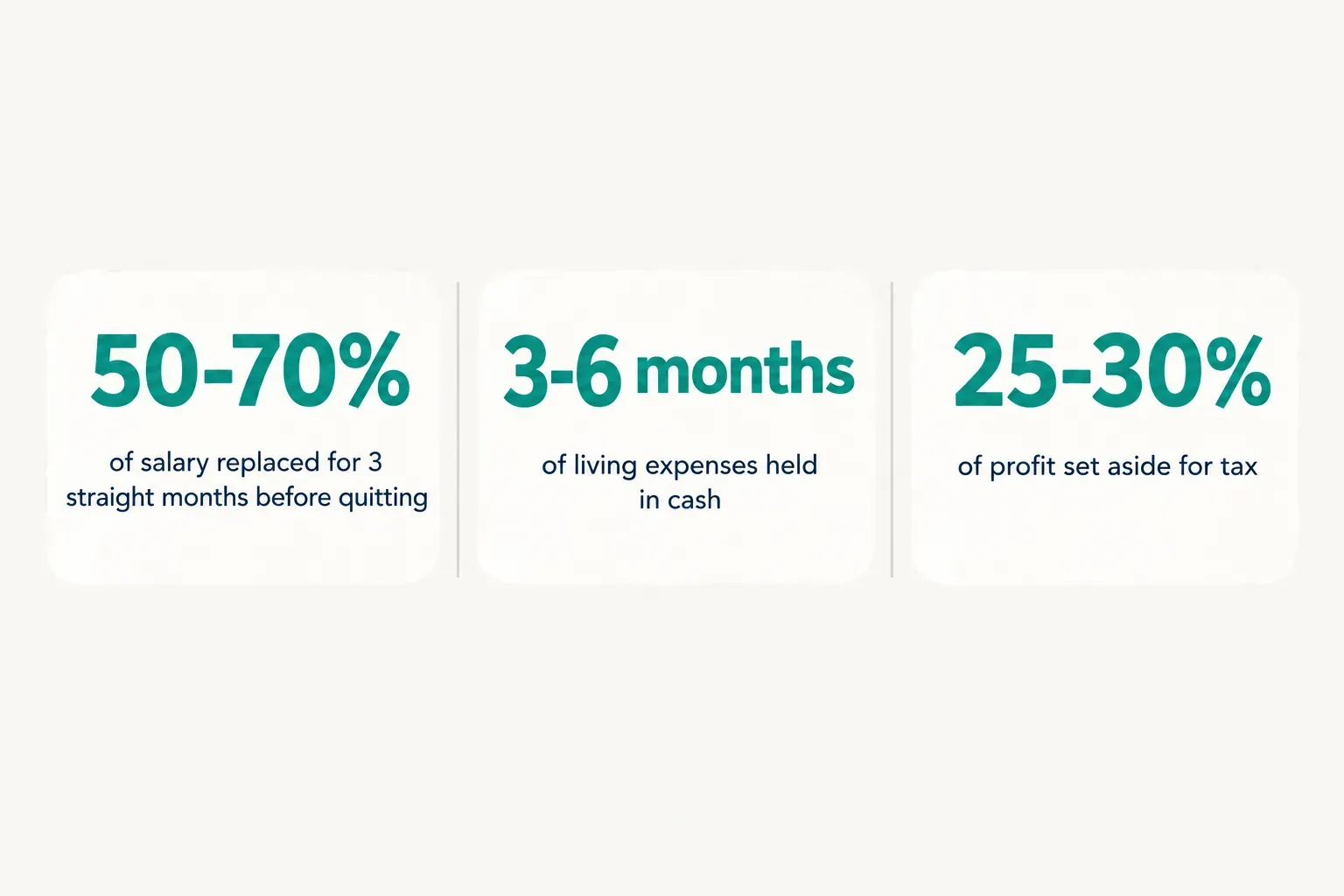
Then set a concrete exit threshold before emotion gets involved. A widely used benchmark: when side income matches 50 to 70% of your current take-home salary for three consecutive months, it is time to go full-time.
The logic is simple.
Full-time hours plus the clients you turn away while employed usually close that remaining gap quickly.
Three consecutive months matters more than the percentage.
One good month is luck.
Three is a pattern.
Alongside the test jobs, do two financial housekeeping tasks.
Open a separate bank account for business income and expenses, from your very first invoice. Mixing personal and business money makes bookkeeping a nightmare and makes deductible expenses almost impossible to prove at tax time.
Second, build a buffer of three to six months of personal living expenses in cash.
Not investments.
Cash.
Self-employment income arrives in lumps, and clients pay late.
That buffer is what stops you from accepting bad work at bad prices out of panic.
Define a sellable offer
“I’m a marketing consultant” is not an offer.
It is a job title.
Nobody knows what to buy, what it costs, or what they get.
A sellable offer has three parts: a name, a clear outcome, and a price range. Compare “I do wellness coaching” with “a six-week habit reset programme, four one-hour calls plus weekly check-ins, £450.”
The second one can be bought.
The first one requires a meeting just to understand it.
This applies far beyond traditional professional services. Some genuinely legitimate starting offers:
- Exam-prep tutoring: “Eight-week GCSE maths intensive, one 90-minute session weekly, £320 total.”
- Event help: “Wedding day-of coordination, 10 hours on site, supplier liaison included, $600.”
- Digital assistance: “Inbox and calendar management, 10 hours monthly, weekly summary report, $400/month.”
- Home organisation: “Single-room declutter and system setup, one full day, materials extra, £220.”
Notice what each one does.
It defines scope, duration, deliverable, and price. That is what turns a skill into a product, and it is the foundation of any workable pricing strategy and set of service packages you build later.
Legal setup and taxes
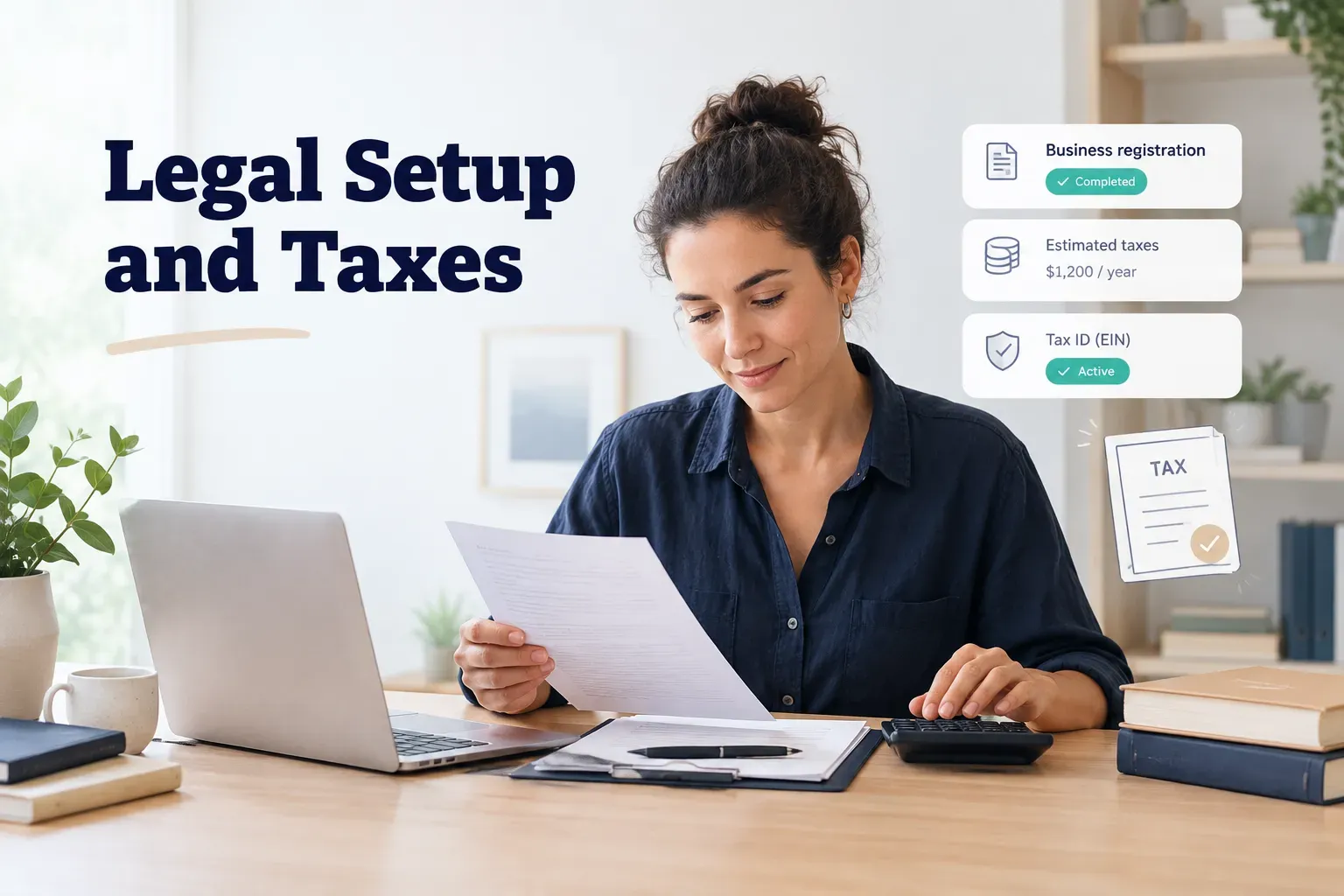
Choosing your business structure
Most people overthink this decision and delay starting for months. In practice, the majority of new self-employed workers begin as a sole proprietorship (called a sole trader in the UK and Ireland) and restructure later when revenue justifies it.
The core trade-off is liability protection versus admin burden.
| Factor | Sole Proprietorship / Sole Trader | LLC / Limited Company |
|---|---|---|
| Business registration | Often none required beyond notifying the tax authority; trading name registration may apply | Formal filing with a state or national registry, typically $50 to $500 |
| Personal liability | Unlimited. Business debts and lawsuits can reach personal assets | Limited to what you invested, provided finances stay properly separated |
| Setup time | Same day to one week | One to four weeks depending on jurisdiction |
| Ongoing admin | One annual tax return plus records | Annual accounts, registry filings, possible separate corporate return |
| Typical annual cost | $0 to $200 | $300 to $2,000 including accountancy |
| Best suited to | Low-risk services, under roughly $60k revenue, solo operators | Physical-risk work, higher revenue, hiring staff, larger client contracts |
An EIN (Employer Identification Number in the US, or the equivalent tax reference elsewhere) is typically required when you hire employees, form a company, or open certain business bank accounts. Some corporate clients also insist on one before issuing payment.
A US sole proprietor with no employees can usually operate using their Social Security Number. Many still get an EIN voluntarily, simply to avoid putting their SSN on every client form.
It takes about fifteen minutes online and costs nothing.
Separately, check whether your activity needs a business license or permit. Food handling, childcare, beauty treatments, electrical work, and driving passengers almost always do.
Writing and consulting almost never do.
What taxes you’ll owe
Four numbers get confused constantly, and confusing them is how people end up with a tax bill they cannot pay.
- Revenue is everything clients paid you. It is not your money.
- Profit is revenue minus legitimate business expenses.
- Taxable income is profit after allowances and deductions your tax authority permits.
- Cash to pay yourself is profit minus the tax you have set aside.
The practical rule: move 25 to 30% of every payment into a separate tax savings account the day it lands. In the US, that covers federal income tax plus self-employment tax, which runs at 15.3% on net earnings and catches most first-timers off guard.
Higher earners should budget closer to 35%.
US sole proprietors report business profit on Schedule C attached to their personal return, and typically make quarterly estimated tax payments in April, June, September, and January.
Miss those and penalties accrue.
UK sole traders file a Self Assessment return by 31 January with payments on account in January and July.
Deductible business expenses commonly include:
- Home office costs, either a proportion of rent and utilities or a simplified flat rate
- Equipment, tools, and computers used for the business
- Software subscriptions, hosting, and invoicing or accounting tools
- Business mileage or vehicle costs, with a contemporaneous log
- Professional liability insurance and other business cover
- Training directly related to your existing trade, plus professional memberships
What qualifies, and at what rate, depends entirely on your local tax authority.
Verify before you claim.
Protecting yourself legally
Every job gets a written client agreement.
Every single one, including work for friends.
Especially work for friends.
It does not need to be twelve pages. A one-page document covering scope, deliverables, timeline, total price, payment schedule, and what happens if the client cancels will prevent the overwhelming majority of disputes.
Take deposits.
For project work, 30 to 50% upfront is standard and entirely reasonable. For booked time slots, a non-refundable deposit protects you against last-minute cancellations that leave a hole in your diary you cannot refill.
Put your cancellation window in writing: 48 hours is a common threshold.
One more thing worth understanding.
The line between contractor and employee is drawn by control, not by what the contract calls you. Tax authorities look at whether you set your own hours, supply your own tools, can send a substitute, work for multiple clients, and carry financial risk.
If a single client controls all of those, you may be an employee in the eyes of the law regardless of what you both signed.
Pricing and landing first clients
Calculate your minimum rate
The single most common pricing mistake is dividing a desired salary by 2,080 hours.
That number assumes every working hour is billable.
It never is.
Here is the sequence that actually works.
- Set your target take-home income. Start with what you need, not what you want. Say $48,000 a year covers your living costs with a small margin.
- Add annual business expenses. Software, insurance, equipment, transport, accounting, marketing. For a typical solo service business this lands between $3,000 and $8,000. We will use $5,000.
- Add your tax set-aside. At 28% of profit, on $53,000 of required pre-tax earnings, that is roughly $20,600. Total required revenue: approximately $73,600.
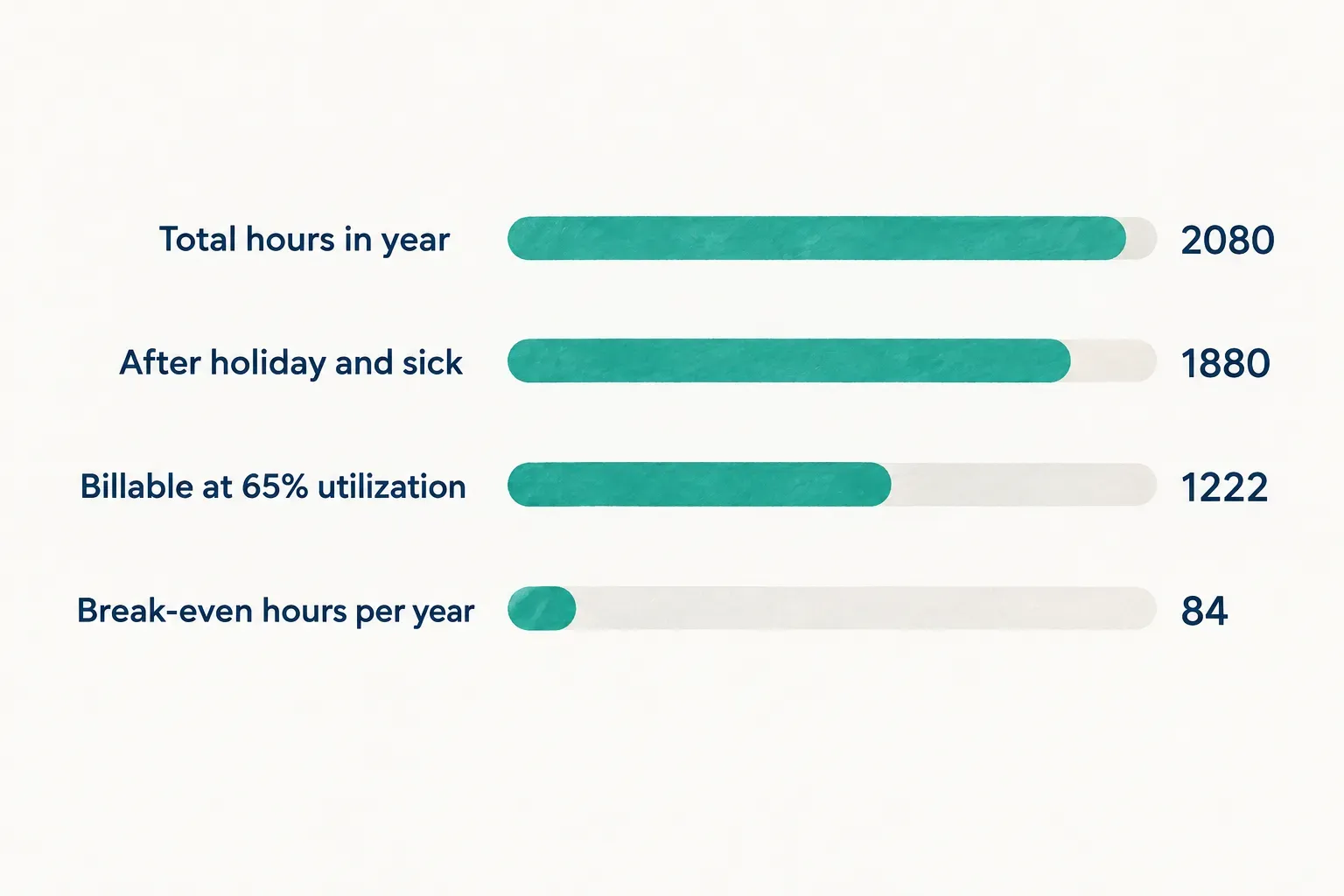
- Calculate realistic billable hours. Start with 52 weeks, subtract 4 weeks holiday and 1 week sick or slow, leaving 47 weeks. At 40 hours a week that is 1,880 hours. Now apply a 60 to 70% utilization rate, because admin, quoting, invoicing, marketing, and travel are unpaid. At 65%, you have roughly 1,222 billable hours.
- Divide. $73,600 divided by 1,222 equals about $60 per hour as your minimum viable rate. That is the floor, not the target. Anything below it means you are subsidising your clients.
- Find your break-even point. Fixed monthly costs divided by your hourly profit tells you how many hours you must sell each month before you earn anything. If fixed costs are $420 a month, that is roughly seven billable hours. Knowing this number transforms how you think about cash flow.
One adjustment worth making early: once you know your hourly floor, convert it into fixed-price service packages. Clients prefer certainty, and packages let you earn more as you get faster, rather than less.
Build a customer loop
Marketing is not a list of tasks.
It is a loop, and a broken link anywhere in that loop costs you money you never see.
- Visibility. Someone who needs your service has to encounter you. That means being present where buying decisions actually happen: local community groups, neighbourhood forums, search results, a local service marketplace, or the mind of someone who knows you.
- Inquiry. They reach out. This link breaks when people cannot find a price, cannot tell if you serve their area, or face a contact form that demands eight fields. Publish a starting price. It filters out the wrong people and reassures the right ones.
- Booking. Convert interest into a confirmed slot fast. Reply within a few hours, confirm scope and price in writing, take a deposit. Online booking tools that show live availability remove the back-and-forth that kills momentum.
- Completion. Deliver on time, communicate proactively if anything slips, invoice the same day you finish. Late invoicing is the leading self-inflicted cash flow problem for new freelancers.
- Review. Ask every satisfied client for a review, within 24 hours of finishing while the goodwill is fresh. Customer reviews are the raw material of future customer acquisition; without them you compete on price alone.
- Repeat and refer. Follow up at a sensible interval. A cleaner asks about a monthly slot. A designer checks in after a quarter. Referral marketing starts with one question: “Do you know anyone else who might need this?” Ask it every time.
On practical first-customer channels: your personal network will almost always produce the first paid job. Tell people specifically what you now sell and what it costs, because vague announcements generate vague support.
Beyond that, local community groups and neighbourhood networks work extremely well for hands-on trades. Platforms such as Frendex place local and online providers on a live availability map, with prices, photos, and reviews from completed bookings visible before anyone makes contact.
For a new provider that transparency cuts both ways, but it also means a well-priced, well-photographed listing can win work without a website, an ad budget, or an existing reputation.
Earn trust before reviews
Zero reviews is the hardest phase of self-employment. Everyone passes through it, and it usually lasts weeks rather than months.
Three things substitute for social proof while you build it.
- Portfolio samples, even self-generated ones. A designer can rebrand a fictional café. A cleaner can photograph before-and-after shots of their own kitchen and a friend’s. Nobody asks whether the sample was paid work; they ask whether it looks competent.
- Discounted demo jobs with a review condition. Offer your first three clients 30% off in exchange for an honest written review. Set an explicit end date so the discount does not become your permanent price. Three genuine reviews change conversion rates more than anything else you can do in month one.
- References from adjacent work. A former manager vouching for your reliability and quality carries real weight, even if the role was different. Ask two people if you may list them, and tell prospects references are available.
Then, counterintuitively, decide what you will not do.
Capacity planning matters from day one.
Define a service area with a maximum travel radius, because a job 50 minutes away at your standard rate is a loss once you count unpaid driving.
Set availability windows and publish them.
Decide your maximum sustainable workload, then hold to it.
Taking every job that comes in is how new self-employed people burn out in year one and lose the clients they actually wanted.
Saying no to marginal work protects delivery quality on the jobs that generate repeat bookings, and repeat business is worth several times a one-off sale once you account for the acquisition cost you never had to pay. Strong client retention is what turns a stressful hustle into a stable income.
Take the first real step
Here is your assignment for this week, and it should take under two hours.
Write down one offer.
Give it a name, a clear outcome, and a price. Then contact ten people who might plausibly need it, or who know someone who does, and tell them plainly what you are now selling.
Ten conversations.
That is the whole task.
Some will ignore you.
Some will say “not right now.”
One or two will ask a follow-up question, and that is where your first paid job comes from.
This is how nearly every self-employed career actually begins, and it is considerably more useful than another week of research.
A small paid job teaches you things no business plan can. You learn what clients actually ask for, where your pricing feels wrong, how long the work really takes, and whether you enjoy it.
Momentum compounds.
Planning does not.
One last practical note.
Before you send your first invoice, check your local registration and tax obligations, because the rules genuinely differ depending on where you live and what you sell.
Ten minutes on your tax authority’s website now is cheaper than a penalty later.
Then send the invoice.
You are self-employed.
Frequently asked questions
What are the first steps to becoming self-employed?
Start by checking your current employment contract for non-compete or moonlighting clauses, then run three to five paid test jobs through your existing network. Define one named offer with a clear outcome and price, open a separate business bank account, and confirm registration and tax requirements with your local authority before you invoice.
Is it better to be self-employed or employed?
Neither is universally better; they trade security for control. Employment gives predictable income, paid leave, and employer-handled tax, while self-employment offers higher earning potential, schedule control, and deductible business expenses in exchange for irregular cash flow and full responsibility for your own tax and pension.
How much income do you need to be considered self-employed?
You are self-employed from the first pound or dollar you earn without an employer withholding tax. What varies is the reporting threshold: in the US you generally must file if net self-employment earnings reach $400, while the UK has a £1,000 trading allowance before Self Assessment registration is required. Confirm the current figure with your own tax authority, since these change.
How do self-employed people pay taxes?
You calculate and pay your own tax, usually through periodic instalments rather than a single annual payment. US sole proprietors report profit on Schedule C, pay 15.3% self-employment tax on net earnings, and make quarterly estimated tax payments; UK sole traders file Self Assessment with payments on account. Setting aside 25 to 30% of profit as it arrives is the practical safeguard.
Can I be self-employed without registering a company?
Yes. Most self-employed people operate as sole proprietors or sole traders, which requires no company formation. You still need to notify your tax authority and may need a business license for regulated activities, but you do not need a limited liability company unless you want liability protection or plan to hire.
What is the easiest business to start as self-employed?
Service businesses using a skill you already have are the easiest, because startup capital is minimal and you can test demand immediately. Tutoring, cleaning, virtual assistance, writing, and event help all start for under a few hundred pounds or dollars and generate revenue within weeks rather than months.
How do I become self-employed from home?
Choose an online service you can deliver remotely, such as virtual assistance, coaching, bookkeeping, design, or tutoring, then package it with a defined scope and price. Set up a separate business account, claim a proportion of home costs as a home office deduction where permitted, and use online booking and invoicing tools to keep the client loop running without face-to-face meetings.
How do I get clients when I first become self-employed?
Your personal network produces most first jobs, so tell people exactly what you sell and what it costs. After that, work the full customer loop: be visible where buyers look, including local community groups and marketplaces such as Frendex that display prices and availability upfront, respond to inquiries quickly, ask every finished client for a review, and follow up for repeat bookings and referrals.
Need a hand with something?
The Frendex map shows you who is available near you, in real time.
Get the app free Get the app freeFree, no card needed
Related articles

A no-show policy that protects your business
A 5-part no-show policy framework, not a copy-paste template. Learn what to charge, when to waive it, and how to cut missed appointments fast.

A service business's guide to bad reviews
Not every 1-star review deserves an apology. Get the 6-category decision tree for replying to bad reviews without looking guilty or defensive.

The small business owner's guide to online booking
See how to pick and set up a booking system for small business in under a month, cut no-shows, and stop losing hours to phone tag. No spreadsheet required.