How service marketplaces actually work
By Kiss János 15 min read
What is a service marketplace, really?
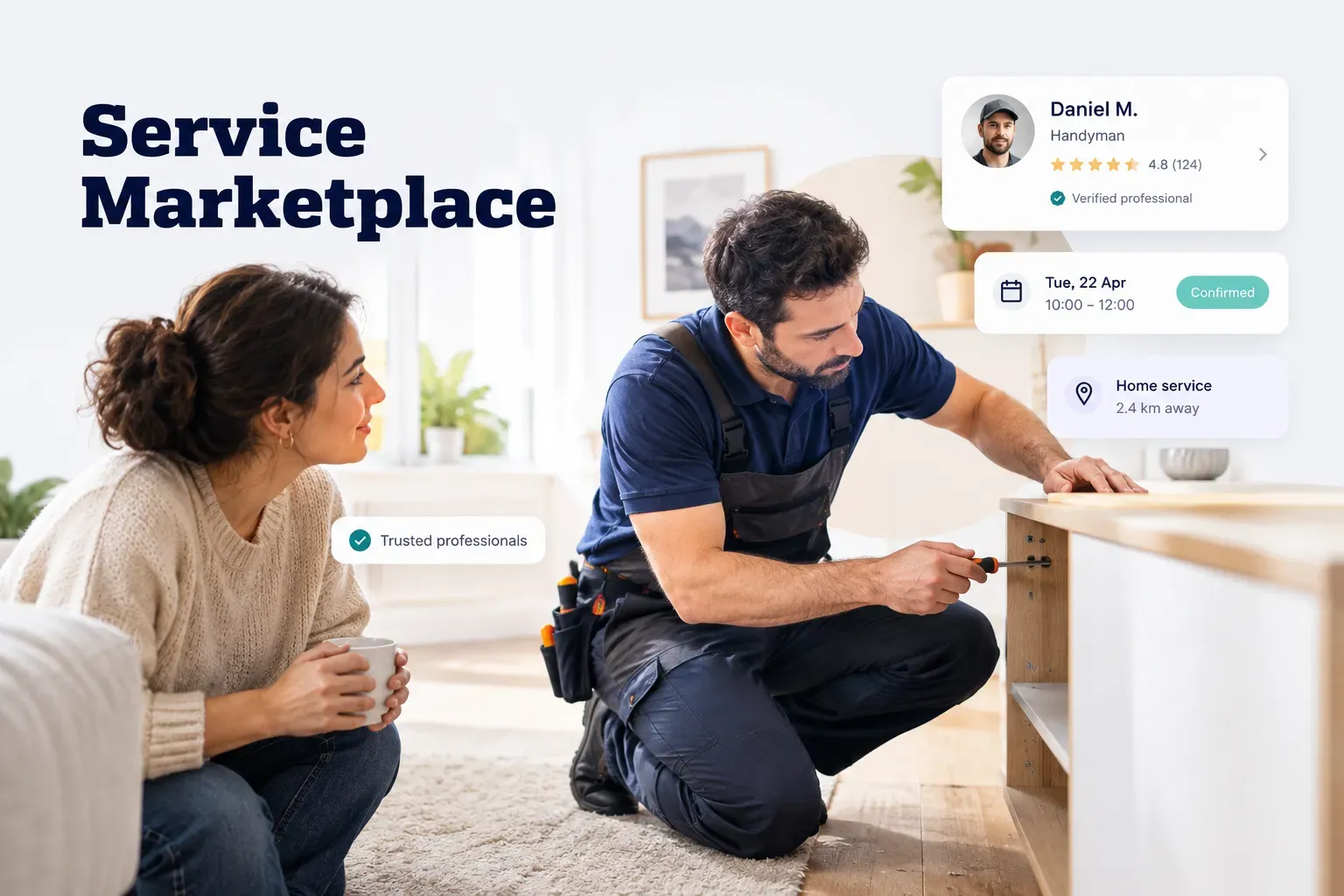
A service marketplace is a platform where customers discover, book, pay for, and review independent providers, with the platform itself recording the transaction.
That last part is the whole ballgame.
If nothing gets logged, it isn’t a marketplace.
Most people use the term loosely, and that causes real confusion.
A phone book with a website is a directory. A salon’s own online scheduler is booking software. A site that sells physical goods is a product marketplace.
None of those are the same animal, even though they can look similar from the outside.
The defining trait is the two-sided marketplace structure: a pool of service seekers on one side, a pool of service providers on the other, and infrastructure in the middle that makes strangers comfortable enough to transact.
Profiles. Reviews. Messaging. Payment processing. Dispute resolution when things go sideways.
A directory answers “who exists?” A marketplace answers “who is available right now, what will it cost, and what happened last time someone booked them?”
This guide follows the full lifecycle in order, for both sides of the transaction.
Discovery, comparison, messaging, booking, payment, review, repeat booking. Then the provider view: profiles, fee models, and what independent contractor status actually means for liability and taxes.
One more thing worth setting up front.
Broad platforms increasingly blend local services delivered in person, like a haircut or a boiler repair, with remote services like design work or online tutoring, in a single search interface.
That mix changes how discovery and availability need to work, and it’s where a lot of platforms quietly fall apart.
Marketplace, directory, or booking app?
Three products, three business models, three completely different reasons to exist.
Mixing them up leads customers to expect protections that aren’t there, and leads providers to pay for reach they never receive.
Directories list, marketplaces transact
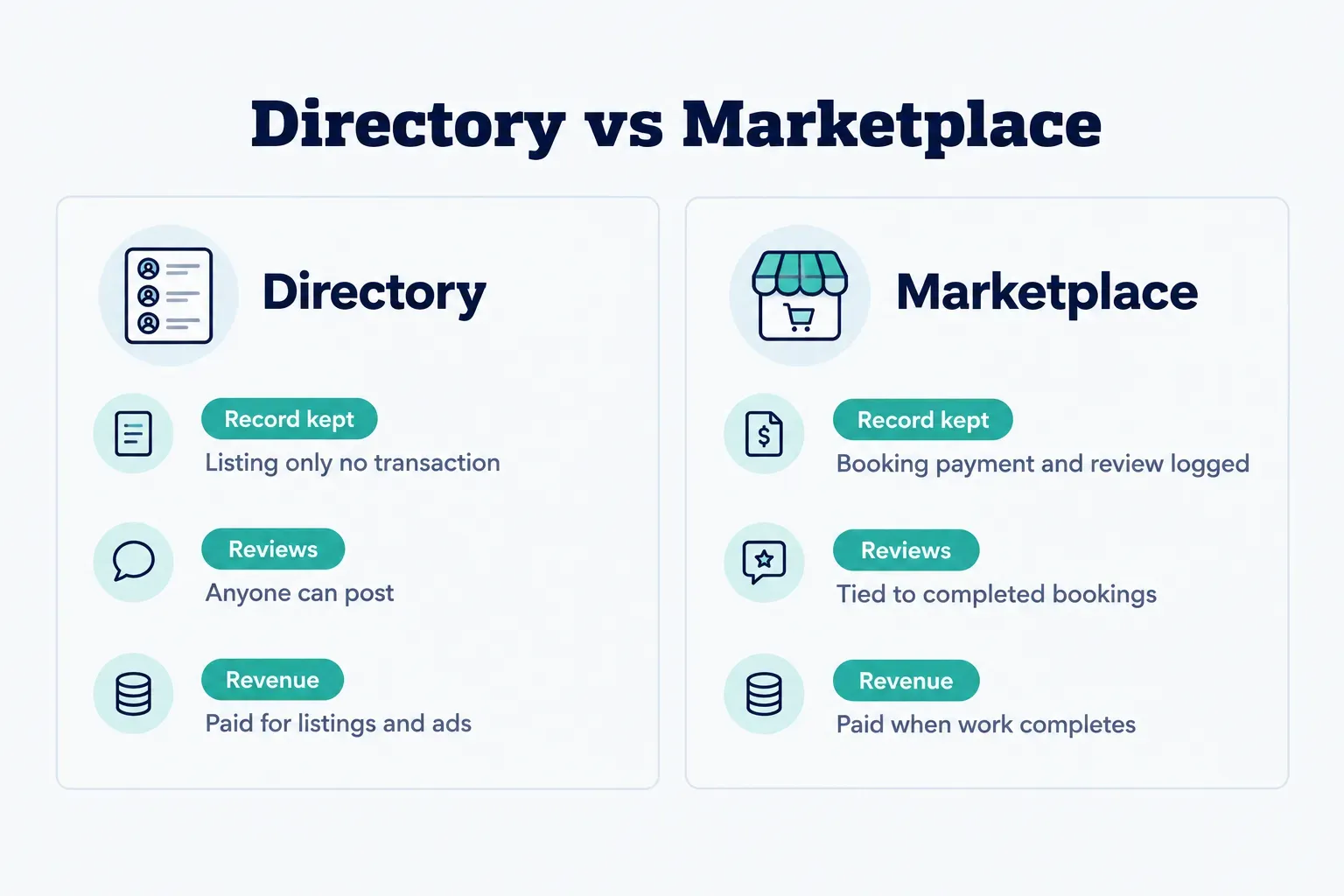
A directory publishes static contact information. Name, category, phone number, maybe hours and a star rating scraped from somewhere else.
You find the listing, then you leave the platform to actually do anything.
That exit is the problem.
Once the interaction happens off-platform, the directory has no record of whether the job happened, what it cost, or whether the customer was satisfied. Reviews on directory sites can be left by anyone, including people who never hired the business.
A marketplace keeps the interaction inside.
The booking is logged, the payment is processed or at least recorded, the messages are stored, and the review is attached to a specific completed job.
That record is what makes accountability possible.
It also changes the platform’s incentives.
Directories get paid for listings and ads regardless of outcomes. Marketplaces that take a cut of completed work only earn when the work actually happens, which aligns them, at least partially, with both sides.
Booking tools schedule, marketplaces match
Appointment scheduling software runs one business’s calendar. It syncs availability, sends reminders, takes deposits, and reduces no-shows.
Excellent tools.
But they assume the customer already chose the business.
A marketplace does the choosing part.
It aggregates many independent providers, then layers on service discovery: search by category, filter by service area or remote delivery, sort by price, rating, or distance, and compare profiles side by side. A matching algorithm decides who surfaces first and in what order.
Then it adds trust infrastructure that a single-business scheduler doesn’t need, because a salon doesn’t have to prove it exists to its own regulars.
A marketplace connecting two strangers does.
Why services resist standardization
Selling a product online is comparatively easy.
A size 10 running shoe is the same object in Manchester and Marseille, and the photo tells you almost everything.
Services break every one of those assumptions.
Quality is intangible and only revealed after purchase. Scope is negotiated: “deep clean a three-bed flat” means different things to different cleaners. Availability shifts hour by hour as jobs run long or cancel.
And fulfillment happens off-platform, in someone’s kitchen or on a video call, where the marketplace can’t observe it directly.
That’s why a simple listing page can’t carry a service transaction.
You need profiles rich enough to convey what someone actually does, in-app messaging to negotiate scope before money moves, real-time availability so the calendar reflects reality, and a reputation system that substitutes for the inspection you can’t perform in advance.
Strip any of those out and the friction returns.
Customers start calling around. Providers start taking work off-platform.
The marketplace becomes a directory with extra steps.
Types of service marketplaces
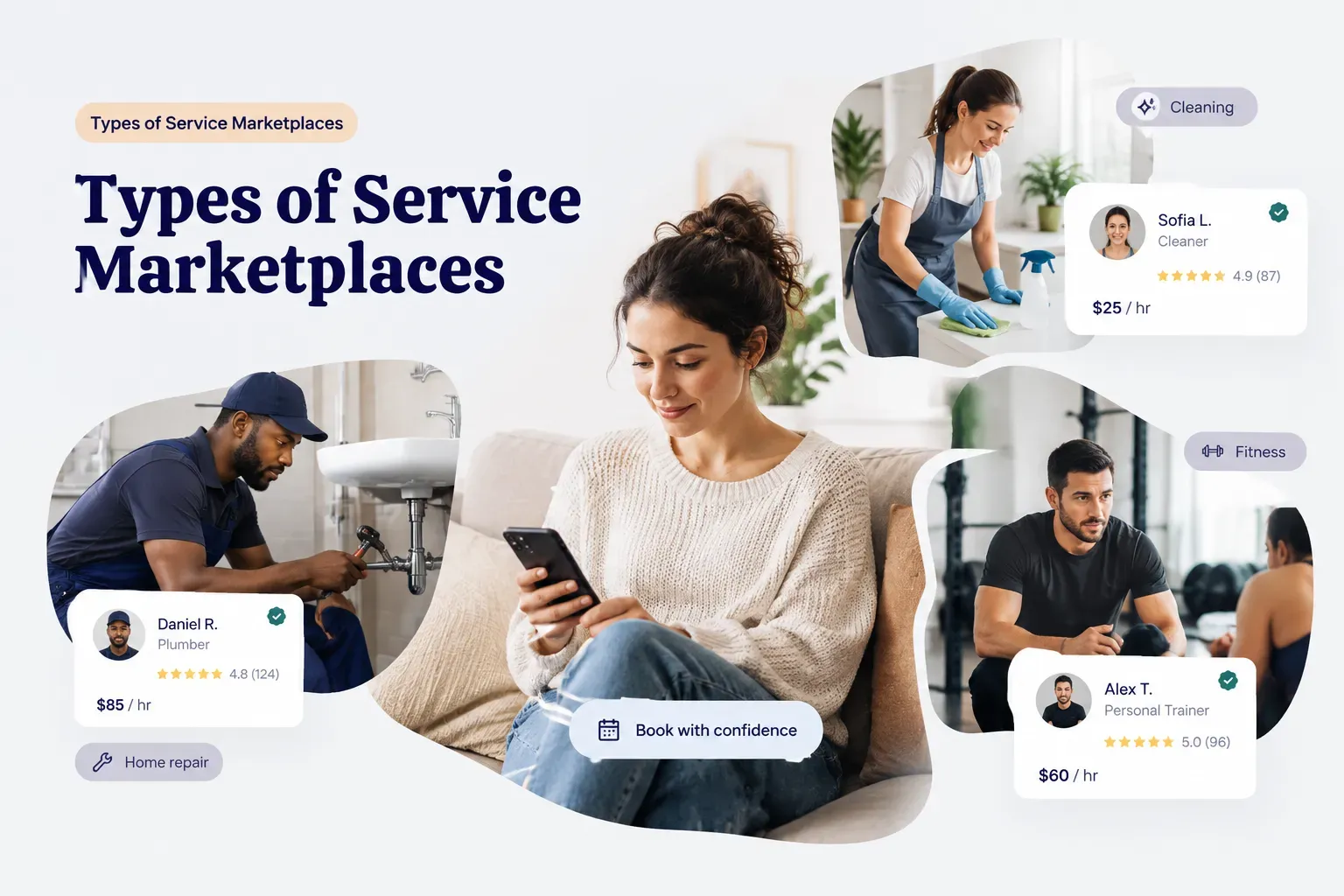
Not all service marketplaces solve the same problem, and the operating model shapes everything downstream: how bookings work, how fees are charged, and how much local density the platform needs before it’s usable.
Five models cover most of what exists in 2026:
- Scheduled appointment marketplaces. Salons, barbers, clinics, dentists, tutors, driving instructors. The core mechanic is a calendar: pick a provider, pick a slot, confirm. Success depends on providers keeping availability genuinely current, because a stale calendar produces cancellations and kills repeat use.
- Instant on-demand marketplaces. Rides, same-day delivery, emergency plumbing, urgent locksmith work. There is no browsing phase in the traditional sense. The platform matches a request to the nearest qualified provider in seconds, and the entire value proposition is speed. These need the highest provider density of any model.
- Freelance and project marketplaces. Design, development, writing, consulting. Work is scoped through briefs and proposals, priced per project or per milestone, and often delivered over weeks. Payment typically sits in escrow and releases against agreed deliverables, which is a very different booking workflow from a 45-minute haircut.
- Local home-services apps. Cleaning, handyman work, gardening, moving, appliance repair. Bookings are often a hybrid of scheduled and semi-urgent, quotes depend on site conditions, and pricing may shift after the provider sees the job. Trust matters intensely here because the provider enters your home.
- Hybrid local-plus-online broad marketplaces. These combine in-person local services with remote delivery inside one search. A user might book a mobile nail technician for Thursday and an online language tutor for Saturday without switching platforms. The challenge is that these two categories behave nothing alike, so the interface has to handle both geography and pure availability.
Why broad coverage needs local liquidity
Marketplace liquidity is the plain-language test of whether a platform works: enough relevant providers near the customer, and enough qualified demand to keep providers logging in.
Miss either side and the network effects never start compounding.
A category list is not liquidity.
A platform can advertise 400 service types and still fail you, because what matters is whether three qualified electricians are available in your postcode on Tuesday afternoon.
Breadth without local depth just produces empty search results, which is the fastest way to lose a user permanently.
This is why the strongest hybrid platforms lead with availability rather than taxonomy.
Frendex, for example, shows live map availability across categories like beauty, home services, IT support, and one-off tasks, alongside remote services, so you see who can genuinely take the job nearby before you commit attention to browsing.
The honest version of the rule: a marketplace’s real size is the number of providers within reach of you, right now.
Everything else is marketing.
From first search to final review
The transaction looks simple from the outside.
Search, book, done.
In practice there are eight distinct stages, and most bad experiences trace back to one specific stage being skipped.
- Discovery. The customer enters a category and either sets a location radius or filters for remote delivery. Good platforms surface distance, price range, and next available slot at this stage, so nobody clicks into a profile only to find a three-week waiting list.
- Comparison. Two or three profiles get opened side by side. The deciding factors are usually photographs of real past work, a clear service catalog with prices, review volume, and response time, in roughly that order.
- Messaging to confirm scope. This is the stage people skip, and it causes most disputes. A two-minute chat clarifying what “full valet” or “small repair” includes prevents the argument that would otherwise happen on the doorstep.
- Booking. Either instant confirmation against real-time availability, or a request the provider accepts within a set window. Instant is better for the customer, but it only works when providers keep calendars honest.
- Service completion. Delivery happens in person or remotely. The platform can’t observe it, which is exactly why the scope agreed in step three matters so much.
- Payment. Processed in-app, released after completion, or split into a deposit plus balance. In-app payment processing produces a receipt, a timestamp, and evidence, all of which vanish if you pay cash.
- Review. The customer rates the completed booking. On well-run platforms only customers with a verified completed job can post, which keeps the reputation system tied to reality.
- Repeat booking. The highest-value outcome for everyone. Rebooking a known provider in two taps is what turns a one-off transaction into retention, and it’s the metric serious marketplaces optimize hardest.
Trust signals that actually mean something
Badges are not interchangeable, and platforms rarely explain the difference clearly. Four distinct things often share similar-looking icons:
- Identity verification confirms the person is who they claim to be, usually via government ID or a document check. It tells you nothing about skill.
- Review-earned status (top-rated, superhost-style tiers) reflects accumulated performance across completed bookings. This is the most informative signal because it’s earned, not bought.
- Professional licensing and insurance covers regulated trades: gas work, electrical, medical, childcare. Check whether the platform verifies these documents or merely displays what the provider typed in.
- Featured or promoted placement is advertising. The provider paid to appear higher. It is a signal of marketing budget, nothing more.
A provider verification badge and a paid placement badge sitting next to each other in the same visual style is a dark pattern.
Read the labels.
What makes a review worth trusting
Five characteristics separate a useful review from noise.
It should be tied to a verified completed booking, recent (within roughly 12 months for most trades), specific about what was done, part of sufficient volume rather than a lone five-star, and part of a balanced pattern.
That last one surprises people.
A provider with 90 reviews averaging 4.7 with a few three-star entries is more credible than one with 40 straight fives.
Real work produces occasional friction, and a perfectly clean record across high volume is statistically odd.
Regulation caught up here.
The FTC’s 2024 rule on consumer reviews and testimonials explicitly bans fake reviews, undisclosed insider reviews, and buying positive or negative ratings, with civil penalties attached.
That’s the enforcement context behind why booking-verified reviews have become the standard rather than a nice extra.
Read the two-star and three-star reviews first. They’re where the specifics live.
Canceling, disputing, and booking again
Before confirming any booking, run a short checklist. It takes ninety seconds and prevents the vast majority of problems.
- Confirm exactly what’s included in writing through in-app chat, including materials, travel, and anything explicitly excluded.
- Check the identity verification status and, for regulated work, whether licensing was verified by the platform or self-declared.
- Read the cancellation policy before you book, not after. Note the free-cancellation window and whether deposits are refundable.
- Refuse off-platform payment pressure. A provider pushing you to pay by bank transfer to “skip the fee” is also removing your dispute protection and your ability to leave a verified review.
- Document agreed scope and price in the platform’s messaging thread. If a dispute reaches dispute resolution, that thread is the evidence.
When something does go wrong, use the in-app dispute process before leaving a review.
Platforms can refund, re-book, or mediate.
Once you’ve posted a one-star and gone quiet, your leverage drops considerably.
The provider side: Profiles, pay, and status
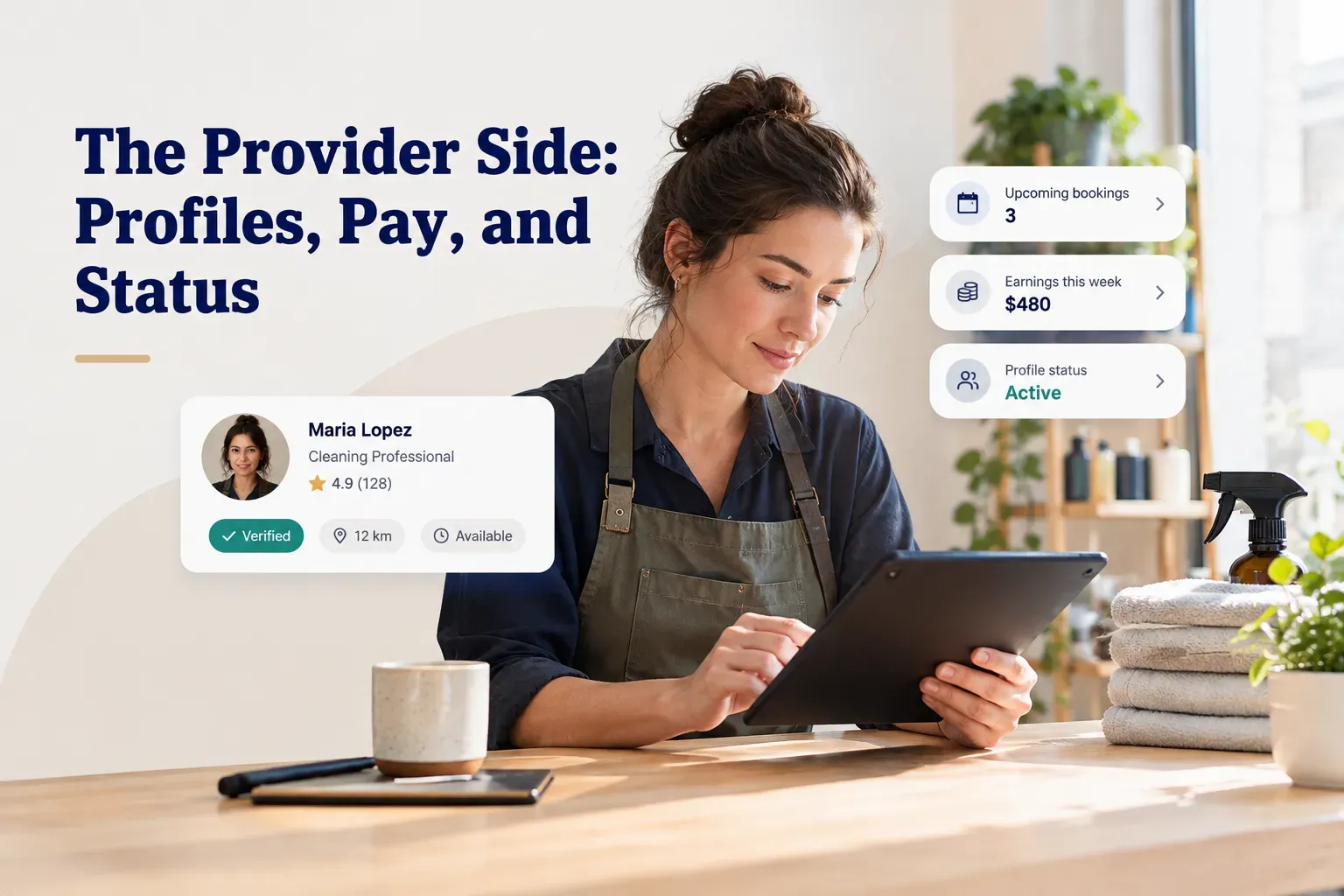
Providers experience a marketplace as a lead-generation channel with strings attached.
The reach is real.
So is the dependency.
A profile that earns trust
A profile is a sales page that works while you’re holding a drill. The ones that convert share five traits, and none of them require design skill.
Start with a specific service catalog. “Home cleaning” is weak; “3-bed deep clean, 4 hours, oven and interior windows included” tells a customer whether to click.
Vagueness reads as inexperience.
Providers routinely hide rates hoping to negotiate later, and it backfires, because service seekers filter out anything they can’t budget.
A range with clear conditions beats “contact for quote” almost every time.
Real photos of your own completed work, not stock imagery. Honest availability, updated when your week changes.
And fast responses in chat before booking, because response time is both a ranking input on many platforms and the single clearest proxy for reliability that a customer has.
How providers actually get paid
Three fee models dominate, and each shifts risk to a different party. The right choice depends entirely on your job volume and average ticket size.
| Fee model | How it works | Risk sits with | Best suited to |
|---|---|---|---|
| Percentage commission | Platform takes a cut of each completed booking, commonly 10-25% | Platform (earns nothing if no work happens) | New providers and low-volume seasonal work |
| Per-lead fee | Provider pays for each contact or quote request, win or lose | Provider (pays regardless of outcome) | High close-rate specialists in high-ticket trades |
| Flat monthly subscription | Fixed fee, zero commission on bookings | Provider (fixed cost against variable income) | Busy providers with steady repeat volume |
| Hybrid | Lower subscription plus reduced commission, or free tier plus paid promotion | Shared | Providers scaling from part-time to full-time |
The math is simple.
Commission is friendliest when you’re starting out and unsure of volume. Subscription wins once your monthly commission bill would exceed the flat fee.
Per-lead models are the riskiest, because you can spend real money on leads that never convert, and you have limited control over lead quality.
Calculate your break-even before switching plans: divide the monthly subscription by your average commission per job. That’s how many bookings you need to make the flat fee worthwhile.
Independent business, not employee
Most providers on these platforms are independent contractors or registered business owners, not employees.
The marketplace supplies distribution and tooling.
It does not supply employment.
Practically, that means insurance, licensing, tax registration, and compliance are your responsibility.
An online labor platform may verify documents and may offer optional coverage on certain job types, but the baseline obligation sits with the provider, and the specifics vary sharply by platform and by jurisdiction.
Worker-classification rules in the EU, UK, and several US states have shifted repeatedly since 2023, so check current local guidance rather than assuming.
The trade-offs are worth stating plainly.
Providers get reach, ready-made trust and safety infrastructure, payment handling, and scheduling tools they’d otherwise pay for separately.
In exchange they accept quality variance across the platform that can affect category reputation, ranking rules they don’t control, and genuine dependency if a single marketplace becomes their only channel.
And customers have obligations too.
Show up for the appointment. Describe the job accurately. Respect the cancellation policy.
A provider who blocks three hours for a no-show has lost that income entirely, and marketplaces increasingly rate customers as well as providers for exactly that reason.
The bottom line on service marketplaces
If you’re a customer, judge platforms on two things: does it show genuine real-time availability near you, and are reviews restricted to verified completed bookings? A platform that nails both will beat one with ten times the listings.
If you’re a provider, weigh fee structure and actual local demand ahead of category breadth. Run the break-even math on commission versus subscription, and test a platform’s real lead quality for a month before committing your calendar to it.
Here’s the reframe worth carrying away.
The strongest service marketplace isn’t the one with the biggest catalog or the loudest advertising.
It’s the one where discovery, trust, and the transaction itself all happen in the same recorded place, so that when something goes right you can book it again in two taps, and when something goes wrong there’s a record proving what was agreed.
Frequently asked questions
What is an example of a service marketplace?
Examples span three broad families. Freelance and project platforms like Upwork and Fiverr connect clients to remote professionals; home-services platforms like Thumbtack and TaskRabbit handle local in-person work; and hybrid platforms such as Frendex combine local providers shown on a live availability map with remote services in a single search. Ride-hailing and food delivery apps also qualify technically, since they match independent providers to customers and record the transaction.
How does an online service marketplace work?
You search a category, filter by location or remote delivery, compare provider profiles, message to confirm scope, book a time slot, pay through the platform, and leave a review tied to that completed booking. The entire workflow, up to actual delivery, happens without meeting anyone in person. The platform holds the record of every step, which is what enables refunds, disputes, and verified reviews later.
What is the difference between a marketplace and a service provider?
The marketplace is the platform layer; the service provider is the individual or business that actually performs the work. The marketplace handles discovery, matching, messaging, and payments. The provider handles the haircut, the repair, or the tutoring session. This distinction matters for liability. Your service contract is usually with the provider, not the platform, even though the platform may mediate disputes.
What is the difference between a marketplace and a directory?
A directory lists; a marketplace transacts. A directory gives you contact details and sends you elsewhere, while a marketplace records a completed booking, payment, or comparable logged interaction inside the platform. That recorded transaction is what makes verified reviews, refunds, and accountability possible at all.
How do service marketplace apps make money?
Through four mechanisms: percentage commission on completed bookings, flat subscription fees paid by providers, per-lead charges, or paid promotion and featured placement. Many platforms combine two or more. The model shapes behavior. Commission-based platforms only earn when jobs complete, which tends to fund better support and dispute handling than lead-fee models, where revenue arrives whether or not the customer is ever satisfied.
Are service marketplaces safe to use?
They are safe when you stay inside the platform's systems. Book providers with verified identities, read reviews tied to completed bookings, pay in-app so there's a payment record, keep scope agreements in the messaging thread, and use the reporting tools if something feels wrong. The main risk is leaving the rails. Off-platform cash payments strip away your dispute rights, your receipt, and your ability to leave a verified review.
Need a hand with something?
The Frendex map shows you who is available near you, in real time.
Get the app free Get the app freeFree, no card needed
Related articles

Do you tip contractors? A clear answer for homeowners
No, tipping contractors isn't required. Get the 4-factor rule to decide when it's worth it and how much makes sense for your project.

How to hire a contractor without getting burned
A step-by-step process for vetting bids, licenses, and contracts, plus the one paper trail habit most homeowners skip until it costs them.
How does TaskRabbit actually work?
See exactly how TaskRabbit's booking flow, real fees, and cancellation rules work in 2026, plus why Taskers set their own rates. No surprises at checkout.