How to price your services and actually turn a profit
By Kiss János 14 min read
Contents
How to price your services and actually turn a profit
Why pricing feels impossible (and how to fix that)
“Charge what you’re worth” is the worst pricing advice ever given to a service business. It sounds empowering.
It’s useless.
Worth isn’t a number you can put on an invoice. And that slogan quietly ignores the three things that actually determine whether you make money: what it costs you to deliver the work, how much of your week you can realistically sell, and what a buyer in your market will pay without flinching.
Most people who undercharge aren’t underconfident. They’re just doing incomplete math. They price against a salary they once earned, forget self-employment tax, forget the 14 hours a week spent quoting and driving and chasing invoices, and end up with an effective hourly rate well below what they’d make as an employee.
A rate that ignores non-billable hours isn’t a rate. It’s a wish.
Here’s the system this guide walks through. First, calculate a floor, the number below which the work loses money. Second, choose a pricing model: hourly, project-based pricing, day rate, retainer pricing, or productized services. Third, validate that number against your local market. Fourth, package it so buyers can say yes without a custom quote. Fifth, revisit it when the evidence changes.
The method doesn’t care what you sell. A mobile dog groomer, an online tutor, a bookkeeper, and a home repair contractor all run the same calculation with different inputs.
The floor changes. The logic doesn’t.
Calculate your profitable floor
Before you pick a price, you need three separate numbers. Not one formula with three names. Three genuinely different figures that answer three different questions.
Your minimum viable rate is the point where you break even after every real cost, including tax. Your target rate is what you need to hit your income goal at realistic utilization. Your value-based price is what the outcome is worth to the buyer, which can be far above both.
The floor protects you. The target pays you. The value price is where profit actually lives.
Your true hourly cost
The costs people forget are rarely dramatic. They’re just invisible, because nobody sends you a monthly invoice for “wear on your van” or “the 22% you owe the tax office.”
Run every line below before you calculate anything else. Annual figures are easier to work with than monthly.
| Cost Category | Typical Annual Range (solo operator) | Why People Miss It | How to Capture It |
|---|---|---|---|
| Self-employment / estimated tax | 20-35% of net income | Feels like “later money”, not a cost | Gross up your target income before dividing by hours |
| Liability and professional insurance | $500-$2,400 | Paid annually, forgotten monthly | Add as a fixed overhead line |
| Software and subscriptions | $400-$3,000 | Small charges spread across 12 cards | Export a year of statements and total them |
| Equipment and replacement | $800-$6,000 | Treated as one-off purchases | Divide purchase price by expected years of life |
| Materials and consumables | Job-dependent | Absorbed into the job price without markup | Bill separately at cost plus 15-30% |
| Payment processing fees | 1.5-3.5% of revenue | Deducted before the money lands | Add to your overhead percentage |
| Vehicle, fuel, and mileage | $1,200-$8,000 | Counted as personal driving | Log business miles and apply the standard rate |
| Marketing and platform fees | $600-$5,000 | Seen as optional, not structural | Include whatever you spend to keep the pipeline full |
Total those. That’s your annual overhead.
It sits underneath every price you quote, whether you acknowledge it or not.
The utilization reality check
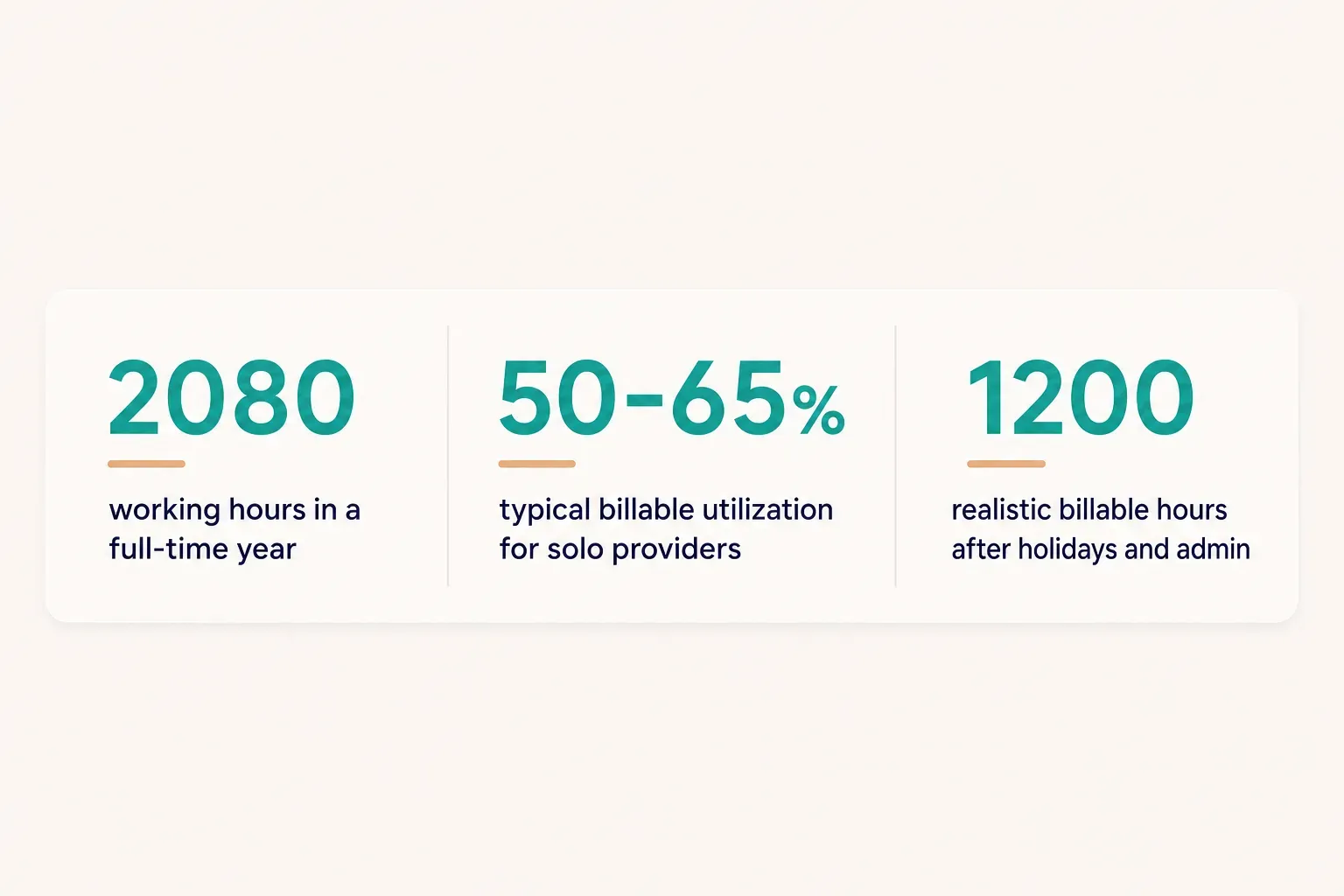
A full-time year holds roughly 2,080 working hours. You will not sell 2,080 hours. You won’t sell 1,500.
Billable utilization is the share of working hours you actually invoice. For solo service providers it usually lands between 50% and 65%. The rest disappears into quoting, invoicing, travel, training, marketing, equipment maintenance, cancellations, and the admin nobody pays for.
Subtract honestly: 10 public holidays, 10 vacation days, 5 sick days, and you’re at about 1,880 hours. Take out 25% for non-billable hours and you land near 1,410. Take out another chunk for gaps between jobs and last-minute cancellations, and 1,200 billable hours is a realistic year for a busy solo operator.
A worked example with real numbers
Meet a one-person mobile home-repair business. Target take-home income: $65,000. Annual overhead from the table above: $18,000.
Gross up for tax at 28%: the business needs roughly $90,300 in pre-tax income. Add overhead and required revenue hits $108,300.
Now divide by billable hours, not working hours.
| Input | Figure | Calculation |
|---|---|---|
| Desired take-home income | $65,000 | Starting point |
| Pre-tax income needed (28%) | $90,278 | $65,000 ÷ 0.72 |
| Annual overhead | $18,000 | From cost table |
| Total revenue required | $108,278 | Income + overhead |
| Billable hours available | 1,200 | 2,080 less leave and 32% non-billable |
| Minimum viable hourly rate | $90.23 | $108,278 ÷ 1,200 |
| Target rate with 15% buffer | $104 | Floor × 1.15 |
| Typical 6-hour job price | $624 plus materials | Target rate × 6 |
Notice what happened. A tradesperson who “feels like $60 an hour is fair” is losing roughly $30 of every hour against their own goal.
Over 1,200 hours, that’s a $36,000 gap.
Run your own version tonight. The inputs take 40 minutes to gather and they change how you quote forever.
Hourly, project, or package?
Customers rarely want to buy hours. They want a clean bathroom, a working boiler, a child who passes the exam. Hours are your problem, not theirs.
But that doesn’t make hourly useless. It makes it a back-office instrument rather than a customer-facing one.
When hourly still works as an internal tool
Keep your hourly rate alive behind the scenes even when the client only ever sees a flat number. It’s how you sanity-check every quote you send.
- As an estimating engine. Scope the job in hours, multiply by your target rate, add materials and markup, then present one fixed figure. The customer gets certainty; you keep the math honest.
- As a post-job audit. After delivery, divide the invoice by actual hours worked. If your effective hourly rate is consistently below your floor on a certain job type, either your scoping is optimistic or that service is mispriced.
- For genuinely open-ended work. Emergency callouts, diagnostic work, and “can you just take a look” jobs suit true hourly billing because nobody can scope them in advance.
- As the basis for a day rate. A day rate is just your hourly rate bundled with a commitment discount and a scheduling premium. Most providers set it at 7 to 7.5 hours rather than 8, because travel and setup eat the rest.
- To price retainer pricing correctly. Retainers fail when providers discount 30% for guaranteed work, then get treated as always-on support. Cap the hours, state them in writing, and price overflow at your standard rate.
Value-based pricing for hard-to-measure outcomes
What is it worth to a homeowner to avoid a $9,000 water damage claim? That’s the question value-based pricing asks, and it’s why a $450 preventative inspection sells comfortably.
For emotional, preventative, or convenience-driven services, estimate value like this:
- Cost avoided. A repair that prevents a larger failure is worth a meaningful fraction of that failure. Price at 5-15% of the avoided cost and it reads as obvious value.
- Revenue or time gained. A business coach whose work lifts a client’s retention by 8% can point to a specific annual figure. So can a virtual assistant who returns six hours a week to a founder.
- Emotional stakes. Wedding photography, pet care, elder care, and tutoring carry stress that money reduces. People pay for reassurance and reliability, not deliverable count.
- Customer lifetime value. A grooming client who rebooks every six weeks for three years is worth far more than one appointment. That justifies investing in onboarding, not discounting the first visit into unprofitability.
Pricing jobs with variable scope
Renovations, photography, coaching engagements, and anything involving “it depends” need a structured path from vague enquiry to fixed price.
- Charge for discovery. A paid assessment or discovery call (often $75-$250, credited against the job) filters tyre-kickers and pays for your scoping time.
- Use a scope checklist. Fifteen standard questions catch the variables that blow budgets: access, age of property, existing damage, permit requirements, deadline pressure.
- Quote a range, then fix it. Give a defensible range up front (“$4,200 to $6,800 depending on substrate condition”), then convert to a single fixed price after assessment. Ranges set expectations; fixed prices win bookings.
- Write the change-order rule before you need it. State the hourly or per-item rate for out-of-scope work in the quote itself.
And when a competitor is cheaper? Five things legitimately justify charging more: experience with the specific problem, speed of completion, availability when others have three-week waits, quality signals like certifications and verified reviews, and reduced customer risk through guarantees, insurance, and fixed pricing.
Turning numbers into packages clients trust

A correct price still loses the job if the buyer can’t tell what they’re getting. Most pricing disputes aren’t about the number.
They’re about a mismatch in expectations that was never written down.
Inclusions, exclusions, and deposits
The quote document does more work than the price on it. Every service package should specify deliverables in plain language, turnaround time with a start and finish date, and a hard revision limit.
Say who supplies materials and at what markup. State the deposit, typically 25-50% for work involving materials or reserved calendar time. Spell out cancellation terms, including the notice window and what portion of the deposit is retained.
Then add the change-order clause. One sentence explaining that work beyond the agreed scope is quoted separately before it begins prevents the single most common source of unpaid labour.
Building good, better, best tiers
Pricing tiers work because they change the customer’s question. Instead of “should I buy?” they start asking “which one?”
Build three. The basic tier covers the core outcome for a price-sensitive buyer. The standard tier, which most people should pick, bundles the two or three add-ons customers request most often. The premium tier includes priority scheduling, extended guarantees, or ongoing support.
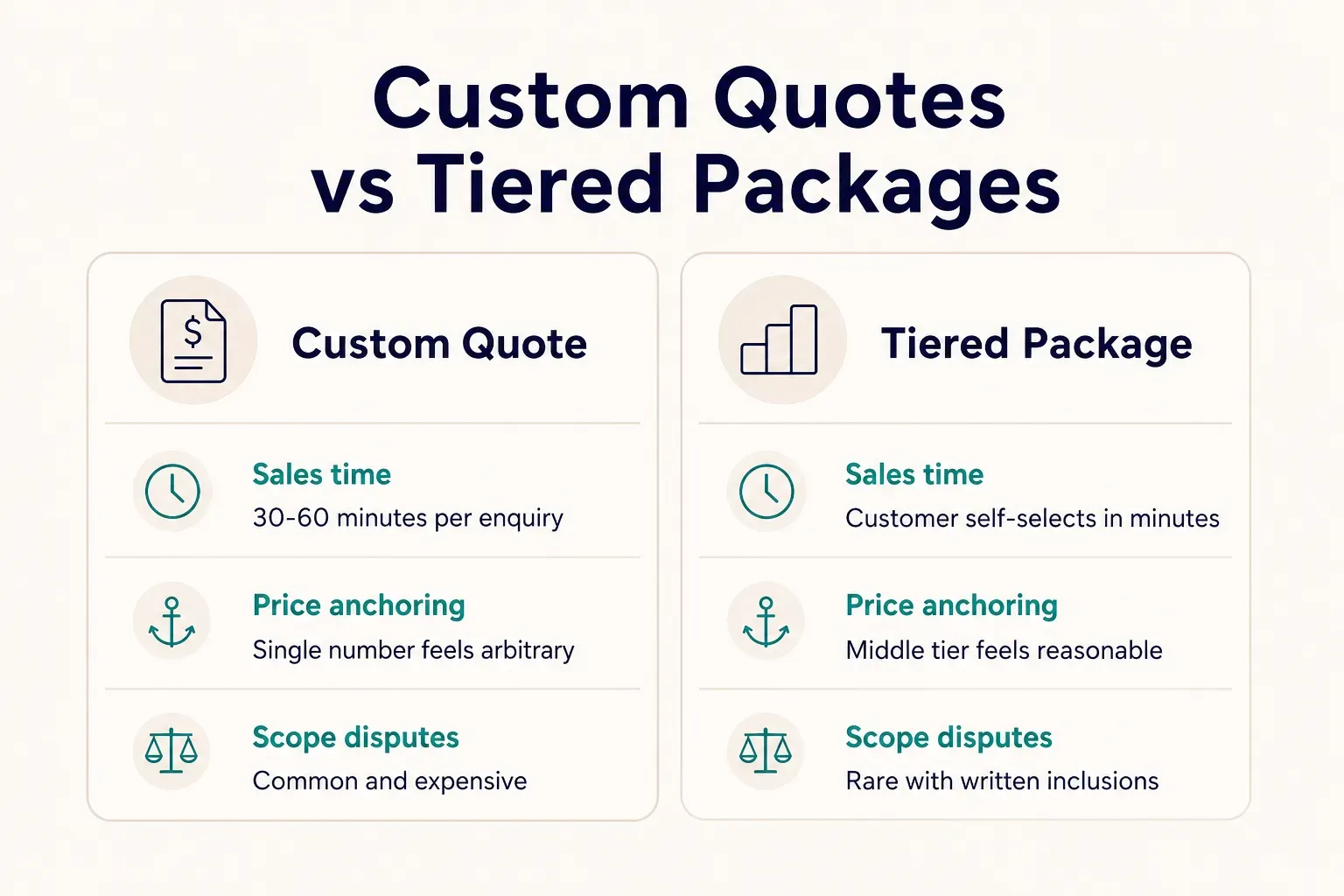
Price the middle tier closest to your target rate and let it carry most of your volume. Productized services, where the same defined package is sold repeatedly at a fixed price, are the logical endpoint of this approach.
Same delivery, less quoting, better margins.
Transparent pricing and discoverability
Hiding your prices until someone calls doesn’t protect your rate. It just adds friction, and friction costs bookings.
Buyers researching a service want three things before contacting anyone: a clear price, evidence that other people were happy, and confirmation you’re available when they need you. Platforms like Frendex are built around exactly this combination, with provider profiles showing listed services, prices, photos, and ratings drawn only from completed bookings, alongside live availability.
Verified reviews plus upfront pricing do the negotiating for you before the first message is sent.
The effect on your pipeline is practical. Published packages filter out buyers shopping purely on price, shorten the back-and-forth, and lift your quote-to-booking rate because the people who reach out have already accepted the number.
Special cases and price changes
The base price is the easy part. Profit usually leaks through everything around it: the 40-minute drive, the Saturday callout, the “quick favour” discount that turned into a six-hour job.
Rush, travel, and add-on fees
Local and mobile services should price the inconvenience, not absorb it. These surcharges are standard practice across trades, beauty, pet care, and tutoring.
- Call-out charge. A fixed $45-$95 fee covering travel and the first 30 minutes, credited toward the job if work proceeds. It stops free diagnostic visits from eating your week.
- Travel zones. Draw three rings on a map. Zone 1 (0-10 miles) included, Zone 2 (10-25 miles) plus $25, Zone 3 (25 miles+) plus $60 or declined. Clear, defensible, easy to publish.
- Evening and weekend premiums. A 20-35% uplift for work outside standard hours. You’re selling scarce personal time, and pricing it flat guarantees your calendar fills with the least convenient jobs.
- Same-day and emergency surcharges. 50-100% above standard rates. Urgency is the moment value-based pricing is most obvious to the buyer.
- Materials markup. 15-30% on supplied materials covers sourcing time, delivery, and the risk of replacing faulty stock. This protects your contribution margin on materials-heavy jobs.
Discounts without devaluing your work
Discounting the same scope teaches the customer that your first number was inflated. It also attracts the wrong buyers, and price-led customers are consistently the ones who take longest to close, complain most, and rebook least.
- Reduce scope, not price. Instead of 20% off a full deep clean, offer the kitchen and bathrooms only at a proportionate price. The rate holds; the budget fits.
- Trade the discount for something. Off-peak scheduling, a longer commitment, prepayment, or a written review with photos. A discount given for nothing is just a price cut.
- Bundle instead. Three sessions for the price of 2.75 lifts customer lifetime value and average booking value without reducing your hourly return on the first job.
- Cap introductory offers. Time-limited, first-booking-only, clearly labelled. Otherwise the promotional rate silently becomes your standard rate.
Raising prices with evidence
Raise prices when the data says so, not when you feel brave. Any two of these signals together justify a 10-15% increase:
- Utilization above 80% for eight consecutive weeks. You’re selling nearly everything you have.
- Quote-to-booking rate above 65%. Winning two-thirds of quotes usually means you’re priced below market.
- A genuine waitlist. Customers waiting more than two weeks are telling you demand exceeds supply.
- Rising input costs. Materials, fuel, insurance, and software increases compress gross profit margin quietly. Audit annually.
- Improved evidence. New certifications, a longer review history, better before-and-after photos.
- Expanded scope. If you’ve quietly added services, the price should reflect them.
When someone says your price is too high, ask one question: what are you comparing it to? Sometimes it’s a different scope entirely.
Offer a reduced-scope option if the budget is real, and hold the line if you’re already at your floor, because work below your floor costs you money to perform.
Review six numbers monthly: effective hourly rate, gross profit margin, billable utilization, quote-to-booking rate, average booking value, and repeat-booking rate.
That’s your entire pricing dashboard.
Set your price tonight, not someday
One task this week. Open a spreadsheet, list every cost from the table in section two, gross up your income target for tax, and divide by 1,200 billable hours.
That number is your floor, and you’ll probably be surprised by it.
Then build one three-tier package around your target rate. Basic, standard, premium. Write the inclusions, the exclusions, the deposit, and the change-order rule.
Publish it somewhere a buyer can see it without having to ask.
Pricing isn’t a decision you make once and defend forever. It’s a number tied to evidence: your utilization, your close rate, your review history, your costs.
When the evidence moves, the price moves with it.
And the providers who publish transparent, package-based pricing on a live profile, with verified reviews and real availability attached, consistently book faster and argue about money less.
The work of pricing well happens once. The benefit compounds every quote after that.
Frequently asked questions
What is the best way to price a service?
The best method combines a cost-plus pricing floor with a value-based ceiling, then validates the result against local market rates. Calculate your minimum viable rate first so you know what loses money, then price toward what the outcome is worth to the buyer. Cost-plus alone caps your income; value-based alone risks pricing below cost on complex jobs.
How do you calculate a price for a service?
Divide your total required annual revenue by your realistic billable hours, then multiply by the hours a job takes. Required revenue means your target income grossed up for tax, plus every overhead line: insurance, software, equipment, mileage, payment processing, and marketing. Add materials with a 15-30% markup and a buffer of 10-15% for scope creep.
Should I charge by the hour or by the job?
Charge by the job for anything you can scope, and keep hourly as your internal estimating tool. Flat project pricing gives the customer certainty and rewards you for getting faster, whereas hourly billing penalises efficiency. True hourly still makes sense for diagnostics, emergencies, and genuinely open-ended work where nobody can predict the finish line.
How much profit should I make on a service?
Aim for a gross profit margin of 50-70% on labour-led services and 30-50% where materials make up a large share of the job. Below 30% gross margin, a single cancellation or a bad debt wipes out the month. Track contribution margin per service type, because one unprofitable offering often hides inside an otherwise healthy business.
How do freelancers decide what to charge?
Successful freelancers work backwards from an income target, apply realistic billable utilization of 50-65%, then adjust upward based on demand signals. Many then shift from an hourly rate to a day rate, retainer pricing, or productized services to reduce quoting time. The move from selling hours to selling defined outcomes is usually what breaks a freelancer's income ceiling.
How do I price my services without underselling myself?
Never quote below your minimum viable rate, and raise prices when the evidence supports it rather than when you feel deserving. If you're winning more than 65% of quotes or running above 80% utilization, you are underselling, regardless of how the number feels. Test a 10-15% increase on new enquiries only, and watch your quote-to-booking rate for eight weeks before deciding.
Need a hand with something?
The Frendex map shows you who is available near you, in real time.
Get the app free Get the app freeFree, no card needed
Related articles
A no-show policy that protects your business
A 5-part no-show policy framework, not a copy-paste template. Learn what to charge, when to waive it, and how to cut missed appointments fast.
A service business's guide to bad reviews
Not every 1-star review deserves an apology. Get the 6-category decision tree for replying to bad reviews without looking guilty or defensive.

Your practical roadmap to becoming self-employed
A step-by-step path to going self-employed: testing your idea, setting rates, and handling tax, without quitting your job on day one.