Thumbtack vs TaskRabbit: Which should you book?
By Kiss János 15 min read
Introduction
Here’s the short answer. Taskrabbit wins if you need a structured, in-platform booking for a hands-on household task: furniture assembly, moving help, TV mounting, hauling. Thumbtack wins if you want to compare multiple quotes across roughly 500 service categories before you commit to anything.
Different tools for different jobs.
And the distinction matters more than most comparisons admit.
Taskrabbit is a managed booking marketplace. You pick a Tasker, book a slot, pay in the app, and rate the work afterwards.
Thumbtack is closer to a lead marketplace: you describe a project, professionals reach out, and you negotiate from there.
One contains the whole transaction. The other contains the introduction.
Both share a gap, though.
Neither shows you live, real-time availability on a map, and neither guarantees that every review you read came from a completed, paid job. That’s the space where alternatives like Frendex compete, and we’ll come back to it.
This guide is written buyer-first, which means separating two things that usually get blurred together: what customers pay and what providers pay. Those are very different economics on these two platforms, and provider costs eventually show up in your quote.
Four decision factors run through everything below:
- Cost transparency: who pays what, and whether the fee is disclosed before you book
- Booking control: whether the hire, payment, and communication stay in one place
- Review trust: whether ratings are tied to completed work
- Category coverage: how wide the catalog actually goes
Updated for 2026.
Quick comparison table
A scannable reference before the detail. No winners declared here; those come in the sections below.
| Factor | Frendex | Taskrabbit | Thumbtack |
|---|---|---|---|
| Platform model | Live-availability booking marketplace | Managed booking marketplace | Quote and lead marketplace |
| Customer fees | None, ever; no card required | Variable service fee plus Trust & Support fee | None to browse, contact, or request quotes |
| Provider fee structure | Flat monthly subscription, 0% commission | Taskers keep 100% of their hourly rate and tips | Variable pay-per-lead or per-contact charges |
| Review type | Completed-booking reviews only | Ratings tied to in-app paid tasks | Submitted reviews, quote-first flow |
| Typical response time | Instant booking from the live map | Same-day slots in supported markets | Wait for pros to reply to your request |
| Category count | 10 categories, 109 professions, 661 services | Narrow, task-focused set plus online tasks | Around 500 categories |
| Vetting | Verified ID badge; Trusted and Pro earned through work | Taskers background checked before joining | Background-check and license info on some profiles |
| Payment | Direct to provider, outside the app | In-app, with tipping | Arranged with the pro, in-platform in some categories |
| Best for | Booking any service fast, local or remote, in English | Defined physical tasks with a managed flow | Comparing quotes on bigger or specialized projects |
Meet the platforms
Both platforms are large, legitimate, and useful. They just solve different halves of the same problem: finding someone competent, and actually getting them booked.
Thumbtack: Quote-based marketplace for home and personal services
Thumbtack is a discovery and comparison engine. You describe a project, answer a few questions about scope and timing, and the platform matches you with professionals who work in that category and area.
From there you compare.
Profiles show pricing indications, photos of past work, reviews, and in some cases background-check or license information. You message pros, ask follow-up questions, and hire the one who fits.
Its real strength is breadth.
With around 500 service categories and nationwide U.S. coverage, Thumbtack handles things a task app simply doesn’t list: kitchen renovations, roofing, wedding photographers, DJs, tax preparers, music teachers, landscape design. If your project is big, unusual, or licensed, this is where you’ll find the deepest bench.
Thumbtack also publishes cost guides and project price estimates, which are genuinely useful for setting expectations before you talk to anyone. Handy when you have no idea whether a job costs $400 or $4,000.
The trade-off is speed and certainty.
You’re waiting for humans to respond, then comparing quotes that may not be structured the same way, then coordinating the actual hire yourself.
TaskRabbit: Managed booking for practical, hands-on tasks
Taskrabbit is a booking marketplace, not a quote marketplace. You browse Taskers by hourly rate, skills, reviews, and availability, then book a time slot directly in the app.
Same-day slots exist in supported markets.
The flow is contained end to end.
Chat, payment, tipping, and reviews all happen in-platform. You know the hourly rate before you book, and Taskers are background checked before they’re allowed to take jobs.
Where it shines: IKEA and flat-pack furniture assembly (a category Taskrabbit has essentially owned), moving and heavy lifting, mounting and hanging, cleaning, yard work, and quick errands. Well-defined physical tasks with a predictable time estimate.
There’s also a secondary set of online tasks: virtual assistance, organization, data entry, basic computer help. Useful, but it’s clearly not the core of the business.
Taskrabbit advertises Taskprotect coverage up to $1,000, subject to terms, which adds a layer of reassurance you won’t find on a pure lead platform.
The limitation is scope.
Taskrabbit’s footprint is smaller and deliberately task-specific. You won’t book a wedding videographer, a tax advisor, or a licensed electrician for a rewiring job here.
Neither platform charges customers a signup fee.
Browsing is free on both.
The meaningful differences sit in provider economics and booking mechanics, which is exactly where we go next.
Costs and fees: What customers and providers actually pay
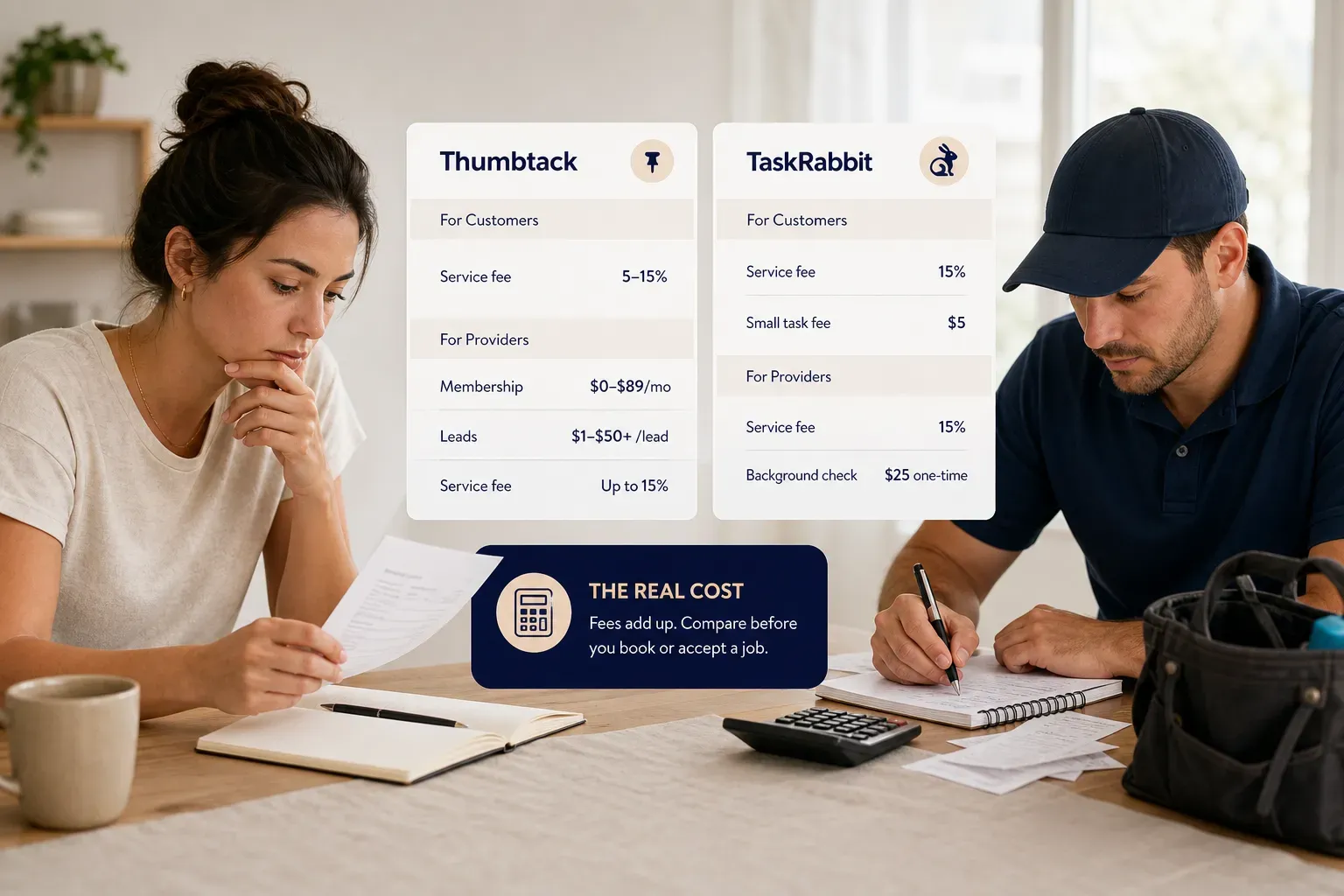
Winner for provider fee transparency: Taskrabbit.
Taskers set their own hourly rate and keep 100% of it, plus tips and reimbursements.
The platform’s cut is charged to the customer as a disclosed service fee, not shaved off the worker’s pay.
Winner for cost-free access: Thumbtack.
Customers browse, message, and collect quotes at no charge with no subscription.
But providers pay for leads and contacts whether or not the job is ever booked, let alone completed.
| Fee type | Frendex | Taskrabbit | Thumbtack |
|---|---|---|---|
| Customer signup | Free, no card | Free | Free |
| Customer service fee | None | Variable Taskrabbit Service fee added to the total | None charged by the platform |
| Customer trust/protection fee | None | Separate Trust & Support fee | None |
| Who sets the price | Provider, listed on profile | Tasker’s hourly rate | Provider quote or cost-guide estimate |
| Provider cost model | Flat monthly subscription | Nothing deducted from the hourly rate | Pay-per-lead / per-contact charges |
| Provider commission on job value | 0% | 0% from the Tasker’s rate | No commission, but lead costs apply |
| Provider pays when the job doesn’t happen? | No | No | Yes, leads are paid for regardless of outcome |
| Fees disclosed upfront? | Yes, flat and published | Disclosed at checkout, but variable by market and demand | No public rate card; varies by category, location, job size |
| Payment handling | Direct between customer and provider | Processed in-app | Arranged with the pro |
What customers pay
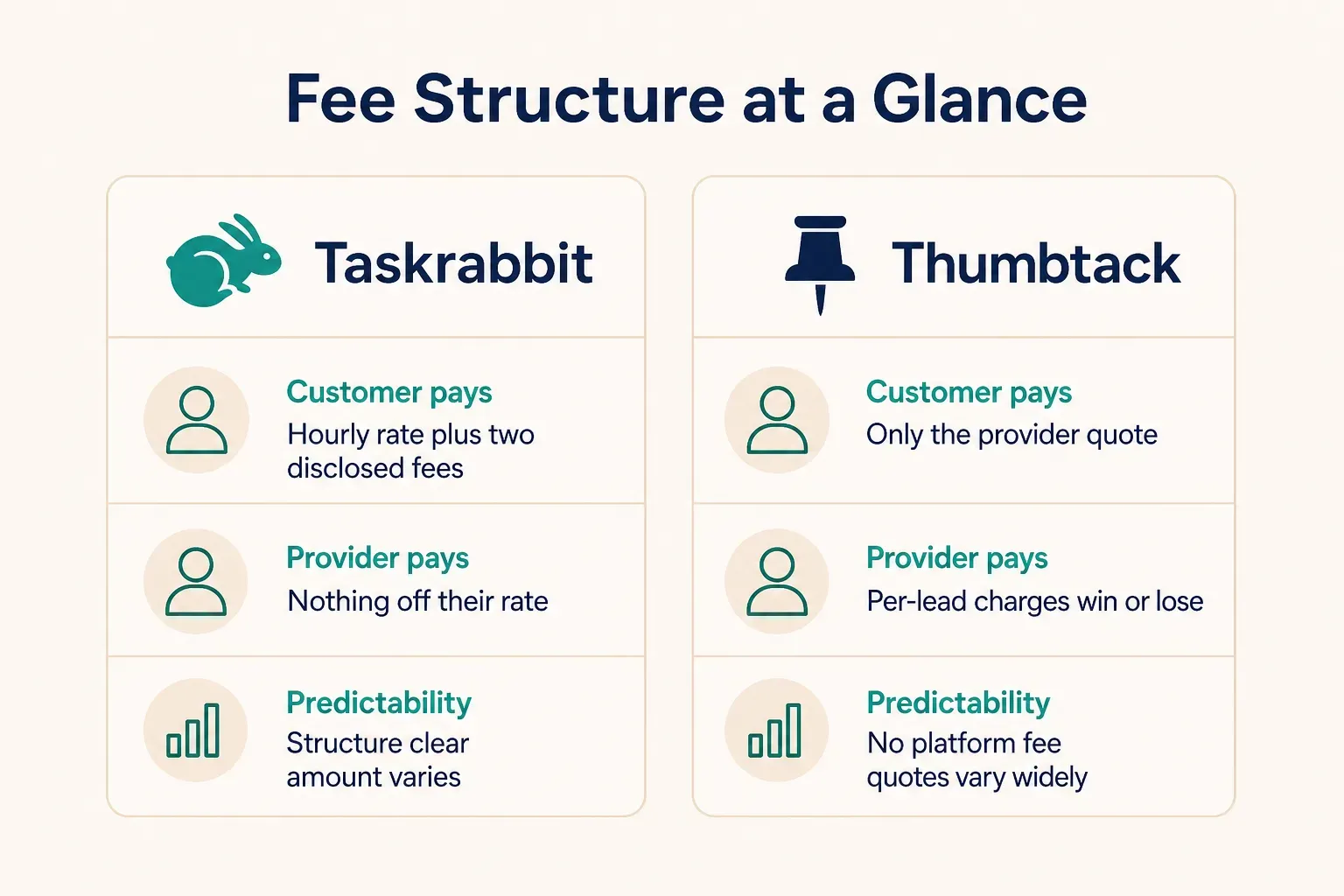
On Thumbtack, the platform charges you nothing.
Your entire cost is whatever the professional quotes, which varies enormously by category, scope, and region.
On Taskrabbit, your total is built from three parts: the Tasker’s hourly rate multiplied by hours worked, a Taskrabbit Service fee, and a separate Trust & Support fee. Both fees are shown before you confirm, but they’re variable and there’s no universal published schedule.
So Taskrabbit is more predictable in structure and less predictable in amount.
You always know fees are coming.
You just don’t know how much until checkout in your specific market.
Thumbtack is the opposite: zero platform fees, maximum quote variance. Two pros can bid wildly differently on the same job.
What providers pay: Leads vs completed jobs
This is the distinction most comparisons skip, and it’s the one that quietly shapes your price.
Thumbtack charges providers for contact, not for completed work.
Pros set a lead budget and pay variable amounts per lead or per customer inquiry based on category, location, job size, and settings.
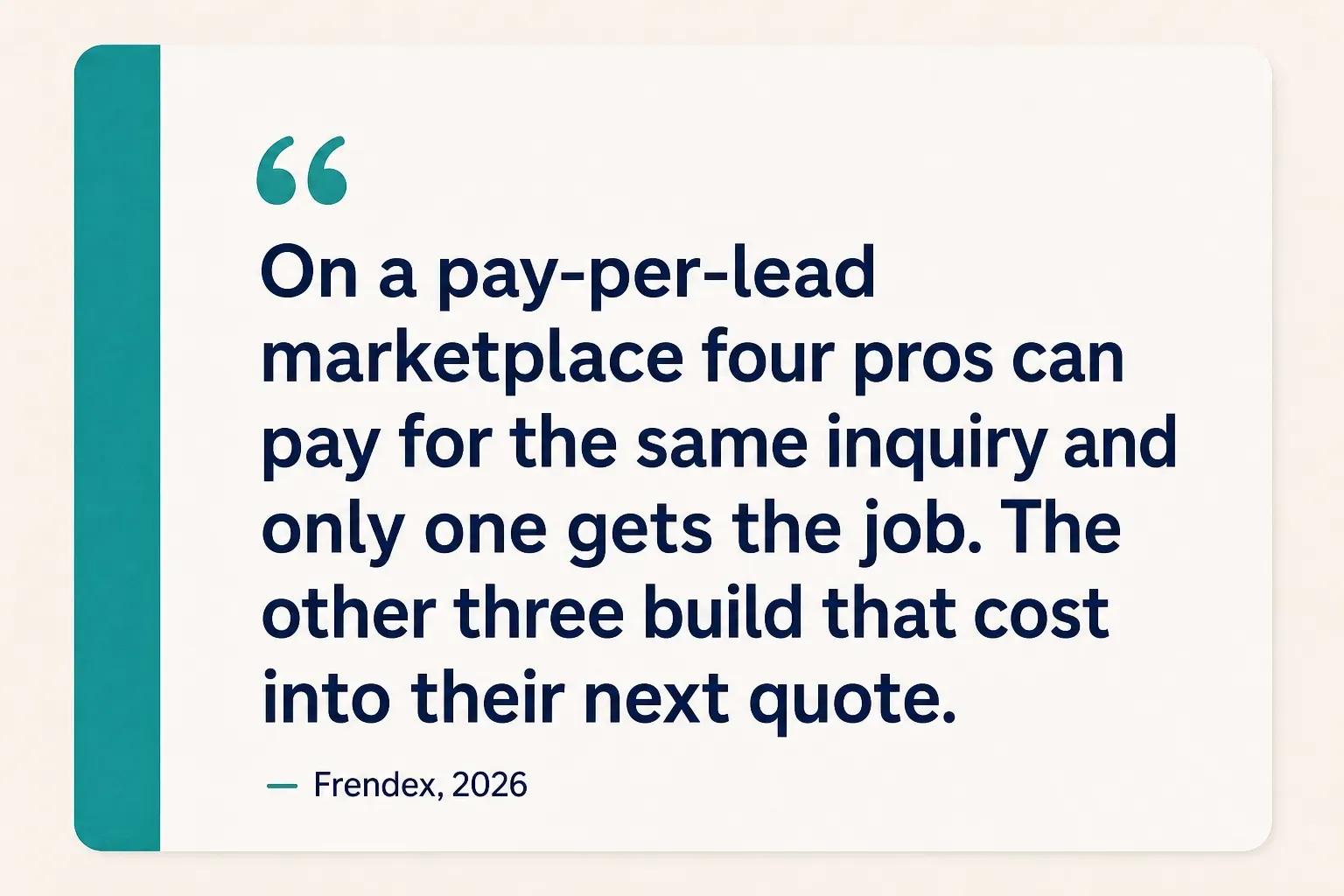
If five pros pay for the same lead and one wins the job, four of them paid for nothing.
That cost doesn’t vanish.
It gets built into quotes across the board. On a pay-per-lead marketplace, you’re indirectly funding every unsuccessful bid the pro made last month.
Taskrabbit’s fee only applies once a task is actually booked and paid through the platform.
No booking, no fee.
And because the fee is charged to the customer rather than deducted from the Tasker, the worker’s take-home is exactly their listed rate.
Frendex takes a third route: a flat monthly subscription with 0% commission and zero lead fees.
Providers pay the same amount whether they complete two bookings or forty, which removes the incentive to pad quotes to cover acquisition costs. A 14-day free trial and cancel-anytime terms come standard, and the plan includes the calendar, guest cards, campaigns, and statistics rather than upselling them.
If a platform charges providers for conversations instead of completed work, someone pays for the failed conversations. That someone is you.
Booking control, availability, and review trust
Four verdicts in this section, and they don’t all go the same way.
| Criterion | Frendex | Taskrabbit | Thumbtack |
|---|---|---|---|
| Booking control | Instant or scheduled booking in-app with status tracking | Book, chat, pay, and review in-platform | Quote-and-contact; hire often confirmed outside a managed flow |
| Availability visibility | Live map of who is free right now | Same-day slots in supported markets | Wait for pros to respond to your request |
| Review source | Only after a completed booking | Tied to in-app paid tasks | Submitted reviews; link to completed job less strict |
| Paid ranking boosts | None; ranking earned through work and ratings | Not a core model | Lead budgets influence match volume |
| Category breadth | 661 services across 109 professions | Task-focused, narrow | Around 500 categories, widest of the three |
| Remote/online services | Core part of the catalog | Secondary online-task section | Some categories, not a focus |
| English-language experience | Interface, profiles, and chat all in English | English available in U.S. markets | English available in U.S. markets |
| Verdict | Best for live availability and review integrity | Best for managed task booking | Best for category breadth and quote comparison |
Quote-and-contact vs in-platform booking
Winner: Taskrabbit.
Booking, payment, chat, and reviews all live inside the platform, which means the transaction and the record of it stay in one place.
Why does that matter?
Because when something goes wrong, you need evidence. An in-app trail of the agreed rate, the booked time, and the messages exchanged is worth more than a text thread and a memory of a phone call.
Thumbtack does support in-platform messaging and booking in supported categories, but its default shape is quote-and-contact. You often end up finalizing scope, price, and scheduling with the pro directly, outside a fully managed flow.
For a $150 shelf install, that’s fine.
For a $9,000 bathroom remodel, you’d want a written contract anyway, and Thumbtack isn’t pretending to be the one issuing it.
Frendex sits closer to Taskrabbit on structure with one difference: payment goes straight from customer to provider, so there’s no escrow and no payout delay. The agreed price and time still stay on record in the app if anything is disputed.
Availability: Waiting for replies vs same-day slots
Effectively a tie, and a shared weakness.
Neither platform shows genuine real-time availability on a map.
Taskrabbit comes closer.
In supported markets you’ll see same-day slots and can book one immediately, which for urgent jobs is a meaningful advantage. Coverage thins out fast outside dense metros, though.
Thumbtack is slower by design.
You submit a request and wait.
Sometimes replies land in minutes; sometimes you’re refreshing your inbox the next morning.
For a leaking pipe at 8pm, that’s the wrong model.
This is the single biggest gap both platforms share against live-availability apps.
Frendex was built around exactly this: open the app and the map shows which providers are available right now, nearby, with instant booking straight from the profile.
Not a directory of phone numbers.
Not a neighbourhood post you wait two days on.
Remote providers show on the same map too, so an online tutor three hundred kilometres away is as bookable as the handyman two streets over.
Review quality: Completed-task ratings vs submitted reviews
Winner between the two: Taskrabbit.
Because payment runs through the app, ratings are much more consistently attached to a task that was actually performed and paid for.
Thumbtack reviews can absolutely come from real hired jobs.
But the quote-first flow leaves more room for reviews that aren’t clearly tied to a finished, paid transaction, and there’s less structural enforcement connecting the two.
That’s not an accusation of fraud.
It’s a design consequence.
When the platform doesn’t process the money, it can’t prove the job happened.
Frendex makes this a hard rule: a rating can only be left after a completed booking.
The trust badges follow the same logic. Verified means the team checked the provider’s name and ID.
Trusted and Pro are earned through completed bookings and ratings, and cannot be purchased.
There’s no paid boosting anywhere in the app, and ratings run both ways, so providers rate customers too.
Category breadth: Task-focused vs general marketplace
Winner: Thumbtack, comfortably.
Around 500 categories covers renovation trades, events, personal services, lessons, and specialized licensed professionals. Nothing in this comparison matches that spread on the home-improvement side.
Taskrabbit’s catalog is intentionally tight: physical tasks plus a light layer of online help. That focus is a feature, not a flaw, because it’s what makes the booking flow so clean.
Narrow scope, predictable hours, fixed rate.
Frendex lands in between on count but wider on type: 10 categories, 109 professions, and 661 individual services, spanning beauty and wellness, health, home and garden, family and care, education, auto, creative and media, IT, business and finance, plus a Freestyle category for things no other app lists.
A queue stander.
A moving buddy.
An IKEA survival buddy.
A pigeon scarer.
Customers can also request new categories and professions directly in the app, so the catalog grows from actual demand rather than a roadmap meeting.
Who should choose what
Match the platform to the job, not the other way round.
- Choose Taskrabbit if you need a defined physical task done soon. Furniture assembly, moving help, mounting, hauling, or a same-day errand. You get in-app payment, a known hourly rate, background-checked Taskers, a disclosed fee structure, and Taskprotect coverage advertised up to $1,000 subject to terms. Best for renters and apartment dwellers with a short, concrete to-do list.
- Choose Thumbtack if you’re comparing quotes on something bigger. A kitchen renovation, a roof, a wedding vendor, a licensed trade, or any specialized service where scope drives price. Around 500 categories and cost guides make it the strongest option for research-heavy hiring. Ideal for homeowners with a multi-thousand-dollar project and time to gather three bids.
- Choose Taskrabbit as a provider if fee predictability matters. You set your rate, keep 100% of it plus tips and reimbursements, and only encounter platform economics once a task is booked and paid. No spending money on inquiries that go nowhere. Best for skilled generalists in dense urban markets.
- Choose Thumbtack as a provider if lead volume beats fee certainty. Broad national demand, flexible lead budgets, and access to high-ticket projects. You’ll pay for contacts that may never convert, so it suits pros with a strong close rate and a marketing budget they’re comfortable burning. Best for established contractors who can absorb provider lead fees as customer acquisition cost.
- Consider Frendex if neither model fits. Specifically: if you want to see live availability instead of waiting for replies, want reviews that can only come from completed bookings, want English-language profiles and chat end to end, and want local plus remote services in one app. For providers, it’s a flat monthly fee with 0% commission and zero lead charges, which includes the booking calendar, guest cards, push and email campaigns, and statistics rather than selling them separately. Best for expats and newcomers who need to book without a phone call in a language they don’t speak yet, and for independents who refuse to pay per contact.
Frequently asked questions
Which is better, Thumbtack or TaskRabbit?
It depends entirely on the job. Book Taskrabbit for managed, hands-on tasks like furniture assembly, moving, or mounting, where you want a known hourly rate, in-app payment, and a same-day slot. Use Thumbtack for broad category comparison and quote shopping on larger or specialized projects. If your task is small, physical, and urgent, Taskrabbit is faster and cleaner. If your project is big, licensed, or unusual, Thumbtack has the categories Taskrabbit simply doesn't list.
Is TaskRabbit cheaper than Thumbtack?
Not necessarily. Taskers keep 100% of their hourly rate, but customers pay a separate Taskrabbit Service fee and Trust & Support fee on top, both variable by market and demand. Thumbtack charges customers nothing, yet providers pay for leads whether or not they win the job. Those acquisition costs get priced into quotes. Cheaper on paper doesn't always mean cheaper on the invoice.
Does Thumbtack take a percentage of the job?
No. Thumbtack does not take a commission on job value. Providers pay variable lead or contact costs instead, based on category, location, job size, and their lead settings. The important nuance: those charges apply win or lose. A pro can pay for five inquiries and book none of them.
Does TaskRabbit take a percentage from Taskers?
No. Taskers keep 100% of their hourly rate, tips, and reimbursements. Nothing is deducted from their pay. Taskrabbit's fee is charged to the customer as a separate line item at checkout, and it only applies once a task is actually booked and paid through the platform.
What is the best app for finding someone to do odd jobs?
For simple, well-defined physical odd jobs in a supported city, Taskrabbit's same-day booking is the most reliable option among the two platforms compared here. Frendex extends the same instant-booking idea to a far wider range of work: 661 services across 109 professions, including remote categories like tutoring, IT help, and coaching, plus a Freestyle category for genuinely odd requests (queue stander, moving buddy, IKEA survival buddy). You see who's available right now on a live map and book from the profile.
What is the best alternative to Thumbtack and TaskRabbit?
Frendex is the strongest alternative for most users in 2026. It closes the two gaps both platforms share: it shows live availability on a real-time map instead of making you wait for replies, and it allows ratings only after a completed booking, so no review exists without a finished job behind it. Profiles, prices, and chat are all in English end to end, which matters if you're new in town. Verified, Trusted, and Pro badges are earned rather than bought, and there's no paid map placement anywhere in the app. For providers, the model inverts the lead marketplace: a flat monthly fee, 0% commission, and no per-lead charges, with a 14-day free trial and cancel-anytime billing. Customers pay nothing, ever, and pay the provider directly. Other worthwhile alternatives include Angi for pre-priced home services, Airtasker for post-and-offer errands, and Care.com for recurring child, senior, or pet care.
Need a hand with something?
The Frendex map shows you who is available near you, in real time.
Get the app free Get the app freeFree, no card needed
Related articles

Do you tip contractors? A clear answer for homeowners
No, tipping contractors isn't required. Get the 4-factor rule to decide when it's worth it and how much makes sense for your project.

How to hire a contractor without getting burned
A step-by-step process for vetting bids, licenses, and contracts, plus the one paper trail habit most homeowners skip until it costs them.
How does TaskRabbit actually work?
See exactly how TaskRabbit's booking flow, real fees, and cancellation rules work in 2026, plus why Taskers set their own rates. No surprises at checkout.