How to hire a contractor without getting burned
By Kiss János 13 min read

Why most contractor hires go wrong
Here’s the uncomfortable truth: most contractor disputes don’t start with a bad contractor. They start with a vague job description that two people interpret in two completely different ways.
You pictured heated floors and a frameless glass door. They priced vinyl and a shower curtain rod.
That means the fix begins long before you pick up the phone.
Learning how to hire a contractor well is mostly about controlling ambiguity. It means writing down exactly what you want, confirming exactly who you’re dealing with, and recording every decision along the way.
This guide walks through the full process in order:
- Picking the right type of professional for the job.
- Defining a written project scope that produces comparable bids.
- Verifying licenses, insurance, and bonding directly at the source.
- Comparing bids that don’t line up neatly.
- Structuring contracts, payment schedules, and change orders.
- Closing out with a punch list, lien waivers, and warranty documentation.
One theme runs through all of it.
A written record from first inquiry to final payment is the single biggest protection homeowners skip.
Memory fades.
Text threads get deleted.
Paper wins arguments.
Contractor types: Picking the right pro
Calling a handyman to move a wall is like asking your family doctor to perform heart surgery. Both are qualified professionals.
Only one belongs in that room.
Choosing the wrong category of pro is the first mistake many homeowners make, and it often can’t be undone cheaply.
General contractor vs subcontractor vs handyman
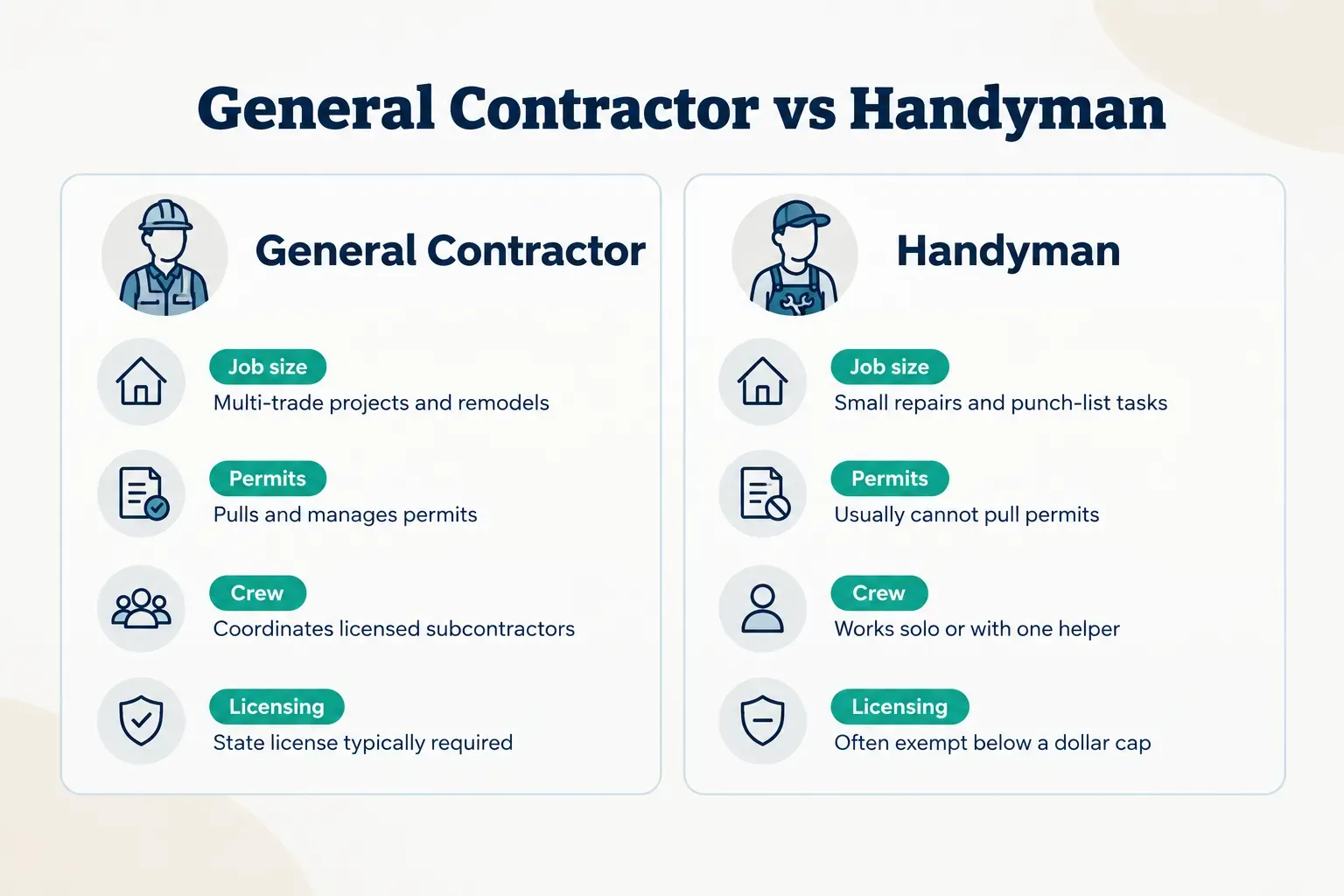
A general contractor (GC) is the project manager. They bid the whole job, pull building permits, schedule the work, and hire and coordinate subcontractors such as electricians, plumbers, and HVAC technicians.
You sign one contract with the GC, and they answer for everyone on site.
A handyman works solo or with a helper on small, non-structural jobs. Think patching drywall, hanging doors, replacing a faucet, or assembling shelving.
Many states cap the dollar value of work a handyman can take on without a license, often somewhere between $500 and $1,000 per job, so check your state’s rules.
There’s also a distinction people rarely think about. When you hire someone for your own home, it’s a personal consumer transaction.
But if you hire a contractor for a business property, such as a rental unit or office, you may pick up obligations around independent contractor classification and tax reporting (for example, issuing a Form 1099-NEC once payments cross the IRS threshold, which rose to $2,000 for payments made starting in 2026).
A homeowner fixing their own kitchen never deals with that. A landlord renovating a duplex might.
When you need a specialist
Use this decision rule.
If the job involves structural changes, gas lines, electrical work, load-bearing walls, or anything that requires a permit, you need a licensed specialty contractor or a GC.
Not a handyman.
No exceptions.
Some projects need a design professional before any contractor sees them. Bring in an architect or structural engineer first for:
- Additions and second stories, where framing loads and zoning setbacks need to be calculated and drawn.
- Foundation problems such as cracks wider than a quarter inch, sloping floors, or water intrusion through the slab.
- Removing or relocating walls when you don’t know whether they carry load.
- Design-build projects, where you want one firm handling both plans and construction but still need stamped drawings for the permit office.
Paying $1,500 to $5,000 for engineered drawings feels painful.
It’s far less painful than paying twice for a beam that failed inspection.
Define the scope and find candidates
Ask three contractors to “remodel my bathroom” and you might get quotes of $9,000, $18,000, and $32,000.
Are two of them crooks? Probably not.
They each imagined a different bathroom, and you gave them nothing to anchor on.
Writing a brief for fair bids
A project brief is a one- to three-page document that tells every bidder the same thing.
It turns a guessing game into a fair contest. A strong brief includes:
- Measurements: room dimensions, ceiling height, and square footage of any surface being replaced.
- Photos: wide shots of the space plus close-ups of problem areas, existing plumbing, and electrical panels.
- Material specs: brand, model, or product line where you know it (for example, “12x24 porcelain tile, matte finish”).
- Must-haves versus allowances: what’s non-negotiable, and where you’ll accept a dollar allowance (say, $1,200 for a vanity) to choose later.
- Timeline constraints: hard deadlines, blackout dates, or seasonal limits.
- Access conditions: parking, stairs, pets, working hours allowed by your HOA, and where materials can be stored.
Without these details, every contractor estimate rests on different assumptions. You end up comparing a Honda quote to a Mercedes quote and wondering why the numbers don’t match.
With them, the bid comparison later becomes almost mechanical.
Finding candidates and reading reviews
Aim for five or six candidates so you end up with at least three solid bids. The best sources:
- Referrals from neighbors who had similar work done in the past two years. Ask to see the finished project if you can.
- State licensing board directories, which list active licensees by trade and location.
- Verified-profile platforms, where contractors confirm identity and credentials before listing.
Pay attention to how reviews get collected. A platform that only allows ratings from completed bookings is a stronger trust signal than an open review site where anyone can post.
It’s the difference between a verified purchase and a stranger’s opinion.
Then read the reviews like an investigator, not a fan. Good review verification looks at four things:
- Recency: most reviews should fall within the last 12 months. A contractor’s crew and quality can change fast.
- Volume: 10 or more reviews gives you a pattern. Three glowing reviews tell you almost nothing.
- Repeated complaints: one gripe about missed start dates is noise. Four of them is a business practice.
- Suspicious uniformity: identical phrasing, similar posting dates, or generic praise like “great job, highly recommend” repeated across profiles often signals fake reviews.
Follow up with reference checks. Ask for two clients from the past year and call them.
Ask one question above all: “Would you hire them again for your next project?”
Verify credentials and compare bids
“Licensed, bonded, and insured” appears on thousands of truck doors.
It’s a slogan, not a verification.
Those words describe separate protections, and a contractor can have one while missing the others.
License, insurance, and bonding explained
Treat these as five distinct checkpoints. Verify every one directly with the issuing source, never from a photo the contractor texts you.
| Protection | What It Covers | How to Verify |
|---|---|---|
| Active contractor license | Confirms the contractor met state or local requirements for their trade and classification | Search the state licensing board lookup by name or license number; confirm status is “active” and the classification matches your job |
| Business registration | Shows the company legally exists and can be held accountable | Search the Secretary of State business entity database; match the legal name to the contract |
| General liability insurance | Pays for damage to your property or injuries to third parties caused by the work | Request a Certificate of Insurance (COI), then call the insurer listed to confirm the policy is current |
| Workers’ compensation insurance | Covers injuries to the contractor’s employees, so claims don’t land on your homeowner’s policy | Ask for a separate COI or check your state’s workers’ comp coverage lookup |
| Contractor bond | Gives you a financial claim if the contractor fails to finish, violates the contract, or doesn’t pay suppliers | Get the bond number and surety company name; confirm the amount and status with the surety or licensing board |
Contractor license verification takes about five minutes online.
Skipping it is how people end up with no recourse when a job goes sideways.
Questions that reveal red flags
Good contractors answer these questions easily because they hear them all the time.
Evasion is the answer.
| Question | Strong Answer | Evasive Answer |
|---|---|---|
| How big is your crew, and who will be on site daily? | ”Four full-time employees. Marco leads your job and is on site every workday." | "It depends on who’s available.” |
| Which parts of the job do you subcontract? | ”Electrical and plumbing go to licensed subs I’ve used for years. I’ll give you their license numbers." | "Don’t worry about that, I handle everything.” |
| What’s a realistic timeline, and what could delay it? | ”Five weeks. Permit approval and tile lead times are the two biggest risks." | "Should be quick, a couple weeks maybe.” |
| Can your insurer send me a COI directly? | ”Yes, I’ll have my agent email it today with you listed as certificate holder." | "I have insurance, I just don’t have the paperwork handy.” |
| Have you had any disputes or complaints filed? | ”One, in 2023, over a delay. We settled it and I can explain what changed." | "Never. Everyone loves us.” |
| Who pulls the building permits? | ”I do, and the fee is in the bid." | "You probably don’t need one for this.” |
A bid comparison framework
Here’s how three real-world-style bids for the same 80-square-foot bathroom remodel might look.
Notice how the “cheapest” one hides costs.
| Category | Bid A | Bid B | Bid C |
|---|---|---|---|
| Labor | $9,800 | $7,600 | $11,200 |
| Materials / allowances | $6,900 (tile $8/sq ft, vanity $1,200, fixtures included) | $4,800 (tile $4/sq ft, vanity $600, fixtures by homeowner) | $7,800 (named porcelain line, vanity $1,500, fixtures included) |
| Exclusions | Drywall repair outside wet area | Permit fees, debris haul-off, fixtures | Mold remediation only |
| Permit responsibility | Contractor pulls; $450 fee included | Homeowner | Contractor pulls; fee included |
| Schedule | 4 weeks, start March 9 | ”About 3 weeks,” start TBD | 5 weeks, firm start and end dates |
| Payment terms | 10% deposit, 3 milestones | 50% deposit, balance on completion | 15% deposit, 4 milestones |
| Warranty length | 2 years labor | 90 days | 3 years labor |
| Bid total | $17,150 | $12,400 | $19,500 |
| Normalized to Bid A spec | $17,150 | ~$15,270 | ~$18,900 |
To normalize bids, pick one bid as the baseline and adjust the others to match it. For Bid B, that means adding the tile upgrade ($320), vanity upgrade ($600), permit fee ($450), debris removal (about $400), and fixtures (about $1,100).
Suddenly the $4,750 gap shrinks to under $1,900.
And that remaining savings buys you a 50% deposit, no firm start date, and a 90-day warranty.
The lowest bid is rarely the safest choice.
It’s often just the least complete.
Contracts, payments, and project control
A handshake feels friendly until week three, when nobody remembers what was agreed. The construction contract is where your project brief becomes enforceable, and where most homeowners get sloppy because they’re eager to start.
What your agreement must include
Every contract, regardless of project size, should spell out:
- Detailed scope of work, ideally attaching your project brief as an exhibit.
- Material specifications, including brands, models, colors, and allowance amounts.
- Total price, plus how allowance overages will be billed.
- A milestone-based payment schedule tied to completed work (demo done, rough-in passed inspection, tile set), not arbitrary calendar dates.
- A permit responsibility clause naming who pulls building permits and schedules inspections.
- Start and completion dates, with how delays are handled.
- Warranty terms covering duration, what’s included, and how to file a claim.
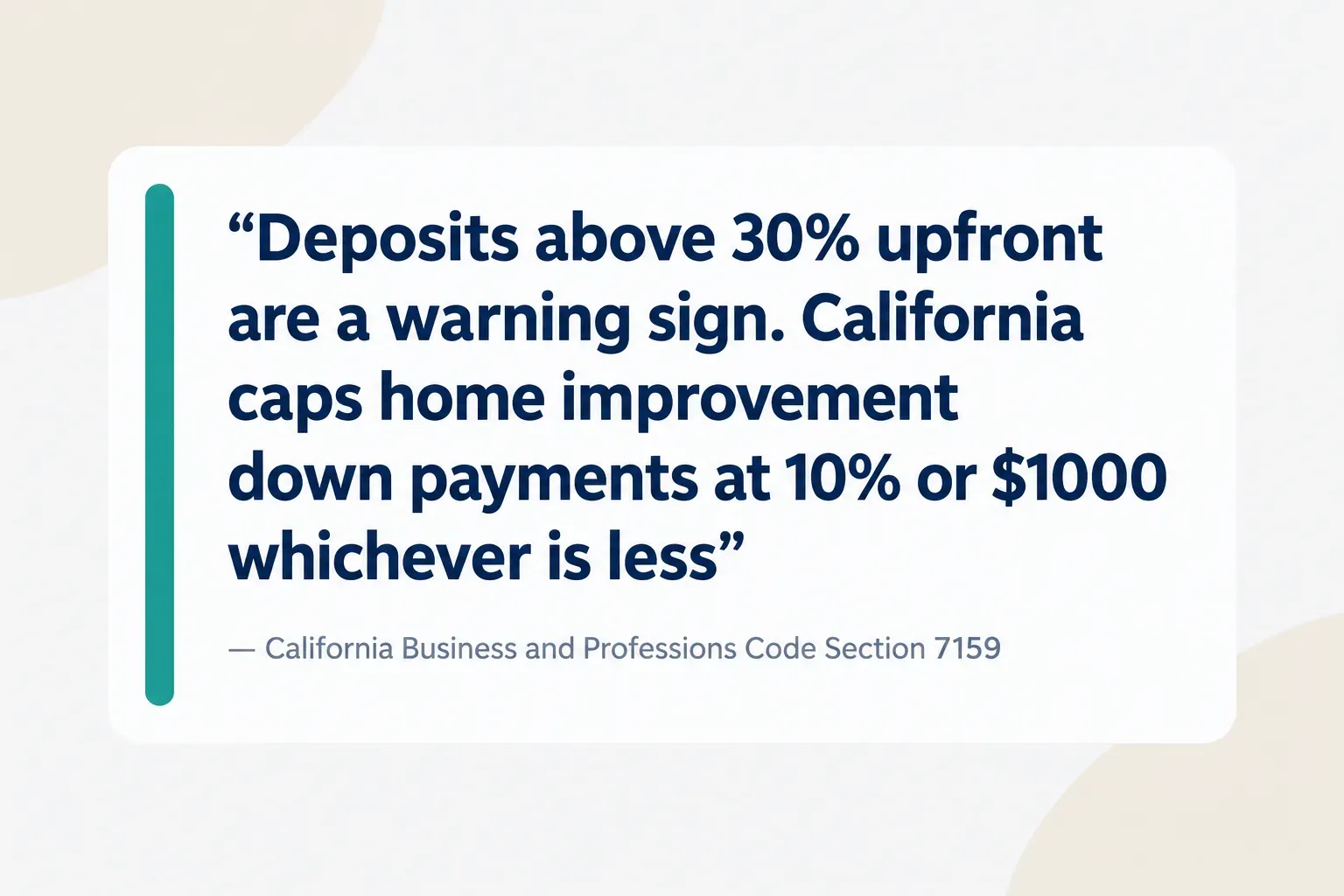
On deposits: anything above 30% upfront is a warning sign.
Some states go further. California, for example, caps home improvement down payments at 10% of the contract price or $1,000, whichever is less.
Insurance-claim repairs deserve extra caution. After storms, fires, or water damage, contractors sometimes arrive before the adjuster does.
Don’t sign anything that assigns your insurance benefits to the contractor.
Get an independent estimate rather than relying only on the insurer’s scope, since insurer estimates frequently miss hidden damage like wet subfloor or smoke in ductwork.
Change orders and communication rules
Projects change.
That’s normal.
What causes fights is changes that happen verbally.
A change order is a written amendment to the contract. It should be triggered by any of three events: a scope change you request, unforeseen conditions (rotted joists behind the tile), or a material swap.
Each change order needs a written description, the cost or credit, the schedule impact, and signatures from both parties before the work continues.
A verbal “sure, go ahead” costs nothing to say and thousands to dispute. If it isn’t signed, it didn’t happen.
Set communication standards on day one, and write them into the contract or a kickoff email:
- Response time: for example, messages answered within one business day.
- One point of contact on each side, so instructions don’t get crossed.
- Progress photos at every milestone, especially before walls close up.
- Site access rules: working hours, lockbox codes, and which areas are off-limits.
- Daily cleanup and site safety: tools secured, nails swept, and hazards marked, particularly if kids or pets live there.
Final walkthrough and closing documents
The last 5% of a project causes a surprising share of disputes.
Why?
Because the final payment is your only remaining leverage, and many homeowners hand it over too early.
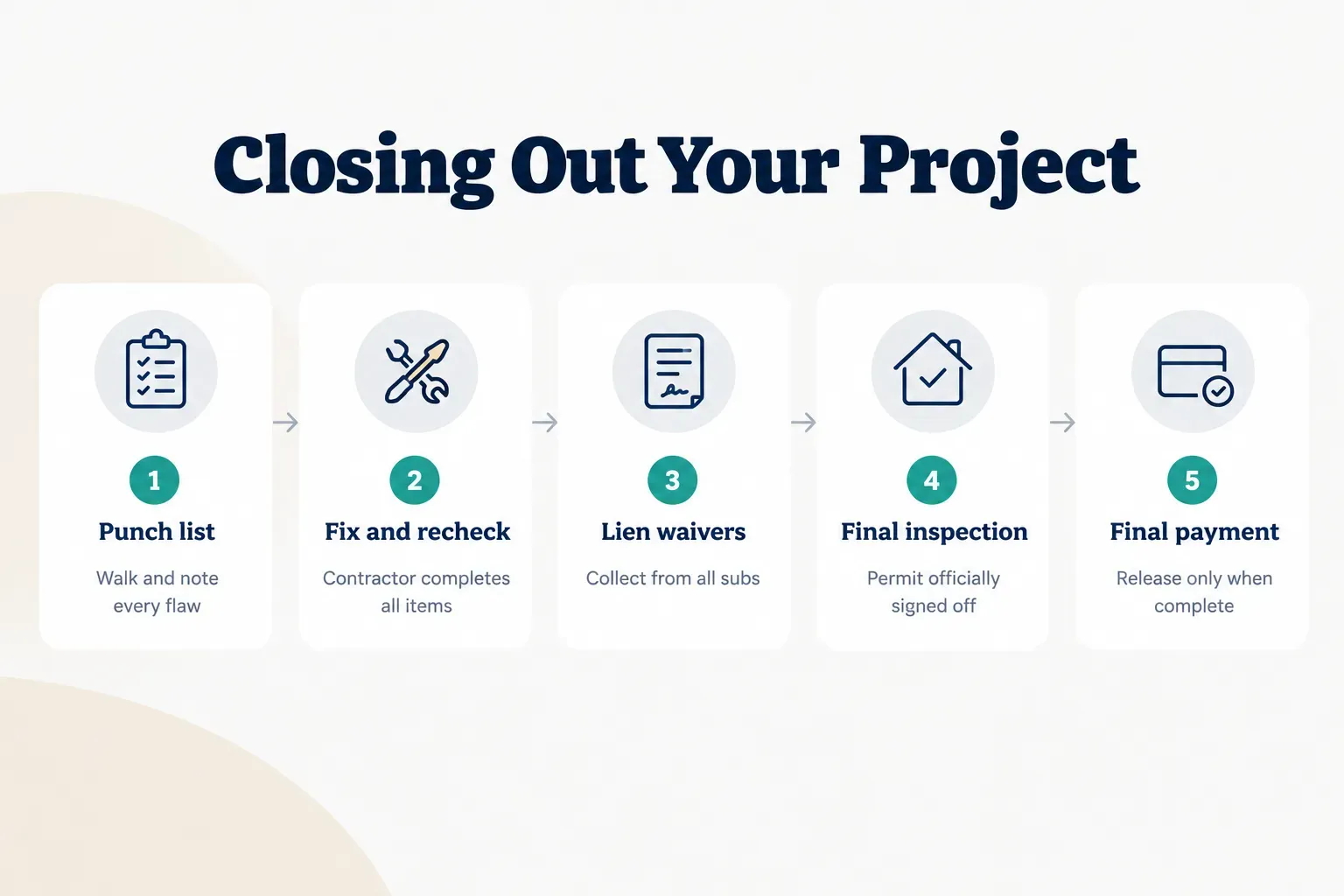
Walk the site with the contractor and build a punch list of every unfinished or flawed item: grout gaps, paint drips, a door that sticks.
Don’t release final payment until the list is done.
Before that last check, collect lien waivers from the contractor and every subcontractor and major supplier. A lien waiver confirms they’ve been paid, so an unpaid sub can’t file a mechanic’s lien against your house.
Then gather your warranty documentation, material receipts, appliance manuals, and the final permit sign-off.
Keep all of it in one place.
Every estimate, COI, contract, change order, and message thread belongs in a single organized record. An app like Frendex centralizes chat, bookings, and job status in one place, which makes contractor dispute resolution far simpler when memory fails six months later.
Your next move before you sign
Here’s the decision in one line.
If the job is cosmetic and falls under your state’s small-job threshold, a vetted handyman is fine. If it touches structure, gas, electrical, or needs a permit, hire a licensed specialty contractor or GC.
Tonight, do one thing.
Pull together your project brief, line up three verified bids, and start a single folder or thread that will hold every estimate, license lookup, COI, and message.
Do it before any money changes hands.
It can feel like overkill… right up until you need it.
That paperwork isn’t bureaucracy.
It’s the only thing standing between a smooth project and a costly dispute.
Frequently asked questions
What are the red flags when hiring a contractor?
The biggest red flags are cash-only payment demands, no written contract, and pressure to sign the same day. Other warning signs include unmarked vehicles, door-to-door solicitation after a storm, and a refusal to produce license or insurance documents when you ask. Watch for vague answers about permits, too. A contractor who says "you don't need one" for electrical or structural work is either uninformed or cutting corners. Neither is good news.
How do I know if a contractor is trustworthy?
A trustworthy contractor has a license and insurance you can verify independently, plus a track record of reviews from completed jobs. Check the license on your state board's lookup and call the insurer directly to confirm the COI. Early conversations reveal a lot. Trustworthy pros respond on time, answer questions specifically, and are happy to put every term in writing. If they resist documentation before you've signed, expect worse after.
What should I ask a contractor before signing a contract?
Ask about the timeline, subcontractor use, payment schedule, change-order process, and who pulls the permits. These five questions cover the areas where most disputes originate. Follow up with specifics. What could delay the start date? Are subcontractors licensed and insured separately? How are allowance overages billed? What happens if they find damage behind the walls? Get the answers in writing, not just in conversation.
Is it normal for a contractor to ask for a deposit?
Yes, deposits of 10% to 30% are standard for most residential projects. The deposit typically covers mobilization and ordering materials, especially custom items like cabinets or windows with long lead times. Anything requesting most or all of the payment upfront is a warning sign. Some states legally cap deposits, so check your local rules. After the deposit, payments should follow completed project milestones, not the calendar.
How do I compare contractor estimates?
Compare contractor estimates by normalizing scope, materials, exclusions, and warranty terms side by side, not by looking at the bottom-line price. Pick one bid as your baseline, then add or subtract the cost of anything the others include or leave out. Pay close attention to exclusions and allowances. A low allowance for tile or fixtures makes a bid look cheaper while guaranteeing overages later. Payment terms and warranty length matter too, since a 90-day warranty is worth far less than a three-year one.
Should I hire a licensed contractor or a handyman?
Hire a licensed specialty contractor for anything structural, electrical, gas-related, or requiring a permit. Handymen are a good fit for small, cosmetic, non-structural jobs like patching drywall, painting, or replacing hardware. The deciding factor is risk, not just cost. Faulty electrical or gas work creates fire and safety hazards, and unpermitted work can complicate insurance claims or a future home sale. When in doubt, go licensed.
Need a hand with something?
The Frendex map shows you who is available near you, in real time.
Get the app free Get the app freeFree, no card needed
Related articles

Do you tip contractors? A clear answer for homeowners
No, tipping contractors isn't required. Get the 4-factor rule to decide when it's worth it and how much makes sense for your project.

How does TaskRabbit actually work?
See exactly how TaskRabbit's booking flow, real fees, and cancellation rules work in 2026, plus why Taskers set their own rates. No surprises at checkout.

How much to tip in 2026: A clear decision guide
A percentage-vs-flat-fee framework covering 20+ scenarios, from tipping apps to movers. No more guessing when the screen flips to you.