Do you tip contractors? A clear answer for homeowners
By Kiss János 13 min read

Why this question confuses so many homeowners
Nobody hands you a tipping chart when the demolition crew shows up. You tip your server, your barber, and your delivery driver without much thought.
So when a contractor finishes your bathroom, it feels like something should happen at the end.
Here’s the short answer to “do you tip contractors”: tipping contractors is optional, not an industry norm. Restaurant servers often earn a tipped minimum wage (as low as $2.13 an hour federally) and depend on gratuities to reach a living income.
Contractors don’t work that way.
When a contractor hands you a project estimate, that number already covers skilled labor, overhead like insurance and equipment, and a profit margin. You’re paying for expertise at a professional rate.
Nothing is missing from that price that a tip needs to fill.
But “optional” still leaves room for judgment. That’s why this guide uses a simple decision framework built on four factors:
- Role: whether you’re dealing with the business owner, an employee, or a subcontractor.
- Project size: a one-hour repair versus a months-long remodel.
- Effort: whether someone went clearly beyond the agreed work.
- Company policy: some firms welcome tips, while others prohibit them.
The most common mistake? Treating a home improvement project like a dinner bill. Apply a flat 10-20% tip to a $10,000 kitchen remodel and you’re suddenly looking at a $1,000-2,000 gratuity.
That’s not etiquette.
That’s an unreasonable expense nobody expects you to pay.
Is tipping contractors actually expected?
No.
Most contractors will tell you, often with a laugh, that they’ve never expected a tip in their careers. Tips happen, and they’re appreciated, but they aren’t part of the business model.
Trade associations and contractor guides consistently describe tipping as a bonus for exceptional service, never a requirement. Your obligation ends with paying the agreed price on time.
Everything beyond that is your choice.
How contractors differ from tipped workers
A licensed and insured contractor or skilled tradesperson sets their own rates. Electricians, plumbers, carpenters, and HVAC technicians price their work based on training, licensing costs, materials, and market demand.
Many electricians and plumbers spend four to five years in apprenticeship before working independently.
Compare that with a server or hairstylist. Those workers often operate in industries where tips are baked into how compensation is structured, sometimes legally.
A contractor’s hourly or project rate is the full compensation, set by the professional themselves.
Think of it like hiring an accountant or an architect. You’d thank them, maybe send a referral.
You probably wouldn’t slip them a 15% tip after they filed your taxes.
What the IRS says about tips vs charges
The IRS draws a clear line here.
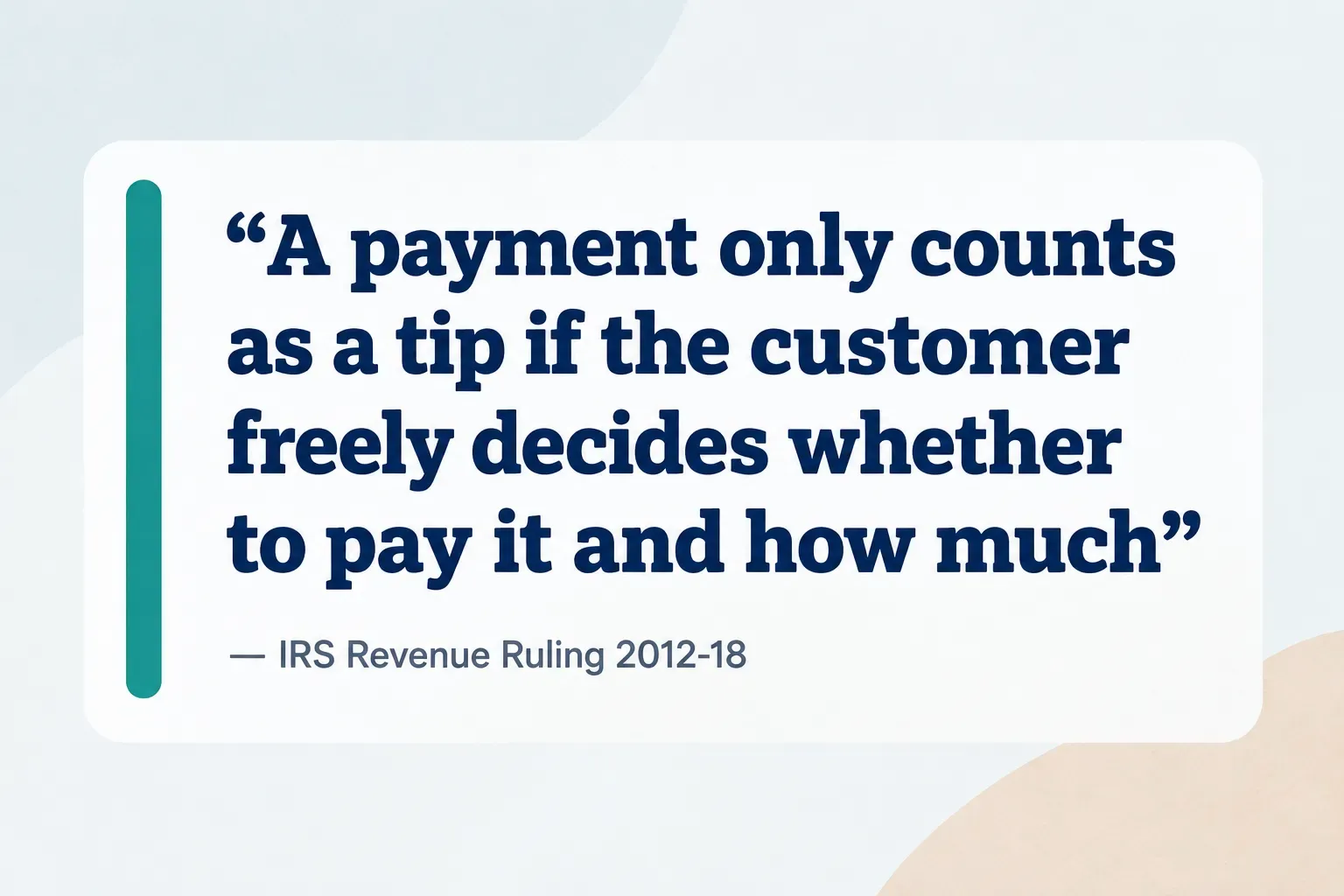
Under Revenue Ruling 2012-18, a payment only counts as a tip if it’s made free from compulsion, the customer has the unrestricted right to decide the amount, it isn’t negotiated or dictated by business policy, and the customer generally decides who receives it.
That means a service charge added to an invoice isn’t a tip at all.
It’s part of the contractor’s revenue, taxed as regular wages or business income. Only a voluntary gratuity qualifies as a true tip, and the federal tip deduction rules introduced in 2025 rely on the same voluntary-payment definition.
One more point matters here.
Withholding a tip is never the right response to poor work.
If the job is incomplete or defective, that’s a dispute over the written contract and scope of work, handled through the contractor, warranty claims, or your state licensing board… not through gratuity etiquette.
A decision framework: Who, how much, when
Percentages work beautifully for a $60 dinner.
They fall apart completely on a $40,000 addition.
A better approach to contractor etiquette uses flat, per-person amounts tied to the job type and the effort involved.
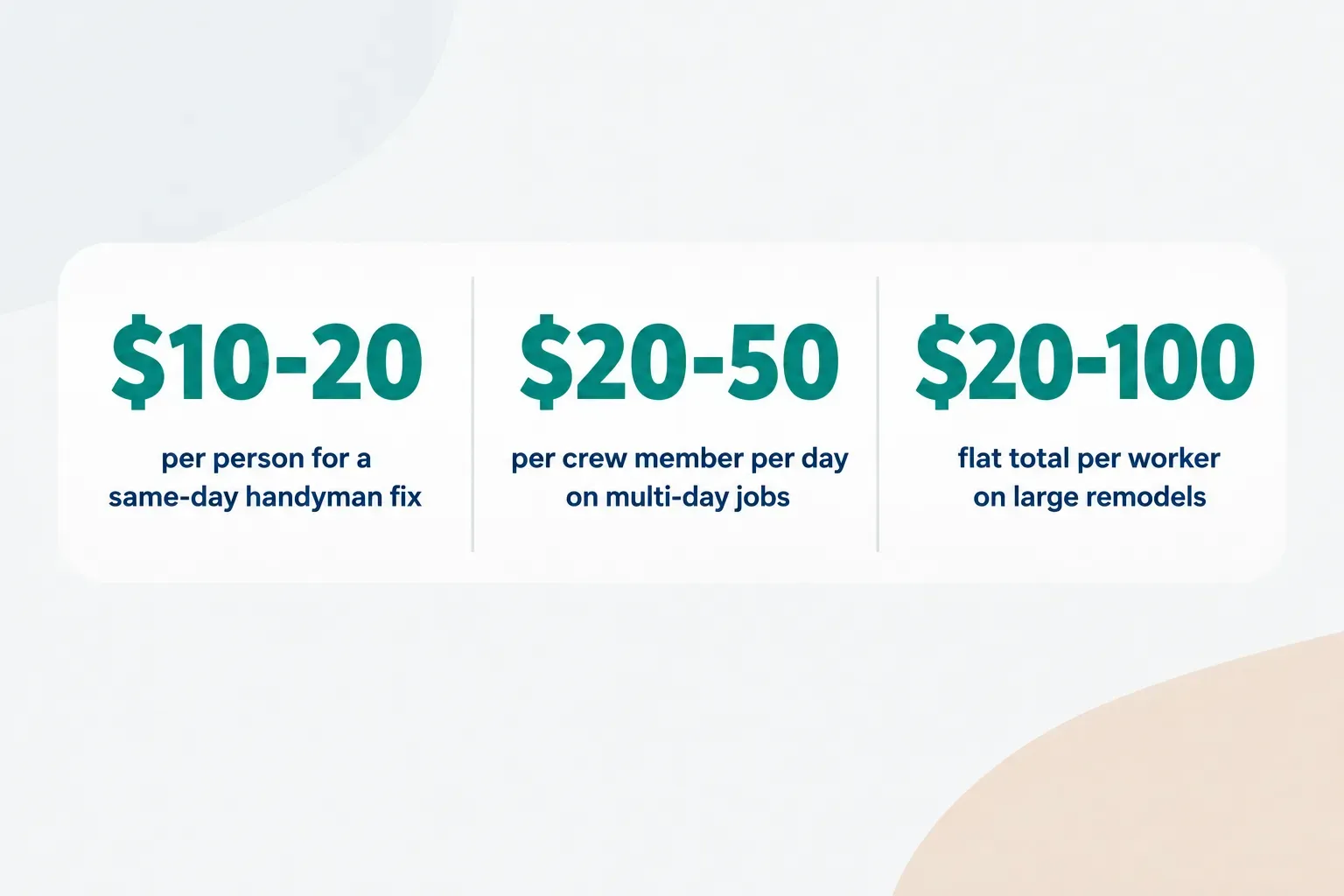
The table below summarizes typical ranges as of 2026. Treat them as ceilings for generous gestures, not minimums you owe.
| Scenario | Who Receives It | Typical Amount | Notes |
|---|---|---|---|
| Same-day handyman fix (1-4 hours) | The individual worker | $10-20 per person | Most common for small repairs done quickly and cleanly |
| Multi-day job with a crew | Each crew member | $20-50 per person per day | Usually given at the end rather than daily |
| Large remodel ($10,000+) | Crew members, with GC approval | $20-100 per worker total | Flat amount regardless of contract price |
| Solo owner-operator | The owner directly | $20-50, or a review instead | Owners set their own rates, so a tip is purely a bonus |
| Emergency service call after hours | The technician on site | $20-50 | Often already billed at a premium rate |
| Appliance or furniture installers | Each installer | $10-20 per person | More common for heavy lifting or stairs |
| Subcontractor on a GC-managed job | Individual sub or their crew | $20-50 per person | Check the general contractor’s policy first |
Business owner vs employee or subcontractor
Who you’re paying changes the math.
When you hire a solo owner-operator, every dollar of your invoice already flows to them. A tip rewards them directly, but it’s also the least necessary, because they set the price.
A general contractor running a crew is different.
The workers hauling drywall up your stairs may earn an hourly wage that’s a fraction of what you’re billed. A crew tip reaches them more meaningfully.
But some companies prohibit employees from accepting tips, often for liability or fairness reasons. Before tipping anyone on a GC-managed job, ask the general contractor.
A quick “Is it okay if I give the crew something at the end?” avoids putting workers in an awkward spot. The same courtesy applies to any subcontractor brought in for electrical, plumbing, or tile work.
Small repair vs large remodel
For a quick fix, a handyman who replaces a garbage disposal in 45 minutes and cleans up afterward might get $10-20.
Simple.
Quick.
Nobody feels awkward.
Large remodels are where the 10-20% rule breaks.
A $50,000 kitchen at 15% would mean a $7,500 tip, which no contractor expects and no reasonable guide recommends. Instead, use a flat per-worker amount of $20-100 total, regardless of what the contract costs.
That keeps the gesture meaningful for the people doing the physical work without turning appreciation into a second invoice.
When extra effort justifies a tip
Baseline work, done well, is what you paid for.
A tip makes the most sense when someone clearly exceeds that. Common triggers include:
- Working through bad weather: a roofing crew finishing in 95°F heat or pushing through rain to seal your home before a storm.
- Emergency after-hours fixes: a plumber stopping a burst pipe at 11 p.m. on a holiday weekend.
- Going beyond scope at no charge: fixing a loose railing or sticky door they noticed while working, without adding it to the bill.
- Finishing early without cutting corners: wrapping up days ahead of schedule while still passing inspection.
When you do tip a crew, hand cash to each member directly if you can.
If that’s not practical, give a sealed envelope to the lead with clear instructions: “This is for the whole crew, split evenly.” Labeling the envelope with the amount and number of people removes any ambiguity.
Tips vs bonuses vs extra payments
Not every extra dollar you hand a contractor is a tip. And mixing up the categories can create headaches with taxes, documentation, and even your warranty.
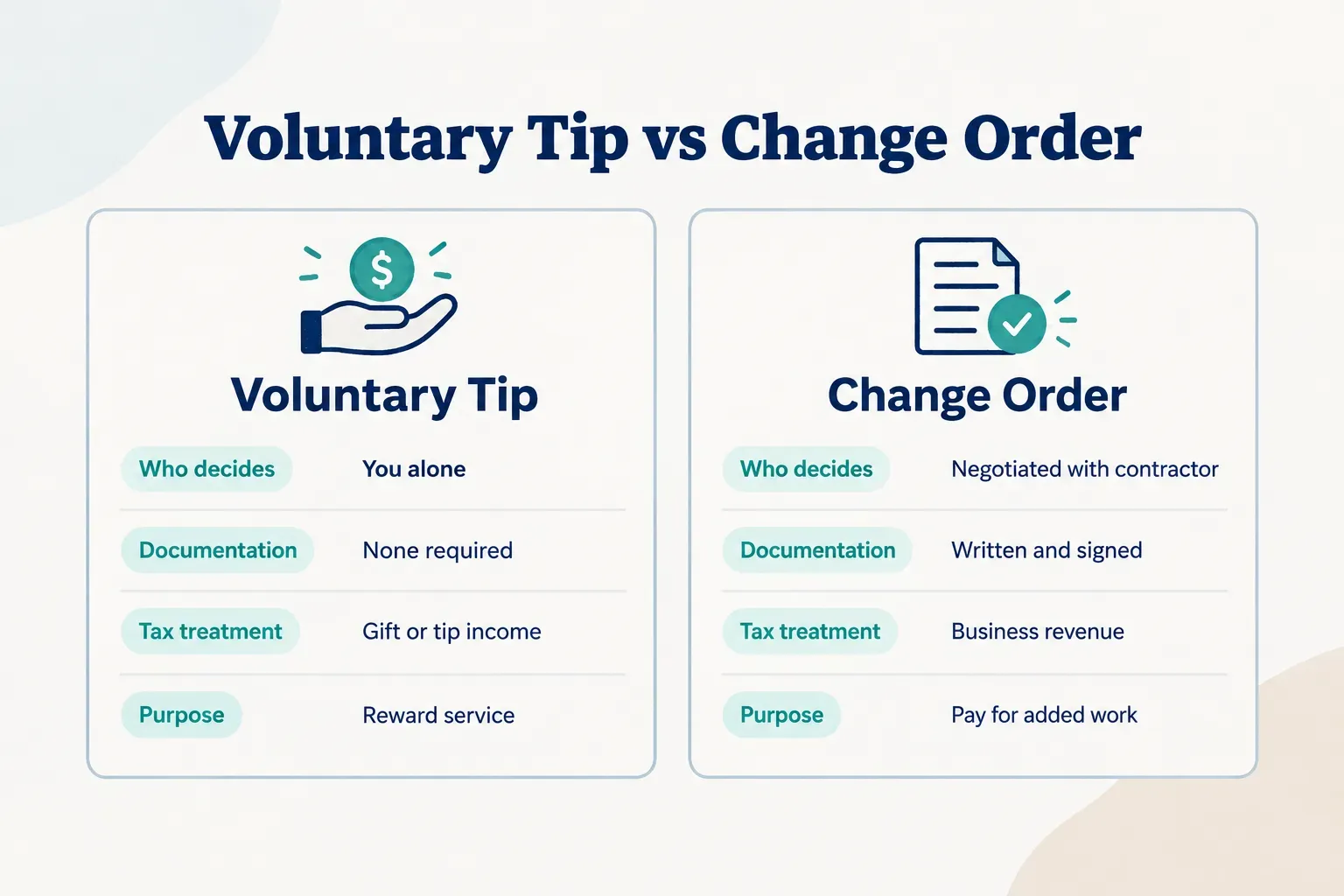
A voluntary tip is a gift for service, decided entirely by you.
A change order is a documented, negotiated adjustment to the contract when scope changes, like adding recessed lighting mid-project.
A contractual bonus clause is written into the agreement upfront, often rewarding early completion on commercial or large residential jobs.
An invoice adjustment covers additional work performed and billed.
Why does this matter?
If a contractor adds work, it should appear on a change order, not get settled with an informal “thank you” payment. Proper contractor payment records protect you if something fails later and you need to prove what was agreed.
Digital payment systems add another wrinkle.
Many contractors now use invoicing apps that display a tipping prompt with preset options like 15%, 20%, or 25%. Some invoices include a “gratuity” line already filled in.
Handle these calmly:
- Verify whether the tip line is optional. On most apps, there’s a “no tip” or “custom” option.
- Ask directly if you’re unsure. “Is this gratuity line required, or optional?” is a perfectly reasonable question.
- Confirm the final total before you tap “pay,” especially on large invoices where a default percentage adds up fast.
A preset 20% prompt on a $3,000 invoice suggests a $600 tip.
That’s software defaults talking, not contractor etiquette.
If a contractor asks for a tip
A direct request for a tip, whether spoken or written, is a professionalism red flag.
Reputable contractors price their work to cover their costs and profit. Asking for more at the end signals either poor pricing or poor boundaries.
You’re not obligated to pay.
A polite “We’ve paid the agreed amount, and we’ll be sure to leave a review” is enough. If the request felt pushy, mention it factually in your review so future homeowners know what to expect.
That said, context matters.
A crew member casually mentioning that tips are welcome isn’t the same as a line item demanding one.
Use your judgment.
Settle disputes before you reward anyone
Never tip before the job is actually done. That includes the punch list, the final inspection, and any cleanup.
If there are warranty issues, incomplete items, or delays that haven’t been explained, resolve those first.
A tip should never substitute for finishing the agreed scope, and it can muddy the waters if you later need to dispute workmanship. Handing over $200 in goodwill and then filing a complaint two weeks later sends mixed signals.
Pay what’s owed. Fix what’s broken. Then decide whether anyone earned something extra.
Better ways to show appreciation
Ask most contractors what they’d rather have, $50 in cash or a glowing review, and plenty will pick the review. A single referral can turn into a $15,000 job.
That’s worth more than any tip you could reasonably give.
For small businesses in the trades, word of mouth drives a huge share of new work. Your appreciation can have lasting impact without costing a cent.
Non-cash gestures that matter
These options often do more for a contractor’s business than a cash tip:
- A detailed written review naming the crew: A positive online review that mentions specific people (“Marcus and Dee rebuilt our deck stairs perfectly and left the yard spotless”) helps the company and recognizes individuals. Specific reviews also carry more weight with future customers than generic five-star ratings.
- A referral to neighbors or a homeowners group: Posting a recommendation in a neighborhood forum or HOA group puts the contractor in front of people with similar homes and similar projects. One good referral can fill a contractor’s calendar for weeks.
- Serving as a reference call: Offer to take calls from prospective clients. Many homeowners want to talk to a real past customer before signing a large contract, and a willing reference is rare and valuable.
- A professional testimonial: A LinkedIn-style testimonial or a short written statement the contractor can use on their website or marketing materials gives them lasting, reusable proof of quality.
- Before-and-after photos with permission: Letting the contractor photograph the finished work for their portfolio costs you nothing and helps them win similar jobs.
Hospitality without obligation
Small courtesies make long jobs more pleasant for everyone. They don’t replace payment, and they shouldn’t feel like a requirement.
Think of them as basic good-host behavior:
- Water and restroom access: Offering bottled water and letting the crew use a designated bathroom is simple, practical, and widely appreciated. Just let them know upfront which bathroom they can use.
- Morning coffee on long jobs: A pot of coffee on the first day of a multi-week remodel sets a friendly tone. You don’t need to repeat it daily.
- Cold drinks on hot days: For roofing, landscaping, concrete, or any physically demanding outdoor work, a cooler of cold drinks in summer heat is one of the most appreciated gestures you can make.
- Lunch on a big day: Ordering pizza or sandwiches on a multi-day job, especially the final day or a particularly grueling one like demolition, is a generous, optional thank-you.
Much of the pressure homeowners feel around tipping comes from ambiguity. When you don’t know what’s included, what’s customary, or what the contractor expects, you default to guessing.
And guessing leads to overthinking.
Transparent pricing removes most of that stress.
Upfront written estimates, documented scope, and a visible review history (as offered on platforms like Frendex) set expectations before work begins. When you know exactly what you’re paying for and can see how past customers rated the job, the end-of-project moment becomes simple: pay the invoice, then decide whether a review, a referral, or a small cash tip feels right.
The bottom line on tipping contractors
So, do you tip contractors?
Only if you want to.
Tipping is a discretionary bonus for exceptional service, never an obligation tied to the contract price. The price you agreed to already covers labor, overhead, and profit.
Here’s the simple rule to remember:
- If the work met scope and price expectations, a sincere review or referral is enough.
- If someone went visibly above and beyond (braving a storm, fixing an after-hours emergency, handling extra tasks for free), a modest per-person cash tip is a fitting thank-you.
That’s it.
No percentages, no guilt, no second invoice.
Next time you start a project, set clear expectations upfront. Get a written estimate, insist on transparent pricing, and document the scope of work before anyone picks up a hammer.
When everyone knows the terms from day one, the question of how to show appreciation stops feeling stressful.
It becomes a simple, generous choice you make on your own terms.
Frequently asked questions
Are you supposed to tip contractors at the end of a job?
No, you're not supposed to tip contractors as a rule. Tipping is optional and reserved for exceptional service. If you do tip, the end of the job is the right time, after the punch list is complete and you're satisfied with the work.
How much do you tip a contractor for good work?
A reasonable tip for good work is $10-20 per person for small jobs and $20-100 per worker total for larger projects. Skip percentage-based tipping on big remodels, since 10-20% of a five-figure contract becomes unreasonable. Scale up only when someone clearly went above and beyond.
Do you tip a general contractor or the workers?
Tip the workers rather than the general contractor, since the GC already earns a profit margin built into your contract. Crew members and laborers benefit more directly from a cash tip. Always check the GC's policy first, because some companies don't allow employees to accept tips.
Do you tip plumbers and electricians?
Licensed plumbers and electricians rarely expect tips, because their rates already reflect specialized training and licensing. A tip is most appreciated for an emergency service call late at night, on holidays, or in harsh conditions. For routine visits, a thank-you and a review are plenty.
Is it better to give contractors cash or a gift card?
Cash is usually better for individual workers because it guarantees they receive the full value immediately. Gift cards work well when you want to thank a whole crew, such as a restaurant card they can share. Either way, hand it directly to the people you're thanking whenever possible.
What do you give contractors instead of a tip?
The most valuable alternatives to a tip are a detailed online review, a referral, or an offer to serve as a reference. These help a contractor win future work, which often matters more than a one-time cash gift. Cold drinks or lunch on long, physically demanding jobs are also well received.
Need a hand with something?
The Frendex map shows you who is available near you, in real time.
Get the app free Get the app freeFree, no card needed
Related articles

How to hire a contractor without getting burned
A step-by-step process for vetting bids, licenses, and contracts, plus the one paper trail habit most homeowners skip until it costs them.

How does TaskRabbit actually work?
See exactly how TaskRabbit's booking flow, real fees, and cancellation rules work in 2026, plus why Taskers set their own rates. No surprises at checkout.

How much to tip in 2026: A clear decision guide
A percentage-vs-flat-fee framework covering 20+ scenarios, from tipping apps to movers. No more guessing when the screen flips to you.