A referral program playbook for small business owners
By Kiss János 15 min read
Contents
- A referral program playbook for small business owners
- A referral program playbook for small business owners
- Why referrals still outperform ads
- What a referral program actually is
- Pricing a reward without losing money
- Building a no-software referral system
- Protecting program integrity
- Start with one satisfied customer
- Frequently asked questions
A referral program playbook for small business owners
A referral program playbook for small business owners
Why referrals still outperform ads
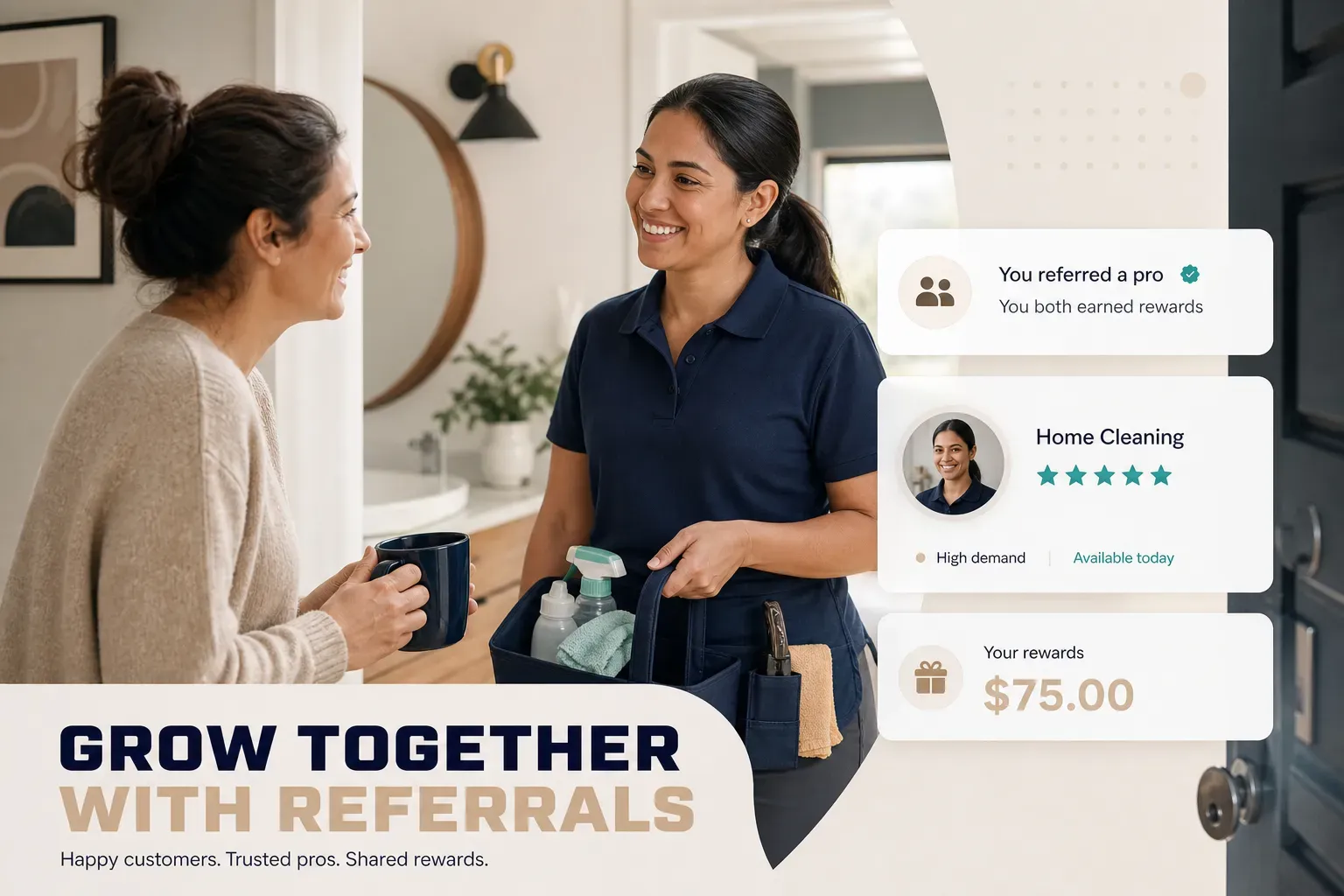
A referred customer doesn’t arrive skeptical.
They arrive pre-sold, because someone they already trust did the vetting for them.
That transfer of trust is the whole engine.
When a friend says “call this guy, he fixed my deck in a day,” the prospect skips the comparison-shopping phase entirely. Studies on word-of-mouth marketing consistently find referred customers close at higher rates, negotiate less on price, and stay loyal longer than customers acquired through paid channels.
Most referral guides stop at the fun part. Here’s a list of reward ideas, good luck.
What they skip is everything that determines whether the program makes or loses money: the unit economics of the reward, the timing of the ask, the quality of the leads coming through, and the fraud that shows up the moment you start paying cash.
This playbook is written for people without a marketing department.
Solo operators. Two-person cleaning crews. Barbers, physiotherapists, freelance designers, mobile mechanics, local landscapers.
If your advertising budget is measured in hundreds rather than thousands, a well-designed referral program for small business is likely the highest-return channel available to you.
But only if you build it deliberately.
An informal “tell your friends about us” produces informal results. A structured program with tracking, qualification rules, and a reward priced against your gross profit margin produces a predictable stream of qualified leads at a fraction of your usual customer acquisition cost.
The difference between those two outcomes is about four hours of setup work.
That’s what the rest of this guide covers.
What a referral program actually is
Word of mouth is what happens anyway.
A referral program is what happens when you decide to systematize it.
A referral program is a structured system that rewards an existing customer, partner, or contact for introducing a new paying customer to your business.
The key word is structured.
There’s a defined trigger for asking, a defined way to track the introduction, a defined qualification threshold, and a defined reward.
Ad-hoc word of mouth has none of that.
It’s pleasant, unpredictable, and impossible to scale on purpose. You can’t forecast it, you can’t improve it, and you can’t tell whether last quarter’s 12 new clients came from three loyal advocates or twelve unrelated conversations.
How the referral loop works
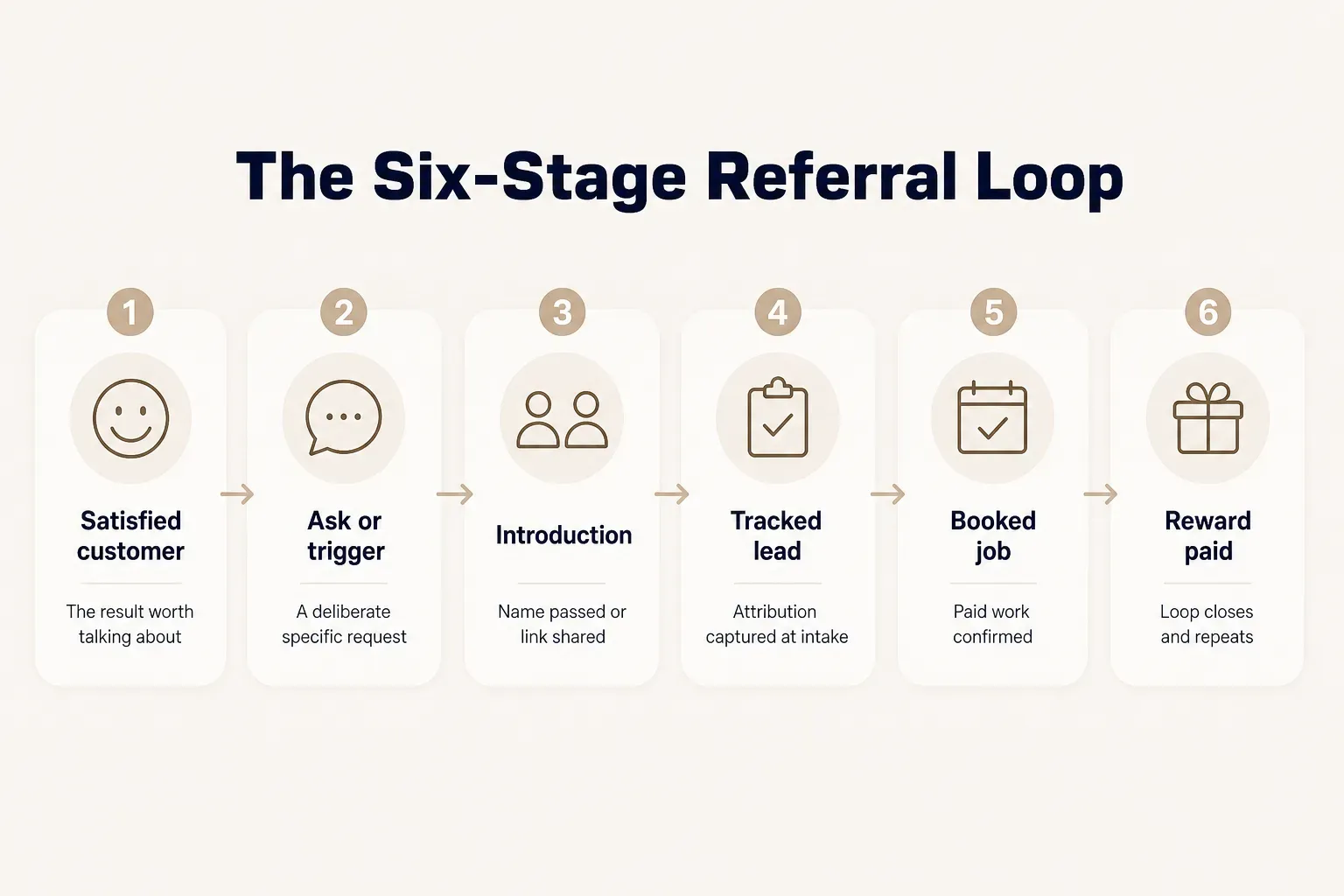
Every functioning program runs the same six-stage loop.
Break any link and the chain stops producing revenue.
It starts with a satisfied customer. Not a neutral one. Someone who got a result they’d happily describe to a friend.
Then comes the ask or trigger, a deliberate moment where you request the introduction or an automated message does it for you.
The introduction follows: a text, a forwarded email, a name dropped at a dinner party, or a referral link shared in a group chat. That introduction has to become a tracked lead, which is where most small businesses lose the thread.
If you can’t attribute the lead back to its source, you can’t reward it, and the loop dies.
Then the booked job, the actual paid work. And finally, the reward paid, which closes the loop and signals to the referrer that referring you is worth doing again.
Worth separating referral programs from affiliate programs, because people conflate them constantly.
A referral program runs on personal trust: your customers introduce people they actually know, usually for a one-time or occasional referral incentive. An affiliate program is a commercial marketing arrangement, often with strangers, paying ongoing commission on volume.
Affiliates are salespeople you don’t employ. Referrers are customers doing you a favour with a thank-you attached.
Different motivations, different economics, different rules.
Are they worth it for small businesses
For most local service businesses, yes, and by a wide margin.
Three reasons.
First, cost.
A referral reward is paid only after revenue arrives, which makes your customer acquisition cost both lower and entirely variable. Compare that to ad spend, which bills whether or not anyone converts.
Second, conversion rate.
Referred prospects arrive with the objection-handling already done. They ask fewer questions about price and more about scheduling.
Third, independence.
You don’t own your Google Ads account performance or your Instagram reach. Algorithm changes have wiped out small businesses overnight.
A referral network is an asset you actually control.
The catch: referral quality and volume must be measured, not assumed. A program you can’t count is a story you tell yourself, not a channel.
Pricing a reward without losing money
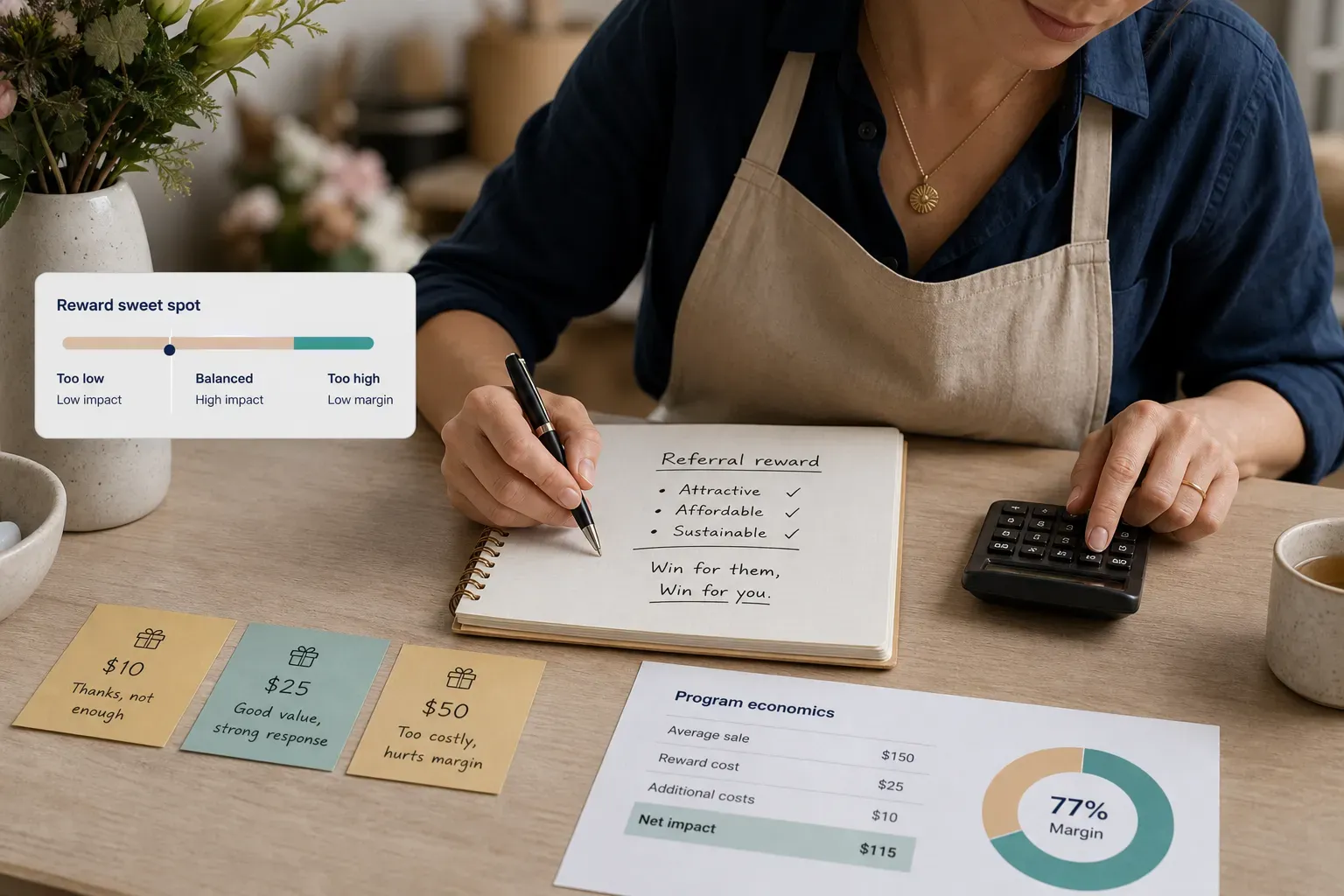
The fastest way to kill a referral program is to be too generous. The second fastest is to be too stingy.
Getting the number right requires arithmetic, not instinct.
Your reward ceiling is a function of what a customer is actually worth to you, discounted by the probability that a given referral converts.
Most owners skip that second part and overpay.
A profit-safe reward formula
Work through this before you promise anyone anything.
- Start with gross profit per customer, not revenue. If a job bills at $400 and your materials and labour cost $250, your gross profit is $150. Rewards come out of that $150, not the $400. This single distinction prevents most referral program disasters.
- Apply your lifetime value multiplier. If the average customer books 3.5 times before churning, your customer lifetime value in gross profit terms is roughly $525. A one-off emergency plumbing call has a multiplier close to 1. A monthly lawn service might be 20 or higher.
- Multiply by a realistic referral-to-close conversion rate. Not every introduction books. If 60% of referred leads become paying customers, your expected value per referral is $525 x 0.60 = $315. That’s your absolute theoretical maximum.
- Cap the reward at 10 to 20 percent of that expected value. In this example, $30 to $60. The program should feel like a rounding error against margin, not a profit-sharing arrangement.
- Stress-test at your worst case. Ask what happens if referral volume triples next month and half of those customers never return. If the program still nets positive at that scenario, the number is safe.
- Recalculate quarterly. Costs move. A reward priced against 2024 margins may be underwater by 2026 if your materials costs rose 15% and you never adjusted.
One more warning that deserves its own paragraph: large cash bonuses and steep discounts attract the wrong customers.
Offer 50% off a first visit and you’ll recruit a population of deal-hunters who churn the moment a competitor undercuts you. They drag down your repeat purchase rate and inflate your servicing costs.
A modest reward filters for genuine advocacy.
Cash, credit, or something else
Cash isn’t always the strongest motivator, and it’s rarely the cheapest.
The first structural decision is single-sided versus double-sided.
A single-sided reward pays only the referrer. A two-sided referral reward gives something to both the referrer and the new customer.
- Use single-sided when trust transfer does the heavy lifting. For high-trust categories like childcare, healthcare, home repair, or personal training, the recommendation itself is persuasive enough. Adding a new-customer discount just cheapens the introduction.
- Use two-sided for low-trust or infrequent purchases. If someone needs a reason to try an unfamiliar provider, a first-visit incentive removes the risk. Also effective for categories where the buyer has no urgent need and needs a nudge on timing.
- Priority booking slots. For anyone with a waitlist, this costs nothing and signals genuine status. “Refer someone and you get first pick of next month’s schedule” is often more appealing than $25.
- A free add-on service. The interior detail with a car wash, the extra room with a cleaning, the follow-up consult after a project. Your cost is marginal; the perceived value is full retail.
- Public recognition. Naming a customer in your newsletter or tagging them in a social post builds customer advocacy and costs zero. It works best with clients who have their own audience.
- A charitable donation in their name. Highly effective in professional services and among clients who’d feel awkward accepting cash from a supplier. $25 to a local shelter often outperforms $25 in credit.
- A reciprocal introduction. Connect them to another trusted provider in your network. For B2B and freelance work, this is frequently the single most valuable thing you can hand someone.
Building a no-software referral system
You do not need referral software to run a referral program.
You need a spreadsheet, a single intake question, and the discipline to ask at the right moment.
When to actually ask
- Immediately after a five-star review. Someone who just publicly praised you is in the peak advocacy window. Reply with thanks and add one line: “If you know anyone else dealing with this, I’d appreciate the introduction.” Conversion on this ask is the highest of any moment.
- At job completion, on site. The work is visible, the relief is fresh, and you’re standing in front of them. Waiting three days to send an email loses most of that emotional charge.
- At the moment of a repeat booking. A customer rebooking has just re-confirmed their own decision to use you. That’s a natural bridge: “Glad to have you back. Who else should I be helping?”
- After a visible result. Before-and-after photos, a hit weight-loss milestone, a website launch. Ask when you send the proof, because the proof is the thing they’ll forward.
- Never mid-complaint, and never before the work is done. Asking for a referral while a customer has an unresolved problem damages the relationship and produces nothing. Fix the issue, wait for the recovery, then ask two weeks later.
Tracking referrals by hand
Manual methods
- Build a seven-column sheet. Date, referrer name, referred contact, source, status, reward owed, reward paid. That’s the whole system. Anything more elaborate will go unmaintained by week three.
- Define your status stages precisely. Use lead, qualified, booked, completed, retained. A casual mention at a barbecue is a lead. A person who paid an invoice and rebooked is retained. Treating those identically is how businesses end up paying rewards on revenue that never materialised.
- Pay only at “completed.” This one rule eliminates the majority of referral fraud and disputes. Make it explicit in your program terms so nobody is surprised.
- Add one intake question everywhere. “Who sent you our way?” on your booking form, in your phone script, on your quote template. Free-text field, always asked, no exceptions. This single question handles most offline referral attribution.
- Use a dedicated field in your CRM or booking tool. A required dropdown beats an optional note. If the field can be skipped, it will be.
- For online traffic, use UTM parameters or a referral code. Give advocates a tagged referral link or a short code to mention. UTM parameters let you see exactly which advocate drove which session in your analytics.
- Reconcile weekly, not monthly. Fifteen minutes every Friday. Memory of “who mentioned what” decays fast, and a month-old unattributed lead is usually unrecoverable.
When a booking app helps
- When your volume passes roughly 30 bookings a month. Below that, a spreadsheet is genuinely faster. Above it, manual reconciliation starts eating an hour a week.
- When the platform already captures relationships. Booking platforms like Frendex give service providers a guest-card system alongside full booking history, so the record of who introduced whom is captured as part of normal operations rather than as a separate admin task.
- When you need history, not just a snapshot. Seeing that a client has booked eleven times and brought three people with them changes how you treat that relationship. Spreadsheets rarely surface that.
- When multiple people take bookings. The moment two staff members answer the phone, a shared system stops attribution from falling through the cracks.
Different approaches by business type
The mechanics are universal. The timing is not.
Appointment-based businesses (salons, clinics, studios) should ask at checkout, while the client is already at the desk and the appointment just ended well. Hand over a physical card with a referral code on it.
Physical cards still outperform digital for walk-in trades.
Home-service providers should ask when presenting completion photos. The photo is the referral asset, and you’ve just given the customer something worth forwarding to a neighbour with the same problem.
Freelancers and professional services with long sales cycles should ask at project milestones, not only at the end. A six-month engagement has three or four natural high points; the final invoice is often the least emotionally positive moment of the whole project.
Online businesses should embed the referral link directly in the post-purchase email, sent at the moment of highest satisfaction, and repeat it in the delivery confirmation.
Two touches, both automated.
Protecting program integrity

Introduce money into any system and somebody will try to game it.
Usually within the first month.
Stopping fraud and self-referrals
The warning signs are consistent across industries.
Watch for duplicate contact information, the same phone number or address appearing under two names. Watch for multiple claims originating from the same IP address or device.
Watch for employees referring themselves through a partner’s account. And watch for accounts created minutes before a reward claim, or submissions with no real engagement: no consultation booked, no questions asked, no follow-through.
The safeguards are simpler than the fraud.
Require a completed and paid booking before any payout, which removes the incentive for fake submissions entirely. Cap rewards at three or four per referrer per month, so an organised abuser can’t drain the budget before you notice.
Verify the referred customer is genuinely new to the business.
Existing customers rebooking under a friend’s referral code is the most common form of leakage, and it’s usually accidental rather than malicious. Write these rules into your program terms in plain language and apply them without exception.
Disclosure and legal basics
Referrers should tell the people they’re introducing that an incentive exists.
That’s the baseline ethical standard, and in many jurisdictions it’s also the legal one for paid endorsements.
There’s a meaningful line here.
Rewarding an honest introduction is legitimate customer advocacy. Paying for a public review or testimonial without disclosure is a different thing entirely, and regulators in the US, UK, and EU have all tightened enforcement on undisclosed paid endorsements since 2023.
Never tie a reward to a positive review specifically.
One last risk that isn’t legal but is existential.
Track referrals as a percentage of total new customers, and keep an eye on that ratio. If more than 60 to 70 percent of your pipeline comes from one channel, you’re one relationship breakdown away from a serious problem.
Diversify deliberately: local search visibility, review volume, and partnerships with adjacent providers.
Referrals should be your best channel, not your only one.
Start with one satisfied customer
Don’t build the whole system today.
Pick one recent job that went well and ask that customer this afternoon.
Use a specific script, not a vague one.
“Most of my work comes from recommendations. If you know anyone dealing with the same issue, would you pass on my number?”
Specific requests get specific answers; “tell your friends” gets nodding and nothing.
Then log it.
Name, date, who they mentioned, what happened.
One row in a spreadsheet is a referral program.
Everything else in this guide is just refinement.
Remember what a referral program can and cannot do.
It amplifies an already-strong customer experience. It cannot rescue a weak one, and launching a program while your reviews are mediocre mostly accelerates the spread of that reputation.
Here’s your decision cue.
If your business has frequent repeat customers, start single-sided cash or credit rewards now, priced at 10 to 20 percent of expected gross profit. If your work is high-ticket or infrequent, start with non-monetary recognition, priority access, or reciprocal introductions, and test a cash reward only after you’ve seen how referral quality behaves.
One customer. One ask. Today.
Frequently asked questions
How do I set up a referral program for my small business?
Set it up in four steps: calculate a profit-safe reward from your gross profit, choose one asking moment, create a seven-column tracking sheet, and add "who sent you our way?" to every intake conversation. You can complete all four in an afternoon with no software. Start asking the next day and refine the reward after your first ten referrals give you real conversion data.
What is the best referral program for a small business?
The best program is the simplest one you'll actually maintain, which for most small businesses means a single-sided reward paid after a completed job, tracked manually. Complex tiered structures and gamified point systems look impressive and get abandoned. A $40 reward, one clear rule, and a spreadsheet outperforms a sophisticated system nobody updates.
How much should I give someone for referring a customer?
Between 10 and 20 percent of the expected gross profit from a referred customer, which for most local service businesses lands between $25 and $75. Calculate it as gross profit per customer, multiplied by your lifetime value multiplier, multiplied by your referral-to-close rate, then take 10 to 20 percent of that figure. Going higher attracts price-driven customers who churn quickly.
Are referral programs effective for small businesses?
Yes, and they typically deliver the lowest customer acquisition cost of any channel available to a small business, because rewards are paid only after revenue arrives. Effectiveness depends on customer experience first and program design second. A referral program amplifies whatever reputation you already have. If the underlying service is mediocre, no incentive structure will fix that.
What are some examples of referral incentives?
Effective incentives include account credit, priority booking slots, a free add-on service, a charitable donation in the customer's name, public recognition, and reciprocal introductions to other trusted providers. Non-monetary rewards frequently outperform cash in professional services and high-trust categories, where accepting money from a supplier can feel awkward. Cash and credit work best in high-frequency consumer businesses.
How do small businesses track customer referrals?
Most track referrals with a spreadsheet containing date, referrer, referred contact, source, status, reward owed, and reward paid, combined with a mandatory intake question. For online traffic, add UTM parameters to unique referral links or issue a simple referral code per advocate. Once volume passes roughly 30 bookings a month, a booking platform that stores client history and guest records handles attribution with less admin overhead.
Need a hand with something?
The Frendex map shows you who is available near you, in real time.
Get the app free Get the app freeFree, no card needed
Related articles
A no-show policy that protects your business
A 5-part no-show policy framework, not a copy-paste template. Learn what to charge, when to waive it, and how to cut missed appointments fast.
A service business's guide to bad reviews
Not every 1-star review deserves an apology. Get the 6-category decision tree for replying to bad reviews without looking guilty or defensive.

Your practical roadmap to becoming self-employed
A step-by-step path to going self-employed: testing your idea, setting rates, and handling tax, without quitting your job on day one.