A no-show policy that protects your business
By Kiss János 13 min read
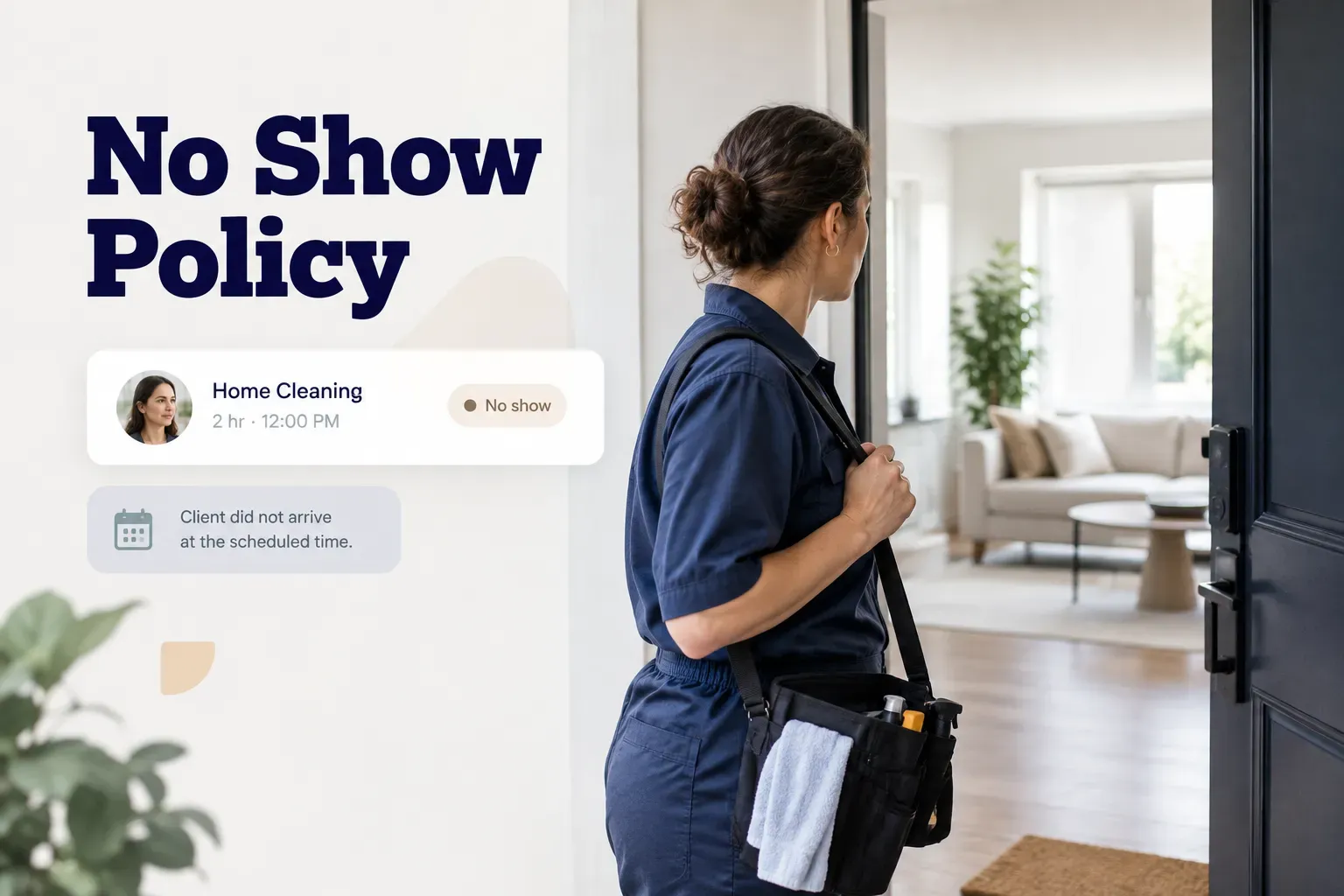
Why every appointment-based business needs this
An empty chair costs more than it looks.
When a client skips a 90-minute appointment, you lose the fee. You also lose the prep time, the supplies you set out, and the chance to give that slot to someone who actually wanted it.
For a solo provider, a few missed appointments a month can erase a full day of income. For a busy studio, a steady no-show rate of even 10% quietly drains thousands of dollars a year.
And the worst part? Most of those misses were preventable.
A good no show policy is not just a fee.
It is a system with five parts: clear disclosure at booking, reminders before the visit, easy rescheduling, fair exceptions, and consistent follow-up. The fee sits at the end of that chain, and in a well-built system you rarely need to collect it.
Here’s the problem with most templates you’ll find online. They copy a healthcare clinic’s rules or a generic “24 hours or pay in full” line.
That works poorly for a mobile dog groomer who drives 40 minutes per job, a tutor running 30-minute sessions, or a lash artist who blocks out three hours for a full set.
A policy copied from someone else’s business protects someone else’s business. Yours needs rules built around your time, your costs, and your clients.
So instead of a copy-paste template, this guide gives you a decision framework. You’ll define what counts as a no-show, pick a cancellation window that fits your services, choose between deposits and fees, and communicate it all without sounding like a debt collector.
What actually counts as a no-show?
Not every missed appointment is a no-show.
Treating a client who called two hours early the same as one who vanished without a word is the fastest way to lose loyal customers and invite chargebacks.
There are five distinct events to separate.
Each deserves its own rule, because each has a different cost to you and a different cause on the client’s side.
| Event | Definition | Typical Fee Treatment | Real-World Example |
|---|---|---|---|
| True no-show | Client does not arrive and gives no notice before or during the appointment time. | Highest fee, often 50% to 100% of the service price, or forfeited deposit. | A client books a 60-minute massage at 2 p.m., never arrives, and doesn’t answer calls. |
| Late cancellation | Client cancels, but inside your stated cancellation window. | Partial fee, commonly 25% to 50%, or a flat amount. | A tutoring client texts at 9 a.m. to cancel a 1 p.m. session under a 24-hour policy. |
| Late arrival | Client shows up after the start time, shortening or disrupting the service. | Shortened service at full price; treated as a no-show after a set grace period (often 15 minutes). | A haircut client arrives 20 minutes late for a 45-minute slot, so only a trim is possible. |
| Rescheduling | Client moves the appointment to a new time with advance notice. | Usually free outside the window; some providers allow one free late reschedule. | A client moves a Friday facial to the following Tuesday with three days’ notice. |
| Provider-caused cancellation | You cancel, reschedule, or run significantly late. | No client fee; many businesses offer a discount or priority rebooking as goodwill. | A mobile groomer’s van breaks down and they cancel three morning appointments. |
Why does this separation matter so much? Because lumping everything into one “missed appointment” bucket produces fees that feel arbitrary. A client charged the full no-show rate for canceling 20 hours out on a 24-hour policy will feel punished, not accountable.
That resentment shows up in reviews, disputes, and clients who simply never book again.
The last row matters too.
If your policy holds clients to a standard you don’t hold yourself to, it reads as one-sided. Stating what happens when you cancel builds trust fast.
Intent is the other half of the picture.
Most missed appointments are not deliberate. They fall into a few categories:
- Forgetfulness: the client booked three weeks ago and it slipped their mind. Reminders fix this.
- Unclear expectations: they didn’t know a fee applied or thought a same-day text counted as notice. Better disclosure fixes this.
- Booking friction: canceling required a phone call during business hours, so they just didn’t. A self-serve rescheduling link fixes this.
- Intentional no-shows: a small minority who double-book or don’t value your time. Deposits and progressive enforcement fix this.
Only the last group is really a fee problem.
The rest are communication and process problems, and fees won’t solve them.
Designing a policy that’s actually fair
The fairest policy is the one that matches your real cost of a missed slot.
Not your frustration.
Not what the salon down the street charges.
Your actual numbers.
Choosing your notice window
Your cancellation window is how much notice a client must give to cancel without a fee.
Too short, and you can’t refill the slot. Too long, and clients feel trapped by a plan they made weeks ago.
Weigh five variables when setting it:
- Service duration: a 3-hour block is much harder to backfill than a 20-minute one.
- Prep or supply cost: custom cakes, mixed color formulas, or printed lesson materials represent money already spent.
- Travel time: mobile providers lose the drive, the fuel, and the adjacent slots they arranged around the route.
- Demand for the slot: a Saturday morning with a waitlist is more valuable than a Tuesday at 3 p.m.
- Refill likelihood: if you can realistically fill a canceled slot within a few hours, a shorter window is fine.
As a starting point, a 2 to 4 hour window works for quick consults, short coaching calls, or walk-in-friendly services.
24 hours suits most standard appointments like haircuts, massages, and tutoring sessions.
48 to 72 hours makes sense for high-prep or multi-hour bookings such as bridal hair, extension installs, or full-day photography.
You can also tier your windows by service. One business can reasonably have a 4-hour rule for a brow tidy and a 48-hour rule for a color correction.
Just make sure each service shows its own rule at booking.
Deposits, cards on file, or fees
You have four main enforcement tools, and they suit different situations. The right choice depends on your service price and how well you know the client.
- Booking deposit: the client pays a portion upfront (often 20% to 50%), applied to the final bill. Best for high-ticket or high-prep services and for brand-new clients with no history.
- Card on file: the client saves a payment method at booking, authorizing a charge only if the policy is triggered. Good middle ground for mid-priced services and returning clients.
- Partial fee: a set percentage or flat amount charged after a late cancellation. Works well when the slot has some chance of being refilled.
- Full fee: the full service price for a true no-show. Reserve it for expensive, unrefillable slots, or for clients who’ve already missed before.
A deposit changes behavior before the appointment.
A card on file changes it only if the client believes you’ll actually charge it.
Is charging a no-show fee legal?
In most places, yes, a business can charge a no-show fee if the client agreed to it in advance.
But legality varies by jurisdiction, contract terms, and industry, so treat this as general guidance rather than legal advice.
Regulated healthcare needs extra caution.
Medicare does not pay for missed appointments, and providers who bill Medicare patients directly generally must apply the same policy to all patients equally. Medicaid rules in many states prohibit charging beneficiaries for missed appointments at all, so check your state’s rules and payer contracts before billing anyone.
A policy nobody saw is a policy you can’t enforce. Enforceability depends on clear advance disclosure, not on the fact that a rule exists somewhere on your website.
As of 2026, card networks and payment processors also side with customers in disputes when there’s no record of consent.
Keep proof that the client saw and accepted your terms before the appointment.
Telling customers without sounding harsh
The same policy can feel protective or hostile depending on when and how clients see it.
Timing does most of the work.
Show it before they book
Your policy should appear at the moment of booking or before payment confirmation.
Not buried in a footer.
Not explained in an awkward text after someone missed their visit.
Put a short summary right beside the “Confirm” button, something like: “Free cancellation up to 24 hours before. Late cancellations are charged 50%. Missed appointments are charged in full.”
Then include a required checkbox or explicit acceptance step, and store a timestamped record of that consent with the booking.
Repeat the same summary in the appointment confirmation message. That way the client sees it twice, and you have two pieces of documentation instead of one.
Plain language beats legal language every time.
Reminders that actually prevent no-shows
Reminders are the cheapest no-show prevention tool you have.
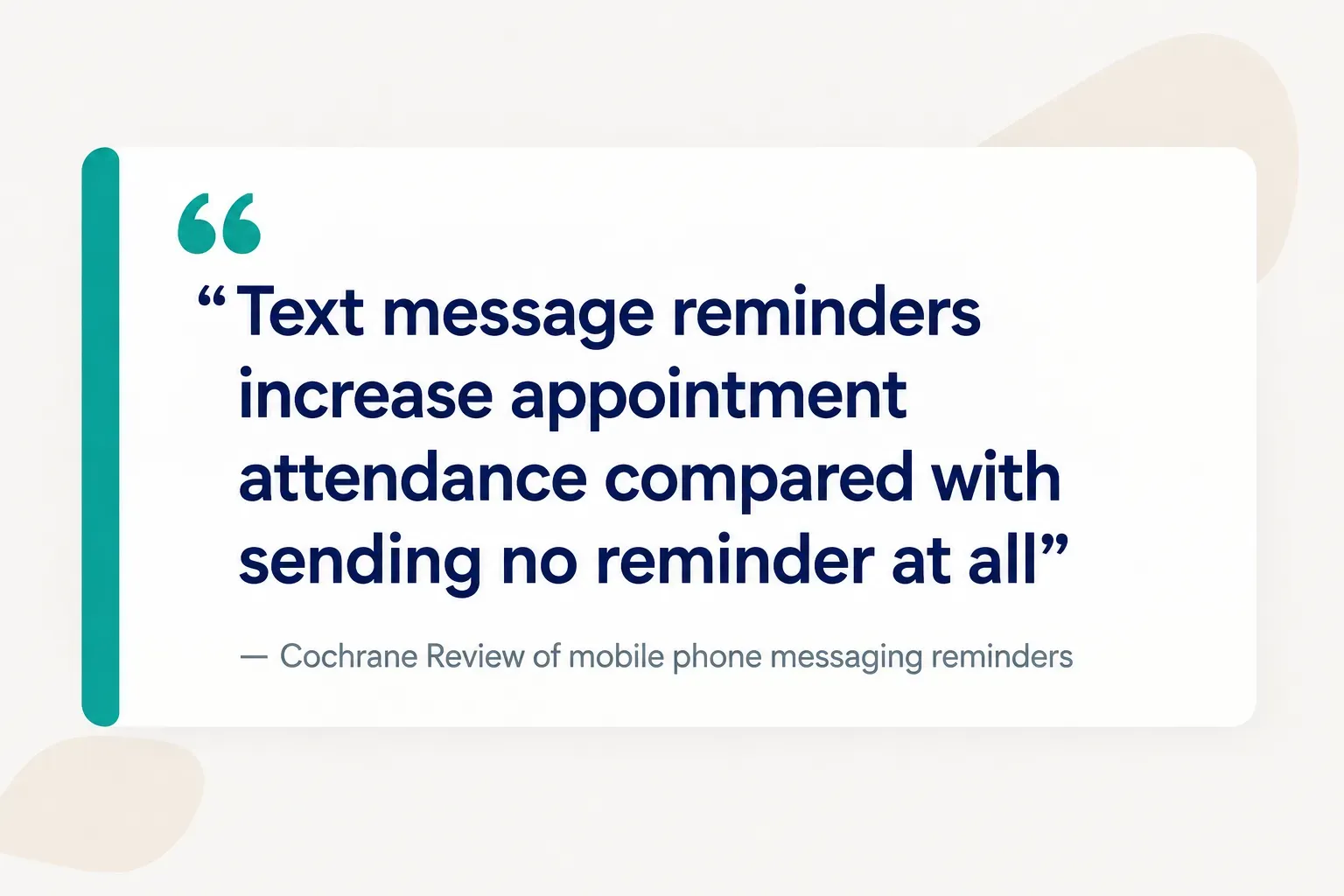
A Cochrane systematic review of mobile phone messaging found that text reminders increased appointment attendance compared with no reminder, and performed about as well as phone call reminders at a fraction of the cost.
One reminder is good.
Several are better.
Studies comparing reminder schedules have found that a sequence (for example, one message a few days out and another the day before) tends to outperform a single text, because it catches clients at both the planning stage and the “tomorrow” stage.
A practical cadence for SMS appointment reminders looks like this: a confirmation at booking, a reminder timed just before your cancellation window closes, and a short same-day nudge.
That middle message is the clever one.
It prompts clients to cancel while you can still refill the slot, which lifts your recovered appointment rate without a single fee.
Make rescheduling one tap
If canceling requires a phone call during business hours, some clients will simply not show up.
Friction breeds no-shows.
Every reminder should include a rescheduling link that lets the client pick a new time from your live service provider availability in seconds.
When moving an appointment is easier than ghosting it, forgetful and overbooked clients stop becoming no-shows. You get the slot back early and never need to act like the bad guy.
Frendex is a good example of this workflow in practice. Confirmations, reminders, and one-tap reschedule or cancel options live in one app for both the provider and the customer, so the client sees the same booking details you do and can change plans without a phone call.
The provider gets notified instantly and can offer the opened slot to someone else.
That shift, from punishing misses to preventing them, is what separates a policy clients respect from one they resent.
Handling exceptions and repeat offenders
A policy with zero flexibility sounds tough.
In practice, it just drives away good clients during their worst weeks. Build exceptions in from the start so you’re applying rules, not making emotional calls on the spot.
When to waive the fee
List your waivable situations in the policy itself. That signals fairness and saves you from debating each case.
Common legitimate exceptions include:
- Medical emergencies affecting the client or a dependent.
- Severe weather that makes travel unsafe, such as ice storms or flood warnings.
- Transportation failure, like a car accident, breakdown, or major transit outage.
- Accessibility barriers, for example a broken elevator or an inaccessible entrance at your location.
- Technical issues for virtual appointments, such as a platform outage on your end.
- Provider running late beyond your own grace period, which should always cancel any late-arrival penalty.
Many businesses also allow one courtesy waiver per client per year. It costs little and builds real goodwill.
Escalating after repeat no-shows
Progressive enforcement means your response grows with the pattern, not with a single slip.
Everyone forgets once.
Three misses is a habit.
- First no-show: send a friendly note restating the policy, and either waive the fee or charge it with a gentle explanation.
- Second no-show: require prepayment or a booking deposit for all future appointments.
- Repeat offenders: move them to same-day booking only, or restrict advance scheduling entirely.
Same-day booking is a smart final tier.
The client can still use your services, but only when a slot is already open, so their absence never costs you a prime spot.
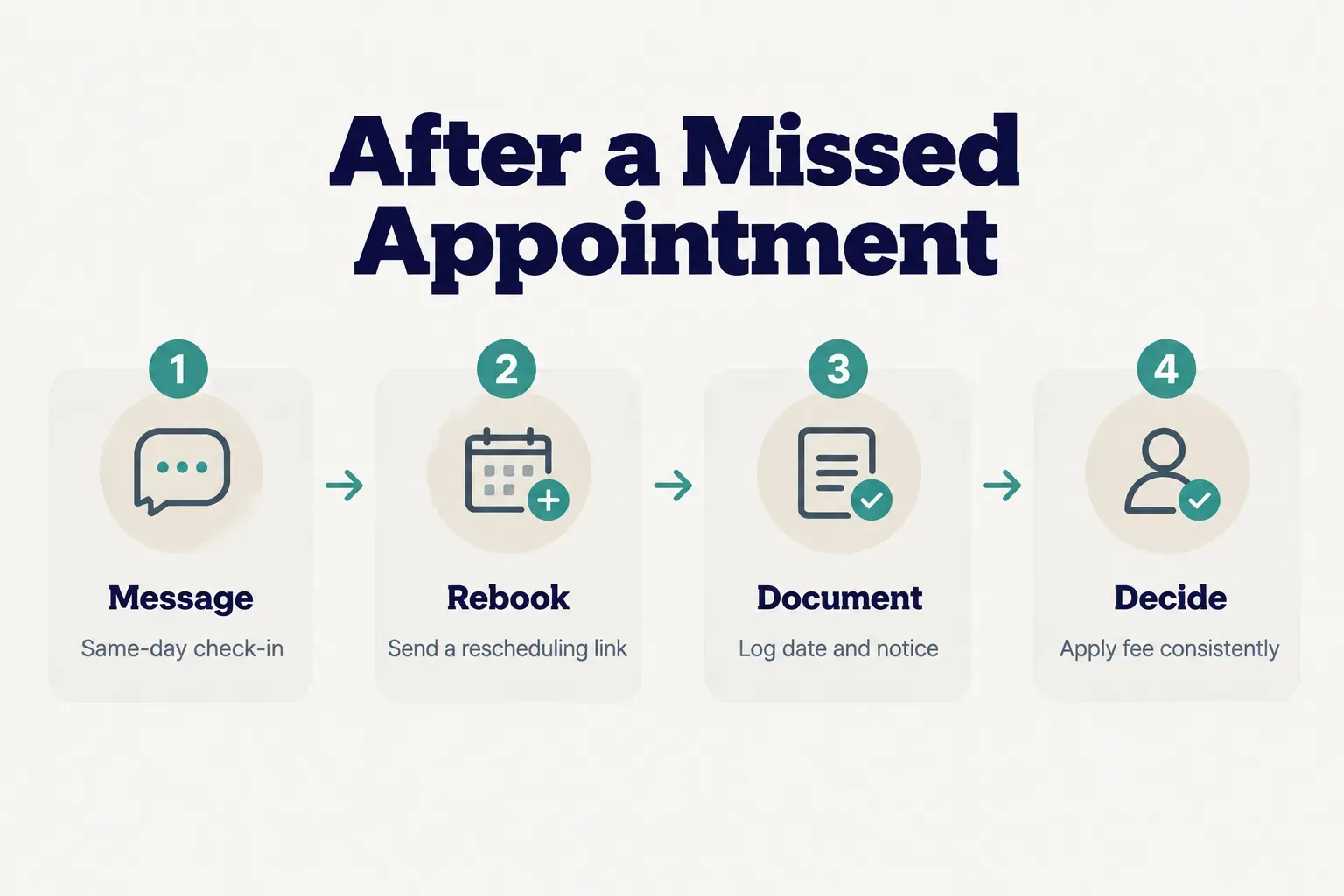
What to do right after a miss
The hours after a missed appointment set the tone for the whole relationship. Keep the process short and identical every time.
- Send a same-day message. Keep it warm and brief: “We missed you today. Hope everything’s okay.”
- Offer rebooking. Include a rescheduling link so returning is effortless.
- Document the incident. Log the date, service, any notice given, and the client’s response.
- Apply the fee consistently. Follow your written policy rather than deciding case by case based on mood or how much you like the client.
Consistency is what makes a policy defensible.
If you waive fees for charming regulars and charge quieter clients, word gets around.
Finally, measure whether the policy works. Track five numbers monthly: your no-show rate, late-cancellation rate, fee collection rate, repeat-booking rate, and complaints.
If no-shows drop but repeat bookings also fall and complaints rise, the policy is too strict.
If fees rarely get collected and no-shows stay high, enforcement is too soft… or disclosure isn’t landing.
Put the system in place tonight
You don’t need a lawyer or a new website to start.
You need about 20 minutes.
Write down your notice window and your fee amount. Add that exact wording to your booking confirmation message.
Then turn on a reminder before your next scheduled appointment, ideally one that lands just before your cancellation window closes.
Not sure how far to go? Use this quick rule.
If you’re a solo provider with few no-shows, start with disclosure and reminders only.
If missed appointments are already costing you regularly, add a deposit or card on file for new clients, and expand from there based on your numbers.
A no-show policy isn’t about punishing clients. It’s about making expectations so clear that fees rarely need to be collected at all.
Set it up once.
Measure it monthly.
Your calendar, and your income, will be steadier for it.
Frequently asked questions
What is a fair no-show policy?
A fair no-show policy sets a notice window matched to your real costs, discloses fees before booking, and separates true no-shows from late cancellations. It includes reminders, easy rescheduling, and written exceptions for emergencies. Fees should be proportional, not punitive.
Can a business legally charge a no-show fee?
Yes, most businesses can legally charge a no-show fee if the client agreed to it clearly in advance. Rules vary by jurisdiction and industry, and regulated healthcare (especially Medicare and Medicaid) has stricter limits. Keep a record of the client's consent.
How much is a typical no-show fee?
A typical no-show fee ranges from 50% to 100% of the service price. Late cancellations usually carry a smaller charge of 25% to 50%. Many businesses collect this through a deposit taken at booking.
How do you politely enforce a no-show policy?
You politely enforce a no-show policy by showing it at booking, repeating it in the confirmation, and referencing it calmly after a miss. Send a warm same-day message with a rebooking link. Apply fees consistently and use progressive enforcement for repeat cases.
What is the difference between a cancellation fee and a no-show fee?
A cancellation fee applies when a client cancels inside your notice window, while a no-show fee applies when they never arrive and give no notice. Because a late cancellation still gives you some chance to refill the slot, its fee is usually lower. A no-show fee is typically the higher charge.
How do you reduce no-shows for appointments?
You reduce no-shows mainly through reminders and easy rescheduling, which are the first line of defense before any fee. Send a sequence of reminders and include a one-tap reschedule or cancel option in each. Add deposits for new clients or repeat offenders only if misses persist.
Need a hand with something?
The Frendex map shows you who is available near you, in real time.
Get the app free Get the app freeFree, no card needed
Related articles
A service business's guide to bad reviews
Not every 1-star review deserves an apology. Get the 6-category decision tree for replying to bad reviews without looking guilty or defensive.

Your practical roadmap to becoming self-employed
A step-by-step path to going self-employed: testing your idea, setting rates, and handling tax, without quitting your job on day one.

The small business owner's guide to online booking
See how to pick and set up a booking system for small business in under a month, cut no-shows, and stop losing hours to phone tag. No spreadsheet required.