How to get clients: A system that actually works
By Kiss János Updated 16 min read

Why most client-getting advice fails
Search “how to get clients” and you’ll get a list of 30 tactics. Networking events. LinkedIn posts. Cold email. Referral programs. Content marketing. Paid ads.
All valid.
All useless without a way to decide which one applies to you, right now, with the budget and proof you actually have.
That’s the failure.
Unranked tactic lists treat a plumber with zero reviews and a consultant with a ten-year client roster as the same person.
They aren’t. One needs cash in nine days; the other needs a pipeline that holds up in Q3.
Client acquisition works as a system, not a menu. The system has five moving parts: choose a channel, build trust, convert the leads that channel produces, stay operationally ready to deliver, then measure what worked and repeat it.
Every tactic that fails usually fails at step four. The lead came in, and nobody answered fast enough.
Before you read another word, name your goal.
There are only two.
Goal one: land your first three clients. You need proof, cash flow, and testimonials.
Speed matters more than scale.
You will do things that don’t scale, and that’s correct.
Goal two: build a predictable monthly pipeline. You have proof.
Now you need lead source attribution, repeatable referral marketing, and a conversion rate you can forecast against.
These goals require different channels, different messaging, and different measures of success. Confusing them is why most people spend six months on SEO when they needed money in three weeks.
Pick your channel first
Choosing a channel is a math problem, not a preference. Three inputs decide it: how fast you need income, how much you can spend, and how much social proof you already hold.
Match the channel to urgency, budget and proof
Run yourself through these rules in order. The first one that matches you is your channel.
- If you need income this week, do referrals and direct outreach. Nothing else. Content marketing and local SEO have a 3 to 9 month lag before they produce meaningful lead generation. Cold outreach and warm referral asks can produce a booked job in 48 hours. Speed of channel must match urgency of need.
- If your budget is zero, favor Google Business Profile, marketplaces, referrals and outreach. All four cost time instead of money. Paid ads require both cash and a tested offer; running ads before you know your conversion rate is how people burn $800 learning what a free phone call would have taught them.
- If you have no proof yet, choose channels where trust is borrowed rather than built from scratch. Referrals borrow trust from the person referring. Marketplaces borrow trust from the platform’s verification and review system. Cold email borrows nothing, which is why response rates for unknown senders sit in the 1 to 3% range.
- If you have proof but no visibility, invest in discovery channels. A complete Google Business Profile, a marketplace listing, and two or three case studies published where your target market actually reads. This is the moment SEO starts paying.
- If you have both proof and visibility, build the pipeline. Systematize referral asks, add a partnership channel, and start tracking customer acquisition cost per source so you know where the next dollar goes.
One channel.
Thirty days.
That’s the commitment.
Splitting attention across four channels at once produces four half-built assets and no data on any of them.
Your ideal client worksheet
You cannot write a good outreach message to “small businesses.” You can write a very good one to “a dental practice owner in Austin whose office manager just quit.”
Fill in these six fields before you send anything. This is your ideal customer profile, and it doubles as the filter for every channel decision you make.
- The specific problem. Not “needs marketing.” Something like “loses 40% of inbound calls because nobody answers after 5pm.” Specific problems make your value proposition write itself.
- The trigger event. What just happened that makes them search today? A burst pipe, a failed audit, a new baby, a bad review, a departing employee, a lease renewal. Trigger events are the single highest-leverage detail in prospecting.
- Location. Radius in miles for service businesses, time zone for remote work. This determines whether local SEO matters at all.
- Budget range. A real number, top and bottom. If your ideal client’s ceiling is $300 and your floor is $2,000, no amount of outreach fixes that.
- The decision-maker. Who signs? In households it’s often not the person who called. In businesses under 20 people, it’s usually the owner. Talking to the wrong person wastes the whole sales funnel.
- Preferred contact method. Call, text, chat, or email. Contractors book by phone. Gen Z clients book by chat and will ghost a phone call. Meeting people on their preferred channel raises conversion rate more than any script rewrite.
Write it on one page.
Keep it visible.
Every message you send should be recognizable to exactly that person.
Landing your first clients
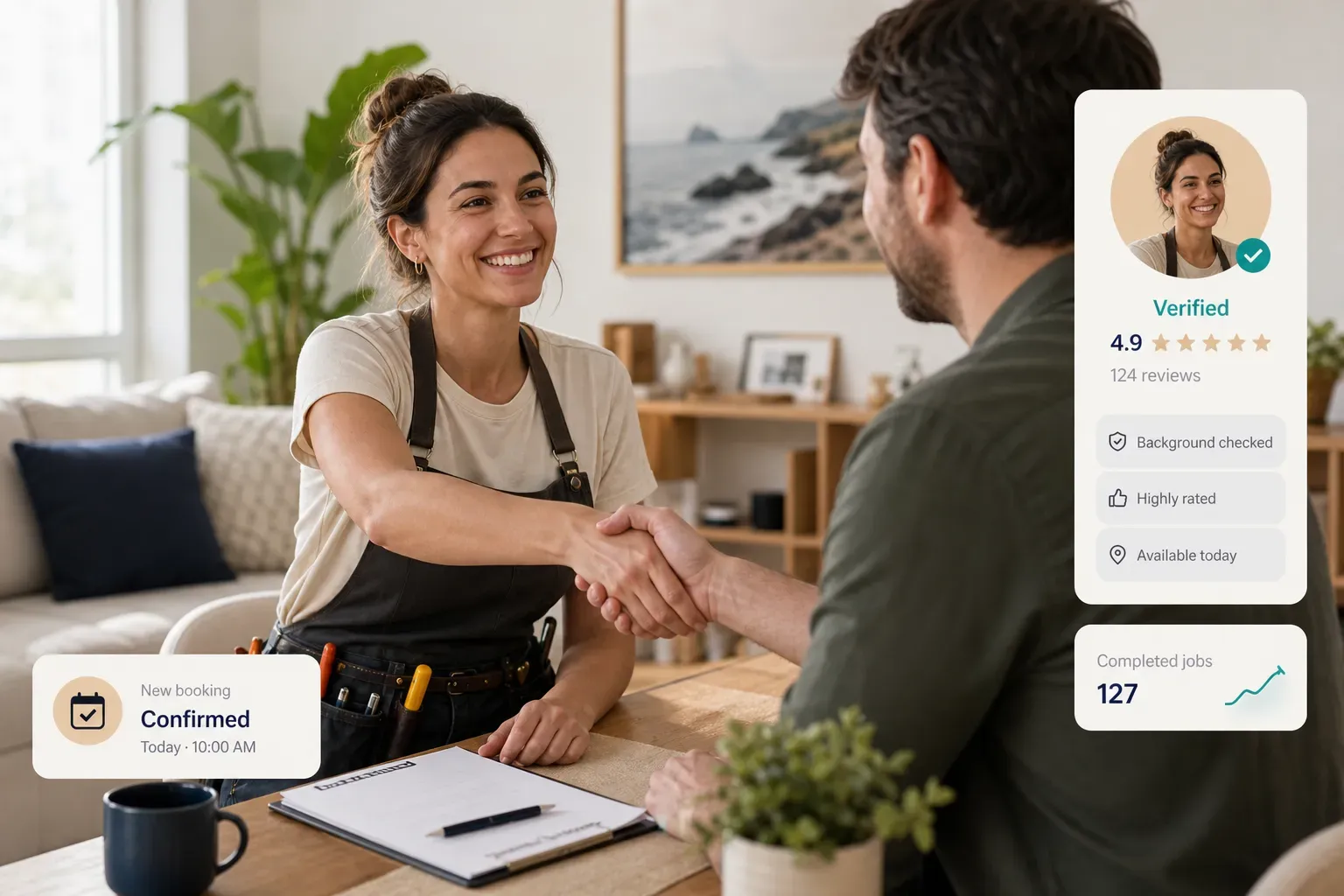
Here’s the uncomfortable part nobody says out loud: your first clients are taking a risk on you, and they know it.
No reviews.
No case studies.
No portfolio.
When a buyer compares you to a competitor with 87 reviews and six years in business, they default to the safer-looking option, even if you’re better.
That’s not unfairness.
That’s rational risk avoidance, and your job is to reduce the risk rather than argue about it.
No portfolio? Build proof ethically
You can create legitimate social proof in under two weeks without inventing a single client.
Four methods work.
Discounted pilot projects with a testimonial requirement. Offer a defined scope at 40 to 60% off, in exchange for a written testimonial and permission to use the work as a case study.
State the terms up front.
This is a trade, not charity, and framing it that way keeps your pricing credible later.
Spec work on a realistic case. A designer picks a real local business, redesigns one page, and documents the reasoning. A copywriter rewrites a landing page and shows the before-and-after logic.
Label it clearly as speculative work.
Buyers care far more about seeing your thinking than about seeing a signed contract.
References from past employment or volunteer work. If you spent four years managing accounts at an agency, that’s four years of proof. Ask two former colleagues or supervisors for a short reference you can quote.
Volunteer projects count too.
Showing your process live. Some of the strongest early trust comes from transparency about how you work: your intake questions, your checklist, your timeline, what you do when something goes wrong.
Competence is visible in process, even before results exist.
What you never do is fabricate testimonials or borrow another firm’s case studies. Beyond the ethics, it collapses the moment someone asks a follow-up question.
Now make it concrete across trades:
- Plumber: free quote visit with a written diagnosis, even if they don’t hire you.
- Tutor: one free 30-minute trial session with a short written assessment of the student’s gaps.
- Designer: redesign one page of a target client’s site as an unsolicited sample.
- Beauty professional: a model day, discounted services in exchange for photos and reviews.
- Coach: a 20-minute discovery call that delivers one genuinely useful reframe.
- Accountant: a free review of one prior-year return, flagging what was missed.
Notice the pattern.
Each one gives away a small, real piece of value that demonstrates competence and costs you under an hour.
First clients, local vs online
Where those first three clients come from depends entirely on whether you serve a postcode or a niche.
Local service businesses get first clients from immediate network plus local search. Tell every person you know, specifically, what you do and who you’re looking for.
Then claim and complete your Google Business Profile the same week. A profile with photos, listed services, hours, and service area starts appearing in map results within days, and it’s free.
Online and remote providers get first clients from niche communities, platforms, and narrow-list outreach. Not “post on LinkedIn.”
Find the forum, Slack group, subreddit, or industry association where your target market already gathers, and be useful there for three weeks before you pitch anything.
Then build a list of 40 businesses that match your ideal customer profile exactly and contact them one by one. Forty personalized messages beat four hundred templated ones.
Every time.
From outreach to booked client
Cold outreach has a terrible reputation because most of it is terrible. The average templated cold email gets a reply rate under 2%. A researched, specific message to a well-chosen list regularly hits 8 to 15%.
The difference isn’t charisma.
It’s structure.
Writing a message that gets a reply
- Research for three minutes, not thirty. Look at their website, recent news, job postings, or reviews. You’re hunting for one specific detail or trigger event, not building a dossier. Three minutes per prospect is sustainable across 40 contacts; thirty minutes is not.
- Open with the specific detail. “Saw you’re hiring a second van driver” or “noticed your booking page still lists 2024 hours.” This proves you’re a human who looked, which immediately separates you from the templated mass in their inbox.
- Offer one useful observation. Give something away: a spotted problem, a quick benchmark, a suggestion they could act on without hiring you. One observation, not five. You’re demonstrating expertise, not delivering the engagement for free.
- State what you do in one sentence. Your value proposition, plainly. “I help clinics like yours cut no-shows with automated reminders.” No adjectives, no mission statement.
- End with a low-friction ask. Ask a question, not for a meeting. “Is missed after-hours calls something you’re actively trying to fix, or is it just background noise right now?” A question costs 10 seconds to answer. A calendar invite costs commitment they haven’t agreed to yet.
- Keep it under 120 words. Long messages read as work. Short messages read as easy to dismiss or easy to answer, and roughly one in eight will get answered.
How many times to follow up
Most deals die from silence, not rejection. Somewhere around 50% of positive replies to cold outreach arrive after the first message, which means one-and-done prospecting throws away half your results.
- Touch one: the initial message. Day zero. Research-led, specific, one ask.
- Touch two: add a new piece of value. Day 3 or 4. Send a relevant example, a short benchmark, or a link to something useful. Never send “just checking in.” It adds nothing and signals you have nothing.
- Touch three: change the angle. Day 7 to 9. Address a different problem or a different decision-maker’s concern. Sometimes the first angle simply wasn’t their priority.
- Touch four: switch channels. Day 11 to 13. If you emailed, try a phone call or a LinkedIn message. Contact-method preference is real, and some people never read email.
- Touch five: the respectful close. Day 14. “I’ll stop here, but if after-hours calls become a priority this quarter, my line is open.” This message gets a surprising number of replies, because it removes pressure entirely.
Three to five touches over two weeks.
Then stop, tag them in your CRM, and revisit in 90 days.
Converting the reply into a booking is a separate discipline, and it’s mostly about friction.
Answer inbound inquiries within one hour during business hours. Research consistently shows response speed is the strongest single predictor of who wins the job, ahead of price.
Quote clearly with a fixed number or a tight range and a defined scope. Give them a calendar link or instant booking rather than “what works for you?” And confirm everything in writing within an hour of agreeing.
Staying legal with cold email
Cold email to businesses is legal in the US, but CAN-SPAM sets non-negotiable rules and penalties run into five figures per violating message.
- Accurate headers and subject lines. Your “from,” “to,” and reply-to fields must identify you truthfully, and the subject line must reflect the actual content.
- A real physical postal address. Every commercial email needs your valid street address or registered PO box in the footer.
- A working opt-out mechanism. Clear, easy to find, and honored within 10 business days. A reply-to-unsubscribe line counts, as long as you actually process it.
- Identify the message as an advertisement where its commercial nature isn’t already obvious from context.
Different rules apply in Canada (CASL) and the EU/UK (GDPR and PECR), which are substantially stricter and often require prior consent.
Check before you send across borders.
Building a predictable pipeline
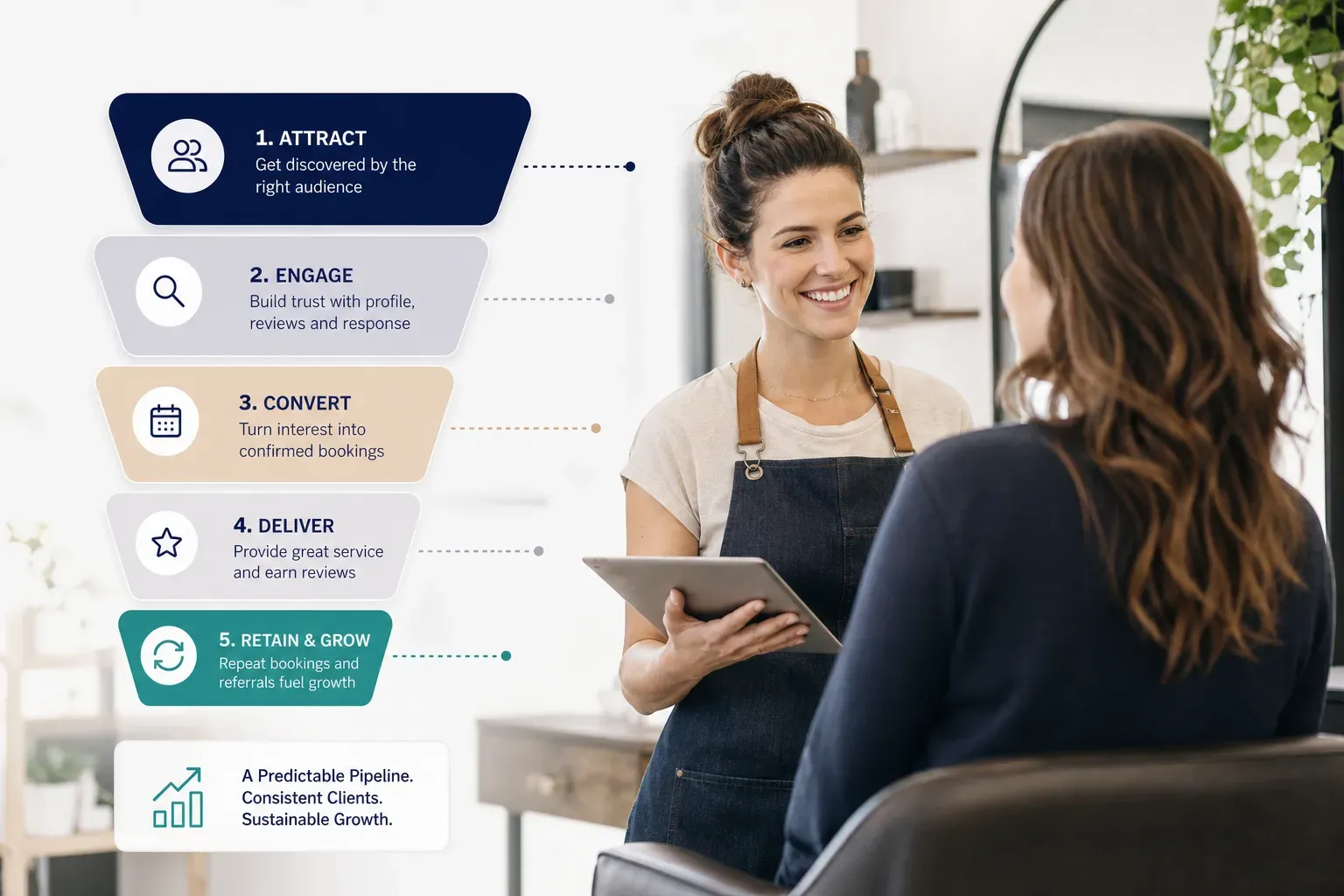
Landing three clients is a hustle problem. Landing twelve a month, every month, is an infrastructure problem.
Different skill entirely.
Predictability comes from three assets working together: a referral engine you operate on purpose, discovery profiles that surface you when people search, and a retention loop that turns one job into four.
Make referrals systematic
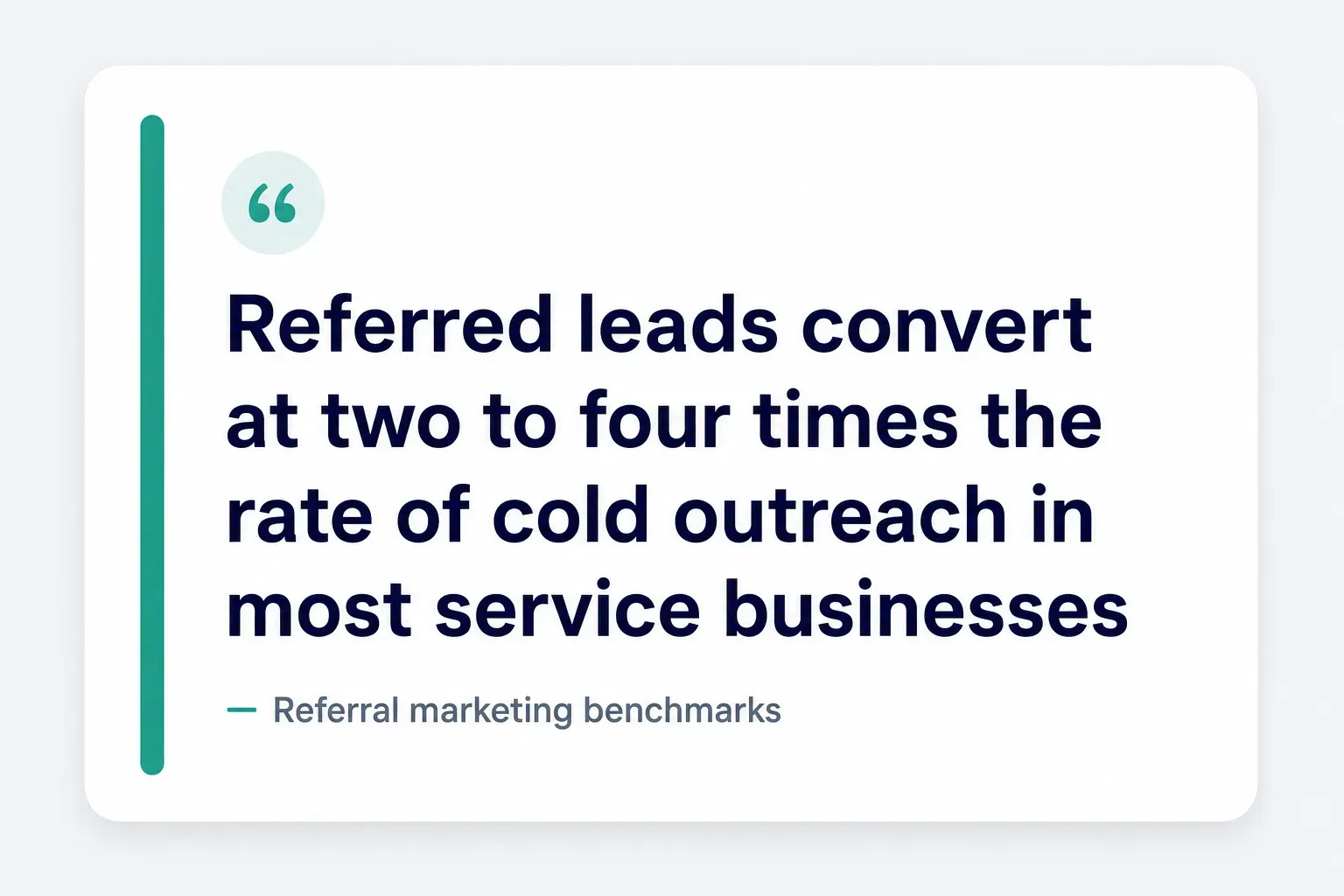
Word-of-mouth marketing produces the highest-converting leads in almost every service business, often converting at two to four times the rate of cold channels. Most providers still leave it entirely to chance.
Ask at the moment of expressed satisfaction. Not in a quarterly newsletter.
The instant a client says “this is exactly what I needed,” you have a 10-second window where the ask feels natural.
Describe exactly who to refer. “Do you know anyone who needs a bookkeeper?” produces nothing, because it asks them to search their entire memory.
“Do you know another restaurant owner with two locations who’s still doing their own payroll?” produces names, because it queries one specific drawer.
Hand them a forwardable line. Write the intro for them.
Two sentences they can copy into a text: who you are, what you fixed, and how to reach you. Removing the writing burden is what converts intent into an actual introduction.
Show up where local and online clients look
A complete Google Business Profile is still the highest-ROI free asset in local client acquisition. Complete means: accurate service area, every service listed individually, 15+ real photos, credentials and licenses, business hours, and a visible response time.
Online reviews do the heaviest lifting.
Profiles with 20 or more recent reviews consistently outperform sparse ones in both ranking and click-through, and recency matters as much as volume. Ten reviews from this year beat forty from 2021.
Marketplace and platform profiles work the same way, with one advantage: the platform’s verification lends you credibility you haven’t earned yet. Frendex is a useful example of where this is heading. Providers appear on a live availability map with verified badges and transparent pricing, clients can chat directly, and booking happens instantly or on a schedule.
No callback queue, no phone tag.
That last part is the point.
Discovery gets you seen; operational readiness gets you paid. Slow replies, vague pricing, and a messy booking workflow will quietly kill leads that your marketing worked hard to produce.
Interest expires fast. If a client has to wait a day to learn your price and availability, they’ve already messaged two competitors.
Turn one client into many
Client retention is cheaper than acquisition by roughly a factor of five, and it compounds. A four-step loop makes it automatic.
Deliver well, then request the review immediately. The window is 24 to 48 hours after completion, while the relief is fresh.
Send a direct link.
Ask for it in one sentence.
Send a rebooking prompt at the right interval. Every service has a natural cadence: six weeks for a haircut, six months for a dental cleaning, annually for a tax return, quarterly for HVAC.
Put the prompt in your CRM the day you finish the job.
Keep notes on preferences. Their dog’s name, their preferred contact method, the parking situation, the thing that annoyed them last time.
Two sentences of notes make the second visit feel like a relationship instead of a transaction.
Then measure.
Tag every inquiry by source: referral, local search, content, partnership, marketplace, outreach. Each month, calculate lead-to-booking conversion rate per channel.
| Source | Leads (Month) | Booked | Conversion Rate |
|---|---|---|---|
| Referral | 8 | 5 | 63% |
| Local search / GBP | 22 | 7 | 32% |
| Marketplace | 14 | 5 | 36% |
| Cold outreach | 35 | 3 | 9% |
| Content | 11 | 2 | 18% |
The table above is illustrative, but the exercise isn’t. Ten minutes a month of lead source attribution tells you where to put the next hour of effort, and it usually contradicts your gut.
Your next move
Pick one channel.
The one that matches the budget you actually have and the urgency you actually feel. Then work it for 30 days before you even consider adding a second.
Thirty days is long enough to generate real data and short enough that you’ll stay honest about the results. Track how many leads it produced and how many converted.
That single number tells you whether to double down or move on.
One warning before you start.
Acquisition without operational readiness is expensive theater.
If your replies take two days, your pricing is vague, and your scheduling lives in your head, more leads just means more people quietly choosing someone else.
Fix the response time and the booking workflow first.
It’s cheaper than any marketing.
Consistent client flow never comes from doing more tactics at once. It comes from running one repeatable system, measuring it, and improving the weakest step.
Choose your channel today.
Start tomorrow.
Frequently asked questions
How do I get clients quickly?
Direct outreach to a warm list plus explicit referral asks to existing contacts is the fastest path, typically producing results in days rather than months. Both channels skip the trust-building delay that makes content marketing and SEO slow. Build a list of 40 people who already know you or match your ideal customer profile exactly. Contact each one individually with a specific, researched message. Ask your last three satisfied clients for one introduction each, naming the exact type of person you want to meet.
How do freelancers find clients?
Successful freelancers combine one owned channel with one discovery channel. The owned channel is referrals or narrow-list outreach, where you control the relationship. The discovery channel is a marketplace or profile-based platform where clients find you. The combination matters because each covers the other's weakness. Outreach gives you control but doesn't scale. Discovery platforms bring volume but you don't own the audience. Running both means a slow month on one side doesn't empty the pipeline.
How do I get clients with no portfolio?
Discounted pilot projects, spec samples, and references from prior employment resolve buyer doubt without requiring years of history. All three create legitimate social proof in under two weeks. Offer a defined scope at a reduced rate in exchange for a written testimonial. Produce one spec case study on a real business, clearly labeled as speculative. Collect two references from former colleagues, supervisors, or volunteer work. Buyers want evidence you can do the job, and they'll accept several forms of it.
What is the best way to attract new clients?
The best channel is the one that matches your urgency, budget, and existing proof, which is why generic answers fail. Need income this week with no reviews? Referrals and outreach. Have proof but no visibility? A complete Google Business Profile and marketplace listings. Whatever you pick, commit for 30 days and track the conversion rate before adding anything else. Channel-hopping every fortnight produces no data and no results.
How do I get local customers for my service business?
Local customers respond most to a complete, review-backed local profile combined with fast response times and easy booking. A fully filled Google Business Profile with 20+ recent reviews, listed services, real photos, and an accurate service area is the foundation. Then close the operational gap. Reply within an hour, quote a clear number, and let people book without a phone call. Speed and clarity beat advertising spend for local service work almost every time.
How do I get clients without social media?
You can build a full pipeline with zero social media using four channels: referrals, local search visibility, marketplaces, and direct outreach. None of them require posting anything. Referrals and outreach handle the relationship side. Google Business Profile and marketplace listings handle discovery. Plenty of profitable service businesses run entirely on this stack, and it tends to produce higher-intent leads than social feeds do.
Need a hand with something?
The Frendex map shows you who is available near you, in real time.
Get the app free Get the app freeFree, no card needed
Related articles
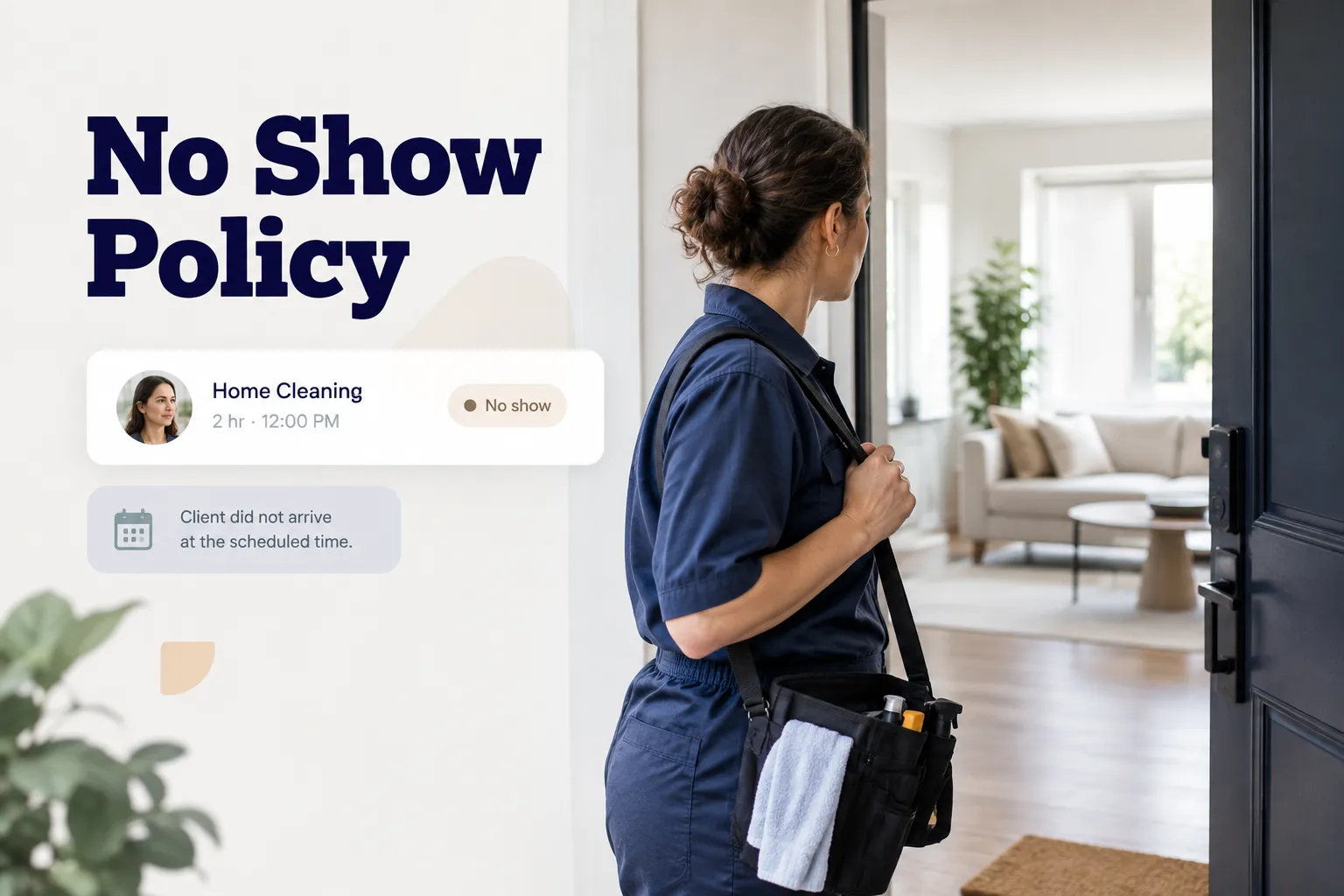
A no-show policy that protects your business
A 5-part no-show policy framework, not a copy-paste template. Learn what to charge, when to waive it, and how to cut missed appointments fast.
A service business's guide to bad reviews
Not every 1-star review deserves an apology. Get the 6-category decision tree for replying to bad reviews without looking guilty or defensive.
Your practical roadmap to becoming self-employed
A step-by-step path to going self-employed: testing your idea, setting rates, and handling tax, without quitting your job on day one.