How home services apps actually work for homeowners
By Kiss János 16 min read
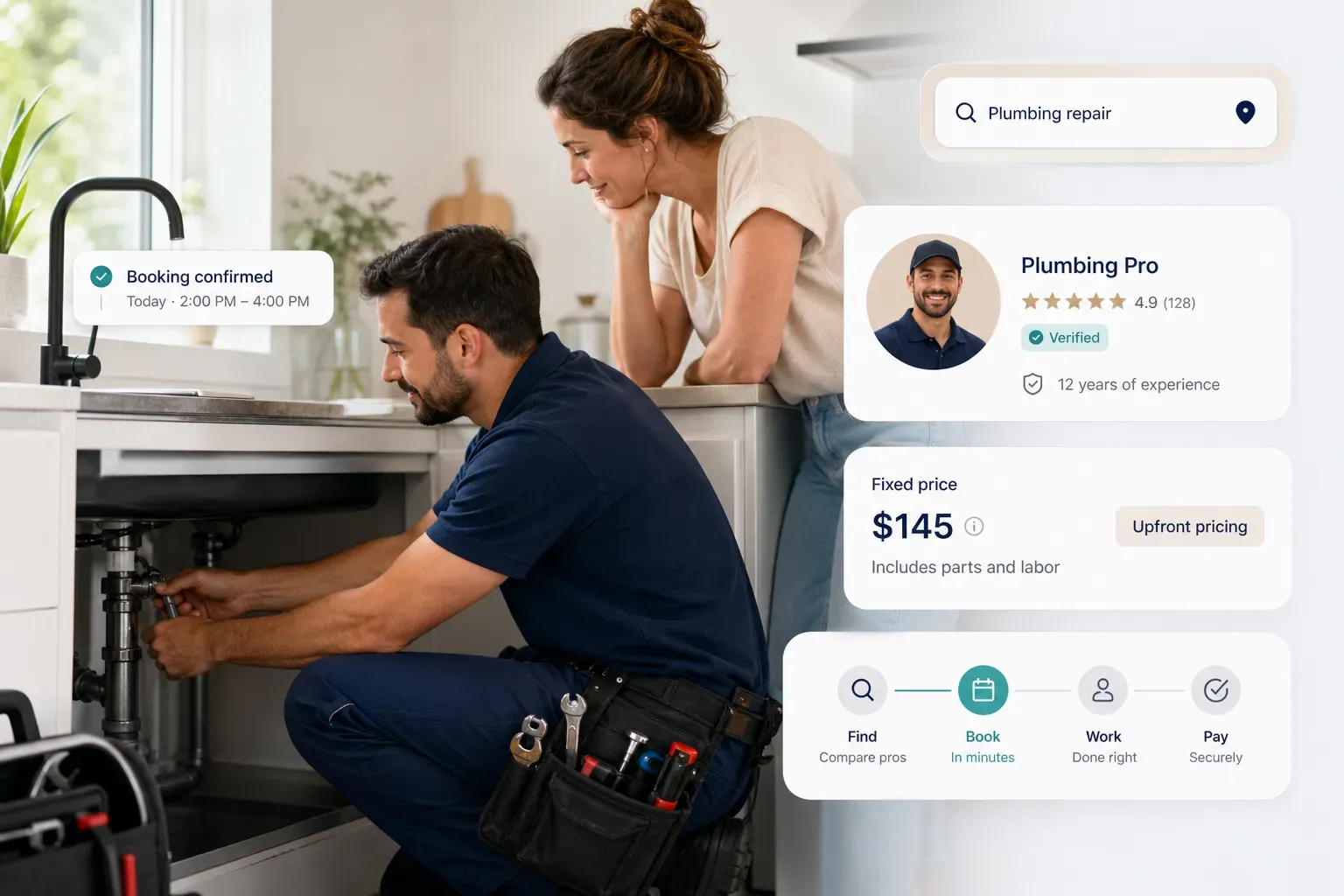
Finding help without the guesswork
Three contractors. Two voicemails. One text that never got answered. And the leak under the sink is still dripping.
That is the standard experience of hiring help for your home, and it has almost nothing to do with the quality of the tradespeople available near you.
The problem is coordination. You cannot see who is free this afternoon, you cannot compare prices before committing, and you have no record of what anyone promised.
A home services app exists to close those gaps. This guide covers how these platforms actually function behind the interface: how booking and payment flow, what “verified” really means (and what it does not), how to write a service request that gets fast accurate quotes, how to compare bids line by line, and what to do when a job goes sideways.
The audience here is broader than just homeowners.
Renters need work approved by a landlord before anyone touches a wall. Landlords need receipts and warranty records for tax season. Property managers juggling eight units need a saved list of providers and a service history per address.
The same app can serve all four, but each needs to use it differently.
What a home services app really is
Strip away the branding and a home services app is a matching engine with a calendar and a payment rail attached.
More precisely: it is software that lets you describe a job, see which local providers can do it, book a time, message the provider, and pay or track payment without leaving the app. Everything that used to live across phone calls, text threads, paper estimates, and a cheque book now sits in one record.
Most of these platforms run a two-sided marketplace. On one side, providers build profiles listing their services, prices, service radius, and availability. On the other, customers browse those profiles and initiate a booking directly.
That direction matters more than it sounds.
The older model worked backwards. You posted a request describing your problem, the platform sold your contact details to three or four contractors, and then your phone rang for a week.
You were the product.
In a browse-and-book local service marketplace, you stay in control: you pick the provider, you pick the slot, and nobody calls you unless you start the conversation.
The shift to on-demand home services also compressed timelines.
A traditional quote cycle for a small repair ran three to seven days from first call to scheduled visit. Platforms with live availability and fixed-price booking can close that loop in under an hour for standardised work like cleaning, assembly, or a plumbing call-out.
Booking platform or just a directory?
This is the single most useful distinction when you are choosing which app to install, and the marketing rarely makes it clear.
A directory gives you names and phone numbers. It might show reviews and a category listing, but the transaction happens off-platform. You call, you negotiate, you pay by bank transfer or cash, and the app holds no record of any of it.
If the job goes wrong, the platform has nothing to look at.
A booking platform keeps the whole transaction inside the system. Availability is live, so you can see that Tuesday 2pm is open. Appointment scheduling, in-app messaging, and often secure payment processing all sit in the same thread.
Because the platform witnessed the agreement, it can act when something breaks.
If the app cannot tell you whether a provider is free tomorrow, it is a phone book with better fonts.
Plenty of well-known services sit in the middle: they take your request, then hand your details to lead-buying contractors.
Useful for large renovation projects where scope genuinely needs a site visit.
Frustrating for a dishwasher that needs installing on Saturday.
The journey from request to payment
Almost every home services app follows the same six-stage arc, whatever the interface looks like.
You search or browse by category and location. You open a profile and check services, prices, availability, and customer reviews.
You either book a fixed-price slot or send a request describing the job. The provider confirms, asks questions, or returns a quote.
The work happens.
Payment is released and both sides rate each other.
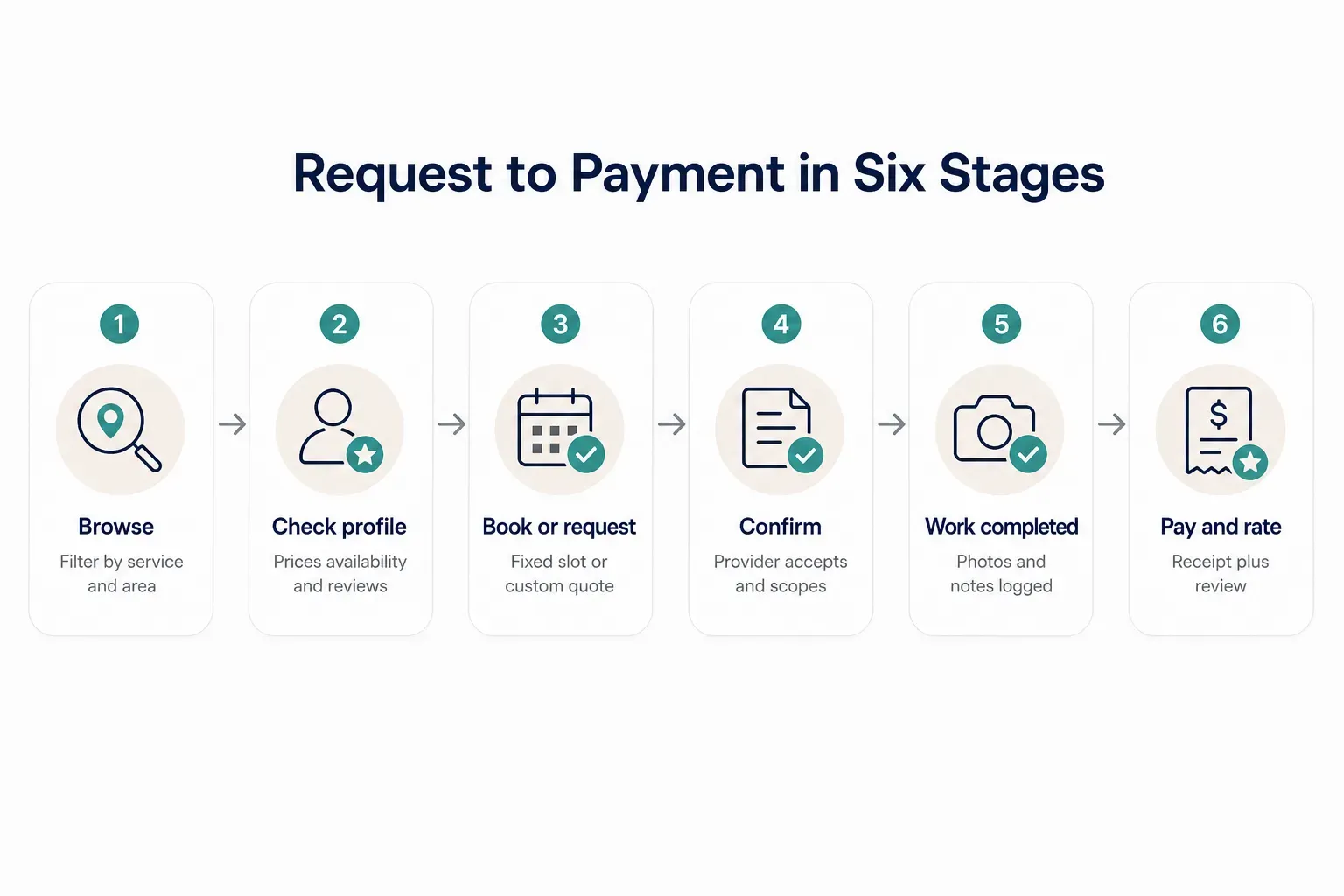
The valuable part is the paper trail. Every message, price change, and reschedule is timestamped. When a provider says the agreed figure was higher than you remember, you are not arguing from memory.
You scroll up.
Trust, verification and safety
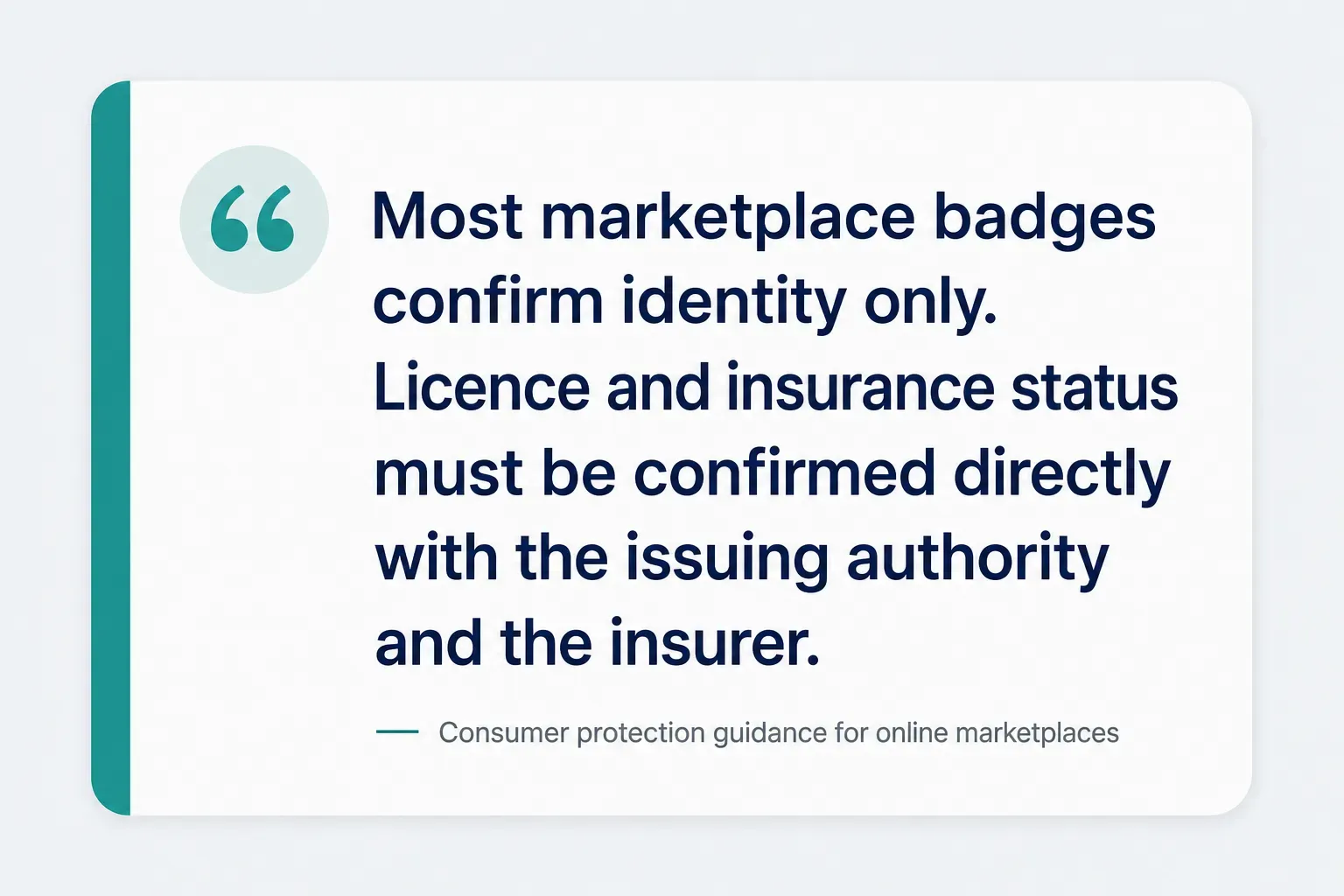
Here is the uncomfortable truth most platforms bury in their terms of service: a verification badge usually means someone confirmed a phone number and a photo ID.
Nothing more.
That is not fraud, and it is not useless.
Identity verification meaningfully reduces anonymous scam accounts. But homeowners routinely read the badge as “this person is licensed, insured, and safe to put inside my house,” and that inference is not supported by what the check actually tested.
A provider’s presence on any platform does not guarantee they are licensed, insured, or legally compliant to do your specific job.
For licensed trades (electrical, gas, structural, and in many jurisdictions plumbing and HVAC), you should confirm the licence number with the issuing authority yourself and request a certificate of insurance naming the current policy period.
It takes about four minutes online.
It is the highest-value four minutes in the entire hiring process.
What verified actually means
Five different checks get marketed under the same vague word.
They are not interchangeable.
- Identity verification: a government ID matched against a selfie, phone number, and sometimes an address. Confirms the person is real and traceable. Says nothing about skill.
- Contractor license verification: the platform (or you) checks a trade licence number against a state, provincial, or national register, including expiry date and any disciplinary history. Rare on general marketplaces.
- Proof of insurance: a current certificate showing public liability, and for larger firms, workers’ compensation. This is what pays for your ruined hardwood floor. Policies lapse, so a certificate from 2024 is worthless in 2026.
- Background checks: a criminal record search, usually limited to one jurisdiction and accurate only up to the date it was run. A check from two years ago is a historical document, not a live status.
- Review-based reputation: the aggregate judgement of previous customers. The only signal that reflects actual work quality, and the easiest one to manipulate.
A sensible rule of thumb: match the depth of service provider verification to the risk of the job.
Furniture assembly gone wrong costs you a wobbly bookshelf. Bad electrical work can burn the house down.
Scale your diligence accordingly.
Reading reviews like a pro
Not all review systems are built the same, and the architecture matters more than the star average.
Open reviews let anyone with an account post about anyone.
Cheap to game. Fake positive reviews get bought in batches, and competitors leave revenge one-stars.
A 4.9 average from open reviews carries less information than it appears to.
Booking-gated reviews only accept ratings from users who completed and paid for a job through the platform. Frendex uses this model: the rating on a profile is tied to real completed bookings, which makes bulk fake reviews expensive and revenge reviews from non-customers impossible.
Fewer reviews, higher signal.
When you read them, ignore the number first and read the middle. Three-star reviews are where the honest detail lives: turned up late but did excellent work, or fixed the problem but left a mess.
- Check recency. Twelve glowing reviews from 2023 and silence since usually means the business changed hands or shrank.
- Check specificity. “Great service, highly recommend” is noise. “Replaced the flapper valve, explained why the old one failed, charged the quoted price” is evidence.
- Check job match. Forty five-star reviews for oven cleaning tell you nothing about their tiling.
- Check provider replies. How someone answers a complaint predicts how they will treat you when something goes wrong.
Requesting service and comparing quotes
Most quote disputes are not caused by dishonest providers.
They are caused by vague requests.
A provider who cannot see the job estimates conservatively, and then adjusts on arrival when reality turns out to be worse. You experience that as a price increase. They experience it as the first accurate information they received.
Fix the information and most of the friction disappears.
Writing a request that gets results
Treat your service request like a brief, not a text message. Six elements cover nearly every trade.
- Problem description in plain language. What is happening, when it started, and what you have already tried. “Kitchen tap drips from the base of the spout, started two weeks ago, worse when hot water runs” beats “tap broken.”
- Photos from at least three angles. One wide shot showing context, one mid-range showing the unit, one close-up of the fault or label. For anything under a sink or behind an appliance, add a photo of the shut-off valves.
- Measurements and model numbers. Room dimensions for flooring or painting, appliance model and serial numbers for repairs, pipe diameter for plumbing. This single item is what turns a range into a firm price.
- Urgency level, stated honestly. Emergency, this week, or flexible within a month. Padding urgency gets you a premium rate; understating it gets you a slot in three weeks.
- Access instructions. Gate codes, parking situation, which buzzer, stairs versus lift, whether a dog will be home, and whether someone will be present. Access problems are a leading cause of failed first visits.
- Preferred time windows. Give two or three real options. “Anytime” sounds accommodating and reliably produces the worst slot available.
Renters should add one line: whether the landlord has already approved the work and who is paying. Providers walk away from jobs where authorisation is unclear, and rightly so.
Fixed price or multiple quotes?
The choice depends entirely on how predictable the work is, not on how much it costs.
Fixed-price booking works when the job is standardised and the variables are visible in advance. Quote-based requests work when scope is genuinely unknown until someone opens a wall, a floor, or a boiler casing.
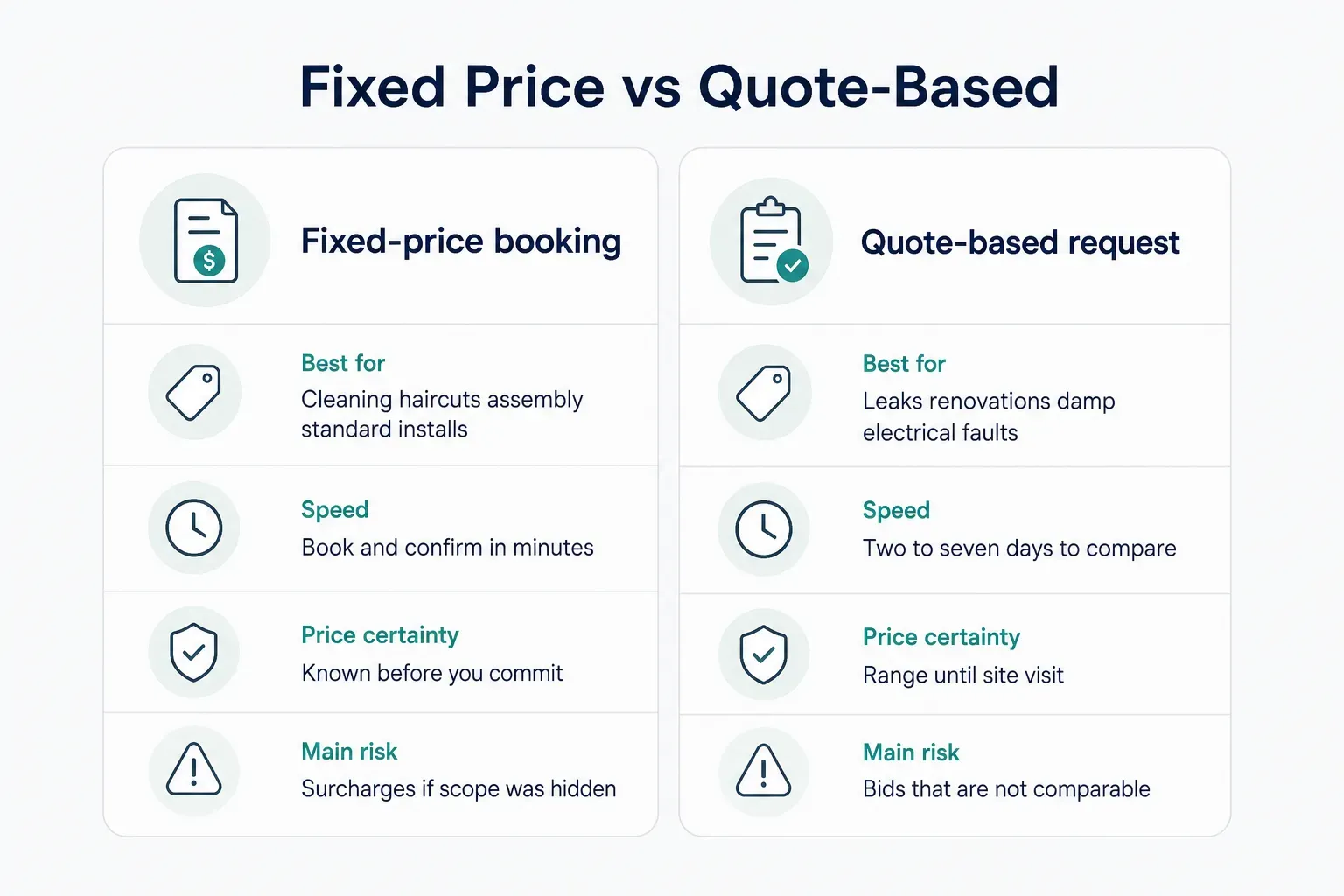
Use fixed price for: regular cleaning, lawn care, furniture assembly, TV mounting, standard appliance installation, mobile beauty and barbering, pressure washing, gutter clearing.
Use quotes for: anything involving a leak of unknown origin, electrical faults, roof work, damp, structural changes, multi-room renovation, or any job needing permits.
Platforms that publish prices and services directly on the provider profile, as Frendex does, narrow that gap considerably. For a large share of everyday jobs you get quote-level clarity at booking speed, because the rate for a standard call-out is visible before you message anyone.
Your quote comparison checklist
Two quotes for the same job can differ by 60% and both be honest.
The difference is usually in what was included. Run every bid through the same nine points before comparing totals.
- Scope of work: a written list of exactly what will be done, and explicitly what will not. Demolition, disposal, and making good are the classic omissions.
- Materials specified: brand, model, grade, and quantity. “Quality paint” is not a specification. Two coats of a named trade emulsion is.
- Labour cost: hourly rate or fixed fee, number of workers, and estimated hours. Ask how overtime or a second visit is charged.
- Permits needed: who applies, who pays the fee, and whether inspection time is included in the schedule.
- Warranty terms: length of cover on labour and on parts separately, and what voids it. Twelve months on labour is a common baseline for trades.
- Taxes: whether the figure includes sales tax or VAT. This alone explains a lot of apparent price gaps.
- Deposit amount: percentage, when it is due, and what it covers. Deposits above 30% for small jobs deserve a hard question.
- Change-order policy: how additional work gets priced and approved. Insist that changes are agreed in writing through in-app messaging before work continues.
- Estimated completion date: start date, working days required, and what happens if it overruns.
Then do the boring thing that saves the most money: ask the cheapest and the most expensive bidder the same question about a detail neither addressed. The quality of the answers usually tells you which number to trust.
Managing work and handling problems
Booking a one-off repair is the easy part. The real value of a home services app shows up on the fourth visit, or on the day something goes badly wrong.
Recurring maintenance and records
Once you find a provider who does good work, the goal is to never search again.
Saving a provider to a favourites list, then booking repeat visits from their profile, turns recurring home maintenance into a two-tap habit. Quarterly gutter clearing, monthly cleaning, annual boiler service, seasonal HVAC filter changes: all of it becomes scheduled rather than remembered.
The quieter benefit is the service history and receipts the app accumulates. Every completed job leaves a dated record of what was done, what was paid, and what warranty applies.
That archive does real work.
For homeowners, it is proof of maintenance when you sell and evidence for a warranty claim when a part fails at month ten. For landlords, it is a deductible expense log and documentation that you responded to a tenant repair request within a reasonable window. For property managers running multiple addresses, a per-property history answers the question that otherwise eats an afternoon: when did we last service the unit at number 14, and who did it?
A maintenance record you can search is worth more than a folder of receipts you can only lose.
When a job goes wrong
Some percentage of bookings fail. The provider cancels an hour before, demands cash on top of the agreed price, expands scope without asking, damages a worktop, or vanishes with the job half finished.
Handle it in this order, and resist the urge to argue verbally first.
- Document immediately. Photograph the state of the work and any damage, with timestamps. Write down times, names, and what was said while it is fresh.
- Move the conversation into the app. Restate the agreement in writing: “To confirm, we agreed $340 for X on Tuesday. You are now asking for $520.” Chat records are the strongest evidence you will have.
- Stop payment before you dispute it. Do not release funds or pay an increase to keep the peace. Recovering money after it leaves your account is far harder than withholding it.
- Report the profile to the platform. Use the in-app report function, attach photos and message screenshots, and ask for a written response. Platforms act on patterns, so reporting matters even when your own case resolves.
- Escalate to a payment dispute. Card chargebacks and platform payment protection both rely on documentation. This is where the app’s transaction record earns its keep.
- Involve your insurer for property damage, and ask the provider for their liability policy details. This is precisely why you requested proof of insurance up front.
- Use small claims as the final step. For amounts within the small claims limit, a documented file with quotes, messages, photos, and receipts makes a straightforward case.
One boundary worth being blunt about: a home services app is the wrong tool for an emergency.
A smell of gas means leave the building and call the emergency number and your gas utility. An electrical fire means the fire service. A burst pipe flooding the property means shut the stopcock, call your utility or an emergency plumber directly, and notify your insurer.
Anything involving structural collapse, carbon monoxide alarms, or a live electrical hazard goes to a licensed specialist immediately, not into a booking queue.
Use the app for the repair afterwards.
Not for the crisis.
Your next repair, simplified
The choice of app matters less than the type of app.
Pick one with live availability, published prices, booking-based reviews, and payment inside the platform. A bare contact directory shifts every bit of the work, and all of the risk, back onto you.
Then change one habit.
Before your next booking, spend five minutes writing a proper request: the problem in plain language, three photos, the model number, honest urgency, access notes, and two workable time windows.
That is it.
That single habit prevents most no-shows, most surprise surcharges, and nearly every argument about what was agreed. Providers quote accurately when they can see the job, and they turn up when they know how to get in.
Verify the licence, keep the conversation in writing, and let the service history build. Your future self, mid-sale or mid-warranty-claim, will be grateful.
Frequently asked questions
What is the best app to find local home service providers?
The best app is one that shows live availability, upfront prices, and reviews tied to completed bookings rather than open posts. Platforms built around browse-and-book, such as Frendex, let you see a provider's services, rates, and free slots before you make contact, which removes the lead-selling phone calls entirely. If an app only gives you a list of phone numbers, it is a directory and will not help you compare or schedule.
Are home service apps worth it?
Yes, for the record-keeping and scheduling alone. A booking platform collapses a three to seven day quote cycle into hours for standard jobs, and it produces a timestamped trail of prices, messages, and receipts that protects you in any dispute. The value drops sharply if you use the app to find someone and then transact off-platform in cash, because you lose every protection the system provides.
How do I find reliable people to work on my house?
Combine booking-gated reviews with your own verification. Read three-star reviews for honest detail, check that reviews are recent and relate to the same type of work, then independently confirm the licence number and current proof of insurance for any licensed trade. Background checks and identity badges are useful screens, but they never substitute for a live licence check.
What app lets you book someone to do work around the house?
Any true booking marketplace does, as opposed to a lead-generation site. These apps let you pick a provider, choose a time slot from their real calendar, message them in the app, and pay through the platform. Cleaning, repairs, assembly, gardening, and mobile personal services are the categories most commonly available with fixed-price instant booking.
How do home service apps make money?
Mainly through commission on completed bookings, provider subscriptions, lead fees, or featured placement. The model shapes your experience directly: lead-fee platforms sell your contact details to several contractors and your phone rings for days, while commission and subscription platforms only earn when a booking completes, which aligns them with the job going well. Ask yourself which side the app is paid by before you trust its recommendations.
What should I look for in a home services marketplace?
Five things: live availability, prices published on the profile, reviews restricted to verified completed bookings, in-app messaging that creates a written record, and secure payment processing with a dispute route. Clear disclosure about what verification actually covers is a sixth marker of a serious platform. Anything missing payment and messaging records leaves you without evidence when a price changes.
Need a hand with something?
The Frendex map shows you who is available near you, in real time.
Get the app free Get the app freeFree, no card needed
Related articles

Do you tip contractors? A clear answer for homeowners
No, tipping contractors isn't required. Get the 4-factor rule to decide when it's worth it and how much makes sense for your project.
How to hire a contractor without getting burned
A step-by-step process for vetting bids, licenses, and contracts, plus the one paper trail habit most homeowners skip until it costs them.
How does TaskRabbit actually work?
See exactly how TaskRabbit's booking flow, real fees, and cancellation rules work in 2026, plus why Taskers set their own rates. No surprises at checkout.