TaskRabbit alternatives: Which one actually fits your task
By Kiss János Updated 14 min read
You searched for a TaskRabbit alternative for one of three reasons: the app doesn’t cover your city, it doesn’t cover your task, or the final price surprised you.
All three are fixable.
But not by picking whichever app ranks first on a “best of” list. The right choice depends on what kind of marketplace you actually need, and there are four fundamentally different models competing for your booking.
Why TaskRabbit isn’t always the right fit
TaskRabbit works brilliantly in Manhattan.
It works considerably less well in Boise.
The platform’s Tasker network is concentrated in dense metros where supply and demand both run high. Step outside those zones, into smaller cities, suburbs at the edge of coverage, or rural areas, and you’ll often find two Taskers listed for your category, both booked solid for a week.
The model depends on liquidity, and liquidity depends on population density.
Then there’s the category problem.
TaskRabbit handles furniture assembly, mounting, moving help, cleaning, and general handyman work well. What it doesn’t handle: licensed trades.
No electrical rewiring, no plumbing repairs, no HVAC servicing. Those jobs require state credentials the platform doesn’t verify or broker.
It also doesn’t cover remote work, tutoring, coaching, pet care, or the long tail of odd requests people actually have.
And the pricing.
Taskers set hourly rates, which is fair enough, but TaskRabbit layers a trust and support fee on top that only becomes fully visible near checkout. For a one-hour job, that fee can represent a meaningful slice of the total.
Budget-conscious users hate discovering it late.
The question isn’t “what’s the best TaskRabbit alternative.” It’s “what marketplace model matches this specific job?”
That’s the frame worth holding onto.
Task type, urgency, your location, and whether you want instant confirmation, competing quotes, or bids you can shop around all point toward different platforms. A same-day IKEA assembly and a full bathroom remodel should not be booked the same way.
The four marketplace models you’ll encounter
Nearly every local services marketplace operating in 2026 fits into one of four structural categories. Once you can identify the model, you can predict how it will behave: how fast you’ll get a response, how transparent the price will be, and who pays for what.
Instant-booking platforms
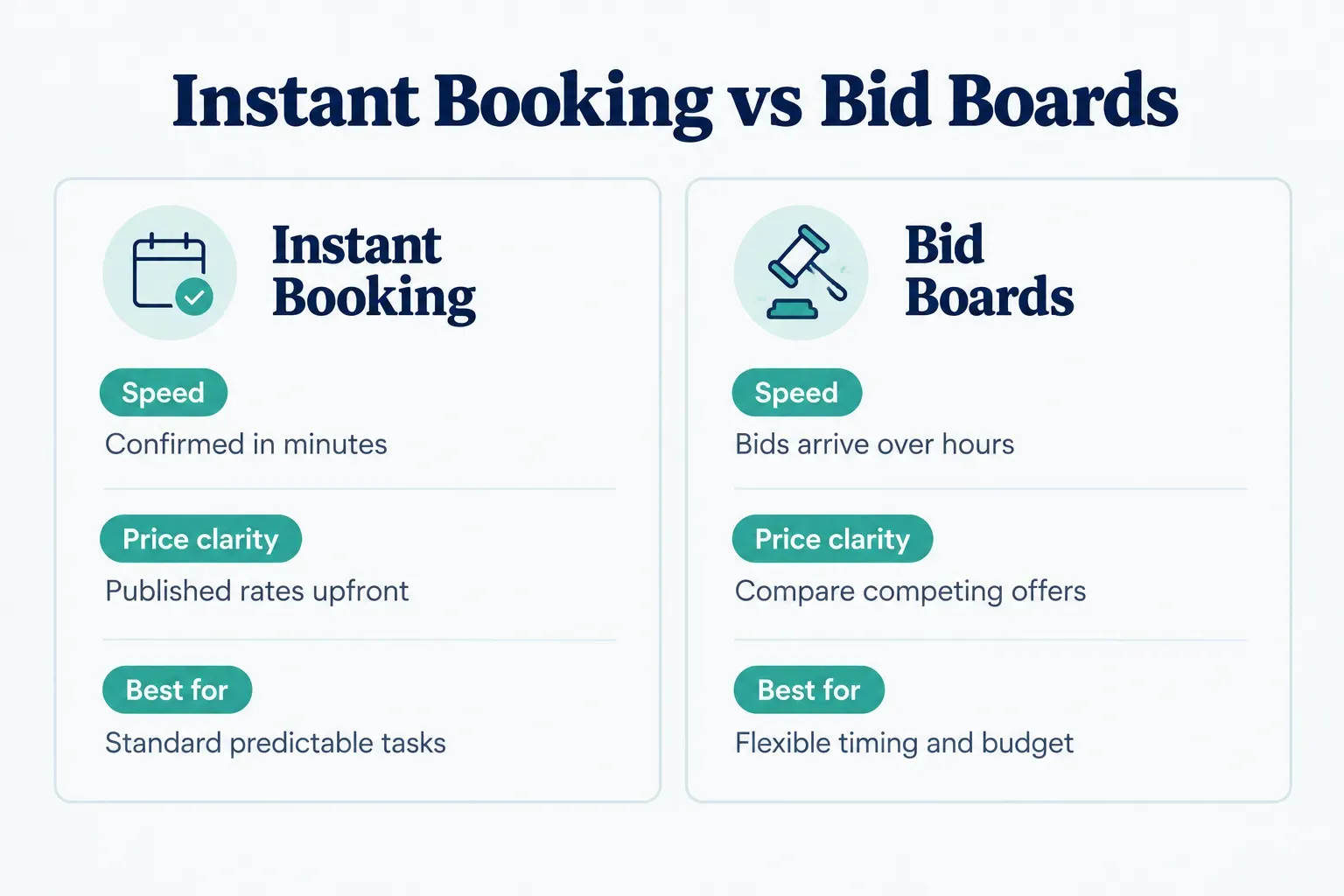
TaskRabbit and Handy pioneered this approach. You select a category, pick a time window, and the platform either assigns a provider or shows you a shortlist with fixed or near-fixed pricing.
The appeal is speed and certainty.
You know roughly what you’ll pay before committing, and you’re not fielding phone calls from six contractors. Instant booking is the right model for standardized, predictable tasks: two hours of cleaning, one flat-pack wardrobe, a TV mounted on drywall.
The weakness shows up with complexity.
When a job has unknowns, a rate card can’t price it accurately, and you end up negotiating mid-task or paying for hours you didn’t expect.
Quote and lead-generation sites
Thumbtack and Angi run a different economy entirely. You describe your project, and the platform sells your contact details to providers who want the work.
This is a lead generation platform model, and it changes the incentives in ways worth understanding. Pros pay per lead, whether or not they win the job.
That cost gets baked into their pricing.
You might receive four bids ranging from $280 to $1,100 for the same described work, which tells you less about the market than it does about each pro’s overhead and appetite.
Quote sites shine for larger, project-based pricing work where variance is genuine: roofing, landscaping design, kitchen installs. They’re slow and noisy for a task that takes 45 minutes.
Bid-based task boards
Airtasker built its business on task bidding.
You post a task and a budget. Taskers submit offers, sometimes above your number, sometimes below.
You review profiles, ratings, and prices, then choose.
The power here is control.
Nobody has your phone number until you accept, and you’re comparing real prices attached to real profiles rather than vague estimates. Competitive bidding tends to push prices toward market rate rather than toward whoever pays most for leads.
The tradeoff is time.
Bids trickle in over hours, occasionally a full day, so this model suits tasks scheduled for next week rather than this afternoon.
Live-availability all-service apps
The newest model answers a question the other three dodge: who is actually free right now?
Platforms like Frendex display providers on a map with live availability status, upfront prices, and the option to book instantly or schedule ahead. Instead of posting a request and waiting, you see that a furniture assembler three miles away is available from 2pm and charges a published rate.
You book.
Done.
The category range is the other differentiator.
A single service provider marketplace covering home services, personal help, tutoring, pet care, and remote or unusual requests removes the need to juggle four apps for four different needs. That matters more than it sounds when your week includes a leaky faucet, a Spanish lesson, and someone to help lift a sofa.
Matching the platform to your task
Here’s the practical mapping.
Find your task type, note the model that fits, and understand why.
| Task Type | Best-Fit Model | Why It Works | Typical Response Time |
|---|---|---|---|
| Furniture assembly (IKEA, flat-pack) | Instant booking or live-availability app | Standardized work with predictable time; published hourly or per-item pricing is accurate | Same day to 24 hours |
| Moving help and heavy lifting | Live-availability app or bid board | Needs real-time confirmation that two people are genuinely free; bids let you compare crew rates | 2 to 24 hours |
| Deep cleaning (one-off) | Instant booking | Square-footage pricing is well established, so flat quotes hold up | Same day to 48 hours |
| Recurring weekly cleaning | All-service app with direct provider contact | You want the same person each week, not a rotating assignment | 1 to 3 days to set up |
| Plumbing repairs | Quote site or licensed-trade category with credential display | Diagnosis changes the price; state licensing must be verified independently | 24 to 48 hours (emergency lines faster) |
| Electrical work | Quote site with license and insurance verification | Regulated trade, permit implications, insurance exposure if done wrong | 24 to 72 hours |
| HVAC service or install | Quote site, multiple bids | Equipment costs dominate the quote and vary hugely by brand and spec | 48 hours to 1 week |
| Tutoring and online coaching | All-service app with remote categories | Home-repair marketplaces simply don’t list these; profile browsing beats bidding | Minutes to 24 hours |
| Pet care and dog walking | Live-availability app or niche pet platform | Timing is non-negotiable; you need someone free at 6pm today | Under 2 hours |
| Unusual one-offs (queue sitting, event help, moving buddy) | Bid board or all-service app | Open task posting handles requests no rate card anticipates | 2 to 24 hours |
Everyday tasks vs licensed trades
This distinction matters more than any platform comparison.
For everyday tasks, the worst case of a bad hire is a wobbly bookshelf and a wasted afternoon. Ratings and reviews are sufficient vetting.
For licensed trades, the worst case involves flooding, fire, or a failed home inspection three years later.
Every state maintains a searchable contractor license database.
Use it.
Regardless of which platform surfaced the pro, regardless of what badges appear on their profile, look up the license number yourself before work starts on plumbing, electrical, HVAC, structural, roofing, or regulated financial and accounting services.
Platform background checks confirm identity and criminal history. They are not a substitute for license and insurance verification.
Urgent same-day help
Urgency is where the four models separate hardest.
Live-availability apps and instant-booking platforms can confirm a provider within minutes because they hold real-time schedule data.
On-demand services only work if the system knows who’s free.
Quote sites, by contrast, typically deliver first responses in 24 to 48 hours, and that’s for responsive pros in dense markets.
So if your dryer vent is disconnected and guests arrive tomorrow, posting on a lead-gen site is the wrong move. Use a map-based app where you can see availability, or call a trade directly.
Unusual or remote services
Try booking an online business-Spanish tutor on a home service marketplace.
You can’t.
The category doesn’t exist.
This is the structural gap in home-repair-focused platforms, and it’s the main reason people end up with five service apps on their phone. General marketplaces such as Frendex and Airtasker accept open-ended requests: someone to sit with a delivery, a second pair of hands for a house move, weekly guitar lessons over video, help sorting a garage.
Recurring needs also favor general apps, because you can rebook the same person rather than re-entering the lottery each time.
What you’ll actually pay
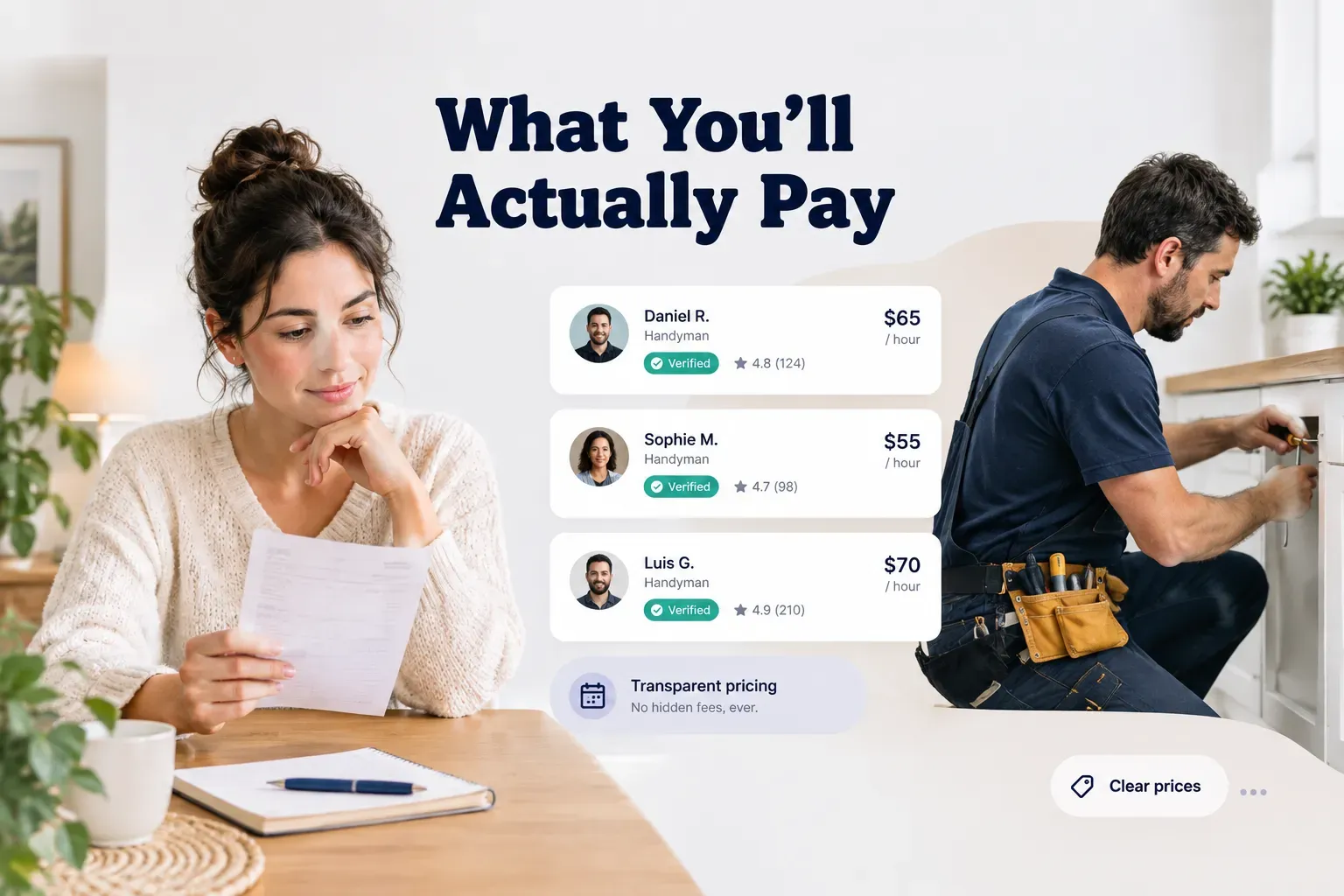
Advertised prices and final totals rarely match.
The gap between them is where most complaints about every one of these platforms originate.
Customer-side fees
Before you book anything, know which of these line items will appear on your receipt.
- Hourly rate versus flat rate. TaskRabbit and most task platforms bill hourly, often with a one-hour minimum. A 20-minute TV mount still costs a full hour. Flat-rate quotes protect you from slow work but cost more when the job goes quickly.
- Trust, support, or booking fees. Platforms add a service layer fee, sometimes as a percentage of the job, sometimes flat. On short tasks this can be the single largest proportional cost, which is why a $45 assembly job becomes $62 at checkout.
- Materials and parts. Almost never included. Clarify whether the provider sources materials and marks them up, or whether you buy them separately. A 15 to 30 percent parts markup is standard for trades.
- Minimum charges and callout fees. Plumbers and electricians commonly charge a diagnostic or callout fee of $75 to $150 that may or may not be credited against the repair.
- Travel and zone surcharges. Providers serving a wide radius often add mileage beyond a set distance. This is the most commonly overlooked cost on suburban bookings.
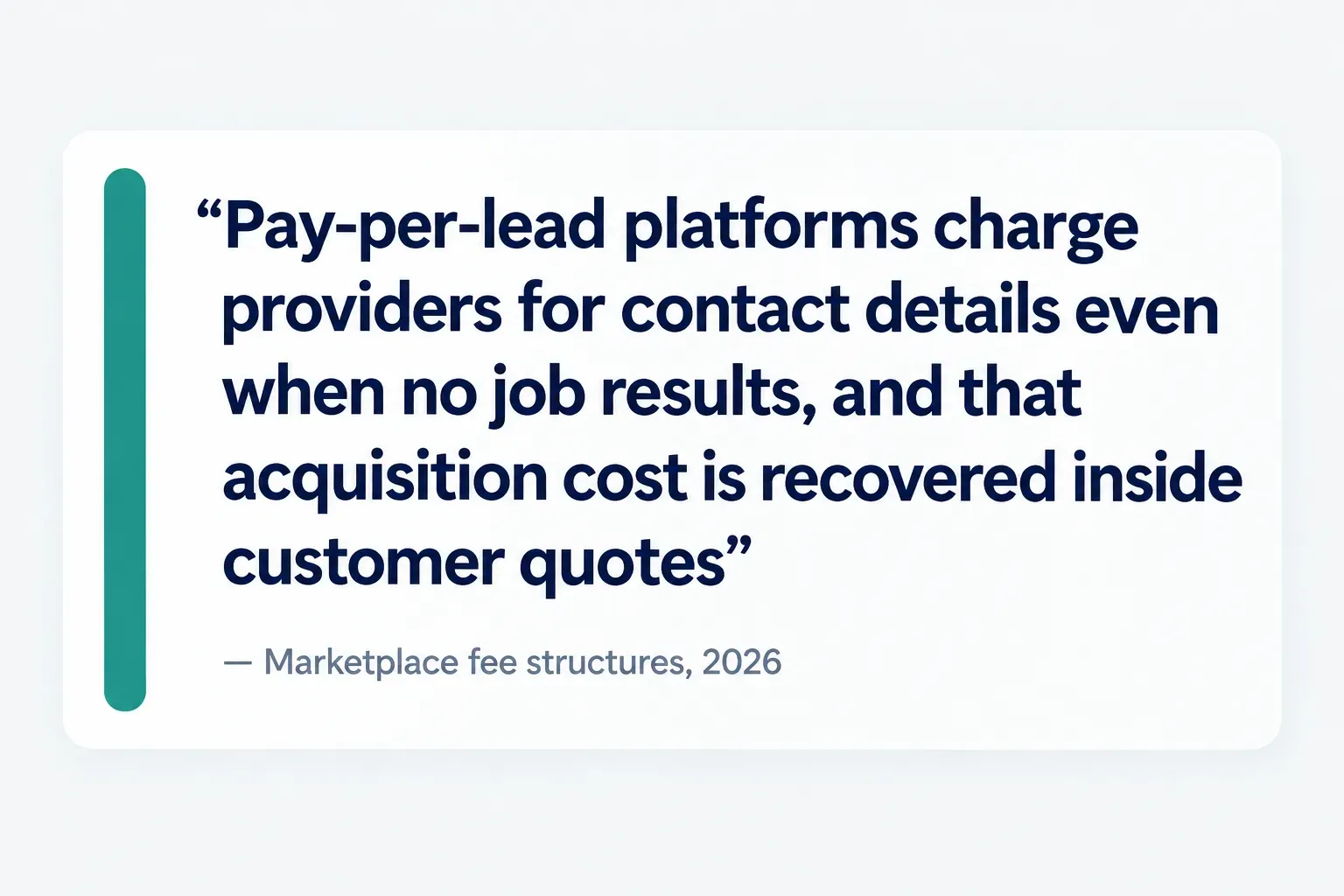
- Hidden markup inside bids. On lead-generation platforms, pros pay for your contact information whether they win or lose. Those acquisition costs get recovered somewhere, and that somewhere is your quote.
- Cancellation and reschedule charges. Late cancellations frequently cost 25 to 50 percent of the booked job, and no-show policies vary sharply between platforms.
- Tips and taxes. Sales tax on services applies in many states, and tipping norms on task apps sit around 10 to 20 percent for in-home work.
Provider-side economics
Provider costs shape your price, so this half matters to customers too.
- Pay-per-lead models. Thumbtack and Angi charge pros for each customer contact. A pro might spend $25 to $90 on leads to win one job. Losing streaks get expensive, and prices rise to cover them.
- Commission per completed job. Bid boards and instant-booking platforms typically take 15 to 30 percent of the job value. The pro only pays when they earn, which is fairer, but the cut still lands in your price.
- Flat subscription with zero commission. Frendex charges providers a fixed monthly fee and takes no percentage of any job. Because the marginal cost of each booking is zero, there’s no commission padding to pass on, and providers have room to quote competitively.
- Promoted placement and ad spend. Several platforms sell visibility. Providers buying top placement need higher margins to justify it.
- Verification and insurance costs. Background checks, license filings, and liability coverage are real annual expenses, particularly in licensed trades, and they legitimately appear in rates.
Fees differ by category, city, and provider tenure. A new provider on a commission platform may pay a higher rate than an established one; a cleaning job and an electrical job on the same app can carry different service fees entirely.
Which is why nobody can honestly name one cheapest platform for everything.
Vetting providers and staying safe
A 4.9-star rating built on nine reviews from 2022 tells you almost nothing.
Ratings are a starting point, not a verdict.
Beyond star ratings
Here’s what experienced bookers actually examine.
Review recency and volume. Twelve reviews in the last three months beats 200 reviews from four years ago.
Providers change, subcontract, or burn out, and stale ratings hide all of it.
Verified-booking-only reviews. Some platforms allow reviews from anyone; others restrict them to customers who paid through the system. Verified reviews tied to completed transactions are far harder to fake, and their presence is a genuine signal of platform quality.
Response time and completion rate. These two metrics predict your actual experience better than stars.
A pro with a 96 percent completion rate and a median reply under an hour will probably show up. One who cancels one job in five will probably cancel yours.
Documentation. For any regulated work, ask for the license number and a certificate of insurance naming the current policy period. Then verify both independently.
Badges on profiles are claims, not proof.
Specificity in negative reviews. A one-star review saying “rude” is noise.
One saying “quoted two hours, billed five, left the old parts in my driveway” is data.
Writing a task description that gets accurate quotes
Vague posts produce vague prices, then arguments.
Cover these six things and your quotes tighten dramatically.
- Scope in plain numbers. “Assemble one IKEA PAX wardrobe, 100cm wide, two doors” not “some furniture assembly.”
- Materials responsibility. State clearly who buys parts, who pays for them, and whether you’ve already got them on site.
- Access details. Third floor, no elevator, street parking only, dog in the house. These change the price and the willingness to accept.
- Timeline. A hard deadline versus flexible scheduling. Flexibility often earns a lower rate.
- Budget range. Giving a range filters out mismatches instantly and speeds up bidding.
- Cleanup expectations. Who removes packaging, old fixtures, and debris? This is the single most common post-job dispute.
After you book
The booking is the beginning, not the end.
Keep every scope change in the platform’s messaging thread. If a two-hour job becomes four because of an unexpected wall stud, get the revised time and price written in the chat before work continues.
Verbal agreements in someone’s hallway are unenforceable.
Understand the cancellation and no-show policy before the day arrives, including what happens if the provider fails to appear. Know when payment releases: some platforms hold funds until completion, others charge on booking, and secure marketplace payments with a completion trigger give you more leverage.
Then the big one: avoid off-platform cash deals.
That $20 discount for paying cash costs you the entire dispute record, the review history, and any platform support if the work fails.
It’s the worst trade in the gig economy.
Platforms handle this differently.
Frendex, for example, keeps the agreed price and scheduled time recorded in the app even though payment happens directly between customer and provider, so there’s a timestamped record of what was promised if a disagreement comes up later.
Picking without overthinking it
You don’t need a spreadsheet.
You need thirty seconds and one honest answer about your job.
Urgent small task, needed today? Use a live-availability app where you can see who’s genuinely free and what they charge. Speed and price clarity matter more than comparing six options.
Complex project with real cost uncertainty? Post it on a bid board or quote site and collect three to five offers. The spread between bids is useful information, and it’s worth the 48-hour wait.
Licensed trade work? Quote site, multiple bids, then verify every license number and insurance certificate against your state database yourself.
No exceptions, no shortcuts.
Recurring, unusual, or remote? An all-service app like Frendex handles the categories that home-repair platforms won’t list, and lets you rebook the same provider instead of starting over each month.
The instinct to find one app for everything is understandable and mostly wrong.
TaskRabbit is genuinely good at what it’s built for. So is Thumbtack, so is Airtasker, so are the newer live-availability platforms.
None of them wins every category, and the people who get consistently good results are the ones who keep two apps and know which to open.
Match the tool to the job.
That’s the whole trick.
Frequently asked questions
What is the best app like TaskRabbit?
There's no single best app, because the four marketplace models serve different needs. For same-day everyday tasks with upfront pricing, live-availability apps like Frendex and instant-booking platforms like Handy are closest to TaskRabbit's experience. For flexible-timing work where you want competing prices, Airtasker's bid board fits better.
Is Thumbtack better than TaskRabbit?
Thumbtack is better for larger projects; TaskRabbit is better for small immediate tasks. Thumbtack's lead-generation model brings you multiple quotes from independent contractors, which suits renovations, landscaping, and licensed trades where prices genuinely vary. For a 90-minute furniture assembly, waiting 24 to 48 hours for bids is slower and rarely cheaper.
What is cheaper than TaskRabbit?
Cost depends entirely on the pricing model, not the brand. For simple jobs, bid boards and flat-fee platforms usually beat hourly-plus-service-fee pricing, because you avoid the one-hour minimum and the trust fee stacked on top. Platforms where providers pay a flat subscription rather than per-job commission also remove the markup pros build in to cover platform cuts.
What are the best websites for hiring local help?
The strongest options in 2026 split by job type. Frendex and Airtasker cover the widest range including remote and unusual requests, Thumbtack and Angi lead for licensed trades and home improvement projects, and Handy and TaskRabbit remain solid for standardized cleaning and assembly in major metros. Niche platforms still win for specialized needs like pet boarding or childcare.
Is there an app where people bid on tasks?
Yes. Airtasker is the best-known bid board, where you post a task with a budget and taskers submit competing offers you can accept or ignore. Frendex supports a similar dynamic through open task posting alongside its live-availability map, so you can either browse available providers directly or let offers come to you.
What is the best TaskRabbit alternative for handyman services?
For handyman work, choose a platform that shows verified credentials and transparent pricing before you book. Thumbtack and Angi surface licensed contractors with insurance documentation for anything touching electrical, plumbing, or structural work. For non-licensed handyman tasks like mounting, patching, and repairs, live-availability apps get you a confirmed provider faster and with clearer pricing than quote-request sites.
Need a hand with something?
The Frendex map shows you who is available near you, in real time.
Get the app free Get the app freeFree, no card needed
Related articles

Do you tip contractors? A clear answer for homeowners
No, tipping contractors isn't required. Get the 4-factor rule to decide when it's worth it and how much makes sense for your project.

How to hire a contractor without getting burned
A step-by-step process for vetting bids, licenses, and contracts, plus the one paper trail habit most homeowners skip until it costs them.
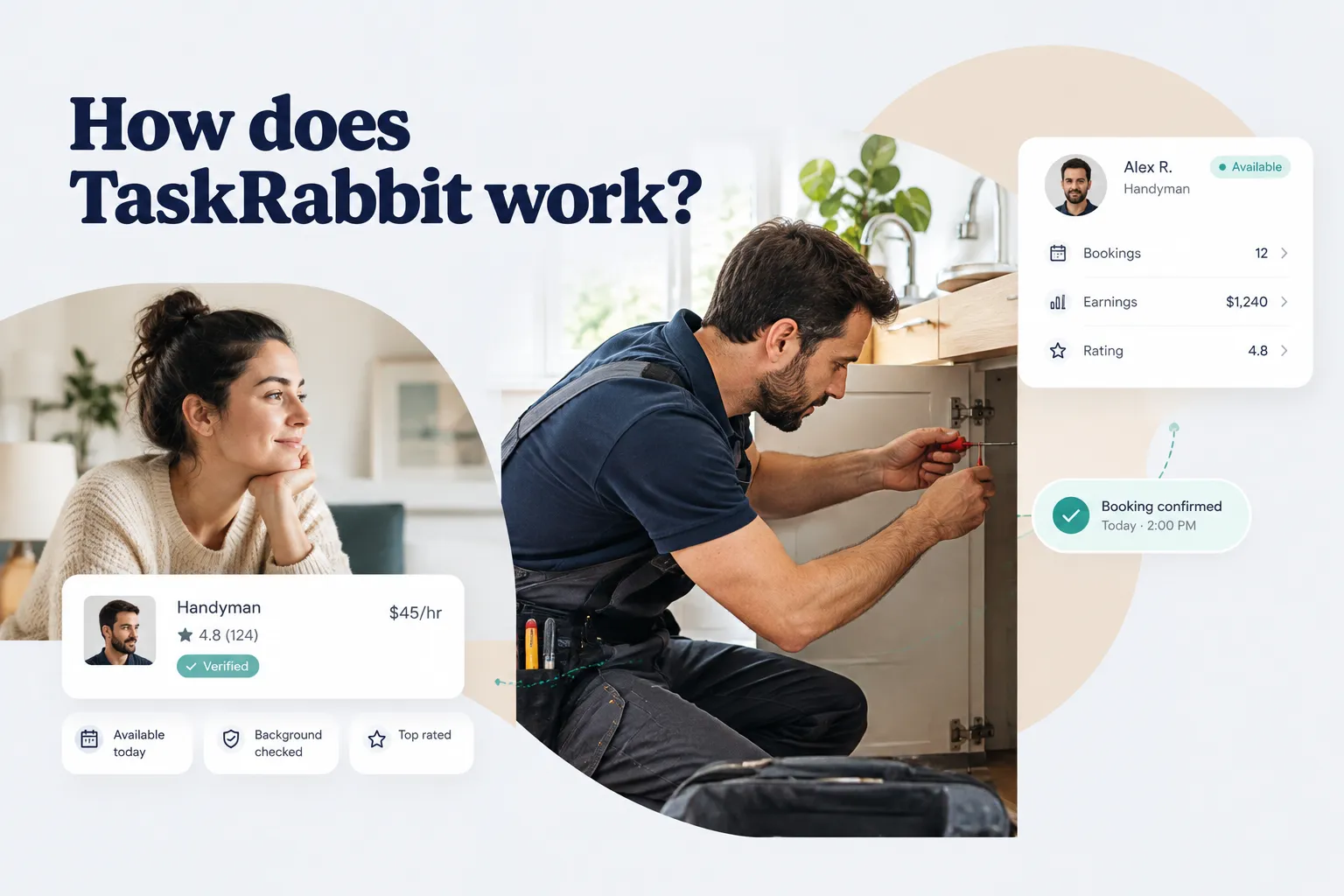
How does TaskRabbit actually work?
See exactly how TaskRabbit's booking flow, real fees, and cancellation rules work in 2026, plus why Taskers set their own rates. No surprises at checkout.