Quote vs estimate: Which do you actually need?
By Kiss János 15 min read
Contents
- Quote vs estimate: Why the label on the paper isn’t the real question
- Quick comparison: Estimate, quote, and upfront booking
- Quote vs estimate: Definitions and legal weight
- Protecting your budget: Financial risk, change orders, and the document checklist
- Skip the quote chase: Frendex vs lead-generation marketplaces
- Who should choose what
- Frequently asked questions
Quote vs estimate: Why the label on the paper isn’t the real question
Here’s the short answer.
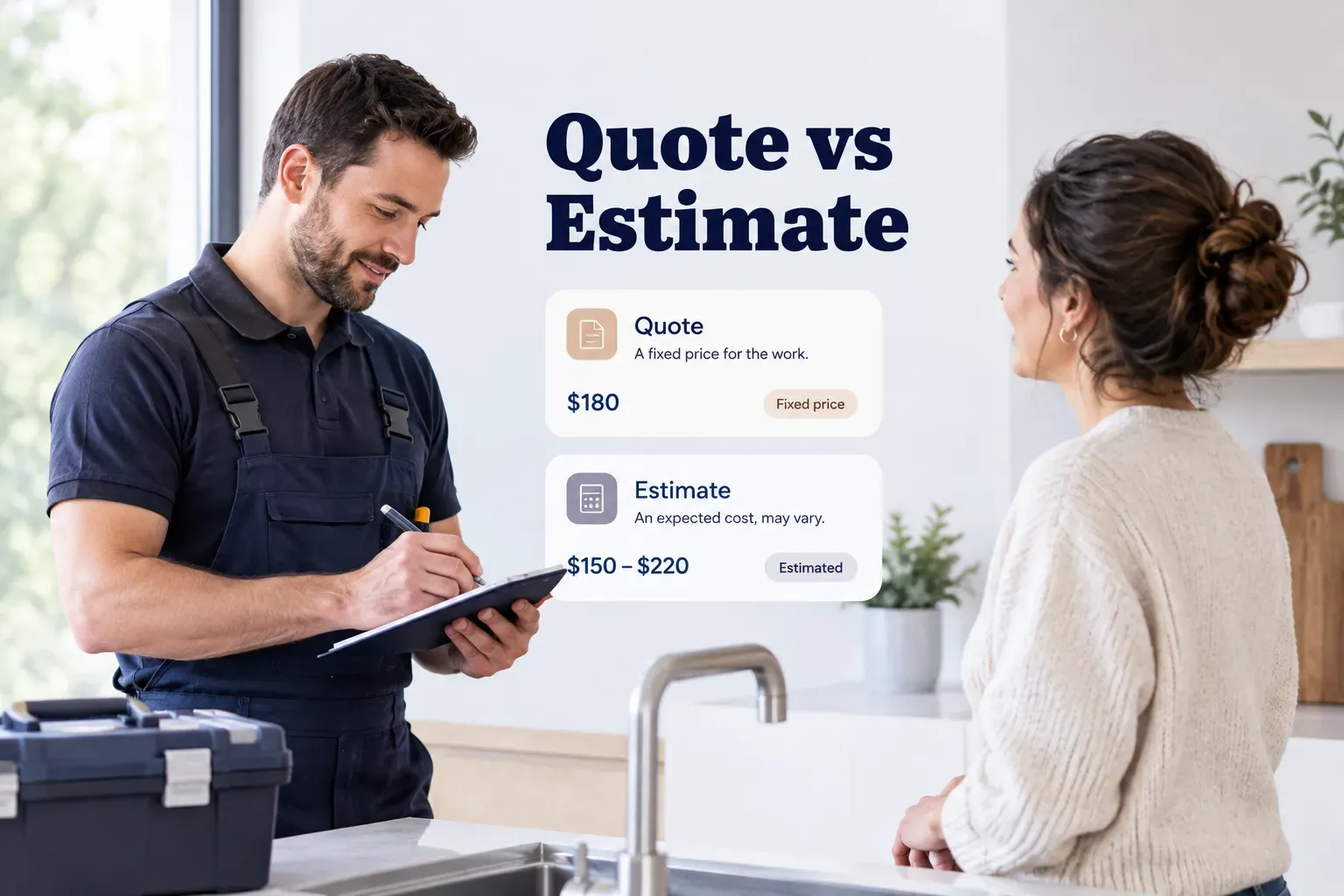
Use an estimate when the scope of work is still uncertain. Use a quote when the scope and price are defined and you want a number to hold the provider to. And if the provider already publishes their price and availability, a transparent booking platform like Frendex lets you skip the paperwork and book directly.
Three situations, three tools. Simple enough.
But the word printed at the top of the document rarely decides what you end up paying.
What protects your budget is whether the scope, inclusions, exclusions, and change-order rules are written down and accepted by both sides. A vague “quote” scribbled on a business card gives you less protection than a detailed written estimate with a stated variance cap.
That’s the gap in most quote vs estimate guides.
They define the two terms, maybe add a tidy table, and leave you standing in your kitchen with a contractor who just said the price “might go up a bit.” So what do you actually do next?
This guide answers that.
You’ll get plain definitions and their legal weight, a realistic look at how far a final bill can drift from a cost estimate, a document checklist that works for either format, and a clear view of when you can avoid the quote request cycle entirely. As of 2026, more service providers publish their pricing up front than ever, which changes the math for many everyday jobs.
Quick comparison: Estimate, quote, and upfront booking
The fastest way to choose is to match the document to how well-defined the job is. If the service is standard and the provider shows the price before you ask, direct booking wins on speed.
If the job hides surprises, you need paper.
| Factor | Published-Price Booking (Frendex model) | Estimate | Quote |
|---|---|---|---|
| Price certainty | High for standard services: price is listed on the provider profile before you book | Low to moderate: an approximation, often with a stated variance range | High: a fixed figure for a defined scope, if the wording supports it |
| Legal weight | Agreed price and time stay on record in the app chat and booking | Generally non-binding; acts as a good-faith prediction | Can be binding once accepted, depending on wording and local law |
| Typical turnaround | Minutes: book instantly or pick a time slot from the profile | Hours to days, sometimes after a site visit | Days, often after a site visit and scope discussion |
| Scope required | Simple, standard service (haircut, tutoring session, IT help, cleaning) | Partially known; hidden conditions likely | Fully defined before work starts |
| Best use case | Everyday services where price and schedule are already public | Diagnosis-first jobs, repairs behind walls, renovations | Defined projects where you want a number locked before work begins |
| Wins on | Speed | Flexibility on undefined jobs | Price certainty on defined jobs |
The pattern is clear.
Frendex is the fastest path when the scope is simple and the price is already published, because there’s nothing to estimate. Complex jobs, or anything involving unseen conditions, still belong in a written quote or estimate, regardless of where you found the provider.
Quote vs estimate: Definitions and legal weight
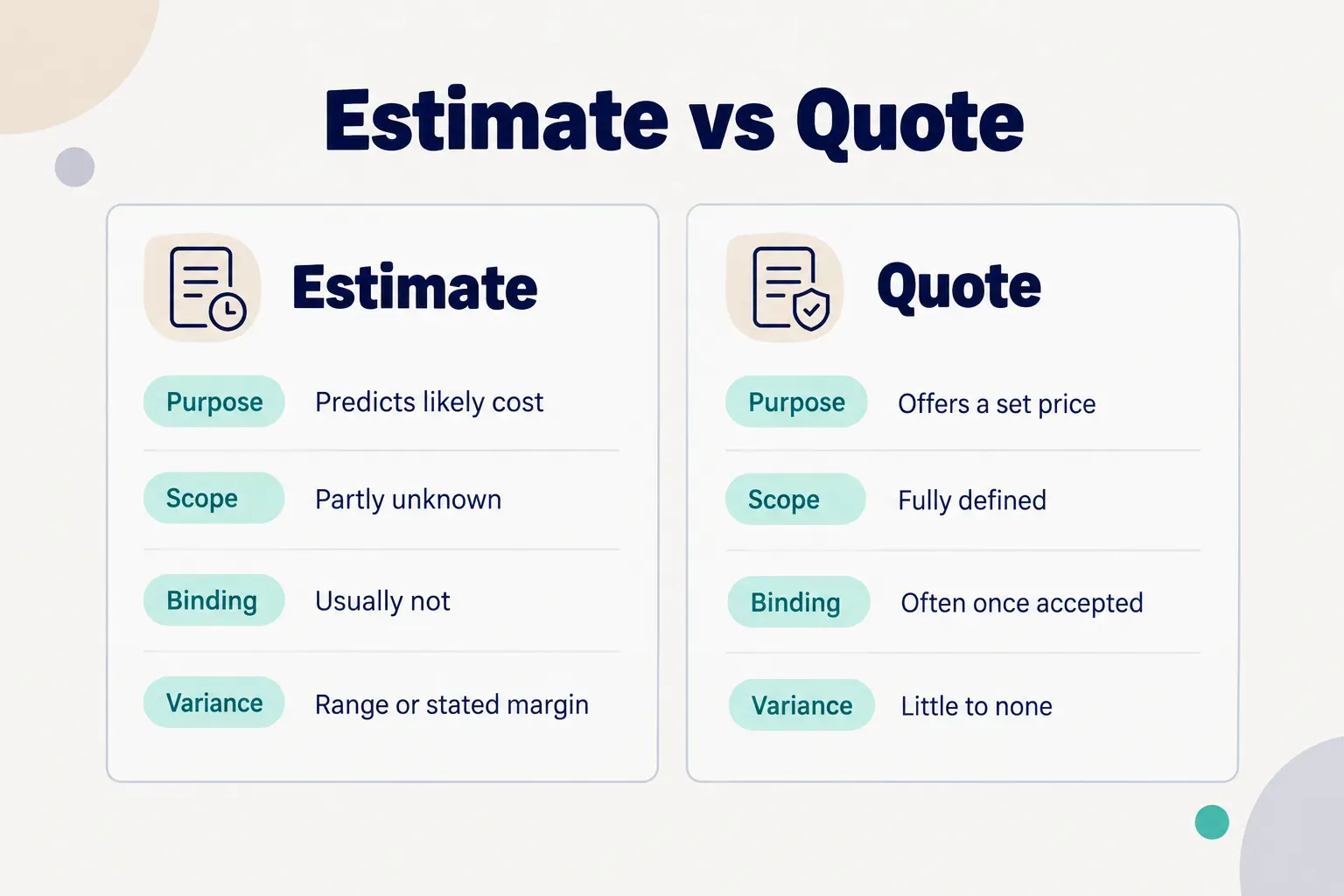
The core difference between a quote and an estimate is commitment.
An estimate predicts a cost, while a quote offers a price. But that distinction only holds up when the document’s wording backs it, which is where many customers get caught out.
What counts as an estimate
An estimate is a non-binding approximation of what a job will cost. Providers use it when the scope, materials, or hidden conditions are still unknown: a plumber who can’t see behind the wall, a mechanic who hasn’t diagnosed the engine, a builder quoting an old house with unknown wiring.
A good written estimate shows its working.
Expect a documented range (for example, “between $1,800 and $2,200”) or a single figure with a stated variance, plus the assumptions behind it. If the provider can’t explain what might push the price up, the estimate accuracy is anyone’s guess.
Don’t confuse invoice vs estimate either.
An estimate looks forward and predicts the cost before work starts. An invoice looks back and bills you for work that’s already done, so the invoice is where any gap between the two shows up.
What counts as a quote
A quote (or quotation) is typically a fixed-price offer tied to a defined scope of work. You accept it, the provider does the agreed work, and you pay the agreed figure.
An itemized quote breaks down labor and materials so you can see exactly what you’re buying.
Most quotes carry a quote validity period, such as 30 days, after which the provider can reprice. That protects them from material cost swings.
It also means a quote you sat on for two months may no longer stand.
The proposal vs quote question comes up too.
A proposal is a broader sales document covering approach, timeline, and sometimes several options. A quote is narrower: it commits to a price for a specific scope.
Does “Quote” automatically mean the price is fixed?
No.
Whether a price is enforceable depends on the wording, the customer’s acceptance, and local consumer law, not on the label at the top of the page. A document titled “quote” that says “approximately” or “subject to change” can be just as non-binding as an estimate.
And the reverse is true.
A document called an “estimate” that states a firm price, a defined scope, and a signed customer approval may be treated as a binding quotation in some jurisdictions. Courts and consumer agencies tend to look at what was agreed, not what the provider called it.
So this one’s a tie.
Neither label wins by default.
The fix is the same for both formats: get the scope of work, price, exclusions, and acceptance terms in writing, and confirm that any change requires your signed approval before you’re billed for it.
Protecting your budget: Financial risk, change orders, and the document checklist
The real financial risk in any quote vs estimate decision is unexpected costs that appear after work begins.
A fixed-price quote wins for budget certainty. An estimate wins for jobs where the scope genuinely can’t be known upfront, because a provider forced to quote blind will either pad the price or fight you on extras later.
How much can a final bill exceed an estimate?
Estimates commonly carry a disclosed variance of around 10-20% over the stated figure. On a $4,000 estimate with a 15% variance, you should be prepared for a final bill of up to $4,600.
Anything beyond the disclosed range should require your approval first.
Some jurisdictions set limits on how far a bill can exceed a written estimate, or require customer approval before the provider goes over. The rules vary by country, state, and industry (auto repair is often regulated separately). Check your local consumer protection guidance before you assume a number is safe.
Quotes should carry little to no variance if the scope hasn’t changed. If a provider quoted $2,500 to replace a bathroom vanity and the bill comes in at $2,900 with no documented change, you have a strong case to push back.
What to do when scope changes, damage is discovered, or a verbal price shifts
Any price increase after work begins should require a written, signed change order before you’re billed. A change order describes what changed, why, and what it costs.
No signature, no extra charge.
When a provider discovers damage mid-job (rotted subfloor, corroded pipes, a failed part), ask them to pause and show you the problem.
Request photos.
Then get the revised price in writing before they continue.
Verbal price shifts are the trickiest.
A contractor mentions on the phone that “it’ll be another few hundred”… and suddenly that number appears on the invoice as something much larger. Reply by text or email confirming the exact figure, so the agreement exists in writing.
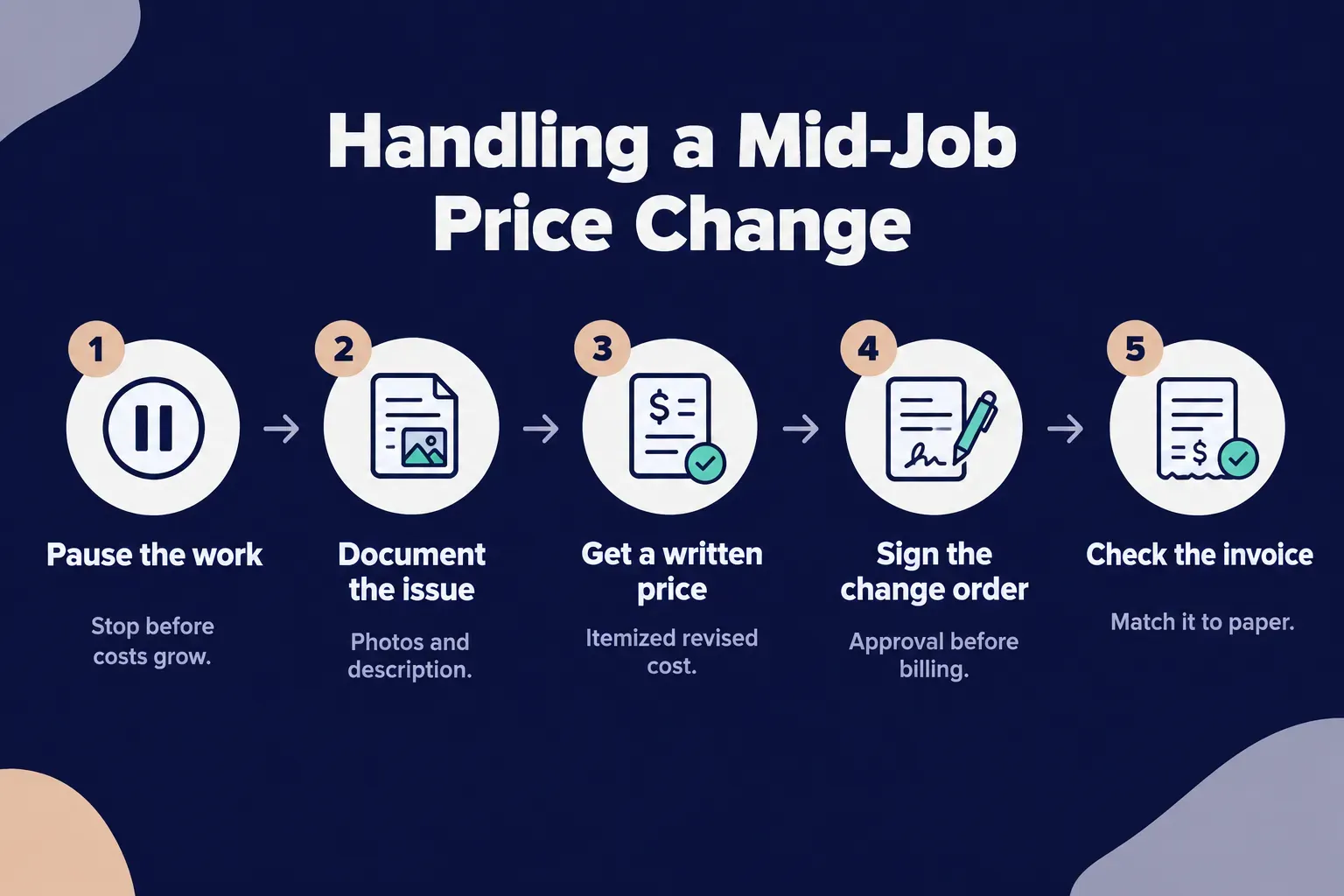
A provider who refuses to write up change orders is a red flag. It doesn’t matter whether they called their paperwork a quote or an estimate.
Refusal to document changes is the single clearest warning sign that your final bill will surprise you.
The side-by-side document checklist
Neither document format wins automatically.
In practice, whichever document includes all eight elements below wins. Use this table to audit any quote or estimate before you sign, and for a fair contractor comparison when you have several in hand.
| Element | What a Strong Estimate Includes | What a Strong Quote Includes | Red Flag If Missing |
|---|---|---|---|
| 1. Inclusions (scope of work) | Tasks expected, with notes on what may expand | Every task covered by the fixed price | ”General repairs” or similarly vague wording |
| 2. Exclusions | Work not covered, such as disposal or permits | Explicit list of what costs extra | No exclusions listed at all |
| 3. Assumptions | Conditions the figure relies on (for example, “no water damage behind tile”) | Site conditions assumed when pricing | Price with no stated basis |
| 4. Validity date | How long the estimate range holds | Quote validity period, such as 30 days | No expiry, leaving repricing open |
| 5. Taxes and fees | Whether taxes, call-out, or travel fees are included | Total including all taxes and fees | ”Plus applicable fees” with no amount |
| 6. Labor and materials breakdown | Estimated hours and material allowances | Itemized labor and materials costs | One lump sum with no breakdown |
| 7. Change-order rules | Variance cap and approval process for overruns | Written, signed approval for any scope change | No process for handling changes |
| 8. Acceptance and payment terms | How you approve, deposit amount, payment schedule | Signature line, deposit, and payment milestones | Large upfront cash deposit, no signature |
Score each document out of eight.
A seven-out-of-eight estimate usually beats a three-out-of-eight quote, because the paperwork that answers more questions leaves fewer gaps for unexpected costs to slip through.
Skip the quote chase: Frendex vs lead-generation marketplaces
For standard services, the best way to avoid quote vs estimate headaches is to book a provider who already publishes their price.
That’s how Frendex works.
Lead-generation marketplaces take the opposite approach: you submit your details, then wait for providers to respond, bid, or call.
Here’s how the main options compare as of 2026, based on each platform’s published information.
| Platform | Live Availability | Published Pricing Before Contact | Verified-Booking-Only Reviews | Instant Booking | Provider Costs |
|---|---|---|---|---|---|
| Frendex | Yes, live map of who’s available now | Yes, on every profile | Yes, only completed bookings can rate | Yes, instant or scheduled | Flat monthly fee, 0% commission |
| Thumbtack | No, submit project details first | Cost guides and averages; pro quotes after request | Not stated | No, match and quote flow | Pay per lead, variable by category and market |
| Bark | No, submit a request first | No, professionals respond after request | Not stated | No | Credits at $2.35 each (U.S.), credits per lead vary |
| Angi | No live map | Pre-priced services for selected projects; cost guides | Not stated | For selected pre-priced services | Leads, memberships, advertising |
| Yelp | No, listings show hours | No, Request a Quote flow | No, reviews not tied to bookings | No dedicated booking workflow | Advertising and lead terms not publicly standardized |
| TaskRabbit | Shows available time slots | Hourly rates shown; service and Trust & Support fees added for customers | Not stated | Yes, same-day or scheduled | Taskers keep hourly rate and tips |
| Airtasker | No, post a task first | No, Taskers submit offers | Not stated | No, post and accept offers | Tasker Service Fee; customer Connection Fee $4.90 to $49.50 (U.S.) |
| Care.com | No, search and message | Caregivers set their own rates | Not stated | No | Customer Premium from $13.99/month (annual) to $39.99/month |
| Fresha | Bookable time slots (beauty, wellness, fitness) | Set by business, shown at booking | Not stated | Yes, within its niche | $19.95/month Independent; 20% new-client fee ($6 minimum) |
| Booksy | Bookable time slots (beauty, barbers) | Set by business, shown at booking | Not stated | Yes, within its niche | $29.99/month plus $20 per extra user; Boost 30% first-visit fee |
Each competitor has a genuine niche.
Thumbtack and Bark are useful when you want several pros to respond to a complex project. TaskRabbit is strong for quick household tasks like assembly and mounting. Fresha and Booksy are established booking tools for salons and barbers, and Care.com specializes in recurring care.
But for standard, pre-priced services across beauty, home, IT, tutoring, and the Freestyle category, Frendex wins.
The published price and live map skip the multi-day quote request cycle entirely.
How Frendex shows price and availability before you ask
Open the Frendex app and the map shows which providers are available near you right now, plus who offers remote services you can book from anywhere. Every profile lists services, prices, photos, and provider ratings up front, in English.
You know the cost before you tap anything.
You can book instantly or choose a time slot straight from the profile. Have a question first? Use the in-app chat.
The agreed price and time stay on record, so if anything is disputed later, there’s a written trail, which is exactly what a good quote is supposed to give you.
Trust signals are earned, not bought.
Ratings come only from completed bookings, the Verified badge means the Frendex team has checked the provider’s name and ID, and Trusted and Pro badges are earned through completed work. Customers use the app free, with no card and no fees, and pay the provider directly.
The catalog covers 10 categories, 109 professions, and 661 individual services, from hairdressers and tax advisors to a queue stander or an IKEA survival buddy.
For most everyday needs, there’s simply nothing to estimate.
When you still need a written quote or estimate
Here’s the honest limitation.
For jobs with unknown scope (structural repairs, major renovations, anything requiring an on-site inspection), a written quote or estimate is still the right tool.
That’s true even if you found the provider on Frendex.
A published price covers the standard service. It can’t account for a cracked joist nobody has seen yet.
In those cases, use Frendex chat to describe the job, arrange an inspection, and ask for the eight checklist elements in writing. Providers on the Pro plan can also send service offers directly in chat, which puts a custom price on record inside the conversation.
Provider economics: Flat fee vs per-lead and commission costs
Why should customers care what providers pay?
Because service marketplace fees don’t vanish. They’re typically priced into what the customer eventually pays.
On Bark, providers buy credits from $2.35 each in the U.S. to respond to leads, whether or not the job happens. Thumbtack lead prices vary by category and market.
Fresha charges a 20% one-time fee on new marketplace clients, and Booksy Boost takes 30% of a Boost client’s first visit.

Frendex charges providers a flat monthly fee that works out to less than a coffee a day, with 0% commission and a 14-day free trial. Commission-free bookings mean providers keep what they earn, and they have no per-lead costs to recover through higher service pricing.
Who should choose what
The verdict: match the tool to how much you know about the job.
Unknown conditions call for an estimate, defined scope calls for a quote, and standard services with published prices are fastest through Frendex.
- Choose an estimate if the job involves unknown conditions. Plumbing behind walls, a car that needs diagnosis before anyone can name a price, or a renovation in an older property with possible hidden damage all fit here. Insist on a written estimate with a stated variance (often 10-20%), clear assumptions, and a rule that overruns need your approval.
- Choose a quote if the scope is fully defined. Replacing a specific appliance, painting a measured room, or installing a fixture you’ve already bought are all quotable jobs. You get a fixed number to hold the provider to before work starts, so ask for an itemized quote with labor and materials separated and a clear validity date.
- Choose a transparent booking platform like Frendex if the service is standard. Haircuts, massage, cleaning, tutoring, IT support, coaching, and Freestyle help like a moving buddy rarely need a quote at all. The price and real-time availability are already published, so you book instantly instead of waiting days for quote responses. Verified reviews from completed bookings take care of the trust question.
- Choose a lead-generation marketplace (Thumbtack, Bark, Angi) if you want competing bids. For a one-off, complex project like a kitchen remodel or a new roof, collecting three to five bids makes sense. Expect quote-request friction and some phone calls, and run every bid through the eight-point checklist before you compare totals.
- Combine approaches for mixed jobs. Many projects have a standard part and an uncertain part. Book the standard work directly, then get a written estimate for the piece nobody can price yet.
Rule of thumb: if you can describe the job in one sentence and the price doesn’t depend on what’s hidden, book it directly. If you can’t, get it in writing first.
One more thought.
Many people default to requesting quotes for everything out of habit, even for a one-hour tutoring session or a standard cleaning.
That habit costs days.
Save the paperwork for jobs that genuinely need it.
Frequently asked questions
Is an estimate the same as a quote?
No. An estimate is a non-binding approximation of cost, used when the scope or conditions aren't fully known. A quote is typically a fixed-price offer for a defined scope of work. In practice, the wording and your acceptance matter more than the label, so read the document, not just the title.
Which is better, a quote or an estimate?
A quote is better when the scope is defined, because it gives you price certainty. An estimate is better when hidden conditions make a fixed price unrealistic, since a forced quote often gets padded. For standard services with published prices, booking directly through a platform like Frendex beats both on speed.
Does a quote mean the price is fixed?
Not automatically. Enforceability depends on the wording, whether you accepted it, and local consumer law. A "quote" marked "approximate" or "subject to change" may not bind the provider. To lock the price, get a written, signed quote with a defined scope and a change-order clause.
How much can a final bill exceed an estimate?
Expect up to the disclosed variance, commonly 10-20% above the estimate. Anything beyond that should require your written approval first. Some jurisdictions limit overruns or require customer approval, so check local consumer protection rules if a bill jumps unexpectedly.
How do I compare quotes from different contractors?
Compare scope first, price second. Line up each quote against the eight-point checklist: inclusions, exclusions, assumptions, validity date, taxes and fees, labor and materials breakdown, change-order rules, and payment terms. The cheapest total often hides missing exclusions that turn into extras later.
What should I do if a contractor refuses to provide a written quote?
Walk away, or at minimum get every price commitment in writing yourself. Send an email or text confirming the scope and agreed figure, and don't pay a large deposit without a signed document. For standard services, avoid the issue entirely by booking through a platform with published pricing, where the agreed price stays on record from the start.
Need a hand with something?
The Frendex map shows you who is available near you, in real time.
Get the app free Get the app freeFree, no card needed
Related articles

The contractor contract: A complete guide for 2026
See exactly what a contractor contract must cover in 2026, from scope to payment terms. Avoid the disputes that start over vague wording.

How to spot fake reviews before you get fooled
Learn the real patterns behind fake reviews: language clues, timing red flags, and reviewer history checks. No single signal is proof, here's what is.

Your 2026 playbook for home repair estimates
A formula, sample itemized estimate, and bid-comparison checklist to budget home repairs right. See why that $1,200 quote became $3,400.