How to find a reliable contractor you can trust
By Kiss János 14 min read
Why ‘verified’ isn’t enough
A green checkmark on a profile feels like proof.
It isn’t.
Most homeowners stop at one trust signal (a badge, a 4.9-star rating, a neighbor’s recommendation) and treat it as the whole answer.
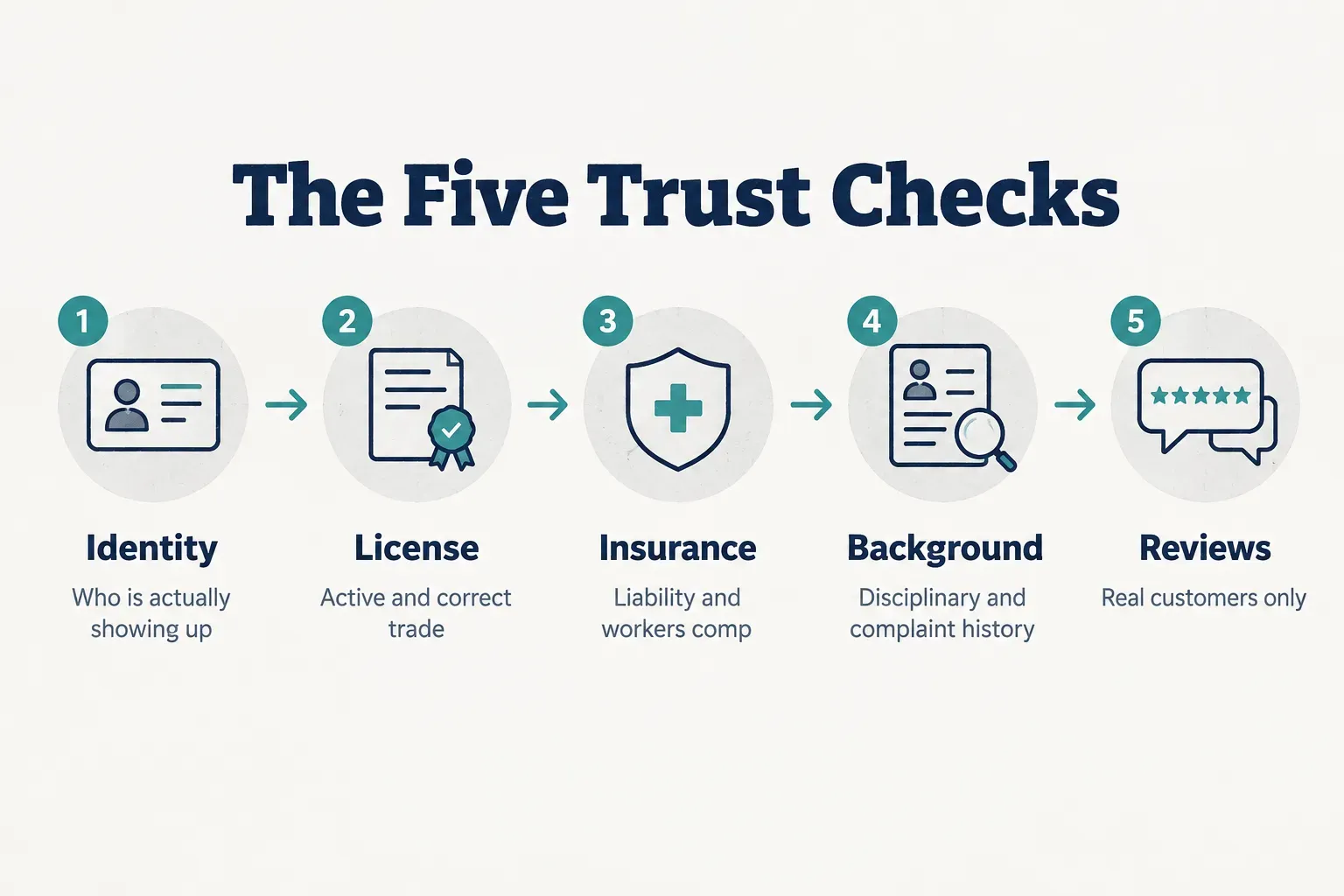
Real reliability rests on five separate checks: identity, license, insurance, background, and review authenticity.
Each one answers a different question. Is this the person they claim to be? Are they legally allowed to do this work? Who pays if something breaks or someone gets hurt? Have they been disciplined before? Are their reviews from real customers?
A badge might cover one or two of those.
Rarely all five.
And almost never as of today, because licenses lapse and insurance policies get cancelled mid-year.
This guide walks through a verification-first system for how to find a reliable contractor, from building a shortlist to releasing the final payment. You’ll learn where to source candidates, how to run a contractor license lookup yourself, how to confirm coverage with an insurer, how to compare bids line by line, and how to structure payments so you keep control.
Why go to this much trouble? Because the stakes are lopsided.
When an unlicensed or underinsured contractor causes damage, injures a worker on your property, or walks off the job, the financial and legal risk shifts to you.
Your homeowner’s policy may deny the claim. Your state’s recovery fund may not cover unlicensed work.
And the money you paid upfront may simply be gone.
Build your shortlist
The best contractor for your job is often not the first one who answers the phone. Good shortlists come from mixing sources, because each channel catches problems the others miss.
Where to find trustworthy candidates
Personal referrals are still the strongest starting point. A friend who watched a contractor work for six weeks knows things no review site can tell you: whether the crew showed up on time, how they handled surprises, and whether the final bill matched the quote.
Local trade associations (builders’ associations, remodelers’ councils, state plumbing or electrical associations) list members who have usually committed to a code of ethics. Membership isn’t a guarantee, but it signals a contractor invested in the trade long term.
Your local permit office records are an underused goldmine.
In many jurisdictions, building permits are public. You can see which contractors pull permits regularly in your area, which tells you they do legal, inspected work.
Service marketplaces with completed-booking reviews add speed and transparency. Platforms like Frendex show live availability, upfront pricing, and ratings that can only be left after a finished job, which cuts down on drive-by fake reviews.
That helps discovery a lot.
But it still doesn’t replace your own independent license and insurance verification.
Know which type of pro you need
Hiring the wrong category of pro is a common and expensive mistake. Here’s how the main types differ:
A general contractor manages an entire project, hires and schedules trades, pulls permits, and is responsible for the overall result.
A subcontractor is hired by the general contractor to handle one portion, such as drywall or tile.
A handyman handles small repairs and maintenance, typically without structural, electrical, or plumbing scope.
A specialty trade contractor holds a license in one discipline: electrician, plumber, roofer, HVAC technician, or structural specialist.
In most states, electrical, plumbing, and HVAC work legally requires a specialty license, and many jurisdictions also license roofers.
Handymen are often limited by a dollar threshold or barred from licensed trades entirely. Painting or minor carpentry may be optional to license, depending on where you live.
Match your search to the job size
Aim to contact 5 to 8 candidates, then narrow to 3 for formal written estimates. That number gives you real price comparison without burning weeks on calls.
Your priorities should shift with the job:
- Emergency repair: speed and availability come first, but still check the license before anyone touches a burst pipe or sparking panel.
- Small job or single trade: a handyman may be enough, as long as the work doesn’t cross into licensed territory.
- Recurring maintenance: prioritize communication and consistency. You’ll be working with this person for years.
- Multi-trade renovation: hire a general contractor with proven subcontractor management, because coordinating five trades yourself is a part-time job.
Verify before you trust
Here’s the uncomfortable truth: a contractor can be friendly, punctual, and confident while holding an expired license.
Verification takes about 20 minutes per candidate.
It’s the cheapest insurance you’ll ever buy.
One rule before you start.
Licensing rules, required classifications, and disciplinary databases vary by state, county, and trade.
There is no single national contractor registry, so always check your specific jurisdiction’s licensing agency rather than assuming a standard that applies everywhere.
Confirm license status independently
- Get the license number in writing. Ask for it on the estimate or business card, not just verbally. A reliable contractor hands it over without hesitation.
- Find your state or local licensing board. Search for your state’s contractor licensing board, and check whether your city or county issues separate licenses for certain trades.
- Search by license number, then by business name. Running both searches catches cases where a contractor borrows someone else’s number or operates under a different entity.
- Check the expiration date. An expired or suspended license means the work may be illegal and uninsurable. “Pending renewal” deserves a follow-up question.
- Confirm the trade classification. A license for general building doesn’t always authorize electrical or plumbing work. Make sure the classification matches your project.
- Review disciplinary history. Look for complaints, citations, bond claims, and suspensions. One resolved complaint over 15 years is normal. A pattern is not.
- Match the name to the person in front of you. The licensed business name should match the contract, the invoice, and the company the person says they represent.
Confirm insurance coverage is current
- Request a current certificate of insurance (COI). Ask the contractor’s insurance agent to issue it directly, listing you as the certificate holder for your project address.
- Call the insurer directly. Use a phone number you look up yourself, not the one printed on the certificate. Confirm the policy is active and hasn’t been cancelled for nonpayment.
- Check general liability insurance limits. This covers damage to your property. Many residential contractors carry $1 million per occurrence, and larger projects often warrant more.
- Verify workers compensation coverage. If an uninsured worker is injured on your property, you could face the claim. Some states exempt sole proprietors, so ask how they’re covered if they claim an exemption.
- Ask about bonding. A bonded contractor has a surety bond that can compensate you if they fail to complete work or follow licensing law. Bond amounts are often modest, so treat bonding as a backstop, not full protection.
Why isn’t an old or emailed certificate enough? Because a COI is a snapshot.
It proves coverage existed on the day it was printed, and PDFs are easy to edit.
Only a direct call to the insurer tells you what’s true today.
Separate real reviews from fake ones
- Check reviewer locations. Addresses or cities that fall outside the contractor’s service area are a warning sign.
- Look for repeated phrasing. Generic lines like “Great job, very professional, highly recommend!” copied across multiple profiles suggest purchased reviews.
- Watch for sudden review spikes. Twenty five-star reviews in one week after two years of silence rarely happen organically.
- Reverse-search project photos. Duplicated photos appearing on multiple listings, or stock images, mean the project portfolio may not be theirs.
- Read for service mismatches. A roofing company with reviews describing kitchen remodels or carpet cleaning may be recycling reviews from another business.
Compare estimates like a pro

The lowest bid is rarely the cheapest job.
Get at least 3 written estimates, and be suspicious when one comes in 20% or 30% below the others.
A low number usually means one of three things: missing scope, inferior materials, or a change-order trap.
That last one is the classic move.
Win the bid with an incomplete price, then recover the margin through “unexpected” add-ons once your kitchen is already gutted.
What ‘apples to apples’ really means
Comparing three single totals tells you almost nothing. Comparing nine line items tells you nearly everything.
Use this worksheet to lay bids side by side and spot exactly where they differ:
| Line Item | What a Complete Bid Shows | Warning Sign in a Low Bid |
|---|---|---|
| Labor | Crew size, estimated hours or days, and hourly or flat rate | One vague lump sum with no breakdown |
| Materials | Brand, model, grade, and quantity for major items | ”Standard materials” with no specifics |
| Allowances | Realistic dollar amounts for fixtures, tile, or cabinets you’ll choose later | Allowances set unrealistically low to shrink the total |
| Permits | Permit fees included and who pulls them | Permits not mentioned at all |
| Disposal and cleanup | Dumpster, haul-away, and daily cleanup terms | Debris removal left out or “by owner” |
| Subcontractor costs | Which trades are subcontracted and what’s included | No mention of electricians or plumbers needed for the job |
| Taxes | Sales tax on materials stated clearly | Tax added later as a “surprise” |
| Warranty terms | Length of workmanship warranty and what it covers | Verbal warranty only, or none at all |
| Stated exclusions | A clear list of what is not included | No exclusions listed, leaving room for disputes |
Once the bids are lined up this way, the “expensive” contractor often turns out to be the only one who priced the whole job.
Questions for contractors and their references
Before you hire, ask each finalist these questions and note how specifically they answer:
- What’s the expected timeline? Ask for a start date, major milestones, and a realistic completion date.
- Who will be on-site daily? You want a name, not “one of our guys.”
- Which parts are subcontracted? Then verify those subcontractors’ licenses too.
- How quickly do you respond to messages? A 24-hour standard is reasonable for most residential work.
- Who is the escalation contact? If something goes wrong and your site lead isn’t answering, you need someone above them.
Then call at least two contractor references, ideally from jobs completed in the last 12 to 18 months. Ask them:
- Did the crew show up on time, consistently?
- How was communication, and did you ever feel left in the dark?
- How were change orders handled, and were they priced fairly?
- Was the site cleaned up daily and at the end?
- Did the contractor honor warranty work when something needed fixing?
- Did the final cost match the original estimate, and if not, why?
Protect your money and your project
Most contractor disputes don’t start with fraud.
They start with a misunderstanding nobody wrote down.
A solid home improvement contract and a smart payment structure prevent the majority of them.
Put every promise in writing
If it’s not in the contract, it doesn’t exist.
That includes the “we’ll throw in the trim” comment from the walkthrough.
Before work begins
- Convert verbal promises into a written scope of work. List every task, material, brand, and finish. “Replace bathroom vanity” becomes “remove existing vanity, install 36-inch model X in white, connect existing plumbing, patch and paint wall.”
- Document pre-work condition with photos. Take dated photos and video of floors, walls, driveways, and landscaping near the work area. If something gets damaged, you have proof of what it looked like before.
- Confirm in writing who pulls building permits. In many places the licensed contractor pulls them, but rules vary by municipality and trade. A contractor who asks you to pull an owner-builder permit may be shifting liability onto you.
- Attach the license number, insurance details, and warranty terms to the contract. Everything you verified should live in the signed document.
- Include start and completion dates. Add what happens if deadlines slip without a valid reason.
When changes come up
- Require a signed change order before any work proceeds. Every addition, substitution, or price change needs a written description, a cost, and both signatures. Unapproved change orders are one of the leading causes of cost overruns.
- Get the time impact in writing too. A change that adds two weeks matters as much as one that adds $2,000.
- Never approve changes verbally on-site. “Sure, go ahead” under pressure is how $500 surprises become $5,000 disputes.
- Keep a running change log. Track each approved change order so the final invoice can be checked line by line.
Pay in milestones, not upfront
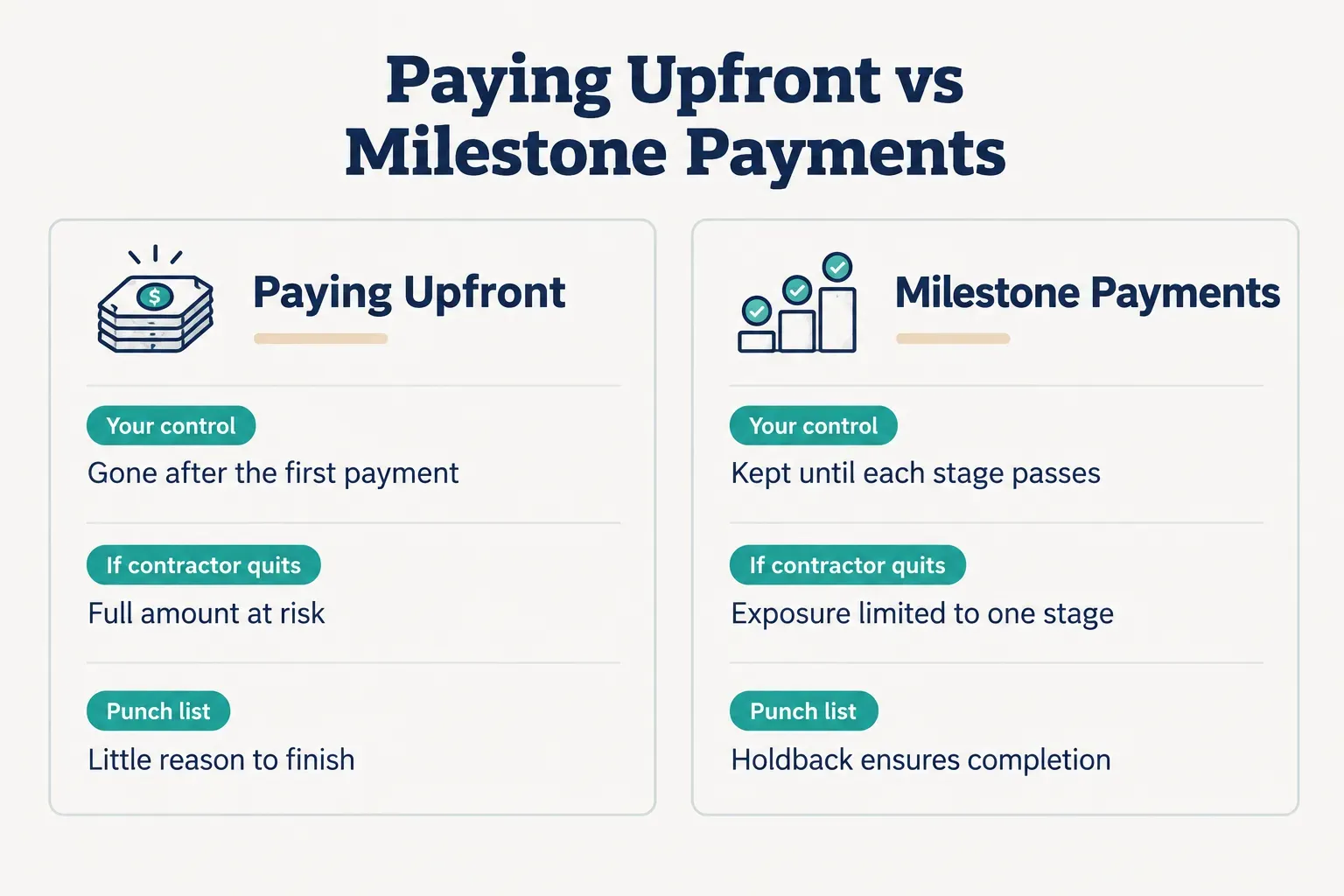
Paying 100% upfront removes your only real influence over the outcome.
Once the money is gone, so is the contractor’s urgency.
Milestone payments keep everyone aligned.
- A reasonable deposit. Common guidance is 10% to 30% depending on project size, and some states cap it. California, for example, limits most home improvement down payments to 10% or $1,000, whichever is less.
- Progress payments tied to completed stages. Pay after demolition, rough-in, inspection approval, or installation, not by calendar date.
- A final holdback or retainage. Keep roughly 5% to 10% until the punch list (the final list of small fixes) is fully cleared and final inspections pass.
- Traceable payment methods only. Use checks, credit cards, or bank transfers. Credit cards may also offer dispute protection.
- Receipts and lien waivers at every stage. Request a receipt for each payment, and ask for lien waivers showing suppliers and subcontractors were paid, so they can’t file a lien against your home later.
Red flags that mean walk away
Some warning signs are subtle.
These are not.
If you see any of them, end the conversation:
- Cash-only or full payment upfront demands. Legitimate businesses accept traceable payments and don’t need your entire budget before starting.
- No permanent business address. A cell number and a truck aren’t enough. You need somewhere to send legal notices.
- High-pressure door-to-door sales. Especially after storms. “Special pricing if you sign today” and “leftover materials from a job down the street” are classic scripts.
- Mid-project requests for more money without a written change order. This often signals cash-flow trouble, or a contractor preparing to disappear.
- Reluctance to share a license number. Excuses like “it’s being renewed” or “you don’t need one for this” should end the conversation.
- Pressure to skip permits. “It’ll save you money” usually means it’ll cost you at resale or when insurance denies a claim.
If a contractor has already taken your money and stopped responding, file a complaint with your state licensing board and your state or local consumer protection agency.
Your next move
If you do just one thing after reading this, make it this: before hiring anyone, look up the license yourself and call the insurer directly.
Do it even if a platform already shows a verified badge.
It takes 20 minutes and catches the problems that cost homeowners the most.
Think of protection as layers.
Marketplace verification helps you find good candidates quickly. Your own license and insurance checks confirm what’s true today.
A written scope of work prevents misunderstandings, and milestone payments keep you in control until the job is done.
Each layer covers a gap the others leave open.
None of them is a substitute for the rest.
The bigger shift is in how you think about trust.
A five-star rating is a claim. A confident sales pitch is a performance.
Reliability is something a contractor proves, one verified document and one completed milestone at a time… and as of 2026, with more tools than ever to check, there’s no reason to take anyone’s word for it.
Reliability isn’t assumed from a badge. It’s proven through a process, and you’re the one who runs it.
Frequently asked questions
How do I know if a contractor is trustworthy?
A contractor is trustworthy when their license, insurance, and reviews all check out independently. Run a contractor license lookup on your state board, call their insurer directly to confirm active coverage, and scan reviews for signs of fabrication. Consistent, transparent answers to your questions are the final signal.
What should I look for when hiring a contractor?
Look for an active license in the correct trade classification, current general liability insurance and workers compensation coverage, and a clean disciplinary record. Beyond paperwork, look for a detailed written estimate, verifiable contractor references, and a real project portfolio. A permanent business address and clear warranty terms round out the picture.
Is it better to get three estimates from contractors?
Yes, three written estimates is the standard for good reason. Three bids reveal the realistic price range and expose any bid that's missing scope or materials. Compare them line by line (labor, materials, allowances, permits, exclusions) rather than by total price alone.
What should you not tell a contractor?
Don't reveal your maximum budget or your insurance payout amount before collecting independent bids. Once a contractor knows your ceiling, estimates tend to rise to meet it. Also avoid saying you're in a rush or that you'll skip permits, since both invite shortcuts.
How do I check a contractor's reputation?
Check reputation through three sources: your state licensing board's disciplinary records, multiple review platforms, and direct reference calls. Look for review red flags like repeated phrasing, sudden spikes, and duplicated photos. Ask references whether the final cost matched the estimate and whether warranty work was honored.
What are the red flags of a contractor?
The biggest red flags are cash-only payment demands, requests for full payment upfront, and reluctance to share a license number. Others include no permanent business address, high-pressure door-to-door sales, and requests for extra money without a signed change order. Any one of these is reason enough to walk away.
Need a hand with something?
The Frendex map shows you who is available near you, in real time.
Get the app free Get the app freeFree, no card needed
Related articles

The contractor contract: A complete guide for 2026
See exactly what a contractor contract must cover in 2026, from scope to payment terms. Avoid the disputes that start over vague wording.

How to spot fake reviews before you get fooled
Learn the real patterns behind fake reviews: language clues, timing red flags, and reviewer history checks. No single signal is proof, here's what is.

Quote vs estimate: Which do you actually need?
Quotes vs estimates explained in plain terms, plus the document checklist that actually protects your money. See when you can skip the paperwork entirely.