Contractor scam warning signs every homeowner should know
By Kiss János 14 min read
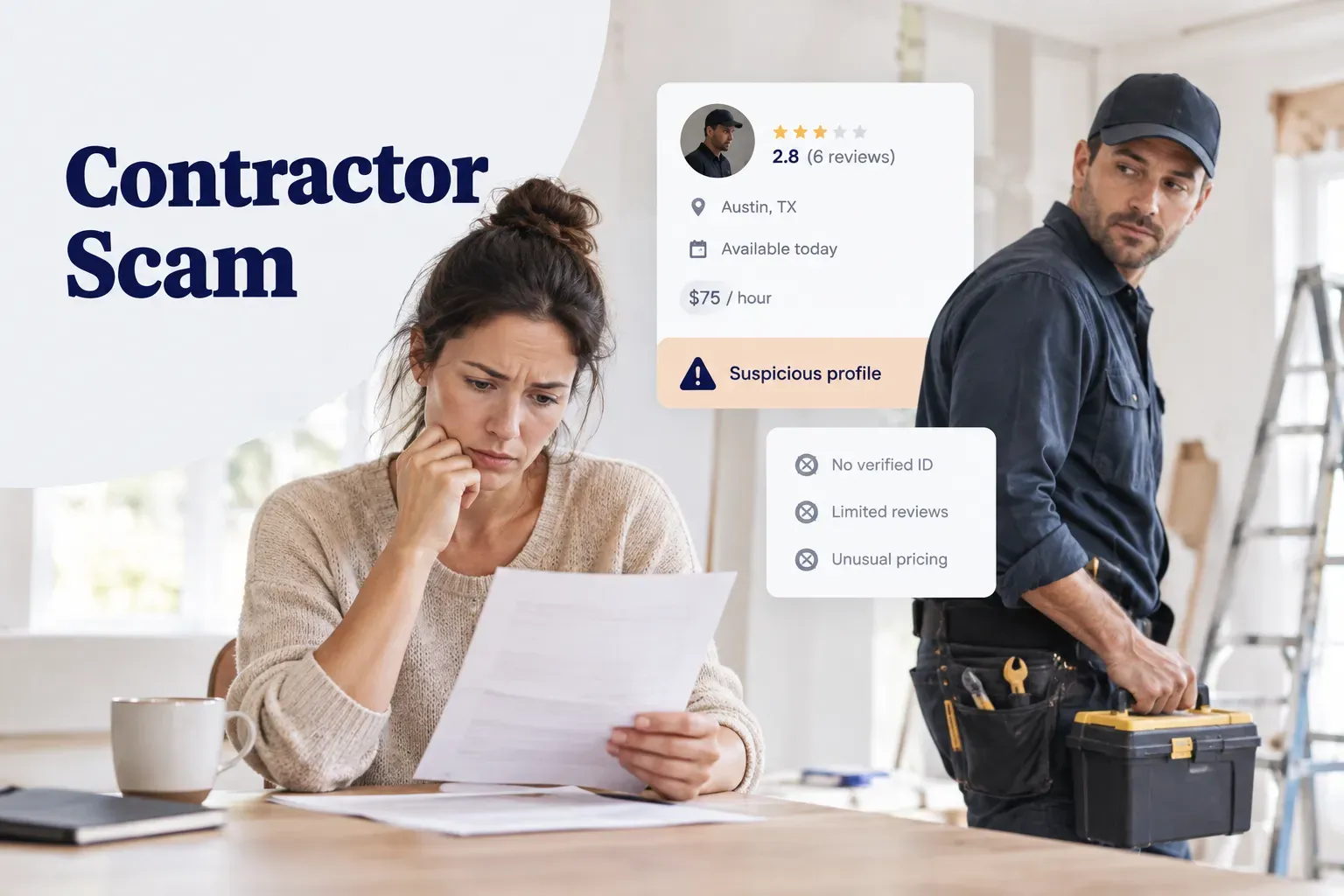
When a renovation turns into a nightmare
Most homeowners who lose money to a contractor never saw it coming. The person seemed friendly, the price seemed fair, and the deposit seemed reasonable.
Then the phone stopped ringing.
A contractor scam is intentional deception for financial gain. It is not the same as sloppy drywall seams, a project that runs two weeks late, or a disagreement over paint color. Those are frustrations.
A scam is a plan to take your money without delivering what was promised, or to extract far more than the job is worth.
Home improvement fraud consistently ranks among the top consumer complaints reported to state attorneys general. And the entry points look remarkably similar from state to state:
Door-to-door pitches after storms, where someone “just happened to be working in the neighborhood.” Lowball online ads promising a full kitchen remodel at half the going rate. Cash-only deals with a discount for skipping paperwork. And high-pressure, same-day signing, where the price is only good “if you sign right now.”
The good news? Scammers depend on homeowners skipping steps.
This guide gives you a four-part system that closes those gaps before money changes hands.
First, verify who you are hiring. Second, standardize the scope so every bid describes the same job. Third, tie payments to milestones instead of promises. Fourth, keep evidence from the first call to the final walkthrough.
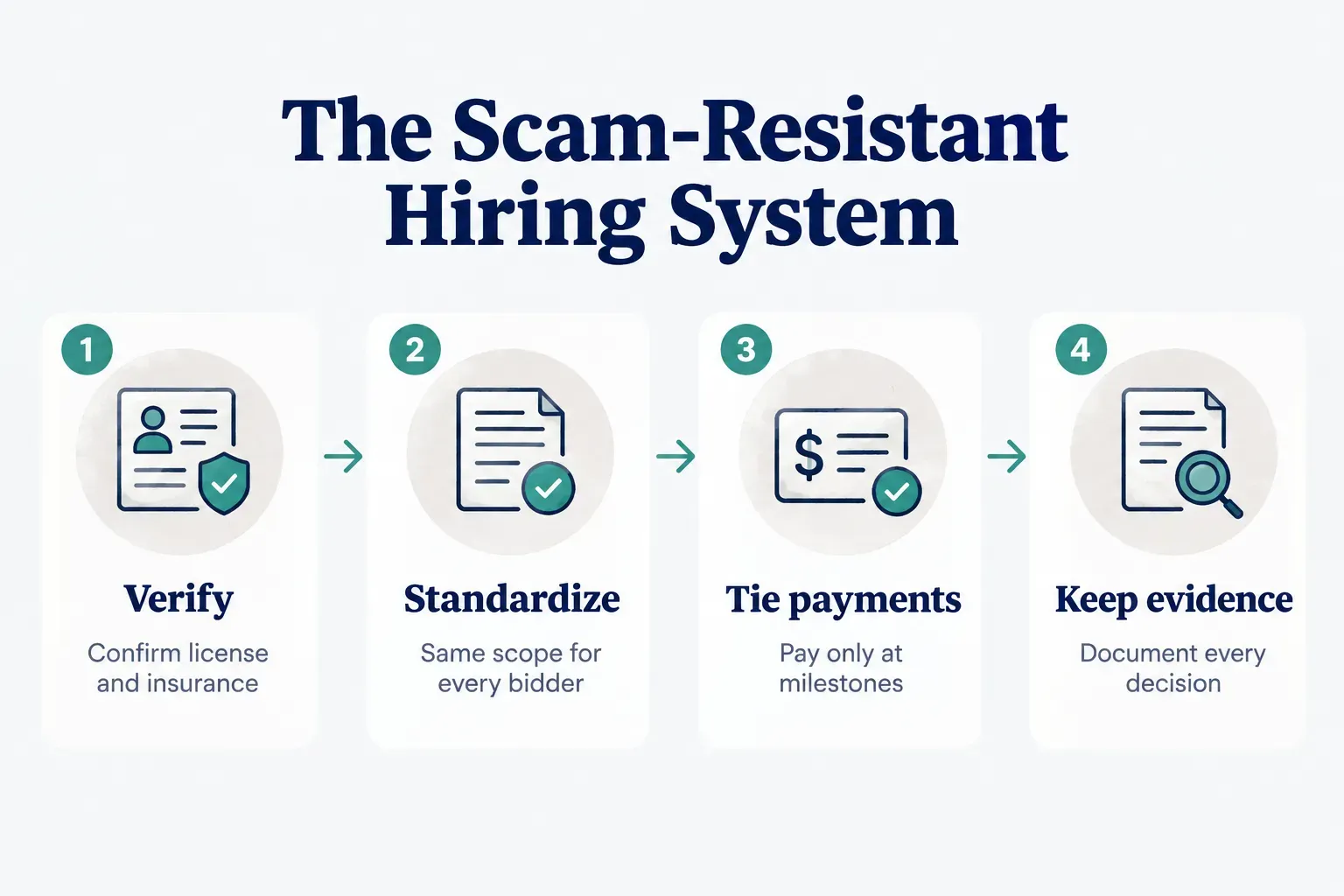
Follow all four, and you make yourself a very unattractive target.
Scam or just a bad contractor?
Not every bad experience is fraud. A contractor who misunderstood the scope or takes three days to return calls is frustrating, but that is a dispute, usually solvable with a conversation, a written change order, or mediation.
Fraud looks different. Demanding full payment upfront, working without a license, and vanishing after collecting a deposit are deliberate choices.
The question to ask is simple: does this behavior protect the contractor’s ability to take money without accountability? If yes, treat it as a fraud signal.
Red flags that point to fraud
Any single item below deserves a pause. Two or more together should end the conversation.
- Unsolicited door-to-door offers. Legitimate contractors are usually booked through referrals and scheduled estimates, not by knocking on doors with “leftover materials” from a nearby job.
- Cash-only insistence. A contractor who refuses checks or cards is often avoiding a paper trail, taxes, or the payment disputes you might file later.
- No written contract. A handshake deal leaves you with nothing to enforce, and many states legally require written contracts for home improvement work above a set dollar threshold.
- Pressure to sign the same day. Expiring discounts and “I can only hold this crew until tonight” are sales tactics designed to stop you from checking references.
- A license number that won’t verify. If the number doesn’t appear on your state licensing board’s database, or it belongs to a different business, walk away.
Verifying who you’re actually hiring
Contractor license verification takes about ten minutes online.
That is less time than most people spend choosing a faucet.
License, insurance, and business identity
- Legal business name: Match the name on the estimate to the name on the license and your state’s business registry. Mismatches are common in borrowed-license schemes.
- License number and status: Confirm it is active, covers the correct trade (roofing, electrical, general), and has no suspensions.
- Bond: If your state requires a contractor bond, the licensing board will usually list the bond company and amount.
- Insurance certificate: Ask for proof of liability insurance and workers compensation insurance sent directly from the insurer, not a photocopy. Call the agent to confirm the policy is current.
- Physical address: A P.O. box or no address at all makes it hard to serve legal papers if things go wrong.
- Authorization: If a salesperson represents a company, call the company’s listed number to confirm that person actually works for them.
Licensing, bonding, deposit limits, and cancellation rights vary by state, trade, and municipality. Always check your own state licensing board and local building department rather than relying on general rules.
Complaint and permit history
- Licensing board complaints: Many boards publish disciplinary actions, citations, and license revocations.
- Attorney general and consumer agency records: Search the business name plus your state for prior consumer protection complaints or settlements.
- Permit history: Many local building departments let you search permits by contractor name. A company claiming 15 years of experience with zero pulled permits is a problem.
Storm chasers and disaster scams
Disasters bring out the best in communities. They also bring out out-of-state crews with magnetic truck signs and no local license.
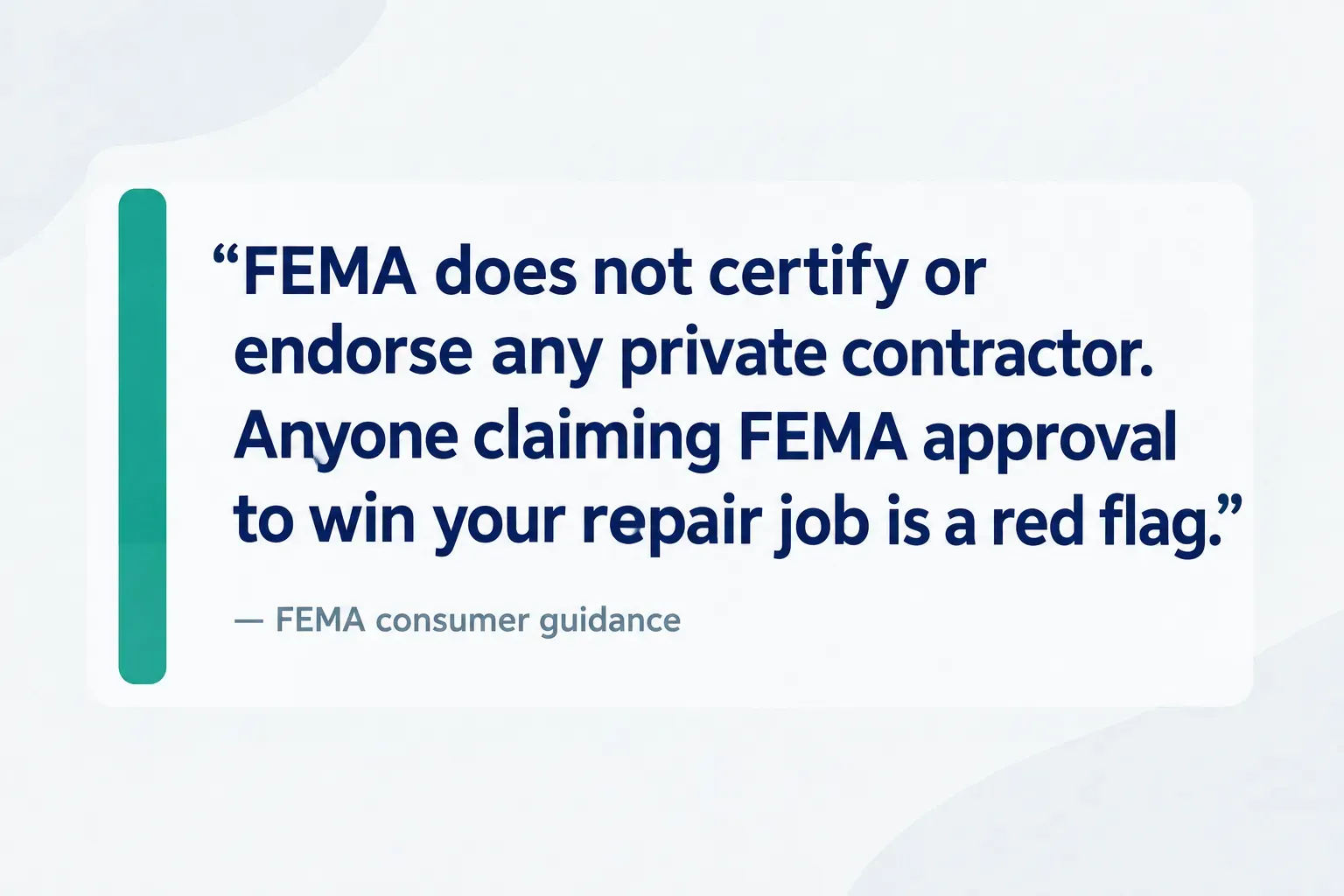
- Fake FEMA affiliation: FEMA does not certify, endorse, or hire contractors for private home repairs. Anyone claiming otherwise is lying.
- Signing over insurance checks: Never endorse your insurance payout directly to a contractor or sign an “assignment of benefits” without reading it carefully, since it can hand over your claim rights.
- Inflated emergency pricing: Tarping a roof is urgent. Signing a $40,000 replacement contract the same afternoon is not.
- Created or exaggerated damage: Some fraudulent “inspectors” climb on roofs and cause hail-like dents or lift shingles themselves. Get your insurance adjuster’s assessment first.
Building a scam-resistant project
Here’s a counterintuitive truth: the best defense against a contractor scam happens before you talk to a single contractor.
When you control the paperwork, scammers lose their favorite weapon, which is vagueness.
Getting estimates you can actually compare
Three estimates mean nothing if each contractor is quoting a different job. One bids builder-grade tile, another bids porcelain, and a third quietly excludes demolition.
Suddenly the “cheapest” bid is the most expensive.
- Write a one-page scope. Describe the work room by room, including what gets removed, what gets installed, and what stays.
- Attach a materials list and specs. Name brands, model numbers, or at least quality tiers so every bidder prices the same products.
- List exclusions clearly. State what is not included, such as appliance installation or painting, so nobody adds it later as a surprise.
- Set a target schedule. Give a preferred start window and completion deadline so contractors price labor realistically.
- State permit assumptions. Specify that the contractor pulls all required building permits and includes permit fees in the bid.
- Request multiple written estimates on the same document. Ask each bidder to price your scope line by line, which makes outliers obvious.
A bid 30% to 40% below the others isn’t a bargain.
It’s usually a setup for change orders later.
What belongs in the contract
A contract is not a formality.
It is the only thing a court, licensing board, or card issuer will look at when deciding who’s right.
- Detailed written scope of work. Copy your standardized scope directly into the contract or attach it as an exhibit.
- Start and completion dates. Include specific dates, plus what happens if deadlines slip without a valid reason.
- Materials and brands. List exact products, so substitutions require your written approval.
- Payment schedule tied to milestones. Link each payment to a completed, inspectable stage, such as rough framing or passed electrical inspection.
- Change-order process. Require every change to be written, priced, and signed by both parties before work begins.
- Warranty terms. Spell out labor warranty length (one year is common) and how manufacturer warranties pass to you.
- Cancellation rights. If the contract was signed at your home, the FTC’s cooling-off rule generally gives you three business days to cancel, and many states add their own protections.
Permits, documentation, and finding providers safely
In most states, the licensed contractor, not the homeowner, must pull permits for licensed trade work. A contractor who asks you to pull an “owner-builder” permit may be shifting legal liability onto you, or hiding the fact that they aren’t licensed.
- Confirm permits before work starts. Ask for the permit number and look it up on your building department’s site; unpermitted work can void insurance coverage or derail a future home sale.
- Keep all project documentation in one place. Store quotes, contracts, photos, receipts, and messages in a single folder or app so nothing depends on memory.
- Move decisions into writing. After any phone call, send a short text or email summarizing what was agreed, which turns verbal promises into evidence.
- Use structured discovery tools. Platforms like Frendex, which only allow ratings after a completed booking and keep chat and booking details on record, show how organized discovery and documentation reduce uncertainty when finding local service providers. No app can guarantee a contractor’s honesty, but verified reviews and a built-in paper trail make bad actors easier to spot.
Payment traps to watch for
Follow the money, and most scams reveal themselves. The deposit, the add-ons, and the payment method are where fraudsters make their profit, which makes them exactly where homeowners should slow down.
How much deposit is normal
Many states cap the contractor deposit a homeowner can be asked to pay before work begins. The limits vary, but they are often modest.
- Common state caps: California limits most home improvement deposits to 10% of the contract price or $1,000, whichever is less. Maryland caps deposits at one-third of the contract price.
- The 50% warning sign: A request for half or full payment upfront is a major red flag unless it’s tied to a documented, custom material order such as special-order cabinets or windows.
- Ask for proof: If a larger deposit is justified, request the supplier invoice. Some homeowners pay the supplier directly to remove the risk entirely.
- Financing caution: Be wary of contractors pushing home improvement financing they arrange themselves, especially loans that pay the contractor in full before work starts.
Change-order and add-on scams
The classic pattern starts with a bid that’s almost too good.
Then the extras begin.
- Deliberately low bids: The contractor wins the job on price, knowing the real profit will come from add-ons once demolition makes it hard for you to walk away.
- Repeated verbal add-ons: “We’ll need another $800 for that” said casually on site, with no written change order, adds up fast and is nearly impossible to dispute.
- Surprise material substitutions: Cheaper products get installed while you’re billed for the originals, which is why brand names belong in the contract.
- Manufactured emergencies: Suddenly discovered rot, mold, or “code problems” that require immediate payment. Ask to see it, photograph it, and get a second opinion if the cost is significant.
- Pressure without pricing: Never approve extra work until you have a written price and a signed change order in hand.
Risky payment methods
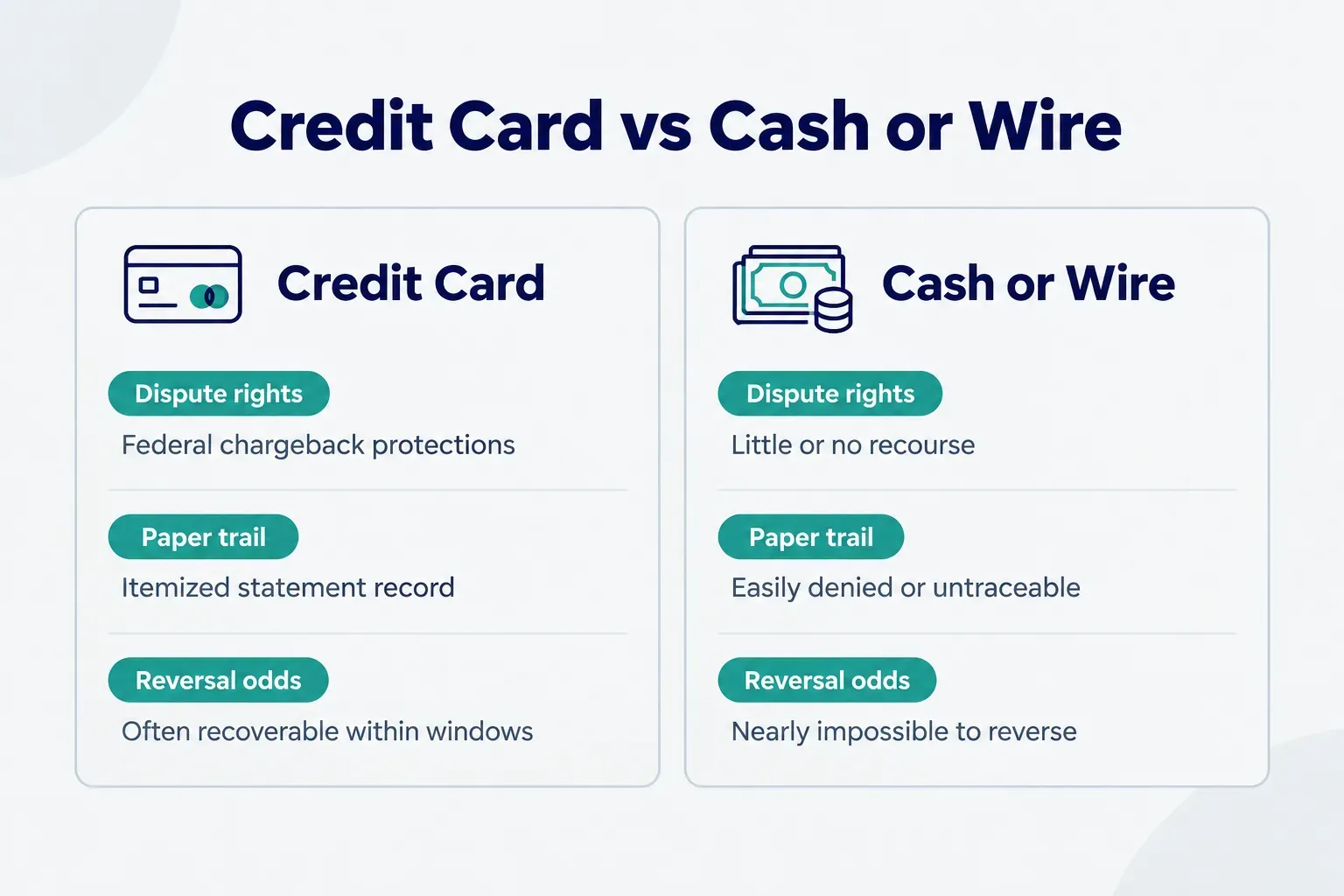
How you pay determines whether you can get money back. Cash, wire transfers, cryptocurrency, gift cards, and peer-to-peer apps like Zelle or Venmo offer little or no fraud protection.
Credit cards carry dispute rights under the Fair Credit Billing Act. Checks create a clear paper trail and can sometimes be stopped.
Gift cards and crypto requests, though… those are never legitimate for contractor work.
- Structure the final payment carefully. Hold the last 10% to 15% until the job passes final inspection, cleanup is complete, warranty paperwork is delivered, and you’ve collected lien waivers from the contractor and major suppliers.
If the contractor already took your money
The first 72 hours after you realize something is wrong matter more than the next 72 days. Payment dispute windows close, evidence disappears, and contractors who sense trouble often stop answering.
Act quickly and in writing.
Stopping further loss
Your goal right now is to freeze the situation and preserve proof.
- Stop further payment. Don’t release the next milestone payment, even if the contractor promises to “make it right.” Cancel any scheduled transfers.
- Send a written demand letter. State what was promised, what was delivered, what you want (completion or refund), and a firm deadline, such as 10 business days. Send it by certified mail and email.
- Photograph and video everything. Capture the current state of the work from multiple angles with timestamps before anyone else touches it.
- Gather every document. Pull contracts, texts, emails, and invoices into one folder now, while you still remember the context.
Recovery options by payment method
Your recovery odds depend heavily on how you paid.
Here’s the realistic picture.
- Credit cards: Chargebacks are the fastest path. Federal law generally requires billing disputes within 60 days of the statement date, and many issuers allow longer for undelivered services.
- ACH and debit: Disputes are possible but windows are tight, often 60 days, and protection is weaker for payments you authorized yourself. Call your bank immediately.
- Checks: If the check hasn’t cleared, you can request a stop payment. If it has, your bank can’t help, but the canceled check is strong evidence.
- Wire transfers and crypto: These are nearly impossible to reverse. Report it to your bank or exchange right away, since a same-day recall occasionally works.
- Cash: There is no recourse through a financial institution. Your options are small claims court, licensing board recovery funds, or criminal charges.
Liens, waivers, and unfinished work
Here’s a trap many homeowners don’t see coming.
You can pay your contractor in full and still face a mechanic’s lien on your property.
- How liens happen: If your contractor didn’t pay subcontractors or material suppliers, those parties can file a lien against your home, even though you paid the general contractor.
- Conditional lien waivers: These release lien rights only once a specific payment actually clears. Collect them with each progress payment.
- Unconditional lien waivers: These release rights immediately and permanently. Get them after final payment clears, from the contractor and every major sub and supplier.
- Finishing the job: Before hiring a replacement contractor, document the incomplete work thoroughly so the cost to complete becomes part of your damages claim.
Who to report and why
Filing with the wrong agency wastes weeks. Each one handles a specific piece of the problem.
- State licensing board: Professional violations like abandonment, unlicensed work, or code failures. Some states operate recovery funds for victims of licensed contractors.
- State attorney general: Consumer protection complaints about fraud and deceptive practices, especially when multiple victims are involved.
- Local building department: Unpermitted work, failed inspections, and safety hazards.
- Bank or card issuer: Payment disputes, chargebacks, and stop payments.
- FTC: Fraud reporting through ReportFraud.ftc.gov, which feeds a database used by law enforcement nationwide.
Full evidence checklist: contracts, estimates, texts, emails, call notes, photos, videos, permits, inspection results, invoices, payment confirmations, and the dates of every missed promise. Organize it chronologically.
A clean timeline is persuasive to every agency on this list.
Protect the project before you sign
If you take only one action from this guide, make it this: before hiring anyone, verify the license and insurance, get a written scope, and never pay more than the legal deposit limit in your state. Those three steps alone block the majority of contractor scams homeowners report.
Everything else, from milestone payments to lien waivers, builds on that foundation. It takes maybe an hour of extra effort per project. Compare that to the months, and sometimes years, victims spend trying to recover lost deposits.
Now the mindset shift.
Asking for proof doesn’t make you difficult. It makes you a serious client.
A legitimate contractor welcomes documentation and verification because it protects them too. Resistance to either is itself a warning sign.
Good contractors in 2026 expect homeowners to check licenses, compare bids, and put every change in writing.
The ones who push back on that? You’ve just learned everything you need to know about them.
Frequently asked questions
How do I know if a contractor is scamming me?
A contractor is likely scamming you if they demand large upfront payments, refuse a written contract, can't produce a verifiable license, or disappear after collecting a deposit. Pressure tactics and cash-only demands are also strong signals. See the red flag list in "Scam or Just a Bad Contractor?" above.
What should you not say to a contractor?
Don't disclose your insurance payout amount, your total budget, or your willingness to pay cash before a written scope exists. Each of those tells a dishonest contractor exactly how much they can charge. Let the bid come in first, based on your standardized scope.
What is the most common contractor scam?
The most common contractor scam is taking a large deposit and then doing little or no work. Close behind are lowball bids followed by inflated change orders, and post-storm roofing scams targeting insurance payouts.
How do you check if a contractor is trustworthy?
Verify their license on your state licensing board's website, confirm liability and workers compensation insurance directly with the insurer, and search complaint and permit history. Then call two or three recent references and, if possible, view a completed job.
What can I do if a contractor took my money and did not do the work?
Stop all further payments, send a written demand letter, and file a payment dispute if you paid by card. Then report to your state licensing board and attorney general. Small claims court is a practical option for amounts under your state's limit.
Is it normal for a contractor to ask for half upfront?
No, asking for half upfront is unusual and often exceeds state deposit limits, which are frequently capped around 10% or a fixed dollar amount. Treat it as a yellow flag. Ask for a written materials justification, such as a supplier invoice for custom items, before agreeing.
Need a hand with something?
The Frendex map shows you who is available near you, in real time.
Get the app free Get the app freeFree, no card needed
Related articles

The contractor contract: A complete guide for 2026
See exactly what a contractor contract must cover in 2026, from scope to payment terms. Avoid the disputes that start over vague wording.

How to spot fake reviews before you get fooled
Learn the real patterns behind fake reviews: language clues, timing red flags, and reviewer history checks. No single signal is proof, here's what is.

Quote vs estimate: Which do you actually need?
Quotes vs estimates explained in plain terms, plus the document checklist that actually protects your money. See when you can skip the paperwork entirely.