The contractor contract: A complete guide for 2026
By Kiss János Updated 14 min read

What is a contractor contract, really?
Most contractor disputes don’t start with fraud. They start with a sentence like “just finish the bathroom” and two people who pictured completely different bathrooms.
A contractor contract is a written agreement between a client and a service provider that spells out the scope of work, price, timeline, payment terms, and each party’s responsibilities. It turns a handshake and a vague plan into a set of terms both sides can point to when questions come up.
And questions always come up.
The term is often tied to construction, but it covers far more than framing and drywall. The same structure applies to home repair, kitchen and bath remodeling, landscaping, roofing, house cleaning, pest control, IT consulting, web development, and nearly any paid service where someone does work for someone else.
If money changes hands for labor, a contractor contract belongs in the picture.
Why bother for a $600 fence repair? Because small jobs generate a surprising share of arguments.
Without a written record, every disagreement becomes a “he said, she said” contest over what was promised, what it cost, and when it was supposed to be done.
A written contract doesn’t signal distrust. It signals that both sides want the same outcome and are willing to define it.
A good contract also protects the contractor, not just the client. It documents what was agreed, so a homeowner can’t later claim the $4,000 deck price included staining, lighting, and a new railing.
Clear terms keep good working relationships good.
One note before going further.
This guide is general education, not legal advice. Contract law varies by state, province, and country, and some rules (deposit caps, licensing thresholds, mandatory cancellation periods) depend on job size and type.
For high-value or complex work, a local attorney is worth the fee.
Estimate, proposal, contract, or invoice?
Here’s a pattern that shows up again and again: a client treats a rough estimate as a locked-in price, the final bill comes in 25% higher, and both sides feel cheated.
Neither is lying.
They’re just holding different documents and assuming they mean the same thing.
Each document in a service job has a distinct purpose and a different level of legal weight. The table below lays them out side by side.
| Document | What It Does | Usually Binding? | When It Appears |
|---|---|---|---|
| Estimate | Gives an approximate cost range based on an initial look at the job | No, it’s an informed guess | After a first call or site visit |
| Proposal / Quote | Offers a specific price for a defined scope, often with an expiration date | Becomes binding once formally accepted | After measurements and scoping |
| Statement of Work (SOW) | Details deliverables, tasks, acceptance criteria, and timeline | Yes, when attached to or referenced by a signed contract | Alongside the contract, common in IT and commercial work |
| Contract | Sets the full legal terms: scope, price, payment schedule, responsibilities, remedies | Yes | Signed before work begins |
| Change Order | Modifies scope, price, or schedule after the contract is signed | Yes, once both parties sign | Mid-project, before extra work starts |
| Invoice | Requests payment for completed work or a reached milestone | Creates a payment obligation under the contract | At deposit, milestones, and completion |
| Receipt | Confirms payment was received | Serves as proof, not an agreement | After each payment |
In a real job, these documents form a chain.
A landscaper visits, gives an estimate of $8,000 to $10,000, then sends a proposal for $9,200 with a plant list and grading plan. The client signs a contract that references that proposal, a change order adds drip irrigation for $1,100, and invoices follow at each milestone.
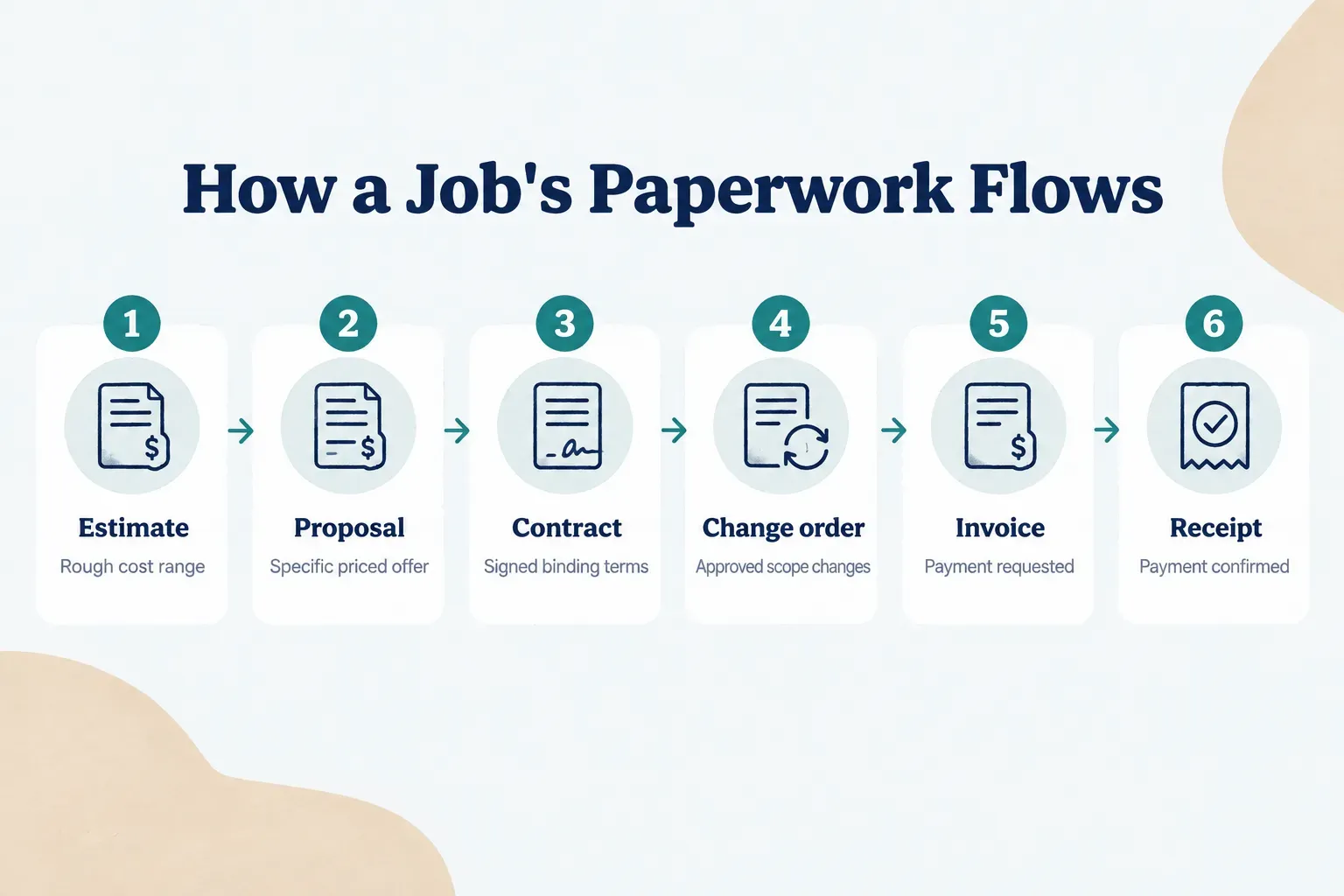
Most client-contractor disputes trace back to confusion at the first link.
An estimate is not a promise.
If the client never signed a contract with a fixed price, the contractor may be entitled to bill actual time and materials, which can land well above the original range.
The other common failure is scattered paperwork.
Approvals buried in text threads, a change order scribbled on the back of a receipt, a photo of a signed page that nobody can find… When these documents live in one digital record, it’s far harder for an approval to “disappear” or a price to get disputed after the fact.
What belongs in a solid contract
The length of a contract tells you almost nothing about its quality.
A tight two-page agreement with measurable terms protects both sides better than a 20-page template stuffed with boilerplate nobody read. What matters is whether three areas are covered clearly: scope, payment, and responsibility.
Defining scope and deliverables
The scope of work is the heart of the contract. It defines exactly what the contractor will deliver, and just as importantly, what they won’t.
Vague scope is the single biggest source of cost overruns and arguments.
A strong scope section lists specific deliverables, the tangible results the client receives. It names the materials, including brand, model, grade, or color where it matters.
It also includes explicit exclusions, because anything unstated becomes a negotiation later.
Then come acceptance criteria: measurable standards that define “done.” These should be checkable by someone other than the contractor.
Finally, a client sign-off step confirms the work meets those standards before final payment.
Compare these two clauses:
Vague: “Contractor will renovate the bathroom to a high standard.” Specific: “Contractor will remove existing tub and tile, install a 60-inch Kohler Archer alcove tub, tile three walls to 84 inches with client-supplied 3x6 white subway tile, and replace the vanity with model #VX-36. Excludes plumbing relocation, drywall repair beyond the tile area, and painting. Work is complete when all fixtures are operational, grout is sealed, and the client signs the completion checklist.”
The first version invites a fight.
The second one ends it before it starts.
For IT, consulting, or creative work, this same section often takes the form of a statement of work. The logic is identical: deliverables, exclusions, acceptance criteria, sign-off.
Payment terms that protect both sides
Money disputes rarely come from the total price.
They come from timing.
When is the deposit due, what triggers the next payment, and what happens if the client thinks a charge is wrong?
Start with the pricing model.
A fixed-price contract sets one total for the defined scope, which gives the client cost certainty and puts overrun risk on the contractor. A time and materials contract bills actual hours and supplies, which suits jobs with unknowns (like opening a wall without knowing what’s inside), ideally with a not-to-exceed cap.
Then build a clear payment schedule. Most contracts cover:
- Deposit: An upfront amount to secure scheduling and materials. Some states cap it; California, for example, limits home improvement down payments to $1,000 or 10% of the contract price, whichever is less.
- Progress payments: Payments tied to milestones like “rough-in complete” or “cabinets installed,” not to calendar dates alone.
- Invoice timing: When invoices are sent and how many days the client has to pay (net 7, net 15, net 30).
- Disputed charges: A process for flagging a charge in writing within a set window, while paying the undisputed portion on time.
- Retainage: A holdback, commonly 5% to 10% in commercial construction, released once the work is accepted.
- Final payment conditions: Typically tied to punch list completion, client sign-off, and any required lien releases or inspections.
Tying payments to verified milestones protects the client from paying ahead of the work. It also protects the contractor from fronting weeks of labor with no cash coming in.
Materials, permits, and insurance
Who pulls the permit?
It sounds like a minor detail until an unpermitted addition blocks a home sale three years later. The contract should name the responsible party, and in most residential work that’s the licensed contractor.
This section should also address contractor licensing. The client should verify the license with the state licensing board, and the contract should list the license number.
Many states require a license above a dollar threshold, sometimes as low as $500 to $1,000 in labor and materials.
Ask for a certificate of insurance covering general liability and, where applicable, workers’ compensation. A property owner can end up exposed if an uninsured worker is injured on site.
If bonding is required for the job type or jurisdiction, note the bond details too.
Don’t skip subcontractors.
The contract should state whether subs are allowed, whether they must carry their own insurance, and who pays them. An indemnification clause, which shifts responsibility for certain losses to the party who caused them, rounds this section out.
Changes, classification, and conflict
Even a perfectly written contract meets reality eventually.
The client changes their mind, the contractor finds rotted joists, or the job stalls halfway. This section covers what the contract can and can’t do when things shift.
Contractor agreement vs independent contractor status
Here’s a misconception that costs businesses real money: writing “independent contractor” at the top of an agreement does not make someone one.
Labels don’t decide classification.
Behavior does.
In the U.S., the IRS looks at three categories of evidence: behavioral control (does the business direct how the work is done?), financial control (who supplies tools, sets rates, and bears profit or loss?), and the relationship of the parties (benefits, permanence, whether the work is core to the business). The Department of Labor and many states apply their own tests, some stricter than the IRS.
An independent contractor agreement helps document the relationship, but it should match how the work actually happens. If you set someone’s hours, provide their equipment, and supervise every task, a court may treat them as an employee regardless of the paperwork.
Misclassification can bring back taxes, penalties, and benefits liability.
Handling change orders mid-project
A change order is a signed amendment that modifies the original contract. It’s the only clean way to handle a scope change after work begins.
Verbal “while you’re at it” requests are where budgets go to die.
Every change order should state what changed, the revised price (added or credited), the schedule impact in days, and which materials are affected. Most important, it should require written approval from both parties before any extra work starts.
Contractors benefit from this rule as much as clients. Without a signed change order, a contractor who does extra work may struggle to get paid for it.
A good contract says plainly: no change order, no change.
If the work isn’t finished
Abandoned jobs happen.
A contractor overcommits, runs into cash problems, or simply stops showing up. The contract should already contain the tools to respond.
The sequence usually starts with written notice describing what’s incomplete and referencing the contract terms. That notice triggers a cure period, often 7 to 14 days, giving the contractor a fair chance to fix the problem.
During this time, a payment holdback (withholding payment for unfinished work) keeps the client from paying for labor that hasn’t happened.
If the contractor doesn’t cure, a termination clause allows the client to end the agreement. It should also spell out the right to hire a replacement and, in many cases, charge the original contractor for the reasonable cost difference.
Without these clauses, the client’s options get murkier and more expensive.
Resolving a dispute step by step
Most disputes never reach a courtroom, and the ones that resolve quickly tend to follow a predictable path. Each step builds the record for the next.
Start with written notice, then document the cure period.
Gather evidence: dated photos, text and email threads, invoices, change orders, and payment records. If talking doesn’t solve it, mediation brings in a neutral third party to help both sides reach an agreement, usually at a fraction of litigation costs.
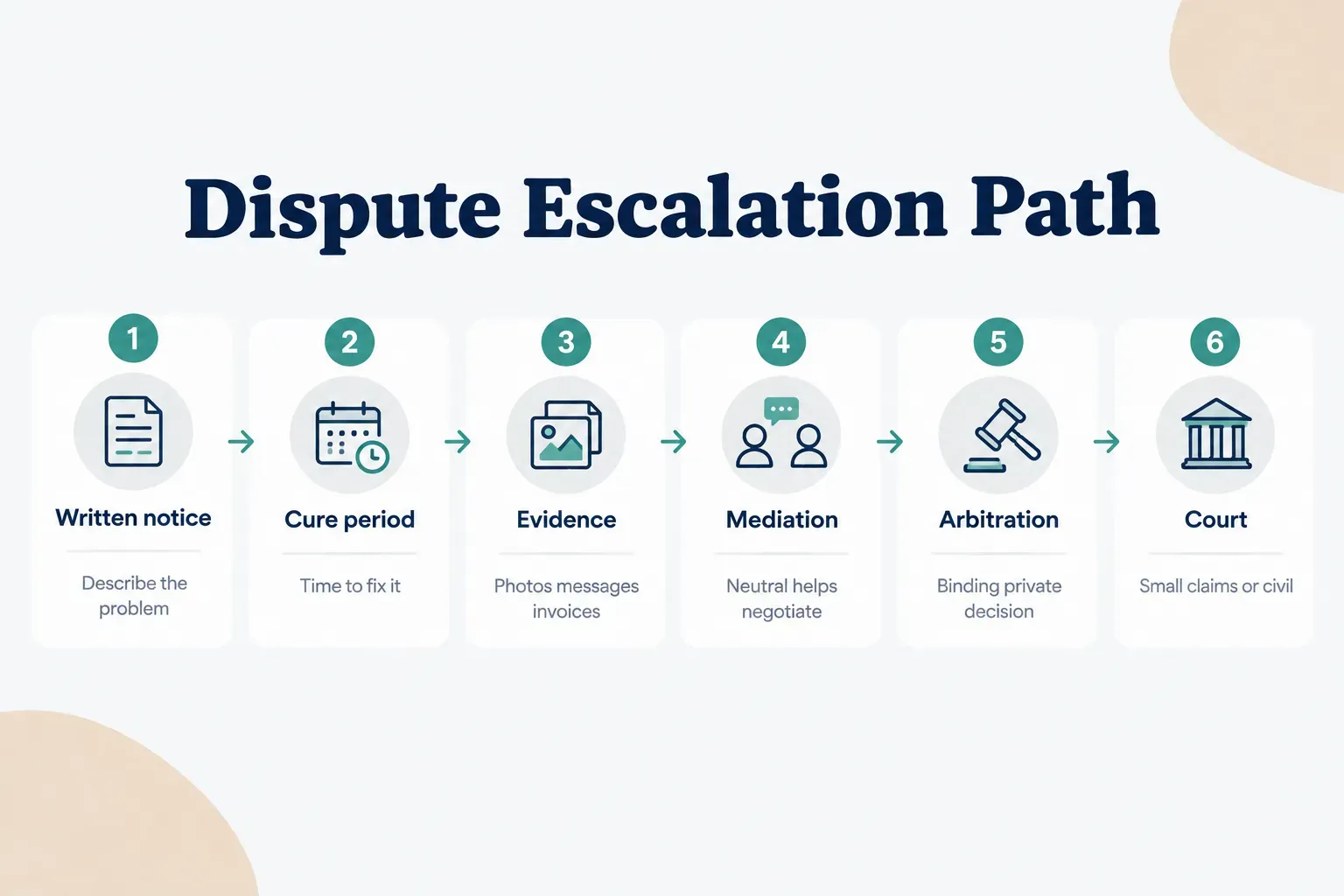
If mediation fails, arbitration produces a binding decision from a private arbitrator, and many contracts require it. Small claims court is the last practical stop for modest amounts; limits vary widely by state, from about $2,500 to $25,000.
Larger claims go to civil court, where a lawyer becomes essential.
Turning terms into a job you can track
A contract only works if people can find it.
The best-written agreement in the world doesn’t help when the signed copy is in a glovebox and the change order lives in a deleted text thread.
Protections local services often skip
Local service contracts tend to focus on price and forget the details that actually cause friction on day one. These are the clauses worth adding:
- Arrival windows: A defined window (say, 8 to 10 a.m.) and a notice requirement if the crew will be late.
- Property access: Gate codes, key handoffs, pet instructions, and which entrances and bathrooms the crew may use.
- Property protection: Floor coverings, dust barriers, and who pays for damage to landscaping, driveways, or finishes.
- Cleanup standards: Daily broom-clean versus final deep clean, plus debris removal and dumpster placement.
- Before and after photos: Documented condition at the start and finish, which settles most damage claims instantly.
- Customer-supplied materials: Who’s responsible if client-bought tile arrives cracked or short, and whether the contractor warranties installation of materials they didn’t source.
Closing out the job properly
The last 5% of a job causes a disproportionate share of headaches. Closeout deserves its own section in the contract.
Start with a punch list, a walkthrough list of small items to fix before the job is considered complete. Then define a defect notice period (how long the client has to report problems) and the warranty terms, including what’s covered, for how long, and whether labor is included.
One year on workmanship is common for residential work.
Where relevant, collect lien releases from the contractor and major suppliers, so no one can file a mechanic’s lien against the property later. Then issue the final invoice, hand over documents like manuals, permits, and paint codes, and agree on how long both sides keep records.
Seven years is a sensible default for anything tax-related.
All of this works better in one place.
When the signed contract, change order approvals, messages, and before-and-after photos sit in a single trackable record, disputes shrink because the evidence is already organized. An app like Frendex, which handles booking, messaging, and job status updates, is one way to keep that trail together instead of scattering it across texts, emails, and paper.
But a tracking tool is a workflow, not a contract.
For any job large enough to warrant one, it should hold a formal written agreement, not replace it.
Before you sign anything
Read the scope and payment sections twice before you sign.
Not once.
Twice.
Those two sections decide what you get and what you pay, and they’re where vague language hides.
And if a contractor promises something verbally (“we’ll handle the haul-away, don’t worry about it”), ask them to add it to the contract.
Spoken promises don’t survive disputes.
Written terms do.
Bring in a lawyer when the stakes justify it: high project values, commercial contracts, any question about licensing, or indemnification and liability language you don’t fully understand.
A one-hour review often costs less than a single change order.
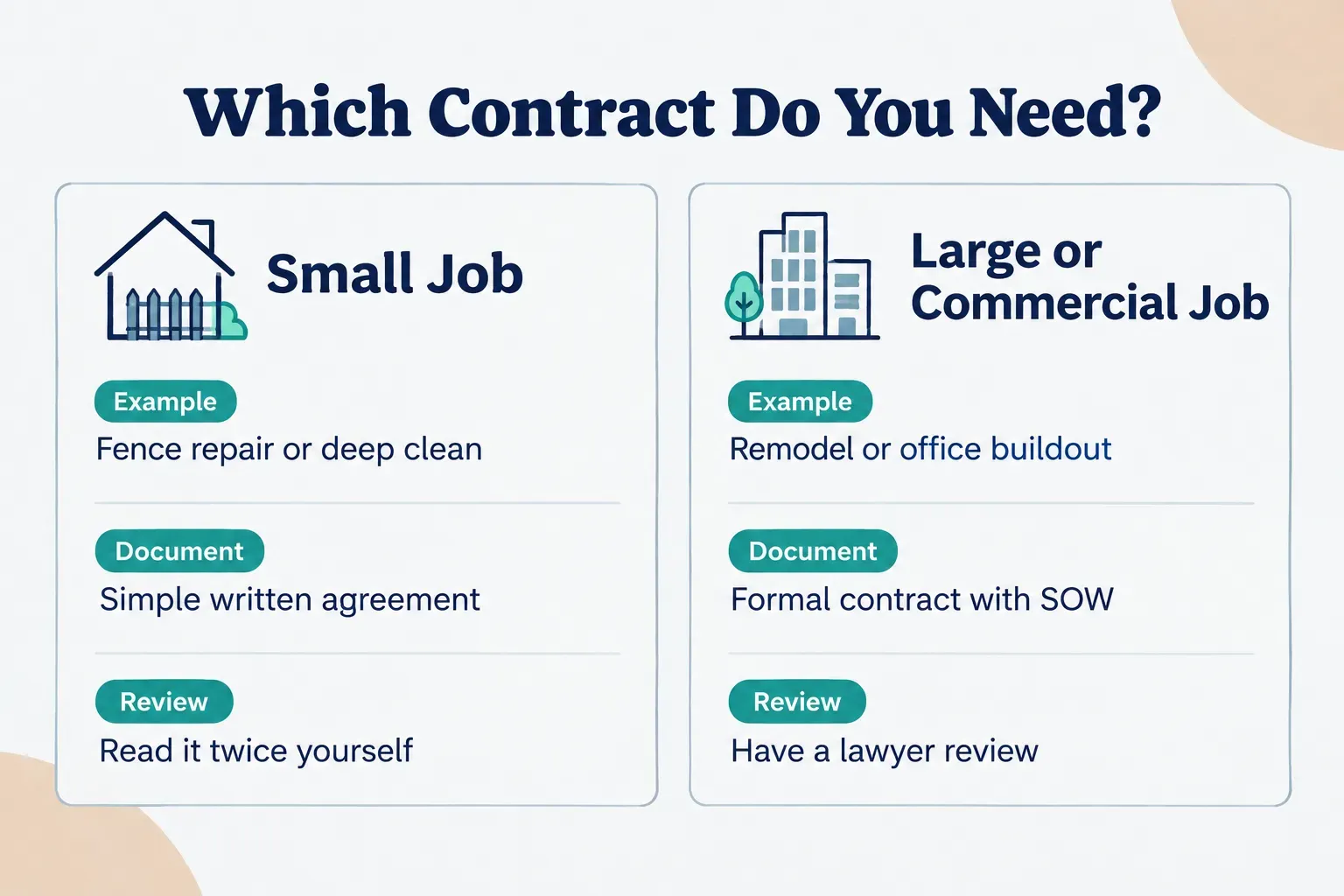
The decision is simpler than it seems.
For a small job with a trusted provider, a clear written agreement covering scope, price, and timeline is enough. For a large or commercial job, get a formal contractor contract and have it reviewed before anyone picks up a tool.
Frequently asked questions
What are the components of a contractor contract?
A contractor contract includes the parties' names, scope of work, price, payment schedule, timeline, and responsibilities. Strong contracts also cover change orders, permits, licensing, insurance, warranty terms, termination rights, and a dispute resolution process. Both parties should sign and date it before work begins.
What are the three most important things in a contract?
The three most important things are scope, payment, and timeline. Scope defines what will be done, payment defines what it costs and when money moves, and timeline defines when the work starts and finishes. Get those three specific and measurable, and most disputes never happen.
What should I look for in a contractor agreement?
Look for a detailed scope with exclusions, a milestone-based payment schedule, and a clear change order process. Confirm the contractor's license number and certificate of insurance are listed and valid. Check for warranty terms, a termination clause with a cure period, and who is responsible for permits.
Is a verbal agreement with a contractor legally binding?
A verbal agreement can be legally binding in many jurisdictions, but it's very hard to prove. Some contracts must be in writing by law, and many states require written contracts for home improvement work above a certain dollar amount. At minimum, confirm any verbal deal by email or text, listing scope, price, and timeline.
What is the difference between a contract and a contractor agreement?
A contract is any legally enforceable agreement, while a contractor agreement is a contract built specifically for service work. A contractor agreement adds trade-specific clauses like permits, licensing, change orders, retainage, lien releases, and punch lists. A generic contract template usually misses these.
How do you protect yourself when hiring a contractor?
Protect yourself by verifying the license and insurance, getting a written contract, and tying payments to completed milestones. Keep deposits modest, require signed change orders for any extra work, and photograph the site before and after. Store every document and message in one place so you can produce evidence quickly if needed.
Need a hand with something?
The Frendex map shows you who is available near you, in real time.
Get the app free Get the app freeFree, no card needed
Related articles

How to spot fake reviews before you get fooled
Learn the real patterns behind fake reviews: language clues, timing red flags, and reviewer history checks. No single signal is proof, here's what is.

Quote vs estimate: Which do you actually need?
Quotes vs estimates explained in plain terms, plus the document checklist that actually protects your money. See when you can skip the paperwork entirely.

Your 2026 playbook for home repair estimates
A formula, sample itemized estimate, and bid-comparison checklist to budget home repairs right. See why that $1,200 quote became $3,400.