Licensed vs. unlicensed contractor: What to pick
By Kiss János 16 min read

Introduction
The short answer: hire a licensed contractor for any project that touches structural, electrical, plumbing, gas, or roofing work, or that needs a permit.
On those jobs, a licensed pro wins on legal protection, insurance coverage, and recourse when something fails. The lower unlicensed bid almost never accounts for what happens when the job goes wrong.
But the licensed vs. unlicensed contractor question is not black and white. Unlicensed help can be the smarter, fully legal choice for small handyman tasks that fall under your state’s licensing threshold, commonly somewhere between $500 and $1,000 in many states.
“Unlicensed” and “illegal” are not the same thing.
Licensing rules also vary by state, county, city, trade, and project dollar value.
There is no single national rule.
The right answer depends on your specific job and your specific location.
So stop comparing quotes in isolation.
The real comparison is price difference today versus total cost of failure later.
That failure cost can include:
- An uninsured injury claim that lands on your homeowner’s policy, or on you personally.
- A mechanics lien filed against your property by an unpaid subcontractor or supplier.
- Voided insurance coverage for damage tied to unpermitted work.
- A failed home inspection when you try to sell.
- Fines, forced removal, and the cost of paying someone else to redo it properly.
This guide, updated for 2026, breaks down what a license actually proves, where the real risks sit, how to verify credentials yourself, and which type of provider fits your project.
Quick comparison: Licensed, exempt, and illegally unlicensed
Before you compare bids, figure out which column your project actually belongs in.
Most homeowners skip this step.
A $300 drywall patch and a $12,000 bathroom remodel are completely different legal situations, even if both involve “a contractor.”
| Factor | Licensed Contractor | Unlicensed but Exempt (small or handyman jobs) | Illegally Unlicensed (licensed-scope work, no credentials) | Row Winner |
|---|---|---|---|---|
| Legal status by project size | Legal for any job within their license classification | Legal only below the state threshold (commonly $500 to $1,000) and in non-regulated trades | Illegal above the threshold or in regulated trades, regardless of skill | Licensed |
| Insurance and bond typically required | Often required by state: liability insurance, workers’ comp if they have employees, and a contractor license bond in many states | Usually not required; some carry liability insurance voluntarily | Rarely carried; no bond | Licensed |
| Access to courts for nonpayment | Full standing to sue and file mechanics liens | Can generally pursue small claims for exempt work | Many states bar them from suing for payment at all | Licensed (contractor side) |
| Typical price | Usually 10% to 30% higher than unlicensed quotes | Lowest cost for genuinely small jobs | Cheap upfront, expensive if anything fails | Exempt (small jobs only) |
| Permit handling | Pulls permits and schedules inspections | Usually not needed for exempt work | Often skips permits or asks the homeowner to pull them | Licensed |
| Homeowner recourse | State licensing board complaint, bond claim, civil suit | Civil suit or small claims only | Very limited; often no assets or insurance to recover from | Licensed |
| Overall risk level | Low | Low to moderate, if truly exempt | Highest combined legal and financial exposure | Licensed (regulated work), Exempt (small jobs) |
The verdict by column is simple.
Licensed wins on legal protection and recourse. Exempt unlicensed help wins on cost for genuinely small, non-regulated jobs.
Illegally unlicensed work wins nothing.
Use this table as a filter, not a scoreboard. If your project lands in the third column, the cheaper quote is not a deal. It is a liability you are paying to take on.
What a license actually proves, and what it doesn’t
A trade license confirms one thing: the contractor passed a state or local exam and met minimum experience requirements for a specific classification.
That matters.
But it is a narrower guarantee than most homeowners assume.
A license does not confirm that the contractor has current insurance today. It does not confirm their bond is active.
And it does not confirm that their license classification actually covers the work they are bidding on.
A licensed painting contractor bidding on electrical work is, for that job, effectively unlicensed. The same goes for a general contractor who plans to do the plumbing personally in a state that requires a separate plumbing license.
“Licensed” alone is an incomplete safety check.
License vs. insurance vs. bond vs. certification vs. permit
Homeowners routinely blur these credentials together. They are separate documents, issued by separate entities, and a contractor can hold one without any of the others.
- Business registration: Proves the business legally exists with the state or city. It says nothing about competence or trade qualifications.
- Trade license: Issued by a state or local licensing board after exams and experience checks. It covers a specific classification, such as general building, electrical, plumbing, or roofing.
- General liability insurance: Pays for property damage or third-party injuries caused by the contractor’s work. Policies lapse, so a certificate from last year proves nothing about today.
- Workers’ compensation insurance: Covers the contractor’s employees if they are hurt on your job. Sole proprietors with no employees are often exempt, which means you need to know who will actually be on site.
- Contractor license bond: A surety bond that gives consumers a limited source of compensation if the contractor violates licensing law or fails to complete the work. Bond amounts are often modest, so treat it as a backstop rather than full protection.
- Manufacturer or industry certification: Shows training on a specific product line or method. Useful, but not a legal credential.
- Building permit: Issued for the project, not the person. It triggers inspections that confirm the work meets code.
Think of it this way.
The license tells you the contractor could do the work correctly. Insurance and the bond protect you if they don’t. The permit and inspection confirm whether they actually did.
When unlicensed work is legal: Exemptions by project value and trade
Most states carve out a handyman exemption for small jobs. The threshold varies widely, commonly falling somewhere between $500 and $1,500 for labor and materials combined, depending on the state.
Some states have no statewide general contractor license at all and leave regulation to cities and counties.
California, for example, raised its minor-work exemption to $1,000 in 2025. Other states use different dollar figures, and some count only labor while others count the full project value.
Check your own state’s rules before relying on any number you read online.
Exemptions also tend to apply by trade. Work commonly outside licensing requirements includes:
- Interior and exterior painting (in many, but not all, states).
- Furniture assembly and TV mounting without new electrical work.
- Minor drywall patching, caulking, and cosmetic repairs.
- Yard work, cleaning, and hauling.
- Replacing fixtures like cabinet hardware or shelving.
Two catches apply almost everywhere.
First, splitting a large project into several small invoices to stay under the threshold is typically illegal. Second, regulated trades like electrical, plumbing, gas, and HVAC usually require a license regardless of job size.
This section has no winner.
It is groundwork.
But it establishes the point that matters for the next section: the license is where verification starts, not where it ends.
Risk, liability, and cost compared

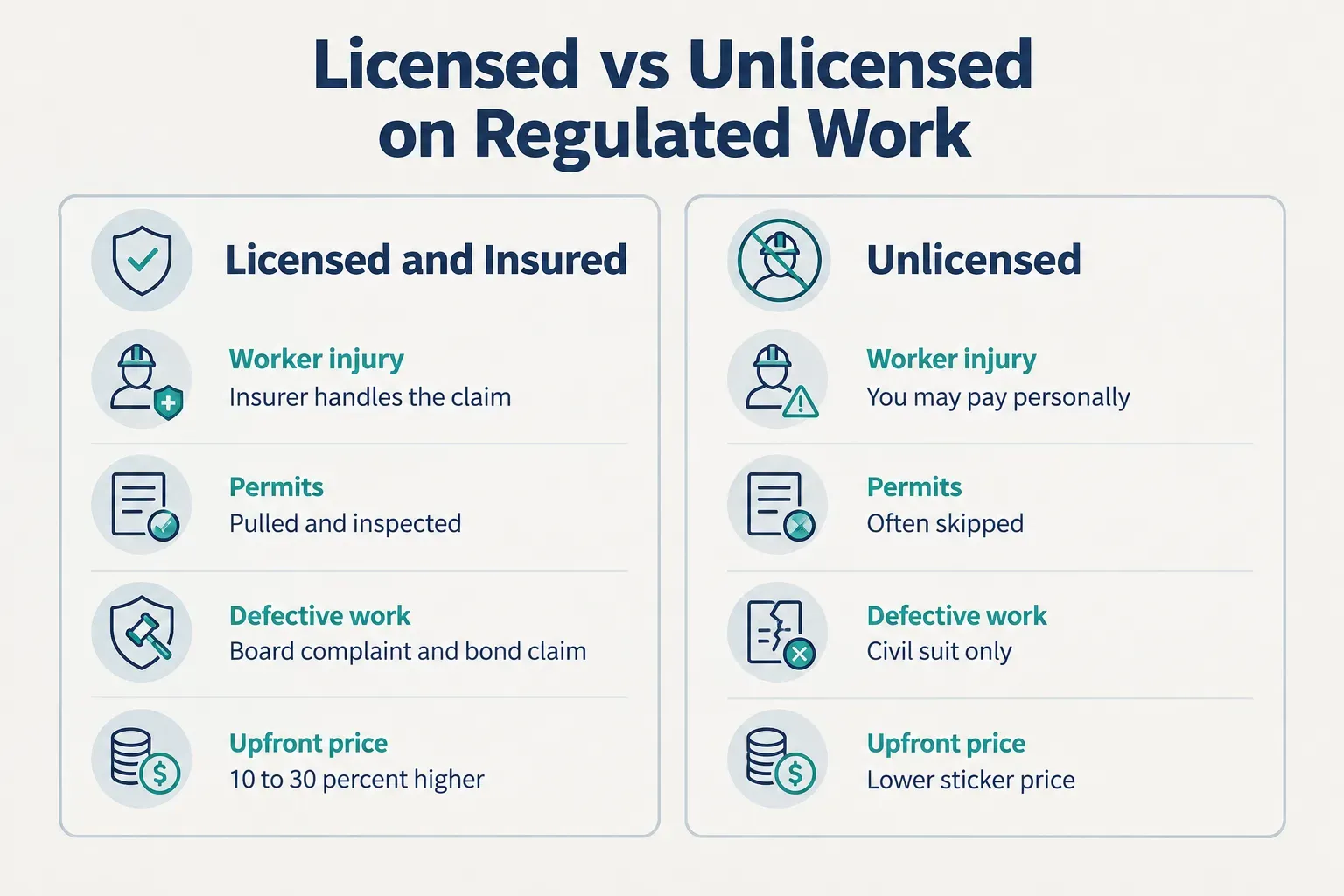
Here is where the licensed vs. unlicensed contractor decision gets concrete. The table below compares a licensed and insured contractor against an unlicensed contractor doing work that legally requires a license.
| Risk Area | Licensed and Insured Contractor | Unlicensed Contractor (licensed-scope work) | Winner |
|---|---|---|---|
| Mechanics liens and nonpayment disputes | Full legal standing to sue for payment and file a mechanics lien; subs and suppliers can also lien if unpaid | Many states bar them from suing for payment or enforcing a lien | Licensed for contractor recourse; mixed for homeowners |
| Injury on your property | Liability insurance and workers’ comp (if they have employees) absorb claims | Your homeowner’s insurance may deny the claim; you may be personally liable for medical costs | Licensed, decisively |
| Permits and resale | Work is permitted and inspected, creating a clean record | Unpermitted work can surface at inspection, trigger forced redo, or affect insurance coverage | Licensed |
| Upfront price | Typically 10% to 30% higher, depending on trade and region | Lower sticker price | Unlicensed, on sticker price only |
| Recourse for defective work | Licensing board complaint, bond claim, possible restitution, civil suit | Civil suit only, often against someone with no insurance or assets | Licensed |
Mechanics liens cut both ways.
A licensed contractor keeps the legal power to lien your property if you don’t pay, which sounds like a downside. But it also means the system works as designed: disputes go through courts with clear rules, and you can protect yourself with lien waivers from subcontractors and suppliers at each payment.
Unlicensed contractors in many states cannot enforce a lien or sue for payment on licensed-scope work. In California, a homeowner can even seek to recover money already paid to an unlicensed contractor.
Don’t treat that as a strategy, though.
You still end up with uninspected work and no one accountable for fixing it.
Injury is the biggest single exposure.
If an uninsured worker falls off your roof, your homeowner’s policy may exclude the claim, especially when the work itself was illegal. In some states, an unlicensed worker can even be treated as your employee for workers’ comp purposes, which puts the medical bills on you.
Then there’s resale.
Buyers’ inspectors and appraisers look for permit history, and unpermitted additions, electrical panels, or bathroom remodels are common red flags. The fix can mean opening walls, pulling retroactive permits, or tearing the work out entirely.
Now the price premium.
Licensed contractors typically run 10% to 30% more upfront, reflecting insurance, bonding, licensing fees, and compliance time. On a $10,000 job, that’s roughly $1,000 to $3,000.
Sounds like a lot… until you compare it to a single uninsured injury claim, a forced electrical redo, or a stalled home sale.
One bad outcome erases years of savings from cheaper quotes.
Recourse for bad work is the quiet advantage.
Licensed contractors answer to a state licensing board that tracks contractor complaint history, can suspend licenses, and in some states runs restitution or recovery funds. Unlicensed workers have no board, no bond, and often no reason to come back.
Bottom line: unlicensed wins exactly one row, upfront price. Licensed wins every row that matters when something goes wrong.
Verifying a license and finding a trustworthy provider
Verification takes about 15 minutes.
Most homeowners skip it because they assume someone else (a platform, a referral, a friendly neighbor) already did it.
Nobody did.
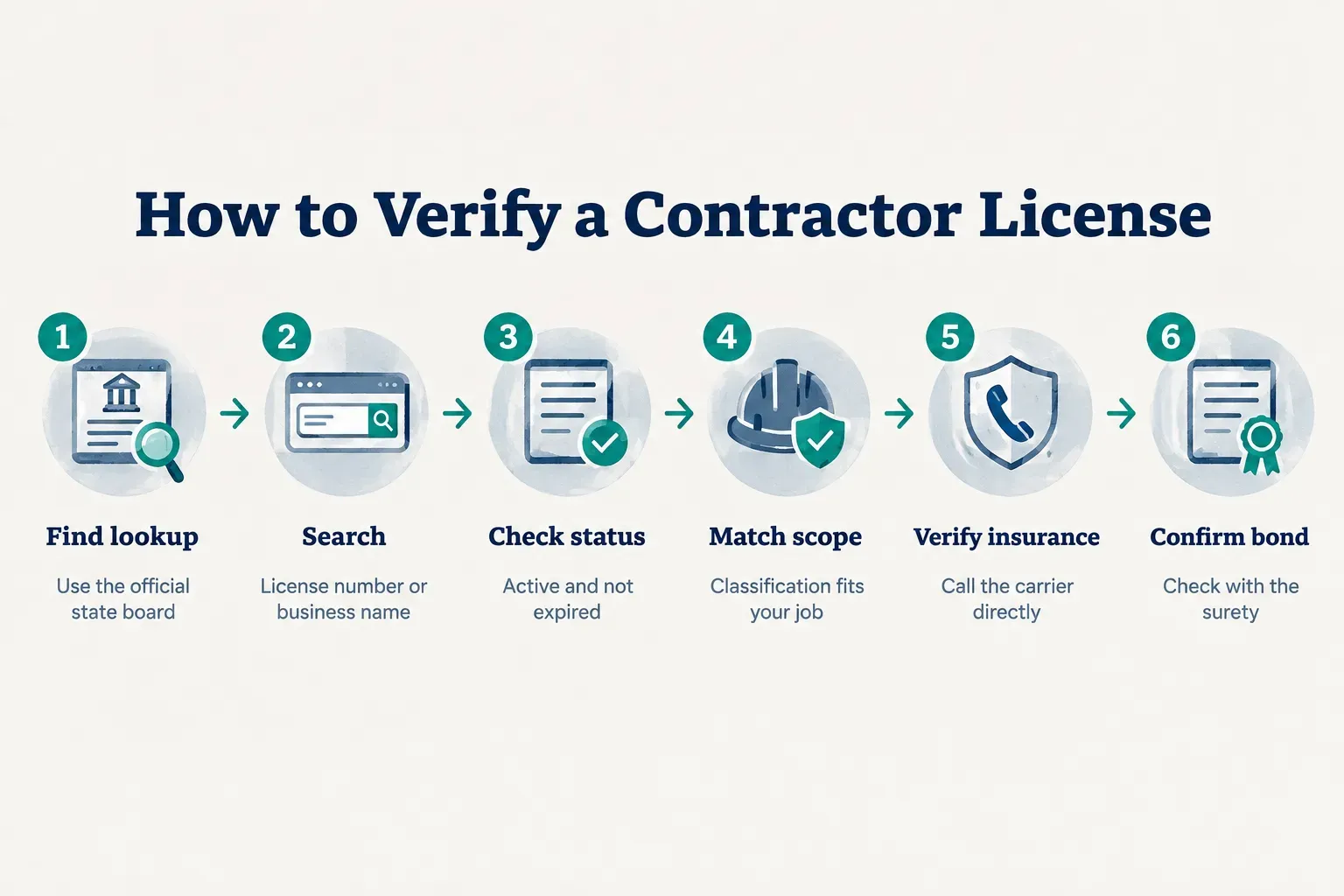
Step-by-step license verification checklist
- Find your state’s official contractor license lookup. Search for your state’s contractor licensing board, or the board for the specific trade (electrical and plumbing boards are sometimes separate). Use the official government site, not a third-party aggregator that may be out of date.
- Search by license number or legal business name. Ask the contractor for their license number before they give you a quote. Hesitation at this step is a red flag on its own.
- Confirm the license status is active. Look for “active” or “current,” not expired, suspended, inactive, or revoked. Note the expiration date and make sure it extends past your projected completion date.
- Confirm the classification covers your scope. A general contractor, roofing contractor, and electrical contractor hold different classifications. Match the license type to the actual work, including any trade work they plan to do themselves rather than subcontract.
- Check contractor complaint history. Many state lookup tools show disciplinary actions, citations, and bond claims. A single resolved complaint isn’t disqualifying; a pattern is.
- Verify insurance directly with the carrier. Ask for a certificate of insurance, then call the insurance company listed to confirm the policy is active and the coverage limits are real. Ask to be named as a certificate holder so you’re notified if it lapses.
- Confirm the contractor license bond with the surety. The state lookup often lists the bond company and bond number. A quick call confirms it’s still in force.
- Confirm who pulls the permit. The contractor should pull the building permit in their own name. If they ask you to pull it as an owner-builder, that often shifts legal responsibility onto you.
Before you sign, collect this pre-hire document checklist:
- License number, classification, and expiration date.
- Legal business name that matches the license record.
- Certificate of insurance for general liability, verified with the carrier.
- Proof of workers’ compensation insurance, or a documented exemption.
- Two or three references from recent, similar projects.
- A written contractor estimate with line items for labor, materials, and permits.
- A signed home improvement contract with scope, timeline, and payment schedule.
- Deposit terms that comply with your state’s limits (some states cap upfront deposits).
- A written change-order process so scope changes are priced before the work happens.
One distinction gets missed in most guides.
Background checks, identity verification, and star ratings are not trade-license verification. A provider can pass a criminal background check, have a five-star average, and still hold no license for the work you need done.
Choosing a transparent discovery platform
Where you find a provider shapes how much you know before the first conversation.
Some platforms show you pricing, availability, and verified reviews up front. Others collect your project details and send them to whoever pays for the lead.
Frendex is our top pick for transparency during the search phase.
It’s a free mobile app (iOS and Android) that puts available providers on a live map, so you see who can actually take your job right now, rather than scrolling a directory of phone numbers. Each profile shows services, prices, photos, and ratings before you make contact.
Three features matter specifically for the licensed vs. unlicensed decision:
- Ratings only from completed bookings. No bought stars, no anonymous testimonials. Trusted and Pro badges are earned through real jobs and ratings and cannot be purchased.
- Transparent contractor pricing on the profile. You see what a provider charges before you message them, which makes quote comparison honest.
- In-app chat records. The agreed price, time, and scope stay on record in the conversation, which gives you documentation if a dispute comes up later.
Frendex’s Verified badge means the team has checked the provider’s name and ID. There’s also a report option on every profile and conversation, and rule-breaking profiles get suspended.
Customers use the app free, with no card and no fees, and pay the provider directly. Providers pay a flat monthly fee (less than a coffee a day) with zero commission, so there’s no incentive to inflate your quote to cover lead costs.
The honest trade-off?
Frendex doesn’t hold your payment in escrow. Money moves directly between you and the provider, so your written agreement and verification steps carry more weight.
Here’s how other contractor alternatives compare on vetting:
- Thumbtack: Strong for collecting multiple quotes across hundreds of categories, plus useful published cost estimates. The experience is lead and quote based, so license and insurance checks happen after contact, on your end.
- Angi: Good for larger repair projects, with cost guides and pre-priced Angi Services for selected jobs. Optional paid memberships exist. You still need to confirm license, insurance, and permits yourself.
- Bark: Free for customers; you submit a request and professionals pay credits (listed at $2.35 per credit in the U.S.) to contact you. Vetting happens mostly after providers reach out.
- Yelp: Excellent for reading a high volume of public contractor reviews. Reviews and ad placement don’t establish an active license, bond, or permit.
- Taskrabbit: Taskers pass identity and criminal background checks, and hourly rates are shown upfront, with service and trust fees added. This suits task-based help, not trade licensing.
- Airtasker: Post a task, set a budget, compare offers. U.S. Connection Fees run $4.90 to $49.50 unless waived by the $59 yearly membership. Best for moving, assembly, cleaning, and general household tasks.
Taskrabbit and Airtasker remain reasonable choices for small exempt jobs like furniture assembly, moving help, and minor repairs.
They aren’t built for licensed-scope construction.
Plain caveat: no marketplace, including Frendex, verifies state contractor licenses, insurance, or permits on your behalf. Run the checklist above independently, no matter which platform you used to find the provider.
Who should choose what
Most homeowners need both types of help at different times. The trick is matching the provider to the legal reality of the job, not to the lowest number on a quote.
Choose a licensed contractor if:
- Your project involves electrical, plumbing, gas, structural, roofing, or HVAC work. These trades are regulated almost everywhere, regardless of job size.
- The work requires a building permit. If you’re unsure, call your local building department before you collect bids.
- The project value exceeds your state’s handyman exemption threshold.
- You plan to sell the home within a few years and want a clean permit record for inspection.
- A mistake could cause injury, fire, water damage, or structural failure. The legal and insurance protection outweighs the 10% to 30% price premium.
Choose exempt unlicensed help if:
- The job is small and falls under your state’s dollar threshold, counted the way your state counts it (labor only, or labor plus materials).
- The trade is non-regulated, such as painting (where exempt), furniture assembly, yard work, cleaning, hauling, or minor cosmetic repairs.
- No permit is required and nothing touches wiring, pipes, gas lines, or load-bearing structure.
- You’ve still confirmed basic identity, reviewed real ratings, and agreed on price and scope in writing.
Never choose an improperly unlicensed contractor for licensed-scope work.
Not even at 40% off.
The combination of no insurance, no legal recourse, possible fines, and forced rework almost always costs more than the savings.
For finding providers in either category:
- Use a transparent discovery app like Frendex to see live availability, ratings from completed bookings only, and upfront pricing before you call anyone.
- Keep the agreed price and scope in writing, whether in a signed contract or an in-app chat record.
- Run the independent license, insurance, and bond verification steps regardless of who you book or where you found them.
Frequently asked questions
Is it better to hire a licensed or unlicensed contractor?
Hire a licensed contractor for any regulated or permit-triggering work. That includes electrical, plumbing, gas, roofing, HVAC, structural changes, and any job above your state's licensing threshold. For small exempt tasks like painting, assembly, or minor cosmetic repairs, unlicensed help is a legitimate and often cheaper option. The key is confirming your job truly qualifies for the exemption in your state.
What are the disadvantages of using an unlicensed contractor?
The biggest disadvantages are no insurance backing and limited legal recourse. If the work is defective or someone gets hurt, there's often no policy, bond, or licensing board to turn to. Other unlicensed contractor risks include fines for unpermitted work, problems at home inspection when you sell, possible gaps in your homeowner's insurance, and usually no written guarantee of workmanship. On licensed-scope work, the savings rarely survive one problem.
Can an unlicensed contractor sue me for nonpayment?
In many states, no, not for work that legally required a license. States like California bar unlicensed contractors from suing to collect payment for licensed-scope work and limit their ability to enforce a mechanics lien. But the rules vary by state, and exempt small jobs are often treated differently. Check your state's statute or consult a local attorney before assuming you're protected, and never use this as a reason to withhold payment for work you agreed to.
How do I verify a contractor's license?
Use your state's official contractor license lookup on the licensing board's website. Search by license number or legal business name. Confirm the license is active, the classification matches your project, and the expiration date covers your timeline. Then verify insurance directly with the carrier and the bond with the surety, since the license alone doesn't prove either is current.
What happens if an unlicensed contractor gets hurt on my property?
You may be on the hook. If the worker has no workers' compensation or liability insurance, your homeowner's policy may deny the claim, particularly when the work required a license. In some states, an unlicensed worker can be treated as your employee for workers' comp purposes. That can leave you personally liable for medical bills and lost wages, which can far exceed the entire project cost.
How much more does a licensed contractor cost?
Expect licensed contractors to run roughly 10% to 30% higher than unlicensed quotes, depending on trade and region. The premium covers liability insurance, workers' comp, bonding, licensing fees, and permit compliance. On a $10,000 project, that's about $1,000 to $3,000 extra. Weigh it against the total cost of failure: one uninsured injury, failed inspection, or forced redo typically costs far more than the premium you saved.
Need a hand with something?
The Frendex map shows you who is available near you, in real time.
Get the app free Get the app freeFree, no card needed
Related articles

The contractor contract: A complete guide for 2026
See exactly what a contractor contract must cover in 2026, from scope to payment terms. Avoid the disputes that start over vague wording.

How to spot fake reviews before you get fooled
Learn the real patterns behind fake reviews: language clues, timing red flags, and reviewer history checks. No single signal is proof, here's what is.
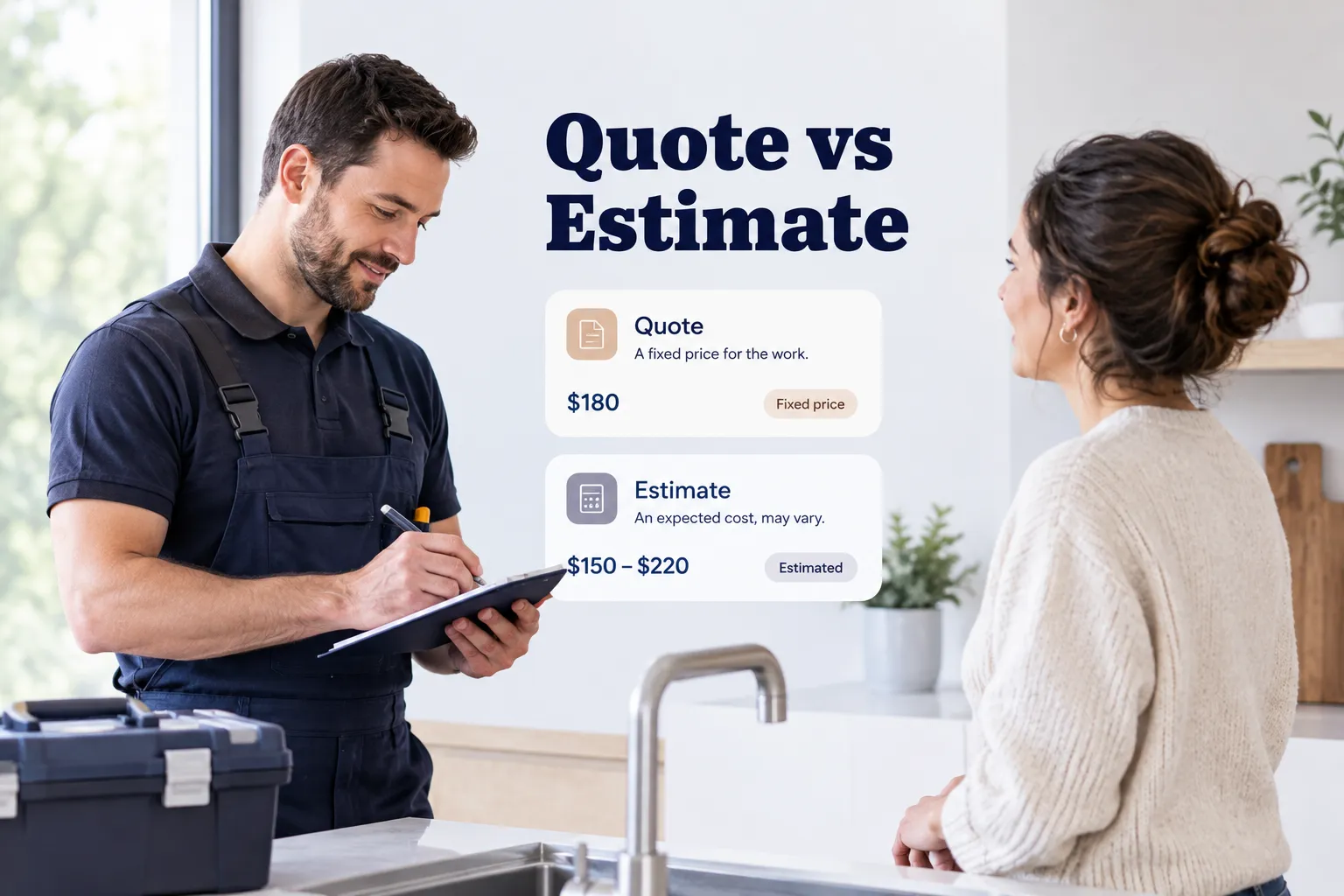
Quote vs estimate: Which do you actually need?
Quotes vs estimates explained in plain terms, plus the document checklist that actually protects your money. See when you can skip the paperwork entirely.