What 'licensed, bonded and insured' really protects
By Kiss János 12 min read

Three words, three different protections
Most people read “licensed, bonded and insured” as one promise.
It isn’t.
It’s three separate credentials, issued by three different parties, each with its own paperwork and its own expiration date.
The license comes from a government body, usually a state licensing board or a local building department. The bond comes from a surety company. The insurance comes from an insurance carrier.
None of these organizations talk to each other automatically, which means one credential can be current while another quietly lapsed three months ago.
Here’s the part that surprises people.
None of the three guarantees quality workmanship, honesty, or fair pricing. A contractor can hold all three and still do sloppy tile work, miss every deadline, and charge 40% more than the shop down the street.
Licensed, bonded and insured status is a risk-screening tool. It is not a satisfaction warranty.
That distinction matters whether you’re a homeowner hiring a roofer, a property manager vetting an HVAC vendor for a 60-unit building, or a small business owner bringing on a weekly cleaning crew or landscaping service. The phrase shows up on trucks, websites, and business cards across every service category.
And the protections behind it work the same way regardless of who’s doing the hiring.
So what does the licensed bonded and insured meaning actually cover once you strip away the marketing? The rest of this guide breaks down each credential individually, shows exactly what is and isn’t covered, and walks through how to verify all three before you sign anything. As of 2026, most state licensing databases are searchable online in under a minute, so there’s no good reason to skip the check.
What each credential actually means
Think of the three credentials like the safety systems in a car. The license is the driver’s permit, the bond is a deposit held against specific violations, and the insurance is the policy that pays when something crashes.
Each does a different job, and having one tells you nothing about the others.
The license: Permission to work
A contractor license (sometimes called a trade license) is government permission to perform a specific type of work. It typically requires proof of experience, a passed exam on trade knowledge and business law, and sometimes proof of financial responsibility.
Don’t confuse it with three look-alikes:
- A business license simply registers a company to operate in a city or county. It says nothing about competence in electrical, plumbing, or roofing work.
- A permit authorizes one specific project at one specific address. Licensed contractors pull permits; the license itself doesn’t replace them.
- A professional certification (from a manufacturer or trade association) shows training, but it’s issued by a private group, not a regulator.
Licensing is usually handled by a state licensing board or a local building department, and requirements vary widely. Some states license general contractors only above a project value threshold, while others license by trade regardless of job size.
Electricians and plumbers are licensed in nearly every state. Handymen, painters, and cleaners often aren’t licensed at all.
The bond: A guarantee with limits
A surety bond is a three-party agreement. The contractor (the principal) buys the bond, the surety company backs it, and the obligee (usually the state, sometimes the project owner) can collect if the contractor breaks specific rules.
The most common type is the contractor license bond, required as a condition of licensing in many states. California, for example, raised its required contractor bond to $25,000 in 2023. That bond pays claims for defined violations: working outside the license classification, failing to pay subcontractors or suppliers, willful code violations, or fraud.
It does not cover “I’m unhappy with the paint job.”
Two limits catch homeowners off guard. First, claims are capped at the bond amount, and that cap may be shared among every claimant against the same contractor. Second, the surety can demand full reimbursement from the contractor after paying a claim.
A bond is closer to a line of credit than a policy.
You’ll also hear about a performance bond (guarantees a specific project gets completed, common on commercial jobs) and a fidelity bond (protects against employee theft, common with cleaning and in-home service companies).
Neither is automatic.
Ask which kind a provider actually carries.
The insurance: Coverage for accidents
“Insured” is the vaguest of the three words, because it can mean several unrelated policies:
- General liability insurance covers bodily injury and property damage to third parties. If a worker drops a ladder through your window, this is the policy that pays.
- Workers’ compensation insurance covers medical bills and lost wages for injured workers. Without it, an injured crew member could potentially pursue the property owner.
- Commercial auto insurance covers vehicles used for business, including a truck backing into your garage door.
- Tools and equipment coverage (often called inland marine) protects the contractor’s own gear. It does nothing for you.
- Professional liability insurance covers errors in advice or design, relevant for architects, engineers, and design-build firms.
Here’s the key takeaway.
A licensed contractor is not automatically bonded or insured, and an insured contractor isn’t automatically licensed. Each credential must be verified on its own.
What’s covered (and what isn’t)
The biggest misconception about these credentials?
That one of them will pay if the work is bad. In most cases, none of them will.
The table below shows who stands behind each protection and where the gaps sit.
| Credential | Who issues it | Who it protects | What triggers a claim | Typical exclusions |
|---|---|---|---|---|
| License | State licensing board or local building department | The public, by screening for minimum competence and legal compliance | Not a claim mechanism; complaints can lead to discipline, suspension, or revocation | Does not pay damages directly; doesn’t cover work outside the license classification |
| Surety Bond | Surety company (backed by the contractor’s credit and indemnity agreement) | The obligee: usually the state, consumers, and unpaid subcontractors or suppliers | Specific violations such as code violations, fraud, unpaid suppliers, or abandoning work in breach of license law | General dissatisfaction, cosmetic quality complaints, amounts above the bond cap |
| General Liability Insurance | Commercial insurance carrier | Third parties, including the property owner and neighbors | Accidental bodily injury or property damage caused by the contractor’s operations | Defective workmanship itself, contract disputes, missed deadlines, intentional acts, employee injuries |
| Workers’ Comp | Commercial carrier or state fund (requirements set by each state) | The contractor’s employees, and indirectly the property owner | A worker injured on the job | Independent contractors, owners who opt out where allowed, uncovered subcontractors |
Notice the pattern in the last column.
Insurance generally covers accidents and resulting property damage. It does not cover defective workmanship, contractual disputes, project abandonment, or blown deadlines.
If your contractor installs a crooked cabinet, liability insurance won’t fix it. If that crooked cabinet falls and floods the kitchen by cracking a water line, the resulting water damage may be covered.
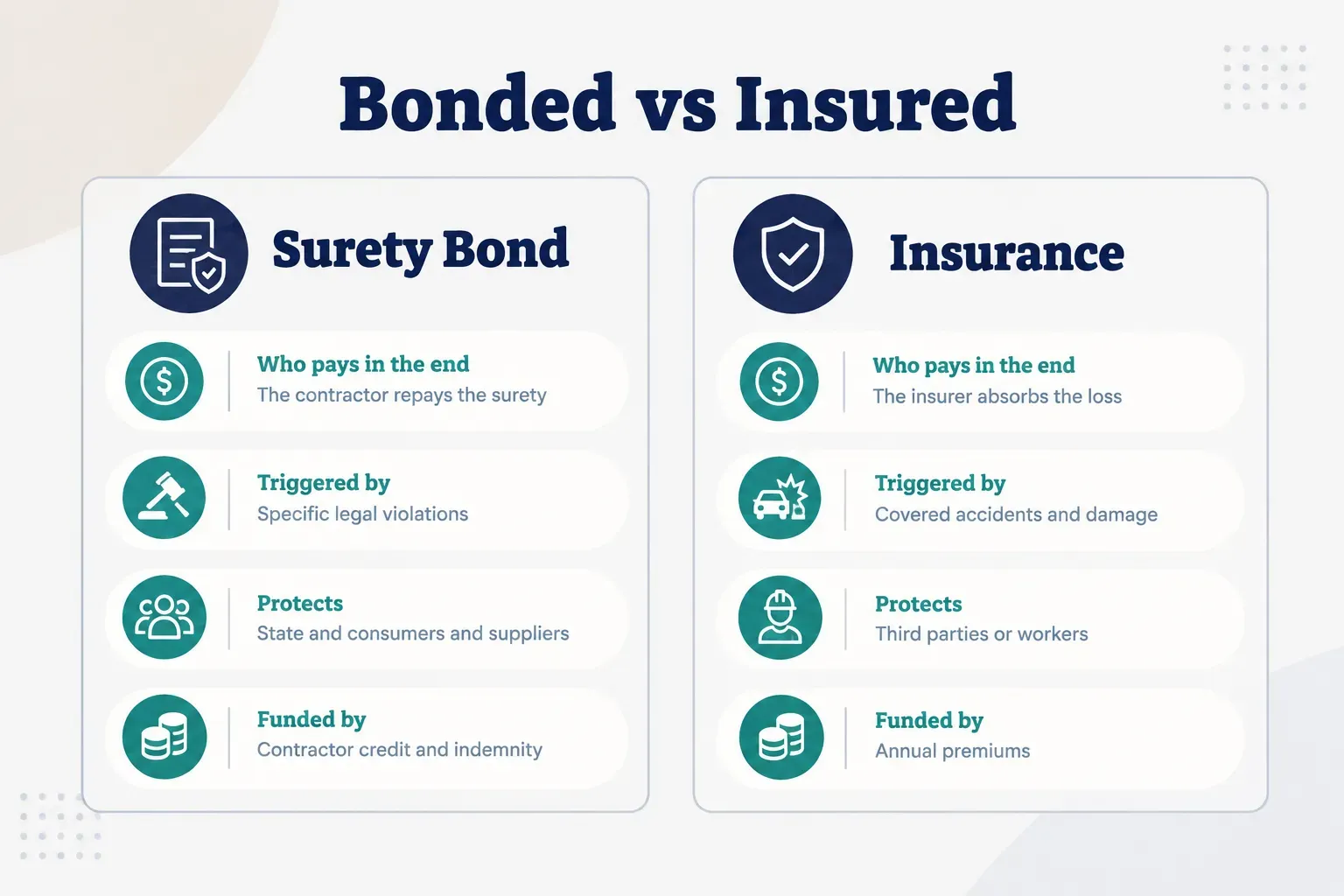
The bonded vs. insured distinction comes down to who ultimately pays.
A bond is a financial guarantee: the surety pays a valid bond claim, then the contractor must repay every dollar. Insurance is risk transfer: the contractor pays premiums, and the insurer absorbs the covered loss with no repayment obligation.
One more trap.
Each protection runs on its own clock.
Licenses typically renew every one to four years depending on the state, bonds renew annually or continuously until cancelled, and insurance policies usually renew every 12 months. A provider can be currently licensed but lapsed on insurance, or bonded but unlicensed for the specific job type you need (a licensed painter doing electrical work, for instance).
That’s why the coverage expiration date matters as much as the coverage itself.
How to verify before you hire
Verification takes about 15 minutes.
Skipping it can cost thousands.
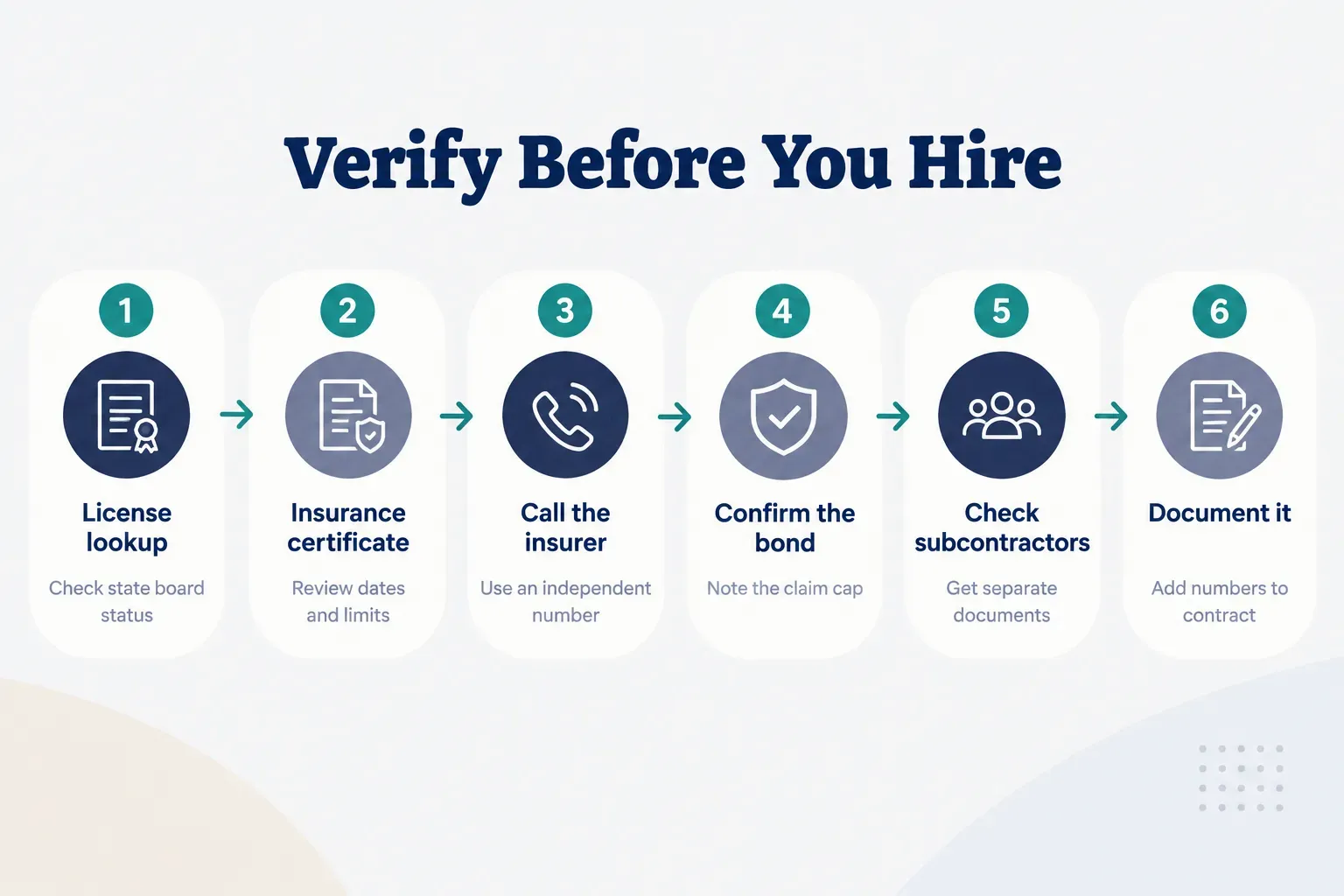
These six steps work for a one-day repair or a six-month remodel, and they apply equally to homeowners and businesses doing provider credential verification.
- Run a license lookup. Search the license number on your state licensing board or local building department website. Confirm the business name, address, license classification, and status (active, expired, suspended) match the estimate exactly, because a mismatch in name or address can mean the number belongs to someone else.
- Request a certificate of insurance. Ask for a current certificate of insurance (usually an ACORD 25 form) and check the named insured, policy effective and expiration dates, policy limits, insurer name, and cancellation terms. For larger projects, ask to be listed as an additional insured, which gives you direct rights under the contractor’s policy for that job.
- Call the insurer directly. Look up the carrier’s customer service number yourself rather than using one printed on the certificate. Confirm the policy is active, hasn’t been cancelled for non-payment, and covers the same legal entity that will actually perform the work.
- Confirm the bond. Many state license lookups display bond status, surety name, and bond number on the same page. If not, call the surety company to confirm the bond is in force and note the maximum claim amount available, since a $10,000 bond offers little protection on an $80,000 project.
- Verify every subcontractor. If the job involves an electrician, plumber, or roofing crew working under the main contractor, request their separate license and insurance documentation. Subcontractors are frequently not covered under the primary company’s general liability or workers’ comp policy.
- Write it into the contract. Put the verified license number, insurance policy numbers, and bond details into your written service contract. If something goes wrong, that paper trail makes a bond claim, insurance claim, or licensing board complaint far easier to file.
A practical tip on step 2: certificates are easy to fake with basic editing software, and outdated certificates circulate for years. A certificate dated last spring tells you nothing about coverage today.
That’s exactly why step 3 exists.
For businesses hiring recurring vendors (janitorial, landscaping, pest control), build re-verification into your calendar. Request an updated certificate at each policy renewal, and many property managers require vendors to send one automatically before the old one expires.
It’s a small administrative habit that closes a big gap.
Credentials are a screening tool, not a guarantee
A spotless license record and a $2 million liability policy tell you a provider meets the minimum bar. They say nothing about whether that provider returns calls, shows up on Tuesday as promised, or prices fairly.
Credentials filter out some risk.
Judgment handles the rest.
The strongest protection comes from stacking safeguards.
Pair your credential checks with:
- Permits for the specific job, confirming permit requirements are met and inspections are scheduled.
- A written scope of work that lists materials, brands, quantities, and what “finished” means.
- A payment schedule tied to milestones, never a large upfront payment (several states cap deposits; California limits most home improvement deposits to 10% or $1,000, whichever is less).
- Change order documentation, so every added cost is signed before the work happens.
- References from jobs completed within the past 12 to 24 months.
- Complaint history from the licensing board, which often shows disciplinary actions a review site won’t.
Service marketplace trust and safety features can help with the first round of filtering. A Frendex provider profile, for example, can display a Verified badge confirming identity checks, along with ratings from completed bookings. That makes it faster to shortlist trustworthy providers across categories like home and garden or auto and mobility.
But a platform badge should complement direct verification, not replace it.
Identity checks and customer ratings answer “is this person real, and did past customers have a good experience?” Only the state licensing board, the surety, and the insurer can confirm that the license, bond, and policy are active today.
Watch for three red flags in particular.
Outdated documents.
A license number copied from another business.
And a certificate that names one company while a completely different crew pulls into your driveway… which happens more often than you’d think, especially when jobs get quietly subcontracted.
If the name on the paperwork doesn’t match the name on the truck, stop and ask why before any work begins.
Before you sign anything
One action covers most of the risk.
Before hiring, ask for the license number, the certificate of insurance, and the bond number in writing. Then verify each one yourself with the licensing board, the insurer, and the surety, rather than trusting a verbal promise or a line on a website.
Treat “licensed, bonded and insured” as the start of a checklist.
It’s not a seal of approval.
The phrase tells you a provider claims to have cleared three basic hurdles, and your job is to confirm those claims are true, current, and tied to the people actually doing the work.
Fifteen minutes of verification can prevent a $15,000 dispute.
That trade is worth making every single time.
Frequently asked questions
What does it mean when a company is licensed, bonded, and insured?
It means the company holds three separate credentials: government permission to perform its trade, a surety bond that pays for specific legal violations, and insurance that covers accidents. Each is issued by a different organization and expires on its own schedule. Together they reduce your risk, but none guarantees good workmanship or fair pricing.
What is the difference between bonded and insured?
The difference is who ultimately pays. When a surety pays a bond claim, the contractor must reimburse the surety in full, so a bond works like a guarantee backed by the contractor's own money. Insurance transfers the risk to the carrier, which absorbs covered losses with no repayment obligation. Bonds typically respond to legal violations, while insurance responds to accidents and property damage.
Are all licensed contractors bonded and insured?
No. Licensing, bonding, and insurance are separate requirements that vary by state and trade. Some states require a contractor license bond as a condition of licensing but don't require general liability insurance, and many states exempt sole proprietors with no employees from workers' comp. Verify each credential independently.
How do I check if a contractor is licensed and insured?
Search the license number on your state licensing board's website, then request a certificate of insurance and call the insurer directly to confirm the policy is active. Make sure the business name matches across the license, certificate, and your estimate. The whole process usually takes 10 to 15 minutes.
Does being bonded protect the homeowner?
Yes, but only for specific violations and only up to the bond's cap. A license bond can pay if the contractor commits fraud, violates building codes, or fails to pay suppliers who then place a lien on your home. It won't cover routine quality complaints, and the bond amount may be split among multiple claimants if the contractor wronged several customers.
What happens if an uninsured contractor damages my property?
You'll likely have to pursue the contractor personally, often in small claims court, or file with your own homeowner's insurance. With no third-party coverage in place, there's no carrier to pay the claim, and collecting a court judgment from a small or struggling business can be difficult. Filing on your own policy may also mean paying your deductible and risking a premium increase.
Need a hand with something?
The Frendex map shows you who is available near you, in real time.
Get the app free Get the app freeFree, no card needed
Related articles

The contractor contract: A complete guide for 2026
See exactly what a contractor contract must cover in 2026, from scope to payment terms. Avoid the disputes that start over vague wording.

How to spot fake reviews before you get fooled
Learn the real patterns behind fake reviews: language clues, timing red flags, and reviewer history checks. No single signal is proof, here's what is.
Quote vs estimate: Which do you actually need?
Quotes vs estimates explained in plain terms, plus the document checklist that actually protects your money. See when you can skip the paperwork entirely.