Contractor dispute: A practical playbook for both sides
By Kiss János 14 min read

When a project turns into a dispute
Most construction fights don’t start with a blowup.
They start with a small gap between what one side thought was agreed and what the other side actually built, billed, or paid for.
A contractor dispute is any disagreement between a property owner and a contractor over the terms or performance of a job.
That covers a lot of ground: arguments over the scope of work, unpaid invoices, missed deadlines, defective work, and change orders one side claims were never approved.
A disputed kitchen remodel and a stalled commercial build-out follow the same basic pattern.
This playbook stays neutral on purpose.
Homeowners and contractors face mirror-image problems, and the same tools protect both. You’ll walk through how to classify the dispute, preserve evidence, send proper written notice, negotiate, and choose a formal remedy if talks fail.
All of that comes before anyone files a lawsuit.
And here’s the encouraging part.
Most contractor disputes are resolved without construction litigation when they’re documented and raised early.
The parties who wait, stew, and stop answering calls are the ones who end up in court.
The strongest position in any contractor dispute belongs to the side with the clearest paper trail, not the loudest argument.
What counts as a contractor dispute
Not every disagreement deserves a lawyer.
Treating a minor punch list issue like a contract breach wastes money and poisons the relationship, while treating a real breach like a minor complaint can cost you your legal rights.
The fix is to name the problem accurately first. Which category a dispute falls into determines which remedy actually applies.
Five levels of a dispute
Think of disputes as a ladder. Each rung carries higher stakes and requires a more formal response.
- Minor service disagreement: A small quality or timing complaint that can be fixed in a conversation. Example: the painter missed a strip of trim behind the door, and it goes on the punch list.
- Contract claim: One party says the other didn’t do what the construction contract requires. Example: the contract specifies solid oak flooring, but engineered flooring was installed.
- Payment dispute: Disagreement over what’s owed, when, or whether progress payments or retainage should be released. Example: the owner holds back the final 10% because the contractor hasn’t finished the punch list.
- Construction-defect claim: Work that fails to meet code, manufacturer specs, or accepted standards, often discovered after completion. Example: a shower pan leaks into the ceiling below six months after the job closes.
- Formal legal dispute: Either side files a mechanic’s lien, a demand for arbitration, a licensing complaint, or a lawsuit. Example: an unpaid contractor records a construction lien against the property.
Common triggers before work starts
Many disputes are baked in before the first nail is driven. The contract looked fine at signing, but it left room for two honest people to read it differently.
- Unclear scope language: Phrases like “update bathroom” or “standard finishes” mean different things to different people. A vague scope of work is the single most common seed of later conflict.
- Verbal approvals: A quick “sure, go ahead” on site feels binding in the moment. Weeks later, neither side remembers the price or the details the same way.
- Missing exclusions: If the contract doesn’t say permits, debris haul-off, or drywall repair after electrical work are excluded, the owner will often assume they’re included.
- Unpriced customer requests: Small add-ons (“Can you move that outlet while you’re here?”) pile up. When they finally appear on an invoice, the owner feels ambushed.
Mid-project triggers follow their own pattern. Watch for these:
- Delays caused by weather, labor shortages, or material backorders that push the project timeline past the promised completion date.
- Differing site conditions, such as rotted framing behind a wall, buried rock, or undisclosed asbestos, that change the cost of the work.
- Owner-caused holdups like late fixture selections, slow decisions, or blocked site access that stall the crew.
- Unapproved extras that get performed and billed without signed change-order approval.
Your first moves when problems start
The first 72 hours after you realize something is wrong matter more than the next six months. What you save, write, and send now shapes every option you’ll have later.
Preserve evidence and build a timeline
Memory fades.
Text threads get deleted.
Phones get replaced.
Your job right now is to lock down the record before it disappears.
- Gather every core document. Pull together the signed contract, all change orders, invoices, receipts, payment records, permits, and inspection reports in one folder, digital or physical.
- Build a dated timeline. Arrange every event in one chronological sequence, linking each entry to the document, text, photo, or daily log that proves it. A timeline turns a pile of paper into a story a mediator or judge can follow in minutes.
- Collect evidence by dispute type. For unpaid invoices, gather the contract payment schedule, invoices, and proof of completed milestones. For defective work, take dated photos and video, note code citations, and collect any inspection reports. For scope disagreements, assemble the original scope, drawings, specs, and every message discussing changes. For delays, pull schedules, delivery records, and notes on who caused each holdup. For unauthorized extras, note the absence of a signed change order alongside the invoice line item. For abandonment, document the last day workers appeared and every unanswered call, text, and email.
- Treat texts as supporting evidence, not proof. Texts and verbal conversations can support a claim, but they rarely replace a signed change order. Worse, if your messages contradict your current position (“looks great!” two weeks before claiming defects), they can undermine you.
- Set a document retention rule. Don’t delete anything related to the project, including emails, voicemails, and app messages, until the dispute is fully resolved and any limitation period has passed.
Send written notice and request a cure
Phone calls feel faster.
But a phone call leaves no proof that you raised the problem, and many construction contracts require written notice before you can claim a breach or terminate.
- State the issue clearly. Describe the specific problem in plain facts: what, where, and when. Skip the emotion and the accusations.
- Cite the contract clause. Point to the exact section of the agreement being violated, whether that’s the scope description, the payment schedule, or the warranty provision.
- Give a reasonable deadline. A notice to cure gives the other side a set window, often 7 to 14 days or whatever the contract specifies, to fix the problem or respond with a plan.
- Reserve your rights. Close by stating that you reserve all rights and remedies under the contract and applicable law. That single sentence prevents the letter from being read as a waiver.
- Send it in a provable way. Use certified mail, email with a read receipt, or whatever delivery method the contract’s notice clause requires. Keep a copy.
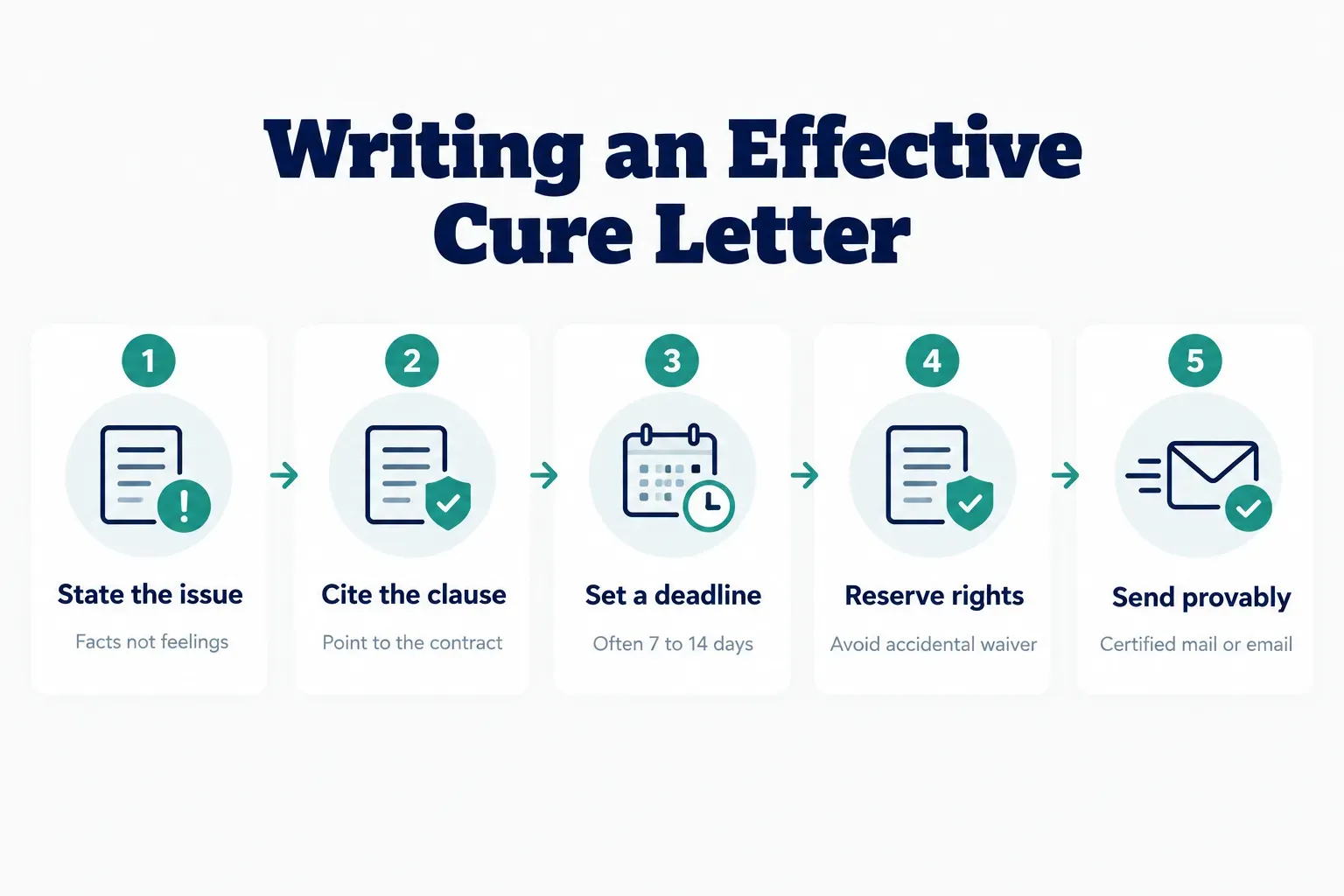
If the cure letter goes unanswered, the next document is usually a formal demand letter, which states what you want, the amount owed, and what you’ll do if it isn’t resolved.
Keep undisputed work moving
One contested item shouldn’t stop an entire job.
Yet that’s exactly what happens when either side goes all-or-nothing.
- Separate the disputed item. Identify precisely which line items or tasks are contested and which aren’t. Put it in writing so both sides agree on the boundary.
- Keep paying for undisputed work. Owners should continue progress payments on portions that are complete and acceptable. This protects you from being the party in breach.
- Keep working on undisputed scope. Contractors should continue performing work that isn’t in question. Walking off the whole job over one change order can expose you to an abandonment claim.
Disputing bills, change orders, and payment
Money is where most contractor disputes become personal.
An unexpected invoice feels like a betrayal to the owner, and a withheld payment feels like theft to the contractor… even when both sides are acting in good faith.
How to dispute an invoice or change order
Before paying or refusing a bill, slow down and compare it against what was actually agreed. Most billing disputes shrink once someone puts the numbers side by side.
- Compare the invoice to the original contract. Match every line item to the contract price, the payment schedule, and any signed change orders. Flag anything that doesn’t trace back to an agreement.
- Request an itemized breakdown. If the invoice shows a lump sum, ask in writing for labor hours, material costs, markup, and the date each item was performed.
- Challenge constructive change orders in writing. A constructive change order happens when scope creeps without formal approval, then shows up billed as extras. Respond in writing, note that no signed change order exists, and ask the contractor to identify where the work was authorized.
- Get an independent inspection when quality is the issue. If you disagree about whether work is actually defective, hire a licensed home inspector, structural engineer, or trade-specific expert. A neutral opinion often ends the argument faster than any letter.
Withholding vs refusing payment
These two moves sound similar.
Legally, they’re worlds apart.
Withholding means holding back a specific, documented amount tied to a specific disputed item, while paying everything else. Refusing means stopping all payment because something went wrong.
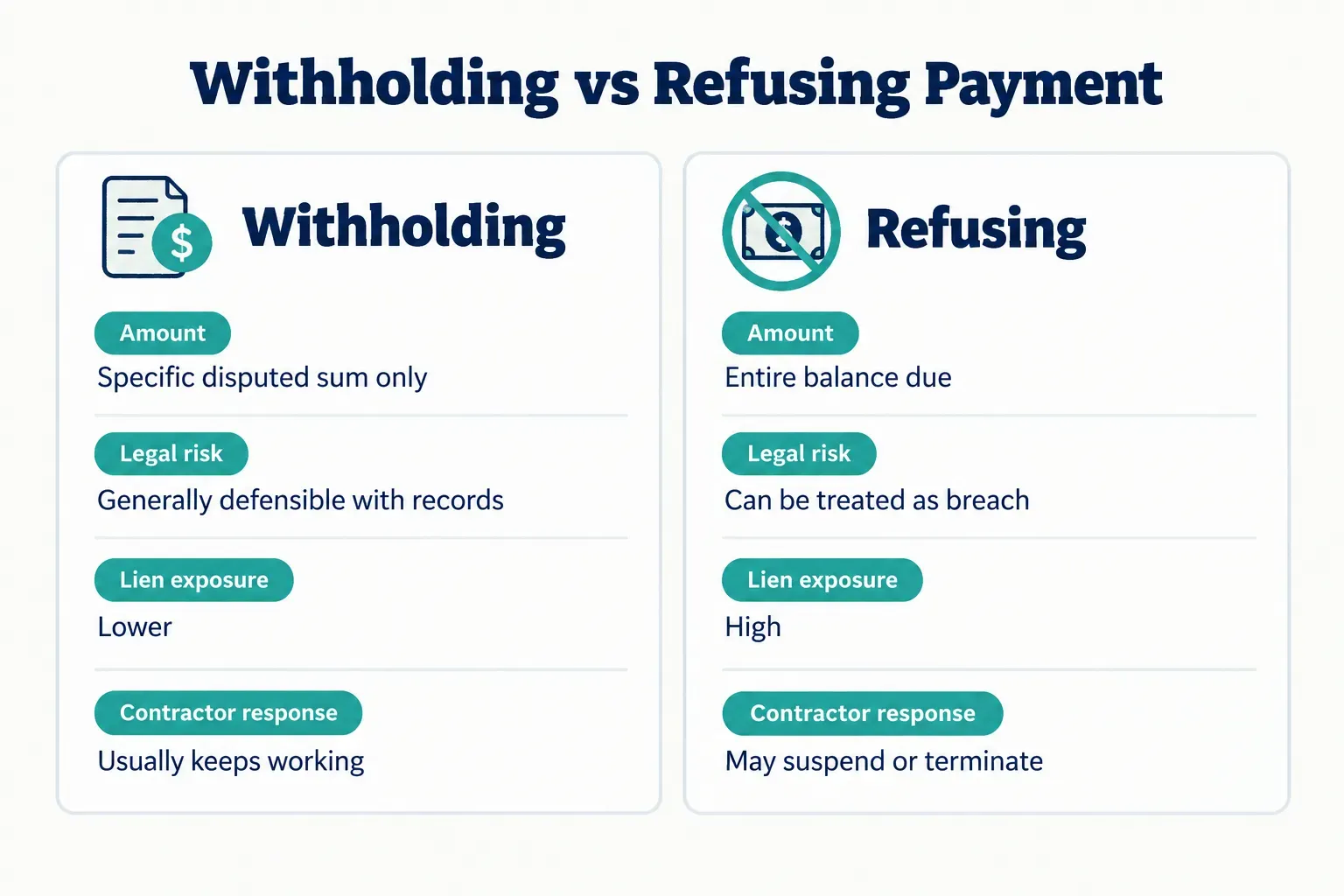
- Breach risk: Refusing all payment, even when some work is poor, can make the owner the party in contract breach, which shifts leverage to the contractor.
- Lien exposure: A contractor who isn’t paid can typically file a mechanic’s lien against the property, which clouds title and can block a sale or refinance.
- Suspension risk: Many contracts allow the contractor to suspend work after a missed payment, which adds delay costs to the original dispute.
- Retainage rules: Holding back retainage (often 5% to 10%) until final completion is normal and usually written into the contract, so it isn’t the same as refusing payment.
Liens and termination risks
Liens are powerful and fast-moving.
And the rules change at every state line.
- Check state deadlines first. Lien rights, preliminary notice requirements, filing deadlines, and lien waiver rules vary widely by state. Some states require notice within weeks of starting work, so always verify local timelines before acting.
- Collect lien waivers when paying. Owners should request conditional or unconditional lien waivers from the general contractor, and ideally from major subcontractors and suppliers, with each payment.
- Don’t terminate without following the contract. Wrongful termination is one of the most expensive mistakes either side can make. Follow the notice and cure provisions exactly.
- Contractors: document owner-caused problems. Record late selections, blocked access, slow approvals, and differing site conditions in a daily log with dated photos. That record is your strongest counter to a nonpayment or delay claim.
- Contractors: send delay notices promptly. Many contracts require written notice of a delay within a set number of days to preserve a claim for extra time or money.
Choosing how to resolve it
Here’s a question worth asking before anything else: does your contract already decide this for you?
Many construction contracts include a dispute resolution clause that requires mediation or binding arbitration before (or instead of) court.
Negotiation, mediation, arbitration, or court
Each path trades off cost, speed, privacy, and finality differently. The table below compares the four main options as of 2026.
| Method | Typical Cost | Typical Speed | Privacy | Binding Outcome? |
|---|---|---|---|---|
| Negotiation | Little to none, unless attorneys draft terms | Days to a few weeks | Fully private | Only if a written settlement is signed |
| Mediation | Low to moderate; mediator fees usually split | Often resolved in a one-day session | Confidential | No, unless parties sign a settlement |
| Arbitration | Moderate to high; arbitrator and filing fees plus counsel | Several months to about a year | Private | Yes, with very limited appeal rights |
| Litigation | Highest; can reach tens of thousands in legal fees | Often one to three years | Public record | Yes, with appeal rights |
Use this decision logic to pick a path:
- Check the contract first. If there’s a mandatory mediation or arbitration clause, that’s your starting point. Courts routinely enforce these clauses. Large commercial projects may also use a dispute review board, a standing panel that issues recommendations during construction.
- Weigh the dollar amount. Small sums often fit small claims court, where limits typically range from roughly $5,000 to $25,000 depending on the state. Spending $15,000 in legal fees to recover $8,000 rarely makes sense.
- Consider urgency. A leaking roof or an imminent lien deadline may demand faster action than a cosmetic punch list item.
- Ask whether the relationship needs to continue. If the job is half-finished and you’d rather not hire someone new, negotiation and mediation preserve goodwill far better than adversarial options.
Most guides stop at those four options. Several other paths are often faster and cheaper:
- Licensing board complaints: State contractor licensing boards can investigate, discipline, and sometimes order restitution from licensed contractors.
- Consumer protection agencies: State attorneys general and local consumer affairs offices handle home improvement fraud and deceptive practices.
- Insurance claims: A contractor’s general liability policy may cover property damage caused by their work, though it usually excludes the cost of redoing the faulty work itself.
- Bond claims: If the contractor is bonded, you can file a claim against the surety. Licensing bonds and performance bonds exist specifically to protect owners when contractors fail to perform.
Preventing the next dispute
The cheapest contractor dispute is the one that never happens.
Prevention is mostly habits, and both sides can adopt them on day one.
Homeowner checklist:
- Confirm the full scope, materials, exclusions, and payment milestones in writing before work begins.
- Sign every change order before the extra work starts, including the price and schedule impact.
- Document site access, selection deadlines, and any days you delayed the crew, so you know your own role in the project timeline.
- Walk the job regularly and keep a running punch list instead of saving every complaint for the end.
Contractor checklist:
- Use a written construction contract for every job, no matter how small, with a clear dispute resolution clause.
- Keep a daily log with photo-dated records of progress, site conditions, and owner decisions.
- Use a formal change-order form that requires a signature and states cost and time impacts.
- Send written notice of delays and differing site conditions as soon as they arise.
Centralized digital records help both sides.
When service bookings, agreed prices, and chat history live in one place, like the records kept by apps such as Frendex, there’s far less room for conflicting he-said-she-said versions of what was promised.
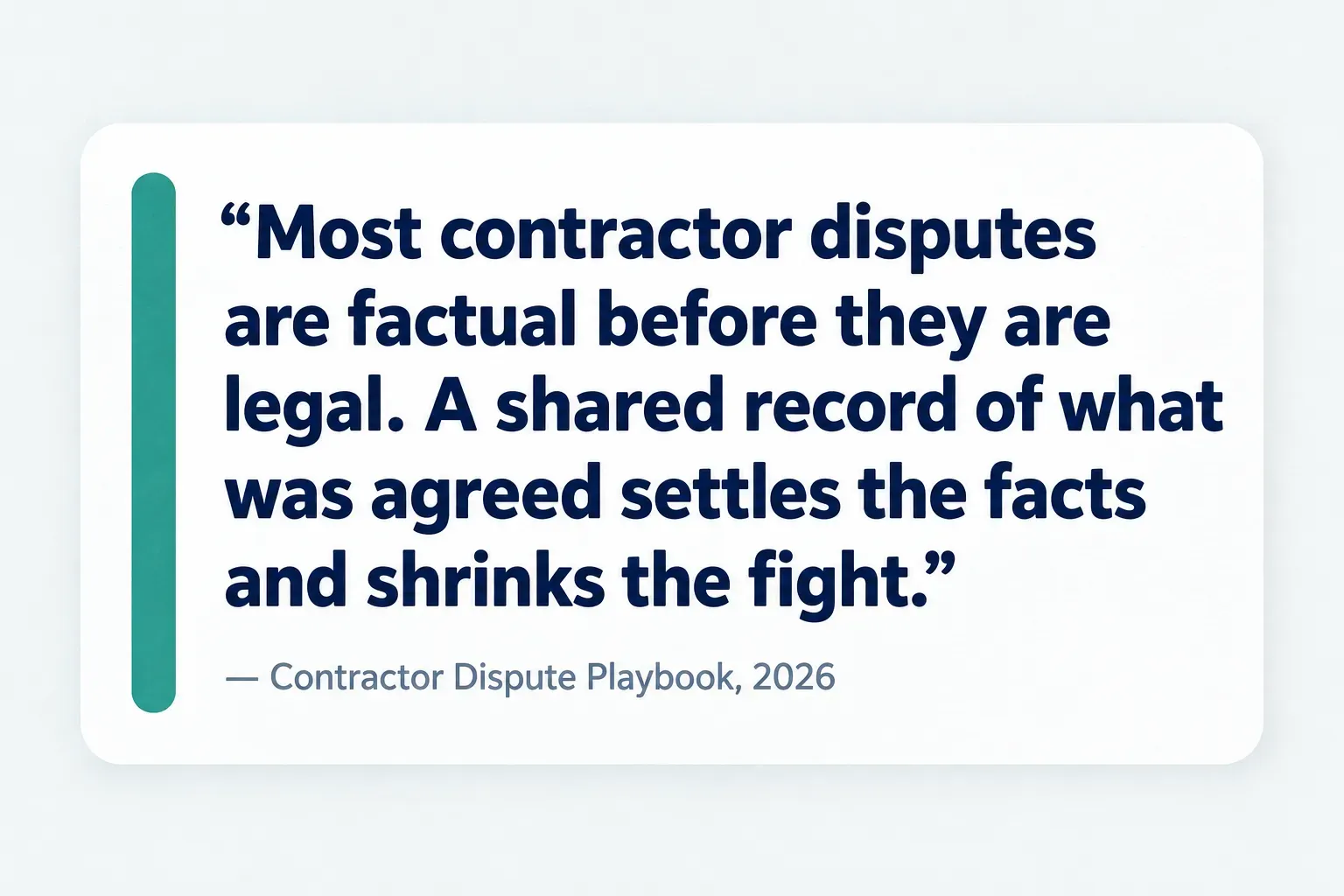
Shared records don’t eliminate disagreements, but they settle the factual ones quickly.
Deciding your next step
The right move depends on three things: the amount, the relationship, and what the contract requires.
Here’s the simple rule.
If the amount is small and the relationship matters, negotiate directly.
If talks stall, bring in a mediator.
If the contract requires arbitration or the stakes are high, arbitrate or consult a construction attorney before deadlines pass.
But every one of those paths gets shorter with one thing.
Documentation built from day one, not scrambled together after the fight starts, is what actually wins arguments, speeds settlements, and keeps disputes out of court.
Start the paper trail before you need it.
Frequently asked questions
How do you resolve a dispute with a contractor?
You resolve a contractor dispute by documenting the problem, sending written notice, and negotiating before escalating. Build a dated timeline, send a cure letter citing the contract, and try direct talks. If that fails, move to mediation, arbitration, or court based on your contract and the amount at stake.
What is the best way to handle a dispute with a contractor?
The best way is to stay factual, put everything in writing, and keep undisputed work and payments moving. Emotional phone calls rarely help. A clear notice letter with a reasonable deadline, backed by photos and contract citations, gives the other side a real chance to fix the issue.
Can I sue a contractor for poor workmanship?
Yes, you can sue a contractor for poor workmanship if the work breaches the contract, violates building codes, or falls below accepted trade standards. Strengthen your case with an independent inspection report and proof that you gave written notice and a chance to cure. Check your contract for an arbitration clause first, since it may require arbitration instead of court.
How do I dispute a contractor's bill?
Dispute a contractor's bill by comparing it line by line to the contract and signed change orders, then requesting an itemized breakdown in writing. Pay the undisputed portion. Clearly state which items you're contesting and why, and keep copies of every exchange.
What can I do if a contractor takes my money and does not finish the job?
If a contractor abandons the job, send a formal demand letter giving a deadline to return or complete the work. File a complaint with your state licensing board, and consider small claims or a civil suit depending on the amount. Some states, including Maryland, Virginia, and Arizona, maintain contractor recovery or guaranty funds that reimburse homeowners harmed by licensed contractors, and a bond claim against the contractor's surety may also apply.
Can I refuse to pay a contractor for bad work?
You can withhold payment for specific defective work, but refusing all payment outright is risky even when the work is bad. A total refusal can make you the party in breach and invite a mechanic's lien. The safer approach is to withhold a documented, reasonable amount tied to the defect while paying for acceptable work.
Need a hand with something?
The Frendex map shows you who is available near you, in real time.
Get the app free Get the app freeFree, no card needed
Related articles

The contractor contract: A complete guide for 2026
See exactly what a contractor contract must cover in 2026, from scope to payment terms. Avoid the disputes that start over vague wording.

How to spot fake reviews before you get fooled
Learn the real patterns behind fake reviews: language clues, timing red flags, and reviewer history checks. No single signal is proof, here's what is.

Quote vs estimate: Which do you actually need?
Quotes vs estimates explained in plain terms, plus the document checklist that actually protects your money. See when you can skip the paperwork entirely.