What a workmanship warranty actually covers
By Kiss János 13 min read

Why this guarantee confuses everyone
Most people only read a warranty after something breaks. By then, the wording that seemed reassuring at signing (“all work guaranteed!”) suddenly means very little.
A workmanship warranty is a provider’s promise to fix problems caused by faulty labor. It covers how the job was done, not defects in the products or materials used.
If a shingle cracks because it was poorly manufactured, that’s a product issue. If it leaks because it was nailed wrong, that’s workmanship.
Here’s the part that trips people up.
A workmanship warranty is a contract term, not a standardized legal product. There’s no universal template that every contractor, mechanic, or salon must follow.
The exact scope, length, and remedy depend entirely on what the written document says.
Most guides on this topic stick to roofing examples.
That’s useful, but limited.
The same logic applies to general construction, auto repair, beauty services, cleaning, tutoring, and even digital work like web development. Any time someone sells you their skill, the question of “what if they do it wrong?” applies.
This guide answers the questions that actually matter in 2026:
What’s covered and what isn’t.
How long coverage lasts and when it starts.
Who’s responsible when labor and parts both play a role.
How to file a claim that gets results.
And how to spot vague or weak terms before you sign.
The promise, defined
Two warranties can sit on the same job and point at completely different people.
That’s the first thing to understand, and it explains most warranty disputes.
Workmanship vs. material warranties
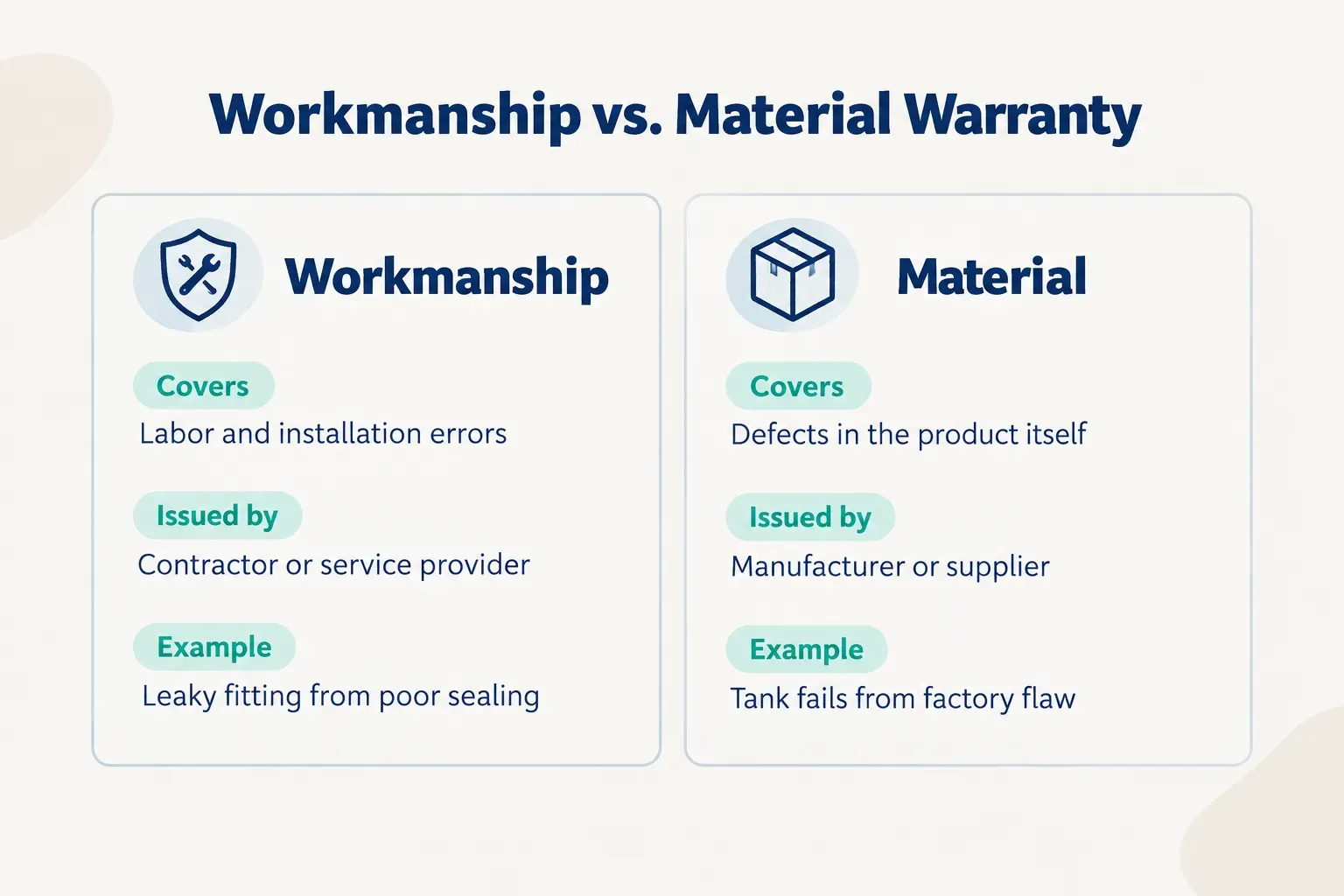
A workmanship warranty guarantees against installation defects and labor errors. A manufacturer warranty (often called a material warranty) covers defects in the product itself.
One protects you from the installer. The other protects you from the factory.
A single water heater replacement shows how both apply.
If the tank fails because of a manufacturing flaw, the manufacturer’s warranty covers the tank. If the tank leaks because the plumber didn’t seal a fitting properly, the plumber’s workmanship warranty covers the fix.
The same split shows up outside construction. A hair colorist uses professional dye (product) and applies it (labor). A mechanic installs brake pads (product) and torques the calipers (labor).
Each failure has a different responsible party.
How it differs from insurance and bonds
People often lump several protections together.
They’re not interchangeable.
An extended warranty is a paid add-on that lengthens coverage beyond the standard term. A service contract is an ongoing maintenance plan, like an annual HVAC tune-up agreement, that covers routine service rather than fixing defective work.
Neither is the same as a warranty on the original job.
Insurance transfers risk to a third party. A contractor’s general liability policy might pay if their crew damages your property, but it usually won’t pay to redo sloppy work.
A surety bond is a financial backstop. If a licensed contractor defaults, abandons the job, or disappears, a bond claim may recover some of your losses.
Think of it this way: the warranty is the contractor’s promise, insurance covers accidents, and the bond covers the contractor vanishing.
Writing terms that hold up
Length, remedies, and warranty exclusions all come from the written contract language. No single legal standard applies to every trade or every state.
That makes wording everything.
Compare these two versions.
Vague: “All work guaranteed” or “100% satisfaction guaranteed.” Specific: “Provider warrants all labor against defects in installation for 12 months from final acceptance. Covered defects will be repaired or redone at no charge, including removal and reinstallation, within 14 days of written notice.”
The first creates arguments.
The second creates an express warranty with a duration, a start date, covered defects, a remedy, and a timeline.
If you’re a provider, write the second version. If you’re a customer, ask for it.
What’s covered, what isn’t
The fix itself is often the cheapest part of a warranty repair. The surrounding costs, like tearing things out and putting them back, can easily double or triple the bill.
Who pays for the extras
A solid workmanship warranty typically covers more than just the corrected labor. It should include removal of the faulty work, disposal of debris, and access costs like opening a wall or lifting flooring to reach the problem.
Diagnostics matter too, because someone has to figure out what went wrong.
Strong terms also cover temporary protection (tarping a roof, capping a pipe), reinstallation of anything removed, and repair of resulting damage. If a badly installed shower valve leaks into the ceiling below, the warranty should cover the drywall, not just the valve.
Weak warranties limit the remedy to “repair of the defective labor only.”
That sounds reasonable until you realize the plumber will fix the fitting and leave you with a hole in your ceiling.
Look for language describing a full repair and replacement remedy, including consequential repairs.
Common exclusions and gray areas
Every warranty has limits.
The standard warranty exclusions include:
Normal wear and tear, since nothing lasts forever.
Customer misuse, such as hanging a heavy TV on a shelf rated for books.
Weather events beyond design limits, like hurricane-force winds or hail.
Settlement or structural movement that cracks finishes through no fault of the installer.
And later work by a different provider that disturbs or alters the original job.
The gray areas live between those categories.
Was the crack from settlement, or from inadequate fastening? Did the paint peel from humidity, or from skipped primer?
Cause is determined in practice through three sources.
First, inspection findings from the provider, an independent inspector, or a trade expert. Second, manufacturer defect reports that confirm or rule out a product flaw. Third, service and installation records showing what was done, when, and how.
Together, these separate defective workmanship from material, design, or usage issues.
Two examples show the same logic across industries.
Construction: roof flashing. A homeowner notices a stain near the chimney eight months after a reroof. Inspection shows the step flashing was face-nailed instead of tucked under the shingles, a textbook installation error.
The roofer’s warranty covers re-flashing, plus the stained ceiling below. If the flashing metal itself had corroded prematurely, the claim would shift toward the manufacturer.
Auto service: brake job. A driver hears grinding three weeks after new pads. The shop finds a caliper bolt that was never torqued to spec.
That’s workmanship, so the shop redoes the job and replaces the scored rotor at no charge.
But if the pads crumbled due to a recalled batch, the parts maker carries the cost, and the shop typically handles the swap.
Different trades.
Same question: was it the work, the product, or something else?
Timing, duration, and who’s liable

A warranty can expire before you even know it started. That happens surprisingly often when the contract never says when the clock begins.
When the clock starts ticking
Common warranty start points include substantial completion (the job is usable, even with minor punch-list items), final acceptance (the customer signs off on everything), the closing date on a new home, the invoice date, or the service-completion date.
The gap between these can be weeks or months. On a commercial build, substantial completion and final acceptance might be 90 days apart.
On a one-year warranty, that’s a quarter of your coverage.
That’s why the contract must name one start point explicitly. “One year from final acceptance, as evidenced by signed completion form” leaves no room for debate.
And duration?
One year is common contract practice, not a universal law. Roofers often offer two to ten years on labor.
Auto shops commonly offer 12 months or 12,000 miles. A hair salon might offer a free fix within seven days.
Some states add statutory warranties on top of the written one. New Jersey’s New Home Warranty program, for example, sets one year for workmanship and materials, two years for major systems, and ten years for major structural defects.
Many states also recognize an implied warranty that work will be performed in a good and workmanlike manner, even when the contract is silent.
Separately, statutes of limitation (how long you have to sue after discovering a problem) and statutes of repose (an absolute cutoff after completion) can outlast the written term.
Construction statutes of repose generally range from roughly 4 to 15 years depending on the state. California, for instance, allows up to 10 years for latent construction defects.
Contractor, installer, or manufacturer?
Liability follows the cause.
But on many jobs, the chain has several links: a general contractor, a subcontractor who did the install, a supplier, and a manufacturer.
Consider a correctly installed but defective part. An electrician installs a new breaker panel exactly to code. Six months later, a breaker fails to trip because of a manufacturing flaw.
The installer isn’t on the hook for the defect itself, since the workmanship was sound.
The manufacturer warranty covers the part.
In practice, though, the electrician may still handle the replacement and file the claim with the manufacturer. Whether they charge you for that labor depends on the contract.
Good warranties state that the provider coordinates manufacturer claims at no labor cost during the warranty term.
For homeowners working with a general contractor, the GC usually remains your point of contact even if a subcontractor did the faulty work.
You hired the GC. Sorting out the subs is their job.
Transfers, verbal deals, and expiration
Verbal promises are real, but nearly impossible to prove. “He said it was covered for five years” won’t carry much weight against a written contract that says one.
If a provider makes a verbal promise, ask them to confirm it by email or text.
That message becomes evidence.
Transferability varies.
Some workmanship warranties transfer automatically to a new owner when a home or business sells. Others require a written transfer request and a fee within 30 to 60 days of closing.
Many don’t transfer at all.
If you’re buying property, ask the seller for any existing warranty documents and check the transfer clause.
Finally, warranty expiration is not the same as losing all legal recourse.
The contractual promise ends.
But claims for breach of contract, negligence, or breach of implied warranty may still be available within your state’s limitation period.
Expired warranty… not necessarily expired options.
Filing a claim step by step
The single biggest reason warranty claims fail isn’t bad faith.
It’s bad process.
Customers call, get a vague “we’ll look into it,” and lose months without a paper trail.
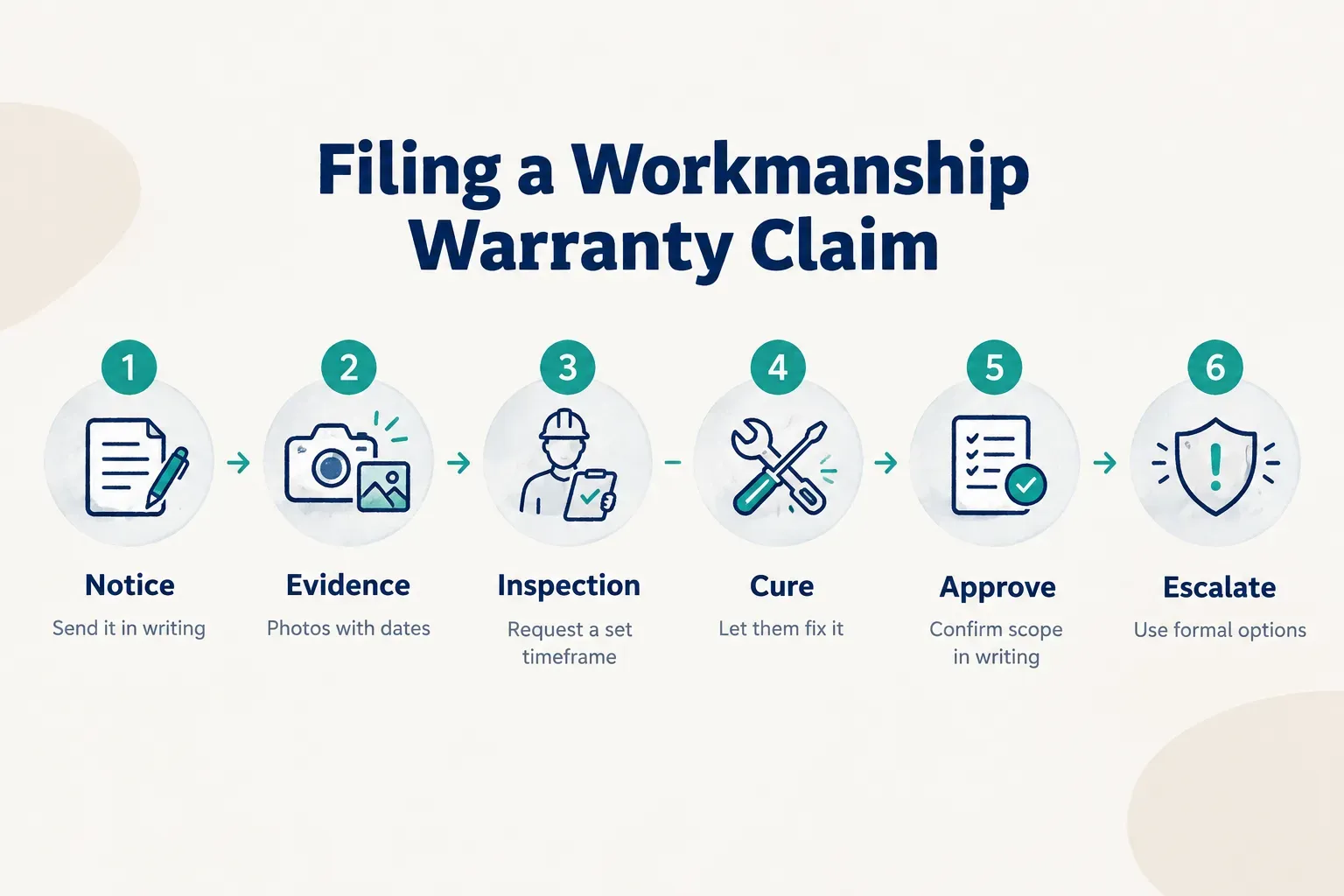
Follow this sequence instead:
- Send written notice. Email or certified letter beats a phone call every time. Your written notice of claim should describe the problem, when you noticed it, the original job date, and a request for inspection.
- Preserve evidence. Photograph and video the defect from several angles, with dates visible. Don’t throw away failed parts, since they may be needed to determine cause.
- Request an inspection. Ask the provider to assess the problem within a specific timeframe, such as 7 to 14 days. Be present if possible and take your own notes.
- Allow a reasonable opportunity to cure. Many contracts and some state laws include a right to cure, giving the provider a chance to fix the issue before you hire someone else. Skipping this step can void your claim.
- Approve the repair in writing. Confirm the scope, the date, and what’s included. After the work, inspect it and document the result.
- Escalate if unresolved. If the provider refuses, stalls, or does a poor repair, move to formal options covered below.
Evidence that actually protects you
Most disputes come down to timeline.
When was the work done? What was promised? When did the problem appear?
Digital records help reconstruct that story. On a service marketplace like Frendex, for example, timestamped booking confirmations, in-app chat messages, the written service description, and photo attachments all create a dated record of what was agreed and delivered.
If a provider wrote “I’ll come back and fix it free if the grout cracks” in chat, that message matters.
But a platform record is not a substitute for a warranty contract.
It shows what happened. It doesn’t automatically create coverage.
Use it to support your claim, and still ask for warranty terms in writing.
When emergency repairs can’t wait
Some problems won’t wait for a scheduled inspection. A burst pipe at 2 a.m. or a roof leak during a storm demands immediate action.
Document the damage immediately, ideally before touching anything. Then make only reasonable temporary fixes to prevent further harm: shut off water, place a tarp, move belongings.
Notify the original provider right away, even if it’s a voicemail followed by an email.
Only hire someone else for permanent repairs if the original provider can’t respond in time.
Keep every receipt.
Courts and contracts generally allow recovery of reasonable emergency costs, but not a full replacement you arranged without notice.
What if the provider goes out of business, stops responding, or flatly refuses? You still have options:
- Small claims court handles disputes up to a state-set limit, often between $5,000 and $15,000, without needing a lawyer.
- Licensing board complaints can prompt a response from licensed trades, since boards can discipline or suspend contractors.
- Bond claims against a contractor’s surety bond may recover costs if the contractor defaulted or disappeared.
- State recovery funds exist in some states to compensate homeowners harmed by licensed contractors.
Read the warranty before you need it
The best time to understand a warranty is before anything goes wrong. Once a dispute starts, you’re negotiating from memory.
So here’s the one action worth taking: before hiring anyone, ask for the warranty terms in writing. Confirm the duration, the start date, and exactly what triggers a covered repair.
Two minutes of questions now can save months of arguing later.
Strong reviews and verified profiles are good signs.
They signal a reliable provider.
But they don’t create warranty coverage, and they don’t guarantee a successful claim.
Only the written terms do that.
And from day one, save everything.
Every invoice, every message, every before-and-after photo.
That folder will feel pointless right up until the moment it isn’t.
Frequently asked questions
What is the difference between a workmanship warranty and a material warranty?
A workmanship warranty covers errors in labor and installation, while a material warranty covers defects in the product itself. The service provider issues the first; the manufacturer or supplier issues the second. A single job, like a roof replacement, usually involves both.
How many years should a contractor warranty their work?
Contractors commonly warranty their work for one to two years, though this varies by trade and region. Roofers often offer longer labor warranties, sometimes five to ten years. One year is common practice, not a fixed legal rule, so always check the written terms.
What does a one-year workmanship warranty cover?
A one-year workmanship warranty covers defects caused by faulty labor that appear within 12 months of the stated start date. Strong versions include removal, reinstallation, and repair of resulting damage. It typically excludes wear and tear, misuse, severe weather, and product defects covered by the manufacturer.
Can I sue a contractor for poor workmanship after the warranty expires?
Yes, you can sometimes sue a contractor after the warranty expires. Statutes of limitation and repose, plus implied warranty and negligence claims, exist separately from the contract. Construction statutes of repose often run several years beyond completion, so consult a local attorney to confirm deadlines.
What should be included in a contractor warranty?
A contractor warranty should include six elements: duration, start date, covered defects, exclusions, remedy, and the process for requesting repair. Clear terms also state response times and whether coverage transfers to a new owner. If any element is missing, ask for it in writing before signing.
How do I get a contractor to honor a workmanship warranty?
To get a contractor to honor a workmanship warranty, send written notice with photos and dates, then request an inspection. Give them a reasonable chance to fix the problem. If they refuse or stop responding, escalate through small claims court, a licensing board complaint, or a bond claim.
Need a hand with something?
The Frendex map shows you who is available near you, in real time.
Get the app free Get the app freeFree, no card needed
Related articles

The contractor contract: A complete guide for 2026
See exactly what a contractor contract must cover in 2026, from scope to payment terms. Avoid the disputes that start over vague wording.

How to spot fake reviews before you get fooled
Learn the real patterns behind fake reviews: language clues, timing red flags, and reviewer history checks. No single signal is proof, here's what is.

Quote vs estimate: Which do you actually need?
Quotes vs estimates explained in plain terms, plus the document checklist that actually protects your money. See when you can skip the paperwork entirely.