Plumber cost in 2026: A homeowner's pricing guide
By Kiss János Updated 14 min read

Why plumbing quotes feel so confusing
One guide says plumbers charge $45 an hour. Another says $350 for a clogged drain.
Both can be accurate, and that is exactly why homeowners end up confused about plumber cost.
The problem is that most pricing articles mix up three different numbers: the plumber hourly rate, the service call fee, and the total project price. Comparing an hourly rate from one source to a full job cost from another is like comparing a taxi’s per-mile rate to the price of a cross-country flight. They measure different things.
This guide separates every layer of a plumbing bill: labor, service-call fees, materials, permits, specialized equipment, and emergency premiums.
The goal is simple.
You should be able to start with a symptom (“my kitchen sink drains slowly”) and translate it into a realistic scope of work and price range before anyone shows up at your door.
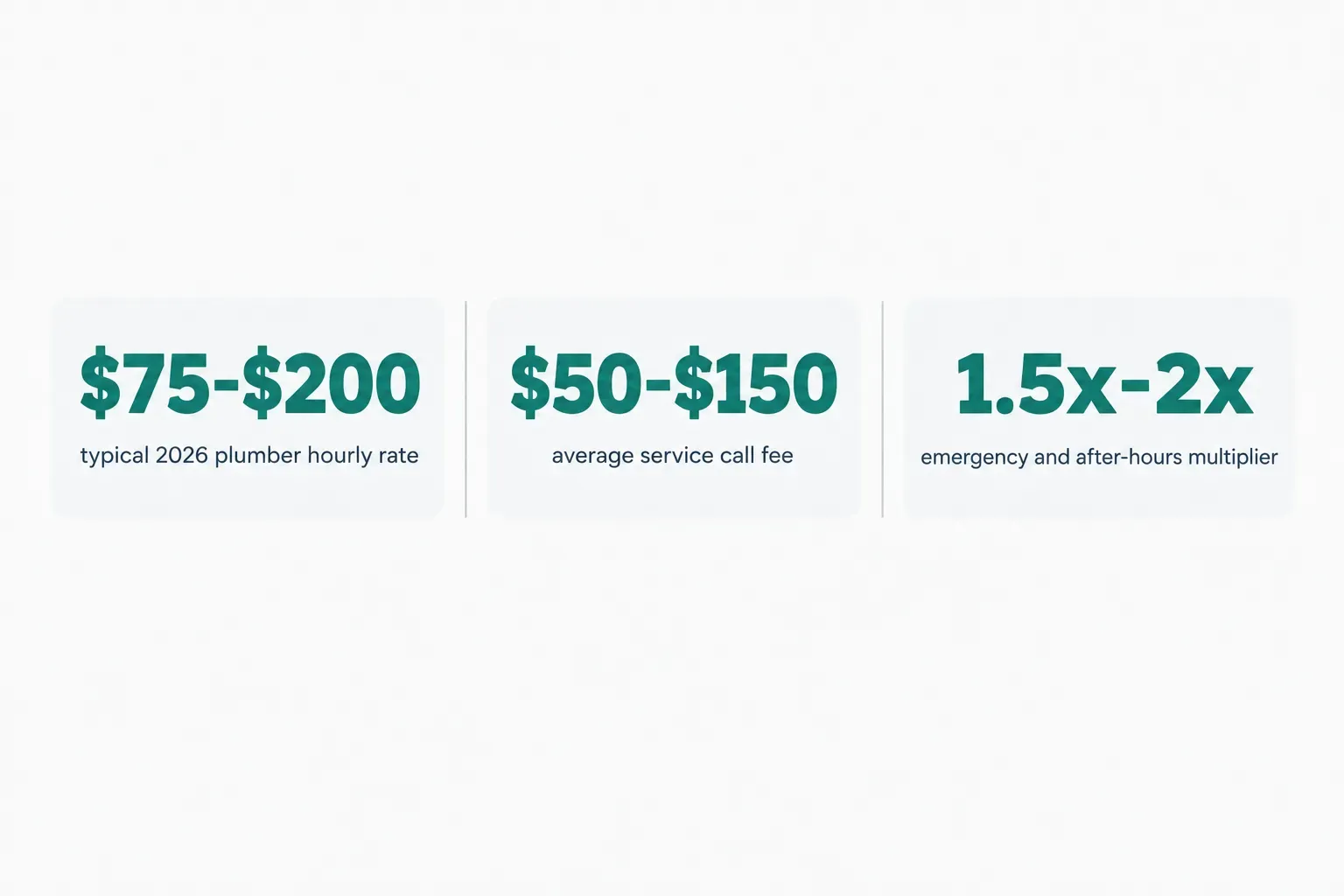
Here are the 2026 national baselines up front:
- Hourly labor: roughly $75 to $200 per hour.
- Service call or trip charge: roughly $50 to $150.
- Emergency plumbing: typically 1.5x to 2x standard rates for nights, weekends, and holidays.
One caveat applies to every figure below. Local labor markets move these numbers a lot, so a plumber in Manhattan and a plumber in rural Missouri can quote very different prices for identical work.
Use the ranges as a sanity check, not a contract.
How plumbers actually price a job
Most plumbing bills are built from four or five separate charges, and many homeowners only see the total. Knowing what each charge covers is the fastest way to spot padding.
Here is what each term usually means in practice:
- Trip fee (or trip charge): covers the cost of driving a stocked truck to your home. Example: $75 just to arrive, regardless of what happens next.
- Diagnostic fee: pays for the time spent figuring out what is wrong. Example: $95 to trace why your water heater keeps tripping its pilot.
- Minimum labor charge: the smallest amount of labor you will be billed, even for a five-minute fix. Example: a one-hour minimum, so tightening a loose supply line still costs a full hour.
- First-hour charge: a higher rate for the first hour that bundles travel and setup. Example: $175 for hour one, then $110 for each additional hour.
- Flat-rate price: a fixed price for a defined task from a price book. Example: $289 to replace a toilet fill valve, parts and labor included.
Hourly rates in 2026
The average plumber hourly rate in 2026 falls between $75 and $200 per hour. Most homeowners in mid-sized cities will see quotes clustered around $100 to $150.
Who shows up matters.
An apprentice working under supervision bills at the low end, a licensed journeyperson plumber usually lands in the middle, and a master plumber (the highest license tier, required for permits in many states) often charges at or above the top of the range. In major metros like New York City, San Francisco, and Boston, rates of $175 to $250 per hour are common for licensed contractors because of higher wages, insurance, parking, and overhead.
Service calls, trip fees, and diagnostics
A typical service call fee runs $50 to $150 in 2026.
The real question isn’t the amount.
It’s whether that fee rolls into your labor or sits on top of it.
Some companies credit the service fee toward the first hour of work, so a $125 call fee simply becomes your first hour of labor. Others charge it separately, so you pay $125 to get the plumber in the door and then the hourly rate starts. Neither approach is dishonest, but the difference can add $100 or more to a small job.
Many shops also waive the diagnostic fee if you approve the repair on the spot. Always ask on the phone: “Is your service fee applied to the repair, or charged in addition to it?”
Hourly vs flat-rate pricing
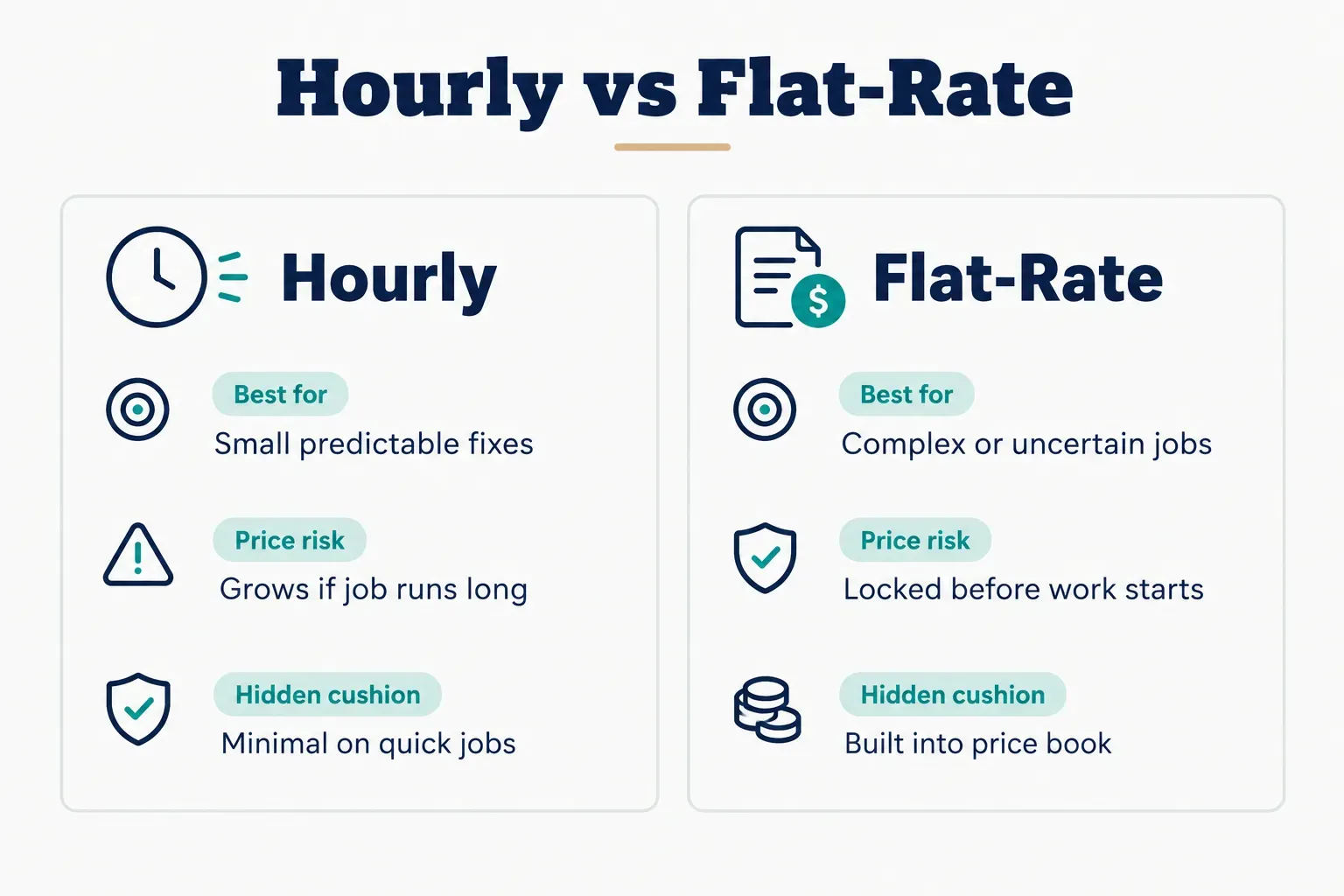
Flat-rate plumbing has become the dominant model for larger service companies. The technician diagnoses the issue, opens a price book, and quotes a fixed number before starting work.
Flat-rate pricing protects you on jobs that could spiral, like a stubborn drain clog or a corroded shut-off valve that fights back.
If the job takes three hours instead of one, the price stays the same.
The tradeoff is that flat rates are built with a cushion, so quick, simple jobs often cost more than they would hourly.
Hourly billing favors you when the task is small and well defined, such as swapping a faucet cartridge you already bought. It works against you when the scope is unknown, especially with older homes and hidden pipes.
A good rule: simple, predictable job, ask for hourly; complex or uncertain job, ask for flat-rate.
What pushes the price up or down
Two homeowners can call a plumber for the exact same leak and receive bills that differ by $800.
The pipe isn’t the difference.
Where the pipe lives, what the work requires legally, and what time of day the call happens are.
Access and location inside the home
A leaking pipe under an open sink cabinet is a 30-minute fix. That same leak behind finished drywall, under a concrete slab, or deep in a crawl space can turn into a half-day project.
Access drives labor hours.
Work behind walls means cutting and patching (and plumbers usually do not do the drywall repair, so budget separately for a drywall pro). Slab leaks may require leak detection equipment, jackhammering, or rerouting the line overhead, which can push a repair past $2,000.
Other access factors that add cost include:
- Upper-floor bathrooms where water damage risk forces slower, more careful work.
- Tight crawl spaces that limit movement and sometimes require two technicians.
- Exterior lines, such as hose bibs, irrigation connections, and sewer laterals, that may need digging or specialized tools.
Materials, permits, and equipment
Materials usually make up 20% to 40% of a typical repair bill. A basic chrome faucet might cost $60, while a designer fixture can run $400 or more, and the labor to install both is nearly identical.
A plumbing permit is legally required in most jurisdictions for water heater replacement, whole-house repiping, sewer line repair or replacement, and new gas line installation.
Permit fees typically range from $50 to $500 depending on your city and the project size. The permit also triggers an inspection, which can add a second visit and sometimes extra labor time while the plumber meets the inspector.
Specialized equipment carries its own line items.
A drain camera inspection often costs $150 to $500, hydro jetting runs roughly $350 to $800, and electronic leak detection typically falls between $150 and $450. These are legitimate tools, but they should match the problem, which we cover in the next section.
Emergency and after-hours premiums
Emergency plumbing calls at night, on weekends, or on holidays typically cost 1.5x to 2x the standard rate. A $120-per-hour plumber can easily become $180 to $240 per hour at 11 p.m. on a Saturday.
Several factors stack on top of the multiplier.
Technician availability is limited after hours, so you may get whoever is on call rather than the closest pro. Rural homeowners often pay higher trip charges because the on-call plumber may drive 40 minutes or more each way.
So when is paying the premium actually the cheaper choice?
When waiting causes secondary damage.
An active leak can saturate subfloors and drywall within hours, a sewage backup creates health hazards and contaminated materials that must be removed, and a gas smell is a life-safety issue that should never wait for Monday.
A $400 emergency call is expensive. A $6,000 water damage claim with a $1,000 deductible is far more expensive. When water is actively escaping or sewage is backing up, the premium is usually the bargain.
If the issue is a slow drain, a dripping faucet, or a running toilet, shut off the local valve and wait for business hours. You’ll save 33% to 50% on labor.
What common repairs really cost
The most common pricing mistake is comparing the wrong line item. A homeowner reads “water heater: $1,000 to $3,500” and panics, when their actual problem is a $200 thermocouple swap.
The table below separates small repairs from major replacements. All figures reflect typical 2026 national ranges including labor and materials, before permits and emergency premiums.
| Job | Typical 2026 Cost | Repair or Replacement | What Drives the Price |
|---|---|---|---|
| Clogged drain | $100 to $300 | Repair | Location of clog, snaking vs hydro jetting, main line vs single fixture |
| Leaking pipe repair | $150 to $500 | Repair | Exposed vs behind walls, pipe material (PEX, copper, galvanized) |
| Toilet repair | $100 to $300 | Repair | Fill valve, flapper, wax ring, or flange replacement |
| Toilet replacement | $300 to $600 | Replacement | Fixture price, removal and disposal, flange condition |
| Faucet repair or replacement | $100 to $350 | Either | Cartridge swap vs full fixture, homeowner-supplied parts |
| Water heater repair | $150 to $600 | Repair | Thermostat, element, thermocouple, gas valve, or anode rod |
| Water heater replacement | $1,000 to $3,500 | Replacement | Tank vs tankless, gas vs electric, permit, venting changes |
Notice the gap between repair and replacement on toilets and water heaters. If a plumber jumps straight to replacement on a unit under eight years old, ask what specific failed component rules out a repair.
Sample itemized invoice
Here’s how a straightforward job, replacing a corroded section of copper pipe feeding a water heater with a permit pulled, adds up on an itemized invoice. Assume the service fee is charged on top of labor and a 7% sales tax applies to the full bill.
| Line Item | Calculation | Amount |
|---|---|---|
| Service call fee | Flat charge | $125.00 |
| Labor | 2 hours x $110/hour | $220.00 |
| Parts and materials | Pipe, fittings, solder, valve | $85.00 |
| Permit fee | Local jurisdiction | $75.00 |
| Subtotal | Sum of above | $505.00 |
| Sales tax | 7% of subtotal | $35.35 |
| Total | $540.35 |
Now run the same job with a company that rolls the service fee into the first hour. The $125 covers hour one, you pay $110 for hour two, and the total drops to roughly $423 after tax.
Same pipe, same plumber skill level, about $117 difference based purely on billing policy.
Tax treatment also varies.
Some states tax only parts, others tax labor as well, so check your local rules before assuming the plumber added something improper.
Finally, know when extra diagnostics are justified:
- Drain camera inspection: justified for recurring clogs, suspected root intrusion, or before buying an older home. Not justified for a single slow bathroom sink.
- Leak detection: justified when your water bill spikes or the meter moves with all fixtures off. Not justified when the leak is visible.
- Hydro jetting: justified for grease-heavy kitchen lines or main lines with buildup. Often an upsell for a simple hair clog.
- Excavation: justified only after a camera confirms a collapsed or broken sewer line.
- Pressure test: justified after repiping, new gas work, or when inspectors require it.
Comparing quotes without overpaying
The cheapest quote is rarely the cheapest job.
Low estimates often achieve that number by excluding work that shows up later as a change order.
And here’s something that surprises homeowners: two licensed plumbers can quote very different prices for the same symptom without either one being dishonest.
One may diagnose a slow drain by snaking it, while another runs a camera first. One may use a builder-grade valve with a 1-year warranty, while another installs a commercial-grade part with a 5-year labor guarantee.
You aren’t comparing prices.
You’re comparing scopes.
A quote comparison checklist
Every written plumbing estimate should answer the same questions. Put competing quotes side by side and check each of these:
- Scope in plain language: the estimate should describe exactly what will be repaired or replaced, not just “fix leak.” Vague scopes give the contractor room to bill for extras.
- Excluded work: look for phrases like “drywall repair by others” or “does not include access.” These exclusions can add hundreds of dollars once walls are opened.
- Allowances: some quotes include a fixture allowance (for example, $250 for a faucet). If you pick a $400 model, you pay the difference, so confirm the allowance matches what you want.
- Labor and materials breakdown: an itemized split of labor and materials helps you see whether a high price comes from expensive parts or padded hours.
- Warranty terms: check both the manufacturer’s parts warranty and the plumber’s labor warranty. A 90-day labor warranty and a 2-year labor warranty are not equivalent offers.
- Cleanup and disposal fees: hauling away an old water heater can cost $50 to $150. Confirm whether this is included.
- Permit responsibility: the estimate should say who pulls the permit and whether the fee is included in the price.
- Change-order terms: ask how unexpected findings are handled. A fair contract requires your written approval before any added cost.
Before the plumber arrives
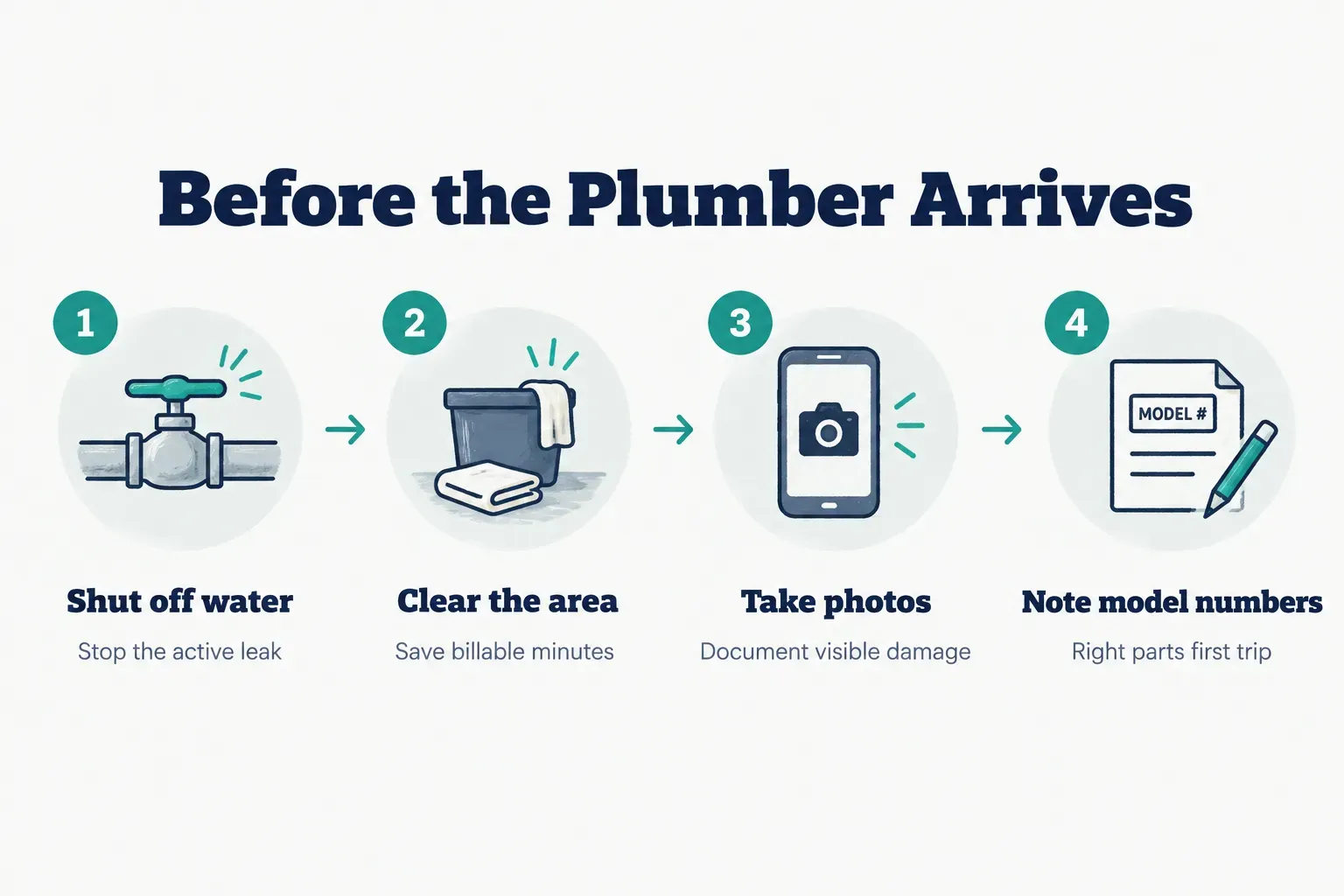
A little preparation shortens the visit and keeps the bill down. Every minute a plumber spends moving boxes or hunting for your main valve is a billed minute.
DIY-safe steps you can take yourself:
- Find and close the water shut-off valve: locate the main valve (often near the water meter, in a basement, or by the water heater) and turn it off if water is actively leaking. For a single fixture, use the small valve under the sink or behind the toilet.
- Clear the work area: empty the sink cabinet, move stored items away from the water heater, and give the plumber a clear path. This alone can save 15 to 30 minutes.
- Take photos and video: document the leak, the stain, or the backup from several angles. Photos help with insurance claims and let you get more accurate phone quotes.
- Note model numbers: write down the brand and model of your water heater, toilet, or faucet so the plumber can bring the right parts on the first trip.
What must be left to a licensed professional:
- Gas lines: any gas smell, gas appliance connection, or gas line repair. Leave the house and call your utility or 911 first if the smell is strong.
- Sewer contamination: sewage backups involve pathogens and require proper cleanup and disinfection.
- Pressurized systems: water heater relief valves, expansion tanks, and main supply lines can release scalding or high-pressure water.
- Anything requiring a permit: unpermitted work can create problems with insurance claims and home sales.
Finding and documenting the right pro
Get at least 2 to 3 written estimates for any non-emergency job over a few hundred dollars. Verbal quotes are not enough, because you cannot compare scope, exclusions, or warranties from memory.
Before booking anyone, verify their license and insurance through your state’s contractor or plumbing licensing board. Most boards offer a free online lookup that shows license status, license class (journeyperson vs master), and any disciplinary actions.
Ask for a certificate of liability insurance too, since a plumber without coverage can leave you exposed if a pipe bursts mid-job.
Keeping everything organized matters more than people expect.
An app like Frendex, for example, lets homeowners and landlords compare verified local providers’ prices and ratings on a map, message job details and photos before booking, and keep quotes and job records in one place. That record becomes useful later for warranty claims, insurance, or proving maintenance history to a buyer or tenant.
Getting a fair price tonight
Before you call anyone, grab your phone and write three things down: the exact symptom, when it started, and any visible damage. “Water pooling under the kitchen sink since 6 p.m., cabinet floor soft” gets you a far more accurate quote than “I have a leak.”
Then apply one decision rule.
If it’s a safety issue (gas, sewage, or active flooding), call now and accept the emergency rate, because secondary damage will cost more than the premium. If it’s non-urgent, shut off the local valve and collect 2 to 3 written estimates during business hours.
The lowest number isn’t what protects you.
A clear, written scope of work is.
When every quote describes the same job in the same detail, overpaying becomes very hard to do… and choosing the right plumber becomes easy.
Frequently asked questions
How much does a plumber charge per hour?
Plumbers charge $75 to $200 per hour in 2026, with most mid-sized markets landing between $100 and $150. Master plumbers and contractors in major metros like New York, San Francisco, and Boston often bill $175 to $250 per hour because of higher overhead and licensing requirements.
How much does a plumber charge just to come out?
A plumber's service call fee typically costs $50 to $150 in 2026. Some companies credit that fee toward the first hour of labor, while others charge it on top, so ask before booking. This one policy difference can change a small job's total by $100 or more.
How much does it cost to fix a leaking pipe?
Fixing a leaking pipe costs $150 to $500 for most accessible repairs in 2026. Leaks behind drywall or under a concrete slab cost significantly more, sometimes over $2,000, because of access work, leak detection equipment, and separate drywall or concrete repair afterward.
Are plumbers more expensive on weekends?
Yes, plumbers usually charge 1.5x to 2x their standard rate on weekends, nights, and holidays. A $120-per-hour plumber may bill $180 to $240 per hour after hours. Pay the premium for active leaks, gas smells, or sewage backups; wait for weekday rates on non-urgent repairs.
How do I know if a plumber is overcharging me?
A plumber may be overcharging if the estimate is vague, lacks a labor and materials breakdown, or pushes replacement without explaining what failed. Compare 2 to 3 written quotes using the checklist above, confirm what each excludes, and verify license status through your state licensing board before approving work.
How much does it cost to unclog a drain?
Unclogging a drain costs $100 to $300 in 2026 for a single fixture cleared with a snake. Main sewer line clogs cost more, and hydro jetting typically runs $350 to $800. A drain camera inspection is worth it only for recurring clogs or suspected root intrusion.
Need a hand with something?
The Frendex map shows you who is available near you, in real time.
Get the app free Get the app freeFree, no card needed
Related articles

Pest control cost in 2026: What you'll really pay
Real 2026 pricing for one-time visits, recurring plans, and termite or bed bug jobs. Learn what drives $95 vs $1,400 quotes before you sign.
Boiler maintenance: A homeowner's safety and service guide
Learn which boiler checks are safe to DIY, which need a pro, and the warning signs that mean call for help now. A homeowner's framework for 2026.

Rodent control: A homeowner's step-by-step guide
Skip the trap-and-hope cycle. This 8-step IPM method shows why sealing entry points matters more than traps. See the full sequence inside.