Pest control cost in 2026: What you'll really pay
By Kiss János 15 min read
Why pest control quotes never seem to agree
Call three pest control companies about the same problem and you might hear $95, $275, and $1,400. None of them is necessarily lying. They’re usually quoting completely different jobs.
One quote may be a minimum service call: a technician walks the perimeter, sprays the baseboards, and leaves. Another may cover a full-home treatment with a follow-up visit two weeks later. The third might bundle a year of quarterly service, an initial cleanout, and a service guarantee into one number.
National averages have the same problem. Most “average pest control cost” figures blend a $150 ant spray with a $2,000 termite job and a $1,200 bed bug heat treatment.
Then they report a single midpoint that describes nobody’s actual situation.
A pest control price means nothing until you know what it covers: the area, the method, the number of visits, and what happens if the pests come back.
This guide takes a different approach. It separates pricing into three categories:
One-time service for a contained, solvable problem. Recurring pest control plans for ongoing prevention. And specialty treatments (termites, bed bugs, and wildlife removal) that follow their own pricing logic entirely.
By the end, you’ll know what each type of service should cost as of 2026. More usefully, you’ll know how to compare quotes by scope, method, visit count, and guarantee terms.
The bottom-line price is the last thing you should judge, not the first.
What pest control actually costs in 2026
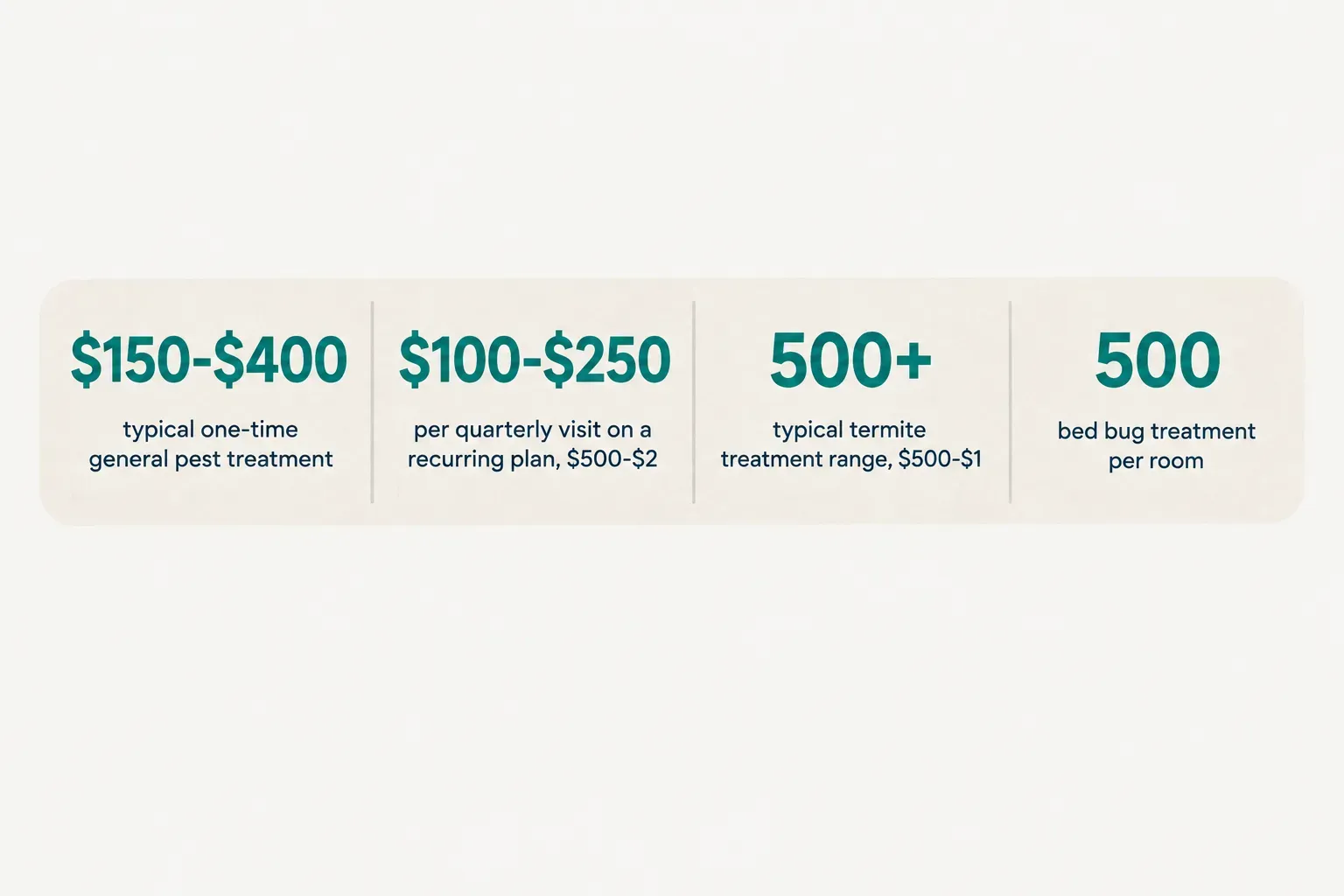
Most homeowners pay between $150 and $400 for a single general pest treatment. That’s the anchor number.
Everything else in pest control pricing either builds on it (recurring plans) or ignores it entirely (termites, bed bugs, wildlife).
Here’s how the main service types break down nationally in 2026:
| Service type | Typical 2026 cost | What’s usually included | Best suited for |
|---|---|---|---|
| One-time general pest spray | $150-$400 | Interior and exterior chemical spray treatment, sometimes one follow-up visit | Single, localized problems like an ant trail or a few spiders |
| Monthly recurring plan | $40-$70 per visit | Perimeter barrier, monitoring, interior treatment on request | High seasonal pest pressure, warm climates, multi-unit buildings |
| Quarterly recurring plan | $100-$250 per visit | Exterior barrier refresh, inspection, free re-treatments between visits | Most single-family homes with moderate, ongoing activity |
| Initial setup fee (recurring plans) | $175-$350 one time | Heavy first treatment, full pest inspection, station installation | Charged at the start of most monthly or quarterly contracts |
| Inspection fee | $0-$150 | Pest identification, infestation assessment, written findings | Termites, wildlife, real estate transactions, unknown pests |
| Termite treatment | $500-$2,500+ | Bait stations, liquid soil treatment, or fumigation | Confirmed active termite colonies |
| Bed bug treatment | $500-$1,500 per room | Heat treatment or multi-visit chemical treatment | Confirmed bed bug infestations |
| Wildlife exclusion | $200-$1,500 | Removal, entry-point sealing, sometimes permits | Bats, raccoons, squirrels, birds in structures |
One-time treatments
A one-time treatment is a deep, front-loaded job. The technician identifies the pest, treats the interior where activity shows up, applies an exterior barrier, and may treat cracks, voids, and nesting sites directly.
It’s the right call more often than pest companies admit. If you had a single ant trail along the kitchen counter, the colony gets treated, and there’s no standing water, leaky pipe, or gap under the door feeding the problem? You don’t need a 12-month contract.
You need one visit and maybe a follow-up.
Monthly and quarterly plans
Recurring visits are lighter than a one-time deep treatment. At each stop, a technician typically refreshes the perimeter barrier around the foundation, spot-checks interior trouble areas, inspects and services monitoring stations or rodent bait stations, and knocks down webs and wasp nests near eaves.
The real value is the guarantee. Most quarterly plans include free re-treatment between scheduled visits.
Over a year, that’s four scheduled visits at $100-$250 each, plus a $175-$350 setup fee, so expect $575-$1,350 in year one.
Termite, bed bug, and wildlife jobs
These specialty jobs start with an inspection, and inspection fees vary widely. Many companies offer free inspections for general pests and termites, while others charge $75-$150, especially for wildlife or real estate reports.
Always ask one question: is the inspection fee credited toward treatment if you proceed? Many reputable companies apply it as a credit.
If yours won’t, factor that $75-$150 into your comparison.
What actually drives your price
Two houses on the same street can get pest control quotes $1,000 apart. Same square footage, same builder, same year.
The difference almost always comes down to three things: what the pest actually is, how hard it is to reach, and how the company bills for the work.
Pest type, severity, and treatment method
Accurate pest identification is the single biggest price lever. A carpenter ant colony, a termite infestation, a bat colony in the attic, and a harmless ground beetle wandering in from the garden can all look like “bugs in the house.” They require completely different methods.
The carpenter ants need a located nest and targeted treatment, often $200-$400. The termites need a structural plan running $500 to well over $2,500. The bats require legally timed exclusion, sometimes with permits.
And the beetle? Often nothing at all, beyond sealing a door sweep.
Infestation severity compounds this. A light roach presence near one sink might clear with one gel bait application. A heavy German cockroach population spread through cabinets, appliances, and wall voids can take three or four visits, and the price scales accordingly.
Method matters too. A standard chemical spray treatment is the cheapest option.
Bait stations, heat treatment, and fumigation each cost more because they involve specialized equipment, longer labor, or monitoring over months.
Property size, access, and billing method
Companies don’t all bill the same way. Depending on the job, you may be charged:
Per visit (most general pest service), per hour (common for wildlife removal and complex inspections), per square foot (based on home square footage, typical for fumigation and some bed bug heat jobs), or per linear foot. Linear-foot pricing is standard for termite trenching, which often runs $3-$16 per linear foot around the foundation.
That last one surprises people. A 2,000-square-foot ranch house might have 200 linear feet of foundation perimeter, which means a liquid termite barrier could land anywhere from $600 to $3,200 depending on soil, slab type, and local rates.
Access is the hidden multiplier. Each of these can add $75-$300 to a quote:
Attics and crawl spaces. Wall voids that require drilling. Roofs and chimneys (common for wildlife). Detached garages and sheds. Heavily landscaped yards where mulch beds and dense shrubs hug the foundation.
Then come the market factors. Seasonal pest pressure in spring and summer can push prices up 10-20% as demand peaks.
Local labor rates, travel distance for rural properties, and state licensing rules also shape the final number. Every state requires a licensed pesticide applicator for commercial treatment, and states with stricter continuing-education or reporting rules tend to have higher service rates.
And if you need emergency pest control (same-day, weekend, or after-hours), expect a premium on top of everything above.
Often $50-$150 extra, sometimes more.
Who pays: Owners, renters, and landlords
Ownership changes who writes the check. Homeowners pay for their own treatment and any resulting repairs.
Renters are in a different position. In many states, landlords are responsible for pest problems that affect habitability, particularly rodents, roaches, and bed bugs, unless the tenant clearly caused the infestation.
Check your lease and local tenant laws before paying out of pocket.
Sellers face their own obligations. Many lenders, especially for VA and some FHA loans, require a wood-destroying insect inspection before closing. Who pays for that inspection, and for any required treatment, is often negotiated in the purchase contract.
Cost by pest: Ants to termites
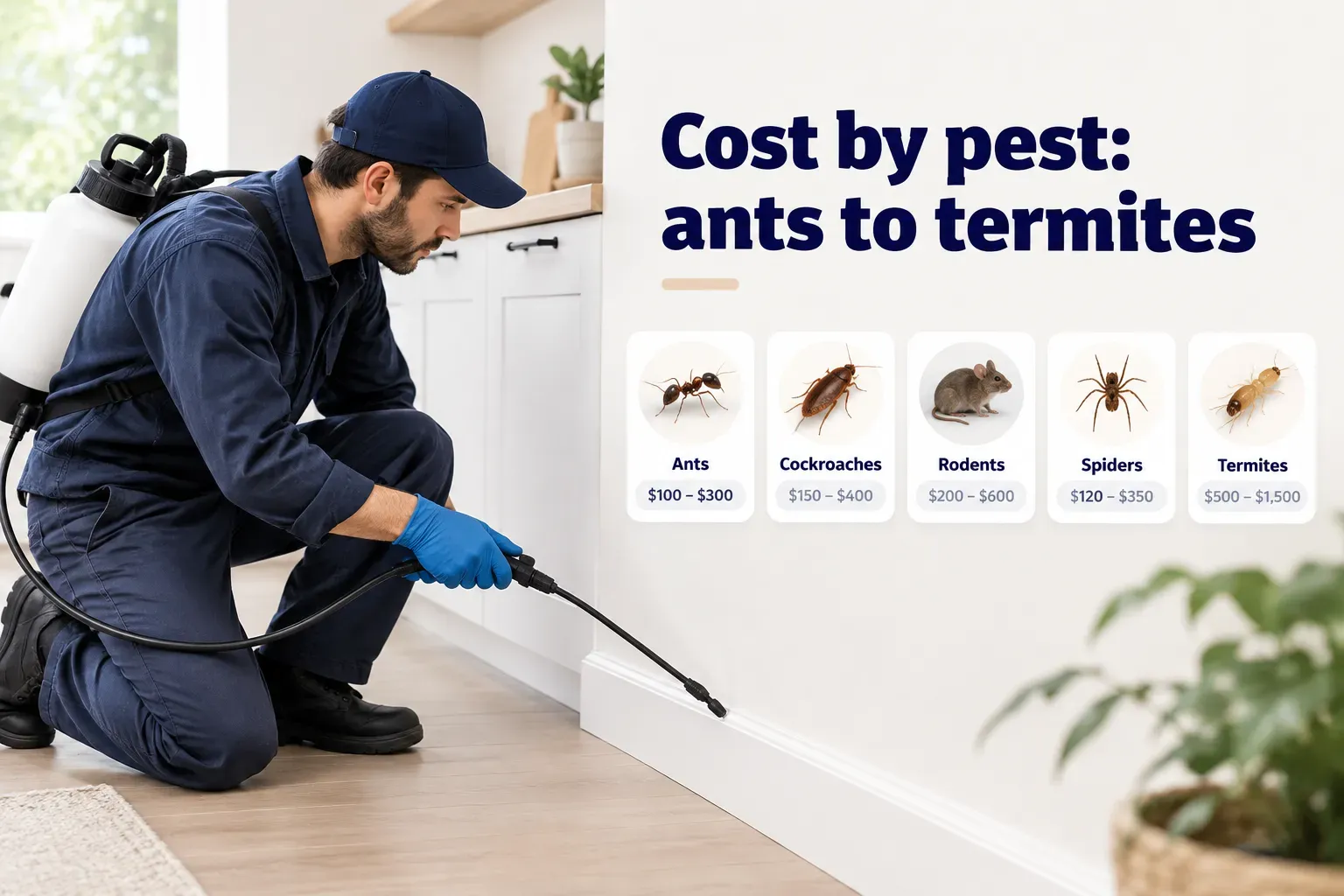
The pest itself sets the price floor. Ants and roaches sit at the bottom of the range, termites and wildlife at the top, and bed bugs scale with how many rooms they’ve reached.
| Pest | Typical treatment cost | Common methods | Often billed separately |
|---|---|---|---|
| Ants | $100-$300 | Gel bait, perimeter spray, nest treatment | Moisture repair for carpenter ants, damaged wood replacement |
| Cockroaches | $100-$400 | Gel bait, insect growth regulators, crack-and-crevice spray | Deep cleaning, sanitation, appliance pull-outs |
| Mice and rats | $200-$600 plus exclusion | Traps, tamper-resistant bait stations, monitoring | Entry-point sealing, droppings cleanup, insulation replacement |
| Termites | $500-$2,500+ | Bait stations, liquid soil treatment, fumigation | Structural repairs, wood replacement, annual monitoring |
| Bed bugs | $500-$1,500 per room | Heat treatment, chemical treatment over 2-3 visits | Mattress encasements, furniture replacement, laundering |
| Wildlife (bats, raccoons) | $200-$1,500 including permits | One-way exclusion doors, live trapping, removal | Dead-animal removal, guano cleanup, roof or soffit repair |
Look closely at that last column. Treatment cost and total cost are not the same thing. Entry-point sealing, sanitation, dead-animal removal, contaminated-material cleanup (like rodent-soiled attic insulation or bat guano), structural repairs, and replacing infested belongings are usually quoted separately.
A $400 rodent treatment can become a $2,500 project once you add attic insulation removal and full pest exclusion.
Ask for these line items upfront so the second invoice doesn’t blindside you.
Insurance rarely helps here. Most homeowners insurance policies exclude termite damage and ongoing pest damage, treating it as a preventable maintenance issue rather than a sudden covered loss.
That puts structural pest damage squarely on the homeowner. Termites alone cause an estimated $5 billion in property damage in the U.S. each year, according to the National Pest Management Association.
Early treatment keeps the problem, and the bill, localized. Waiting is the most expensive pest control strategy there is.
Consider a small roach problem under the kitchen sink. Treated in the first few weeks, it’s often a single $150-$250 visit with gel bait.
Left alone for six months, the same population can spread through cabinets, appliances, wall voids, and neighboring rooms, requiring multiple visits, deep cleaning, and in extreme multi-unit cases… whole-structure treatment.
The same logic applies to every pest on this list.
Small and early is cheap. Large and late is not.
How to compare quotes without overpaying
The cheapest quote and the best-value quote are rarely the same. A $150 spray that fails and needs a second company at $350 costs more than a $275 treatment with a 90-day service guarantee.
Comparing quotes well comes down to knowing what should be on the page, spotting what’s missing, and keeping everything in one place so you’re comparing like with like.
What a complete estimate should include
A professional estimate should read like a scope of work, not a sticky note. Before you sign, make sure it clearly states:
- Treatment area: Interior, exterior, attic, crawl space, garage, or yard. If the shed isn’t listed, assume it isn’t covered.
- Target pest: The specific species identified, such as German cockroach or subterranean termite, not just “insects.”
- Number of visits: An exact count, including any follow-up visit and when it’s scheduled.
- Active ingredients: The products being applied, so you can research them or flag allergies.
- Re-entry timing: How long people and pets should stay out of treated areas, often 2-4 hours for sprays and much longer for fumigation.
- Preparation instructions: What you need to do beforehand, like clearing cabinets, laundering bedding, or moving furniture from walls.
- Pesticide safety precautions: Specific guidance for pets, young children, and aquariums, which are highly sensitive to many insecticides.
- Nonchemical alternatives: Whether exclusion, trapping, heat, or sanitation could reduce or replace chemical use.
- Warranty or re-treatment terms: How long the guarantee lasts, what it covers, and whether re-treatments are free.
Red flags in a pest control quote
Some quotes are incomplete by accident. Others are incomplete on purpose. Watch for these warning signs:
- No written scope. A verbal price with nothing on paper leaves you no recourse if the job falls short.
- Vague “as needed” visit counts. Open-ended visit language can turn a quoted job into an indefinite billing cycle.
- Same-day urgency tactics. “This price is only good if you sign today” is a sales technique, not a pest emergency. Termites that have been there for two years won’t collapse your house this weekend.
- No mention of a guarantee. Reputable companies stand behind their work with defined re-treatment terms.
- Long contracts with steep cancellation fees. Auto-renewing 12- or 24-month agreements can lock you into service you no longer need.
- No license number. Any company applying pesticides commercially should provide its state license number on request.
DIY vs. professional treatment
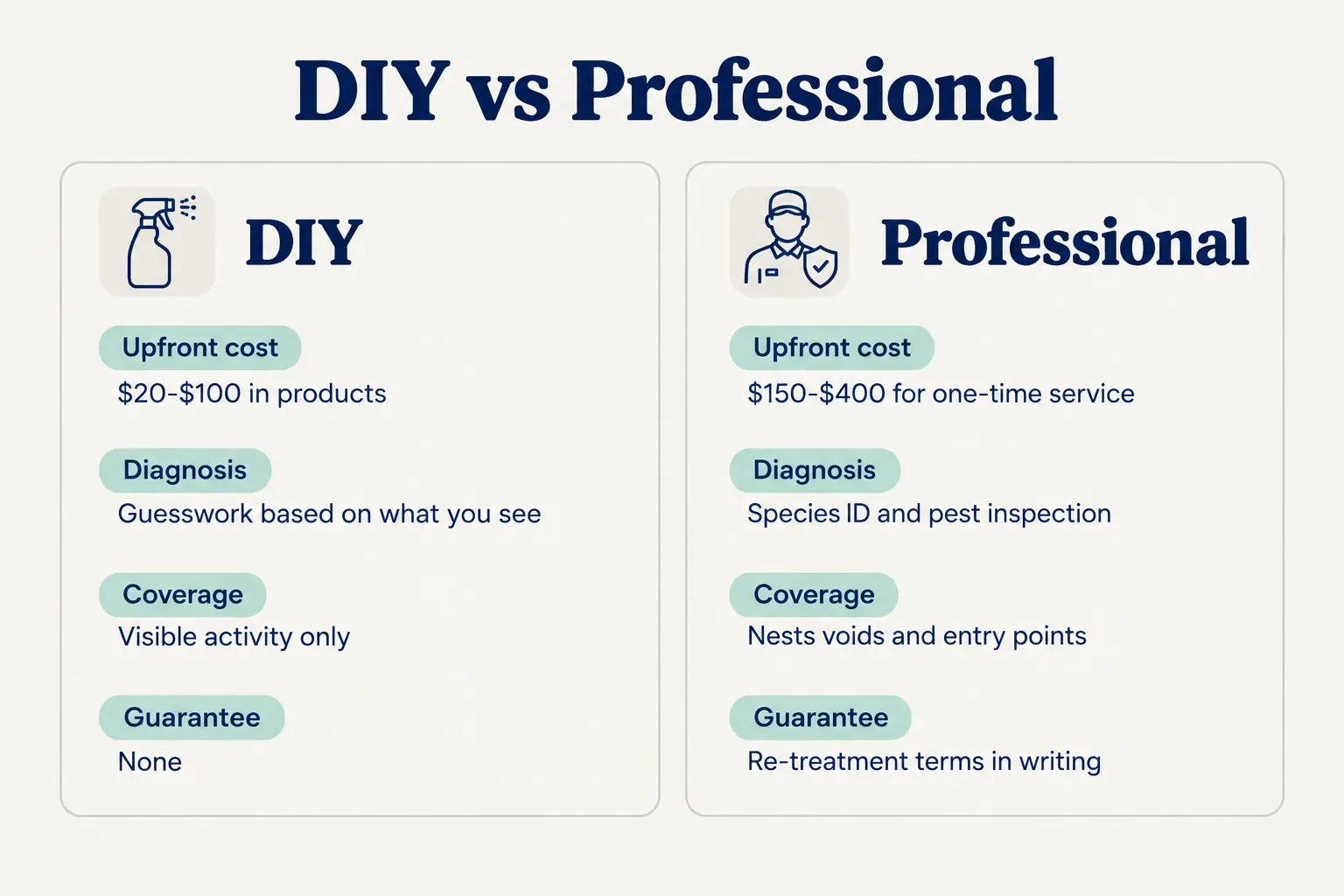
DIY pest treatment looks cheap on the shelf. Sprays, baits, and traps typically run $20-$100 upfront, and for a handful of ants or a single mouse, that’s often enough.
But a failed DIY attempt has real costs:
- Reinfestation: Over-the-counter sprays often kill visible insects while missing the nest or colony, so activity returns within weeks.
- Scattering the problem: Repellent sprays can cause some ant species and roaches to scatter and form new colonies, making a later professional job harder.
- Lost time: Weeks of trial and error let infestation severity grow quietly.
- The professional visit anyway: Many homeowners end up paying for a full treatment after spending $50-$150 on products that didn’t work.
- Skipped diagnostics: DIY approaches skip inspection, monitoring, and exclusion, which are the parts that keep pests from coming back.
The smartest long-term approach, whether DIY or professional, is integrated pest management (IPM). Recommended by the EPA, IPM targets the conditions pests need: food, water, shelter, moisture, and entry points.
Fixing a leaky pipe, sealing gaps around utility lines, and moving firewood away from the foundation cost little, but they cut repeat-treatment bills for years.
Keeping multiple quotes organized
For anything beyond a basic one-time job, get 2-3 quotes. Termites, bed bugs, rodents with exclusion work, and wildlife removal all have enough price variation to justify the extra effort.
A few habits make comparison easier:
- Ask every provider the same questions. Same pest, same areas, same visit count, so the numbers are actually comparable.
- Get everything in writing. Verbal promises about free follow-ups or guarantees disappear when you need them.
- Use one place to track it all. Frendex is a practical option here: you can find verified local pest control providers on a live map, compare prices and ratings from completed bookings, and message providers in-app to confirm scope before booking. Every quote and confirmation stays in one thread instead of scattered across texts, emails, and voicemails.
- Compare scope before price. Line up treatment areas, methods, and guarantee terms side by side, then look at the totals.
The one number that matters most
It isn’t the price. It’s the scope.
Every number in this guide only makes sense once you know exactly what’s being treated, how, how often, and what happens if the pests return.
Here’s the decision in plain terms. If you have a single, localized pest problem with no obvious moisture issues or entry points, a one-time treatment at $150-$400 is usually enough.
Don’t let anyone talk you into a year-long contract for one ant trail.
But if you have a history of recurring activity, standing moisture, gaps around the foundation, or seasonal invasions every spring, the math flips.
A recurring pest control plan or proper pest exclusion pays for itself faster than repeated one-time calls, often within the first year.
Specialty jobs follow their own rules. Termites, bed bugs, and wildlife deserve a professional inspection, multiple written quotes, and a close look at treatment method, because method is where the biggest price differences hide.
The cheapest quote is only a good deal if its scope matches what you actually need.
So here’s your next step. Before you agree to anything, request a written, itemized quote that lists the target pest, treatment areas, number of visits, products used, and guarantee terms.
Compare two or three of them side by side.
Then, and only then, look at the price.
A number without a scope tells you nothing.
Frequently asked questions
How much does pest control cost for a 1,500-square-foot house?
A one-time general pest treatment for a 1,500-square-foot house typically costs $150-$300. That sits in the lower half of the national $150-$400 range because smaller homes take less product and labor. If you choose a recurring plan instead, expect $100-$200 per quarterly visit or around $40-$60 per monthly visit, plus a $175-$350 setup fee. Attics, crawl spaces, or detached structures will push those figures higher.
Is it cheaper to get monthly pest control or pay for one treatment?
A one-time treatment is cheaper if your problem is single and localized. At $150-$400, it costs far less than a year of monthly service, which runs $480-$840 in visits alone before the setup fee. Recurring plans win when pests keep coming back. If you're calling for one-time service two or three times a year, a quarterly plan with free re-treatments ($575-$1,350 in year one) usually costs less and prevents problems instead of reacting to them.
How much does an exterminator cost for roaches?
Roach treatment typically costs $100-$400. A light infestation caught early often clears with a single gel bait visit near the low end. Heavy German cockroach infestations cost more because they spread into cabinets, appliances, and wall voids, often requiring 2-4 visits. Severity and access drive almost all of the price difference.
How much does it cost to get rid of mice or rats?
Rodent removal usually costs $200-$600 for trapping, bait stations, and monitoring. Exclusion work is billed on top of that. Entry-point sealing can add a few hundred dollars for a simple home or over $1,000 when crawl spaces, rooflines, or attics need extensive work. Contaminated insulation cleanup is a separate cost again. Skipping exclusion is the most common reason rodents return.
How much does termite treatment cost?
Termite treatment typically costs $500-$2,500 or more. Liquid trenching is often priced at $3-$16 per linear foot of foundation. The method drives most of the spread. Bait stations sit toward the lower-to-middle range but require ongoing monitoring fees. Liquid soil treatments land in the middle to upper range. Whole-structure fumigation for drywood termites often exceeds $2,500 for larger homes.
Is professional pest control worth the money?
Professional pest control is worth it for termites, bed bugs, rodents, wildlife, and any infestation that DIY products haven't solved. These pests cause structural damage or health risks that cost far more than treatment. For a few ants or a single spider, DIY at $20-$100 is often enough. The value of hiring a professional comes from accurate identification, targeted treatment, and a written guarantee.
Need a hand with something?
The Frendex map shows you who is available near you, in real time.
Get the app free Get the app freeFree, no card needed
Related articles
Boiler maintenance: A homeowner's safety and service guide
Learn which boiler checks are safe to DIY, which need a pro, and the warning signs that mean call for help now. A homeowner's framework for 2026.
Rodent control: A homeowner's step-by-step guide
Skip the trap-and-hope cycle. This 8-step IPM method shows why sealing entry points matters more than traps. See the full sequence inside.
Emergency electrician: What to do before help arrives
Smell burning or see sparks? Get the 3-call decision tree (911, utility, or electrician) plus a prep checklist for faster, safer help.