Emergency electrician: What to do before help arrives
By Kiss János 16 min read
Is this really an electrical emergency?
It’s 11 p.m. You smell something hot and plasticky, trace it to the hallway, and see a faint orange flicker behind the outlet cover.
Your heart rate spikes.
Do you call 911? The power company? Google “emergency electrician near me” and hope for the best?
That moment of hesitation is the real danger.
There are only three correct responses to an electrical problem: call 911, call your electric utility, or call an emergency electrician. Each one handles a different kind of risk, and picking the wrong one can cost you critical minutes.
A utility crew won’t fix a scorched outlet. An electrician can’t de-energize a downed street line. And neither will put out a fire.
This guide gives you a fast decision tree for choosing the right call. It also includes a scenario-by-scenario breakdown of the most common electrical emergencies and a call-prep checklist so the professional who shows up can work quickly and safely.
Read it now, while nothing is burning.
You’ll think more clearly later.
911, Utility company, or electrician?
Most people default to calling whoever comes to mind first. That instinct is understandable, but electrical emergency safety depends on matching the problem to the responder who actually controls the hazard.
Use this breakdown as your decision shortcut. If a situation fits more than one category, always choose the more urgent option first.
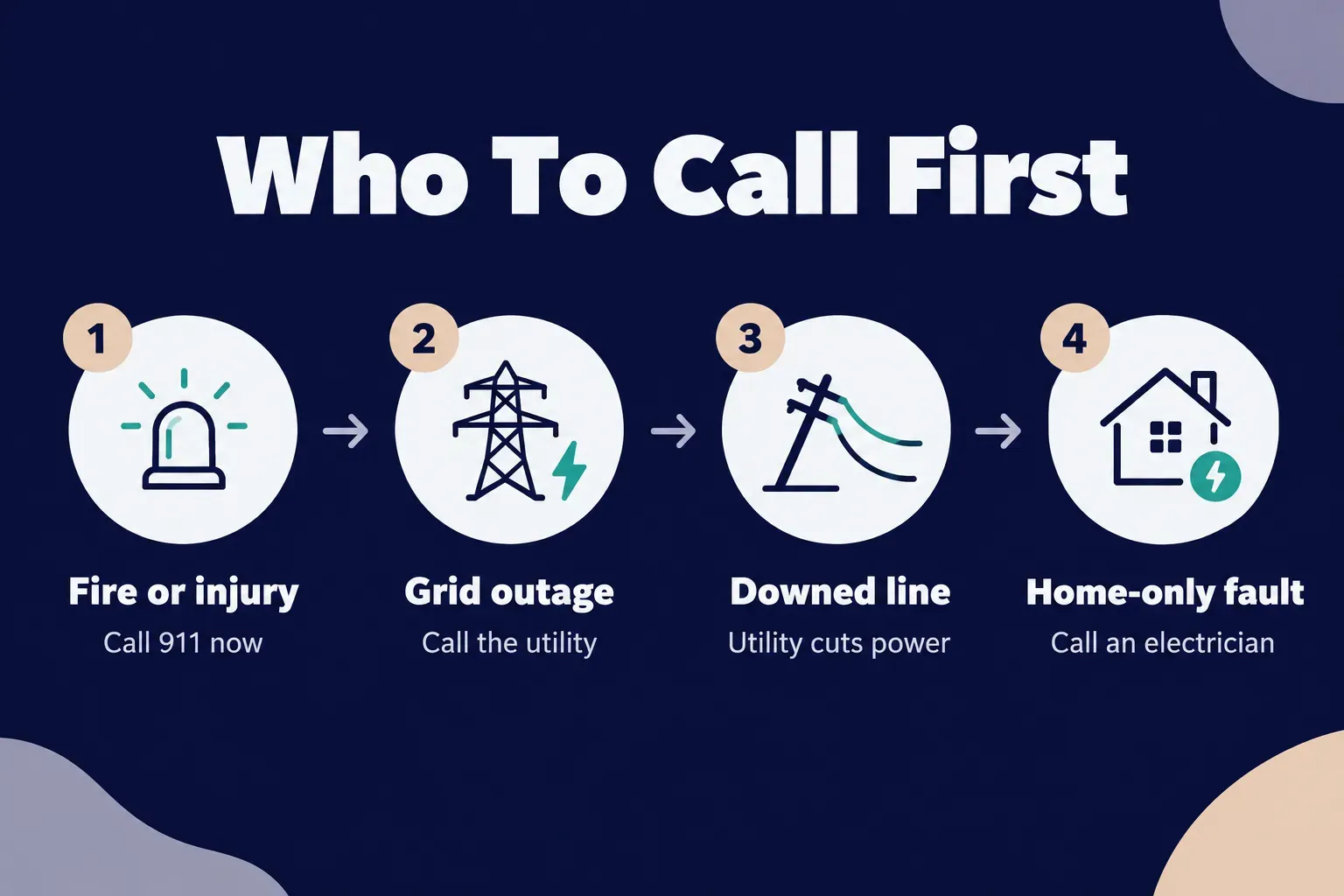
- Call 911 immediately for visible flames. If an outlet, appliance, panel, or wall is on fire, get everyone out and call from outside. Never throw water on an electrical fire, because water conducts current and can spread the hazard.
- Call 911 if a person is in contact with live current. Someone frozen against an appliance, collapsed near exposed wiring, or unresponsive after a shock needs emergency medical help. Do not touch them until the power source is confirmed off.
- Call 911 if a downed line is touching a person or vehicle. Anyone inside a car with a line on it should stay put unless the vehicle catches fire. Emergency services will coordinate with the utility to cut power.
- Call the electric utility for neighborhood-wide outages. If your street lights are dark and your neighbors have no power either, the problem is on the grid side. An electrician can’t fix it, and calling one wastes your money and their time.
- Call the utility for downed lines with no fire or injury risk. A line lying in a field or across an empty road still needs urgent attention, but the utility owns those lines and is the only party authorized to de-energize them.
- Call the utility for damage to the meter box or service drop. The service drop (the overhead cable running from the pole to your house) and the meter typically belong to the utility. If a storm rips the cable loose or a tree crushes the meter, start there.
- Call an emergency electrician for isolated sparking or electrical arcing. One outlet throwing sparks, a switch crackling, or visible arcing inside a fixture is a property-level fault. A licensed electrician is the right responder once any immediate fire risk is controlled.
- Call an electrician for a burning odor from an outlet or panel. That smell usually means insulation is overheating, often from a loose connection or overloaded circuit. It can precede a fire by minutes or by days, and there’s no way to know which.
- Call an electrician for a partial power outage confined to your property. If half your house is dark but the neighbors are fine, the fault is likely in your electrical panel, a failing breaker, or a loose neutral connection.
- Call an electrician for exposed wiring or repeated breaker trips. Damaged insulation, wires hanging from a ceiling, or a circuit breaker that won’t stay on all point to faults inside your home’s system.
Some situations overlap, and the order of calls matters.
A downed power line on private property is the classic example. The line may have damaged your mast, weatherhead, or panel, which is an electrician’s job to repair.
But the utility must de-energize the line first, because no qualified electrician will work near a live service conductor they don’t control.
Storm damage often works the same way.
Call the utility to make the line safe, then call an electrician to inspect and repair everything on your side of the meter. Many utilities won’t reconnect service until a licensed electrician has repaired damaged customer-owned equipment and, in some areas, passed a local inspection.
Electrical emergencies by scenario
Here’s a counterintuitive truth: the scariest-looking electrical events aren’t always the most dangerous ones.
A loud pop and a flash when you plug in a vacuum is often harmless. A faint warm smell from an outlet nobody is using can be far worse.
The scenarios below help you tell the difference.
Fire and shock risks
Sparking or burning outlets
A brief, small blue spark when you insert or remove a plug is usually normal. It’s the current jumping the tiny gap as the connection forms, and it disappears in a fraction of a second.
No smell, no marks, no repeat.
That’s fine.
What isn’t fine is repeated arcing, scorch marks around the receptacle, a melted faceplate, or sparks coming from an outlet with nothing plugged into it.
Those are signs of an arc fault, where current jumps across a damaged or loose connection and generates intense heat. Arc faults are a leading cause of residential electrical fires, which is why modern codes require arc-fault circuit interrupters (AFCIs) in many rooms.
If you see these signs, stop using the outlet and unplug anything connected to it, but only if you can do so without touching scorched parts. Then switch off the breaker for that circuit at your electrical panel.
If you smell burning but see no flames, keep the circuit off and call an emergency electrician.
If there are flames or smoke, get out and call 911.
Downed power lines
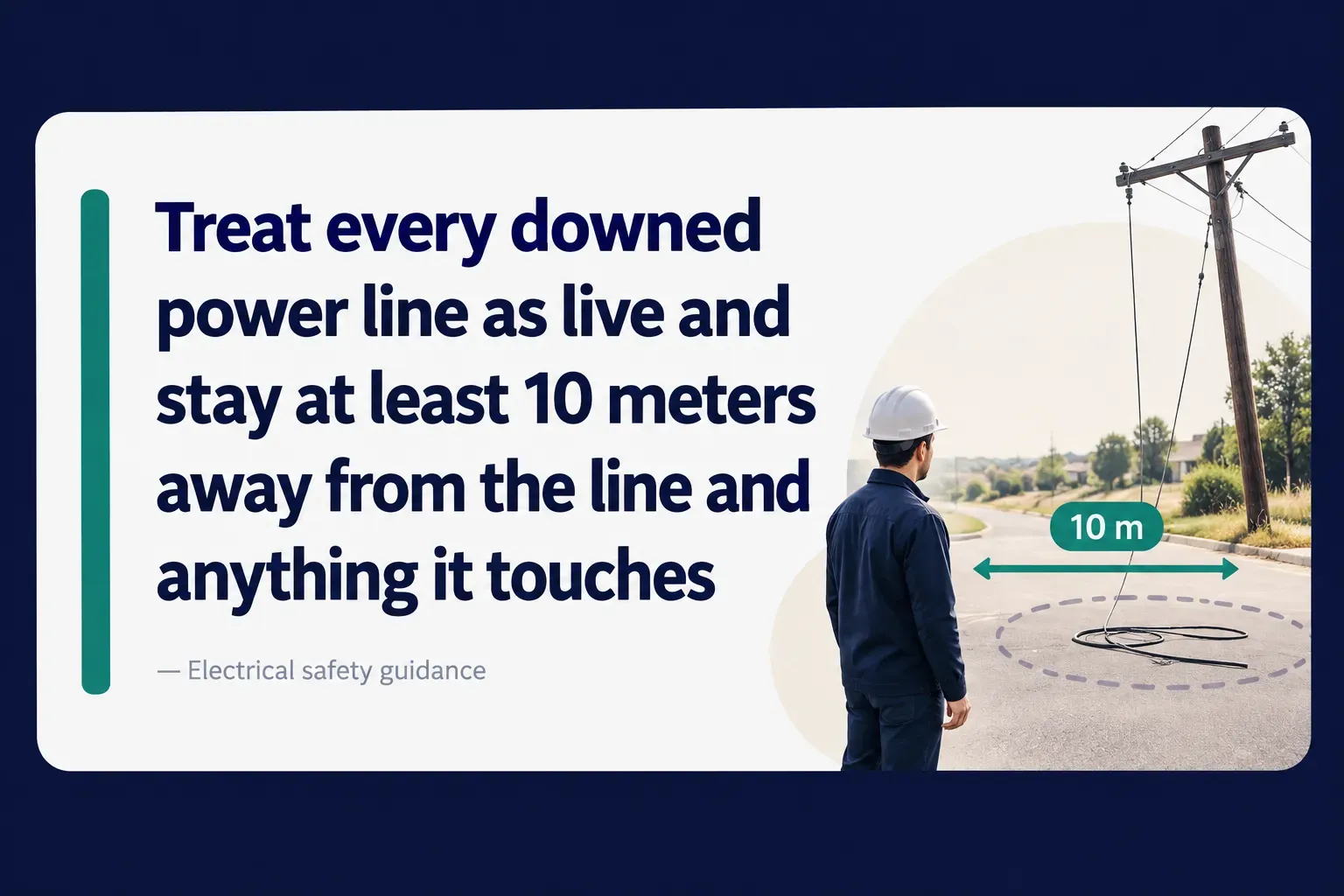
Treat every downed power line as live.
Always.
Lines can look dead, lie silently on the ground, and still carry thousands of volts. Some lines re-energize automatically when the utility’s equipment attempts to restore power.
Stay back at least 10 meters (about 33 feet).
Electricity can spread through wet ground in a pattern called step potential, meaning the voltage changes from one foot to the other as you walk. If you’re too close, shuffle away with small steps and keep your feet together.
Do not touch the line, any vehicle it may be touching, fences, or nearby standing water. Never try to move a line with a broom, branch, or “non-conductive” tool.
Call 911 if anyone is in danger, otherwise call the utility right away.
Electrical shock
Your instinct will be to grab the person.
Don’t.
If they’re still in contact with the source, the current can pass through you as well, and now there are two victims instead of one.
Effective electrical shock first aid starts with cutting the power. Switch off the breaker or main disconnect, or unplug the appliance if you can reach the plug safely.
Only once the source is confirmed off or disconnected should you touch the person. Then call 911, even if they seem fine.
Electrical injuries can cause internal burns and heart rhythm problems that don’t show up for hours.
Power and water problems
Partial or full power loss
Look outside first.
Are the neighbors’ lights on? Is the streetlight working? This 20-second check tells you most of what you need to know.
A neighborhood-wide outage points to the utility.
Report it and wait.
But power loss confined to one property, especially a partial power outage where some rooms work and others don’t, suggests a problem with your panel, a breaker, the wiring, or the service connection. Flickering lights combined with some appliances running weakly can indicate a loose neutral, which can damage electronics and overheat wiring.
That one deserves an emergency call.
Breakers that keep tripping
A circuit breaker trips for a reason.
It’s a safety device doing exactly what it was designed to do: cutting power before wires overheat. One trip after running a space heater and a hair dryer on the same circuit is usually just an overload.
One cautious reset is reasonable. Unplug the devices on that circuit, push the breaker fully to “off,” then back to “on.” If it holds, plug devices back in gradually.
If it trips again immediately, or trips with nothing connected, stop.
Repeatedly re-energizing a circuit with a short or ground fault is like restarting an engine that’s out of oil. Each attempt can do more damage.
Leave the breaker off and call an electrician.
Water near electrical equipment
Water and electricity are a dangerous pairing, and flooding creates some of the most hazardous situations a homeowner can face. If your basement is flooded, do not step into the water to reach the panel.
The water itself may be energized.
Shut off the main only if you can reach it from a dry, safe location while standing on a dry surface. If the panel is wet, in standing water, or you’d have to wade to reach it, stay out and call the utility to disconnect power at the meter.
For storm-damaged outdoor outlets, switch off their circuit from the panel if it’s safe to do so and keep people and pets away.
Any equipment that has been submerged needs inspection by a qualified electrician before it’s used again.
Getting ready for the electrician
The first 10 minutes after an emergency electrician arrives often determine how fast you get safe power back. An electrician who knows exactly what happened, where, and how to reach it can start diagnosing immediately instead of spending half an hour asking questions in the dark.
What to tell them on the phone
You don’t need technical vocabulary.
You need clear observations.
Gather these details before you call, but never open panels, remove outlet covers, or poke at live equipment to get them.
- Exact location of the problem. “Kitchen outlet to the left of the stove” is far more useful than “somewhere in the kitchen.” Mention the floor and room, and whether the panel is in a garage, basement, or closet.
- Symptoms you observed. Describe what you saw, heard, and smelled: sparks, buzzing, a burning odor from an outlet, flickering lights, warm faceplates, or a breaker that won’t reset.
- How long it’s been happening. A problem that started 20 minutes ago during a storm is different from flickering that’s been getting worse for three weeks.
- Current urgency level. Tell them whether the circuit is now off, whether power is out to the whole house, and whether anyone is at risk (elderly residents, medical equipment, no heat in winter).
- Access instructions. Share gate codes, parking details, pets on the property, and where the electrical panel is located so they can get to work quickly.
Photos can help an electrician prepare the right parts. Take them only from a safe distance, and never photograph smoking, actively arcing, or submerged equipment up close.
No picture is worth a shock.
Checking their qualifications
Panic makes people hire the first number that answers.
That’s understandable… and it’s how homeowners end up with unlicensed workers doing dangerous jobs at premium rates.
Even in an emergency, a few quick checks take less than five minutes.
- License status. Confirm the person is a licensed electrician in your state or region. Most licensing boards offer online lookups by name or license number, and a legitimate pro will share their number without hesitation.
- Insurance. Ask about liability insurance and, for companies with employees, workers’ compensation. If something goes wrong in your home, you don’t want to be the one paying for it.
- Emergency callout experience. Not every electrician handles after-hours work. Ask whether they regularly respond to emergencies like yours, such as panel failures, storm damage, or flood-affected circuits.
- Verified reviews and credentials. Platforms like Frendex make this faster by showing verified badges, work photos, and ratings from completed bookings. You can check those signals, then book an electrician with live availability on a map instead of calling down a list of numbers at midnight.
- Clear pricing terms. Ask how they charge for emergency callouts (flat callout fee, hourly rate, or both) before they arrive. A reputable pro explains this upfront.
Renters and landlords: Extra steps
Renters face a different problem.
The wiring isn’t theirs, and unauthorized repairs can violate a lease, void insurance coverage, or create legal liability. Landlords, meanwhile, usually carry the legal duty to keep electrical systems safe.
- Renters: document the issue. Take photos from a safe distance and note the date, time, and symptoms. This record protects you if the problem worsens or a dispute arises later.
- Renters: notify the property manager immediately. Use the emergency maintenance line if there is one, then follow up in writing by text or email so there’s a timestamp. If there’s fire or injury risk, call 911 first and notify the landlord second.
- Renters: avoid unauthorized electrical repairs. Flipping a breaker off for safety is fine. Replacing outlets, rewiring fixtures, or hiring your own electrician without permission usually isn’t, unless your lease or local law allows it when the landlord is unreachable.
- Landlords: respond fast and keep records. Dispatch a qualified electrician promptly, keep invoices and inspection notes, and communicate expected timelines to tenants. Many jurisdictions treat loss of electrical service or active hazards as urgent habitability issues.
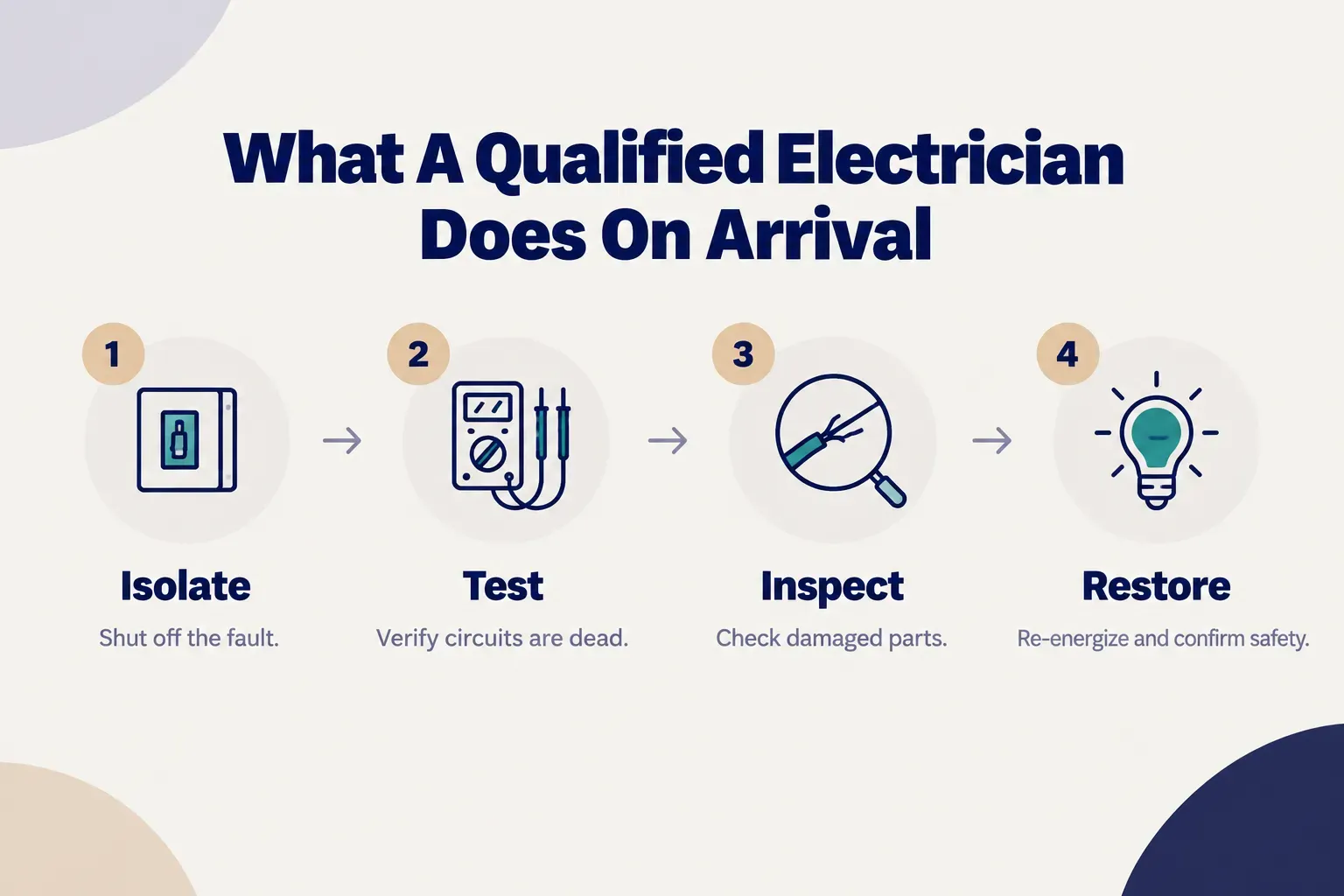
Once a qualified electrician arrives, they should follow a predictable safety sequence. If they skip steps or seem rushed to “just flip it back on,” ask questions.
- Isolate the fault. They’ll shut off the affected circuit, or the main disconnect if needed, so no one is working near live conductors.
- Test for energized conductors. A proper electrician verifies with a meter or tester that circuits are actually dead before touching them. Breaker labels are often wrong.
- Inspect damaged components. Expect them to check outlets, wiring, connections, breakers, and the panel for heat damage, corrosion, or water intrusion.
- Confirm safe restoration. Before leaving, they should re-energize circuits, test them under load, and explain what failed, what was fixed, and whether follow-up work is needed.
Preventing the next emergency
Most electrical emergencies announce themselves weeks in advance.
The warm outlet, the plug that falls out, the breaker that trips “only sometimes.” Catch these early and you may never need an emergency electrician at 2 a.m.
Each tip below connects back to a scenario from earlier in this guide, so you can see exactly which emergency it helps prevent.
- Watch for warm or discolored outlets. An outlet that feels warm or shows brown or yellow staining is overheating, usually from a loose connection. Addressing it early prevents the sparking and burning outlet scenario entirely.
- Replace outlets with loose-fitting plugs. When plugs slide out easily, the contacts inside have worn down, which creates poor connections and heat. Worn receptacles are a common source of arc faults.
- Stop overloading power strips. Daisy-chained strips feeding heaters, kettles, and microwaves push circuits past their rating. This is the most common cause of breakers that keep tripping.
- Retire frayed or damaged cords. Cracked insulation exposes conductors, creating both shock and fire risk. Never repair cords with tape, replace them.
- Add GFCI protection where it’s missing. A ground fault circuit interrupter cuts power in milliseconds when current leaks to ground, such as through water or a person. Install GFCIs in kitchens, bathrooms, garages, laundry areas, and outdoor outlets to reduce the danger from water near electrical equipment and electrical shock.
- Consider arc-fault protection. An arc-fault circuit interrupter detects dangerous arcing patterns that ordinary breakers miss. Ask an electrician whether your bedrooms and living areas have it, especially in older homes.
- Label your panel. Clear labels let you shut off the right circuit in seconds during an emergency instead of guessing in the dark. Do it on a calm Saturday, with a helper calling out which lights go off.
- Schedule a periodic inspection. Homes over 20 years old, homes that have had additions, and any property after storm or flood damage benefit from a professional inspection. It’s the best way to catch hidden partial power outage causes like loose neutrals and corroded connections.
The bottom line
The worst time to search for an electrician is when you’re standing in a dark hallway smelling smoke. Panic makes people choose badly, and it burns minutes you can’t spare.
So do one thing today.
Save a trusted emergency electrician’s number, or install a booking app that shows verified pros, before you ever need it. Check their license and reviews now, while you’re calm and have time to compare.
And memorize this shortcut, because it covers nearly every scenario in this guide:
Fire or injury means 911. A widespread outage means the utility. Everything else isolated to your property means an electrician.
Three calls.
One decision.
Make it fast, make it right, and let the professionals handle the live wires.
Frequently asked questions
What is considered an electrical emergency?
An electrical emergency is any situation where electricity poses an immediate risk of fire, shock, or serious property damage. Examples include sparking or burning outlets, a burning smell from a panel, exposed wiring, downed power lines, water contacting electrical equipment, and power loss affecting only your property. Visible fire or injury means calling 911 first.
How much does an emergency electrician cost?
Emergency electrician callouts typically cost more than standard service rates. Pricing varies based on the time of day, whether it's a weekend or holiday, your location, and the severity and complexity of the fault. Many electricians charge a callout fee plus hourly labor and parts, so ask how they bill before they arrive.
Can an electrician come out in the middle of the night?
Yes, many electricians offer 24/7 emergency service, including overnight callouts. Availability depends on your area and the provider, so it's worth confirming after-hours coverage before you need it. Booking platforms that show live availability can help you find someone who is actually on call right now, rather than leaving voicemails.
What should I do if my electrical outlet is sparking?
Stop using the outlet and turn off its circuit breaker at the electrical panel. Unplug connected devices only if you can do so without touching scorched or melted parts. If there's smoke or flames, leave the home and call 911. Otherwise, keep the circuit off and call an emergency electrician.
Is a tripped breaker an emergency?
A single tripped breaker is usually not an emergency, but repeated tripping is. One trip often means a simple overload, and a single cautious reset after unplugging devices is reasonable. If the breaker trips again immediately, trips with nothing plugged in, or shows signs of heat or a burning smell, leave it off and call an electrician.
Who do I call first for a power outage: The utility company or an electrician?
Call the utility company first if the outage affects your neighbors or the whole street. Call an electrician if the power loss is limited to your property, especially if only some rooms or circuits are dead. If a downed line has damaged your home's service connection, call the utility to de-energize it, then call an electrician for repairs.
Need a hand with something?
The Frendex map shows you who is available near you, in real time.
Get the app free Get the app freeFree, no card needed
Related articles

Pest control cost in 2026: What you'll really pay
Real 2026 pricing for one-time visits, recurring plans, and termite or bed bug jobs. Learn what drives $95 vs $1,400 quotes before you sign.
Boiler maintenance: A homeowner's safety and service guide
Learn which boiler checks are safe to DIY, which need a pro, and the warning signs that mean call for help now. A homeowner's framework for 2026.

Rodent control: A homeowner's step-by-step guide
Skip the trap-and-hope cycle. This 8-step IPM method shows why sealing entry points matters more than traps. See the full sequence inside.