Boiler maintenance: A homeowner's safety and service guide
By Kiss János 15 min read
Why boiler maintenance isn’t just an annual check
Most homeowners think boiler maintenance means one thing: booking a service once a year and forgetting about it until next winter.
That habit is better than nothing.
But it leaves eleven months where small problems can quietly grow into expensive ones.
A 3-year-old combi boiler in a small flat and a 20-year-old oil boiler heating a large family home do not need the same care. Age, fuel type, water hardness, and how hard the system works all change what preventive maintenance should look like.
The annual service is the anchor.
It isn’t the whole routine.
This guide draws a clear line between three categories:
Self-checks you can safely do yourself, professional-only tasks that legally or practically require a licensed technician, and emergency situations where the right move is to stop, leave, and call for help.
Knowing which category a problem falls into is the single most useful skill a boiler owner can have.
A quick reality check before we start.
Service intervals, licensing rules, and landlord duties vary by boiler type, fuel source, and local regulation, so treat this guide as a framework and confirm the specifics with your manufacturer and local authority.
And while good maintenance supports safety and boiler efficiency, it cannot guarantee lower bills or prevent every breakdown.
Parts wear out.
Weather is unpredictable.
What maintenance does is shift the odds firmly in your favour.
That’s the realistic promise, and it’s worth keeping.
Maintenance, servicing, inspection or repair?
Ask four heating engineers what “boiler maintenance” means and you may get four slightly different answers. The terms overlap in everyday speech, but they mean different things on an invoice, in a warranty, and in the eyes of a regulator.
Getting them straight saves money and confusion.
The four terms homeowners confuse
Maintenance is the ongoing upkeep of the system. It includes the small, regular things like checking boiler pressure, watching for leaks, and radiator bleeding, plus the professional work that keeps everything running.
Think of it as the umbrella term.
Servicing is a scheduled professional check-up, usually annual. A technician inspects and cleans key components, runs a combustion analysis to confirm the fuel-to-air ratio is correct, tests safety devices, and checks for gas or water leaks.
It’s the boiler equivalent of a car’s yearly service.
Inspection is a compliance or safety review. It may be required by law, by a landlord agreement, by an insurer, or by a building code. An inspection confirms the appliance meets a standard; it doesn’t necessarily involve cleaning or tuning anything.
Repair is fixing an identified fault. A failed circulating pump, a leaking pressure relief valve, or a cracked heat exchanger all fall here. Repairs happen when something has already gone wrong.
The gas safety check deserves its own mention. In many regions it is a distinct legal requirement, separate from a general service.
In the UK, for example, landlords must arrange an annual gas safety check by a Gas Safe registered engineer and keep the record for two years under the Gas Safety (Installation and Use) Regulations 1998.
A gas safety check confirms the appliance is safe to use. A service goes further, cleaning and adjusting parts to keep the boiler working well.
Many engineers do both in one visit, but they are not the same thing.
A boiler can pass a safety check and still be running inefficiently. Safe and well-maintained are related, but they aren’t identical.
Residential vs commercial and industrial boilers
A home boiler service focuses on three areas: combustion (is fuel burning cleanly?), controls (do the thermostat and heating controls and safety cut-outs respond correctly?), and leak checks on gas, water, and flue connections.
For most households, that covers the essentials.
Commercial and industrial units are a different animal.
Their maintenance programmes typically add:
- Water treatment programmes to control scale and corrosion, often with regular chemical testing.
- Blowdown procedures that flush sediment and dissolved solids from steam boilers.
- Combustion tuning with detailed flue gas measurements to optimise fuel use across large loads.
- Pressure-vessel inspections, which in many jurisdictions must be performed by an authorised or insurance-company inspector at set intervals.
Regulatory obligations and documentation requirements scale up with boiler size and building type.
A single-family home might need nothing more than a service record in a drawer. A hospital, school, or apartment block may need certified inspections, logbooks, and permits displayed on-site.
Your boiler safety checklist
Here’s the uncomfortable truth: most dangerous boiler incidents don’t start with a dramatic failure.
They start with someone trying to fix something they shouldn’t have touched.
This checklist splits boiler tasks into three clear zones so you always know where you stand.
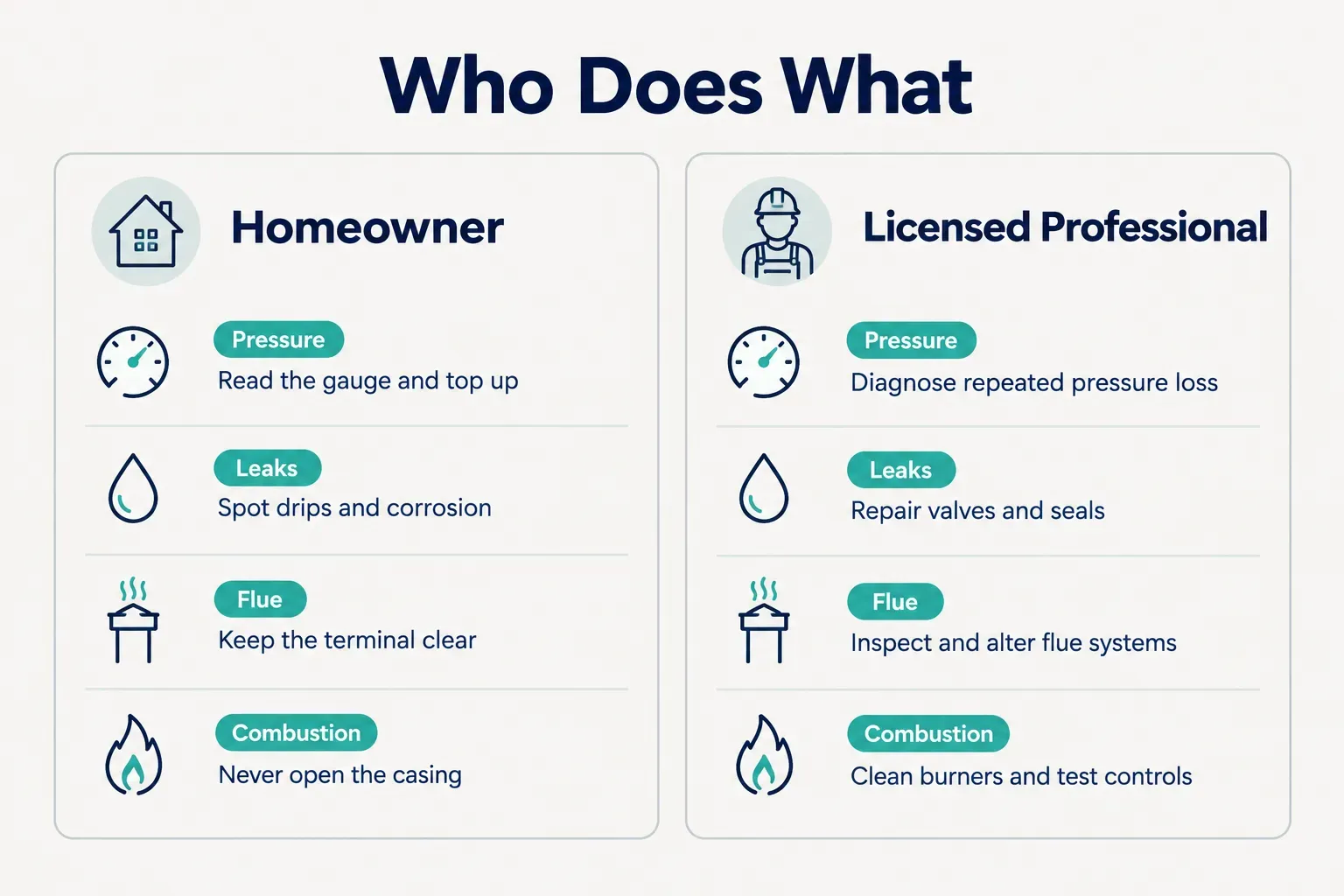
What’s safe for homeowners to check
These tasks require no tools beyond what most households already own, and none of them involve opening the boiler casing.
Do them monthly, or whenever something feels off.
- Read the pressure gauge. Check the dial or digital display when the system is cold. Most sealed systems should sit between roughly 1 and 1.5 bar (more on this in the pressure section below).
- Look for leaks and corrosion. Inspect visible pipework, valves, and the area beneath the boiler for drips, damp patches, green or white crusting on joints, or rust streaks. Catching a slow leak early is far cheaper than replacing a water-damaged floor.
- Bleed radiators. If radiators are cold at the top and warm at the bottom, trapped air is the likely cause. Use a radiator key with the heating off, then recheck boiler pressure afterward because bleeding releases water from the system.
- Clear condensate pipe blockages in mild weather. Condensing boilers drain acidic water through a plastic condensate drain pipe. If it’s blocked by debris, you can usually clear the external end; if it’s frozen, see the emergency section below.
- Keep vents and flue terminals unobstructed. Make sure nothing (plants, stored boxes, snow, bird nests) is blocking the flue outlet or ventilation grilles. A blocked flue can push exhaust gases back into your home.
- Test your carbon monoxide detector. Press the test button monthly and replace batteries at least once a year. Most alarms also have a sensor lifespan of 5 to 10 years, so check the expiry date printed on the unit.
Tasks only a licensed professional should do
Anything that involves the gas supply, combustion, or the flue belongs to a qualified engineer. In the UK that means a Gas Safe registered engineer (or OFTEC for oil); in the US and Canada, a licensed HVAC technician or gas fitter certified under state or provincial rules.
- Opening the combustion chamber. The sealed chamber keeps exhaust gases separate from your living space. Breaking that seal incorrectly can release carbon monoxide into the room.
- Adjusting gas valves. Gas pressure and the fuel-to-air ratio must be set with calibrated instruments. Guesswork here leads to incomplete combustion, soot, and CO production.
- Cleaning burners and the heat exchanger. These components need specific tools and replacement seals, and mishandling them can cause gas leaks or permanent damage.
- Testing safety controls and flame sensors. Flame failure devices, overheat thermostats, and pressure switches are the boiler’s last line of defence. Only trained technicians should test or replace them.
- Altering flue systems. A flue and vent inspection checks for correct pitch, sealed joints, and safe termination. Any modification must meet building codes and manufacturer specifications.
- Handling oil or gas line connections. Even a tiny leak at a fitting can create a fire or explosion risk.
Why the hard line? Three reasons: carbon monoxide, gas leaks, and fire.
There’s also a financial one.
Unqualified work on gas appliances is illegal in many countries, and it can void both your manufacturer warranty and your home insurance.
When to shut off and call for emergency help
Some situations aren’t maintenance problems.
They’re emergencies.
If any of the following happen, stop troubleshooting and act on safety first.
- You smell gas. Don’t touch light switches or create sparks. Open windows, turn off the gas at the meter if it’s safe, leave the property, and call your gas emergency line from outside (in the UK, the National Gas Emergency Service on 0800 111 999; in the US, your utility’s emergency number or 911).
- Your CO alarm sounds. Get everyone, including pets, into fresh air immediately. Call emergency services and don’t go back inside until a professional confirms it’s safe.
- The flame looks wrong or you see soot. A healthy gas flame is crisp blue. A yellow, orange, or lazy flame, or black sooty marks around the boiler, signal incomplete combustion and possible CO production.
- There’s a major water leak. Switch off the boiler and the water supply, then call a technician. Water near electrical components is a serious hazard.
- The boiler bangs or rumbles loudly. This is often kettling, caused by scale or overheating inside the heat exchanger. Turn the boiler off and book an urgent visit.
- The condensate pipe is frozen. Pouring warm (not boiling) water over the external pipe is a common thaw method, but if the boiler keeps locking out or you can’t reach the pipe safely, call a professional.
- The boiler keeps locking out. One reset is reasonable. Repeated lockouts mean a safety system is detecting a real fault, so stop resetting and get it diagnosed.
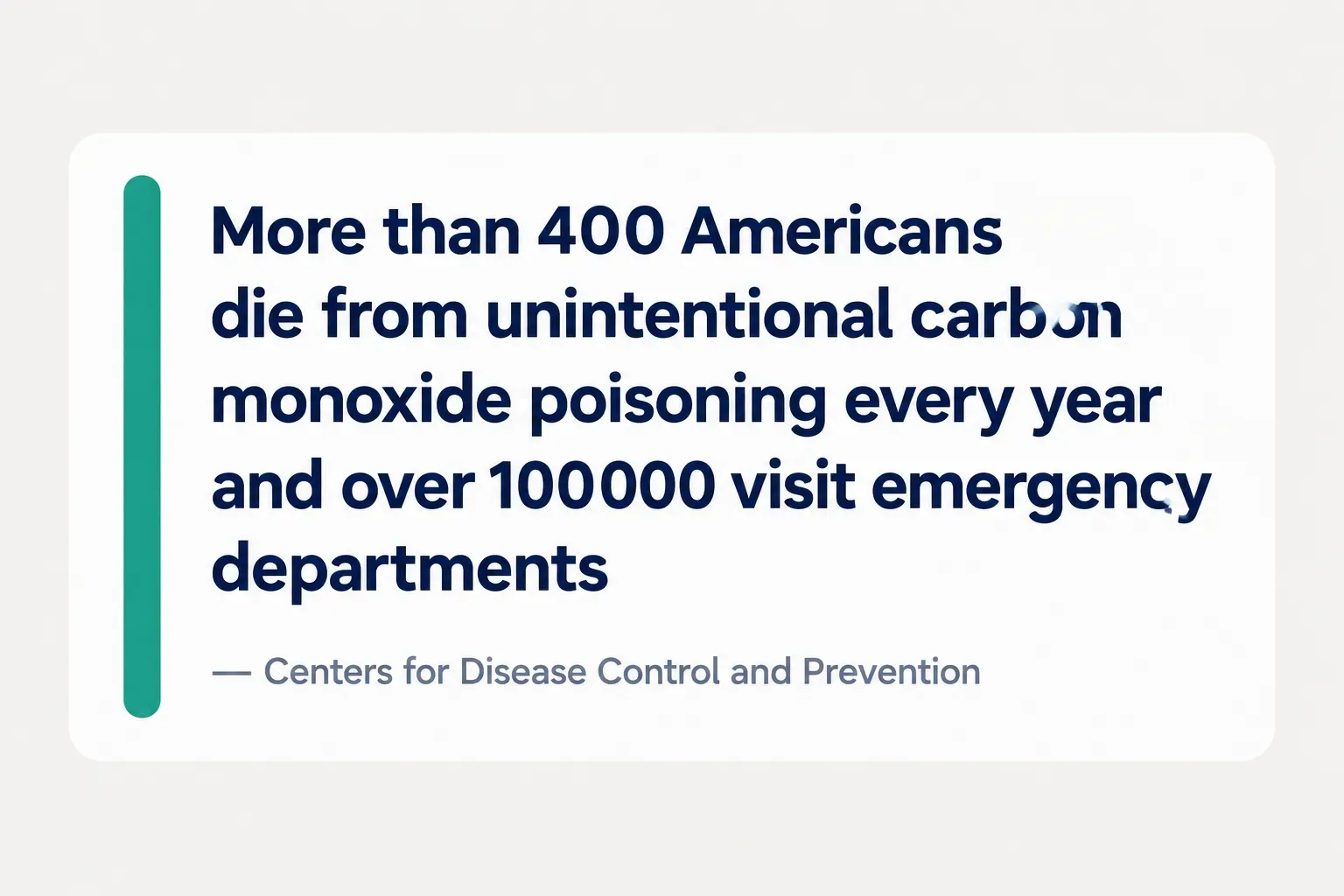
Carbon monoxide is the reason these rules exist.
It has no colour, no smell, and no taste.
How often to maintain each boiler type
“Once a year” is the answer everyone gives.
It’s also incomplete.
The correct interval depends on manufacturer instructions, fuel type, boiler age, usage intensity, and warranty terms. An oil boiler burning through a long northern winter needs more attention than an electric boiler in a mild climate.
The table below shows a practical schedule across the most common residential boiler types, as of 2026. Use it as a baseline, then adjust to your manual.
| Boiler type | Daily / visual | Monthly | Seasonal (pre-winter) | Annual | Multi-year |
|---|---|---|---|---|---|
| Gas combi | Glance at display for fault codes | Check pressure, look for leaks, test CO alarm | Bleed radiators, check condensate pipe insulation | Professional service with combustion analysis and gas safety check | Plate heat exchanger descale in hard water areas (every 3 to 5 years) |
| Gas system | Check display and cylinder temperature | Check pressure, inspect cylinder and pipework | Bleed radiators, test heating controls | Professional service plus expansion vessel check | Unvented cylinder inspection and system powerflush if sludge builds up |
| Gas conventional (regular) | Confirm pilot or ignition is normal | Inspect feed and expansion tank in loft, check for leaks | Bleed radiators, insulate loft tanks and pipes | Professional service and flue inspection | Tank and pump inspection; consider inhibitor top-up every 2 to 3 years |
| Oil | Check fuel level and listen for unusual noises | Inspect tank and fuel lines for leaks or damage | Book service before heating season, check oil filter | Professional service including nozzle and filter replacement and combustion test | Oil tank condition survey (often every 5 years or per insurer) |
| Electric | Check display and indicator lights | Check pressure (if sealed system) and look for leaks | Bleed radiators, test thermostat | Professional check of electrical connections, elements, and safety devices | Element and controls replacement as recommended by manufacturer |
Two things stand out.
Oil boilers usually need the most frequent professional attention because nozzles and filters clog with combustion residue. Electric boilers need the least, since there’s no combustion and no flue, though they still benefit from an annual check of electrical components and the expansion tank.
Warranty terms can override everything else.
Many manufacturers require proof of an annual boiler service by a qualified engineer to honour warranties of 5 to 12 years.
Miss one, and a claim may be refused.
Boiler pressure: What’s normal and what isn’t
For most sealed residential systems, a healthy reading is roughly 1 to 1.5 bar when cold. When the heating is running, pressure naturally rises as water expands, often to around 2 bar.
That rise is normal.
(In North America, gauges often read in psi, with 12 to 15 psi a typical cold range for residential hydronic systems.)
A reading below 1 bar usually means the system has lost water.
Many boilers will lock out to protect themselves when pressure drops too far, often below about 0.5 bar. You can typically top up using the filling loop as described in your manual.
A reading above 2.5 bar is a warning sign. At around 3 bar, the pressure relief valve is designed to open and discharge water through a pipe outside, which is a safety feature doing its job, not a fix.
So what causes pressure to keep dropping? The usual suspects:
- Slow leaks in radiator valves, pipe joints, or inside the boiler itself.
- A faulty pressure relief valve that drips or doesn’t reseat properly after opening.
- Bleeding radiators, which releases water and lowers pressure (expected, but it must be topped up afterward).
- A failed expansion vessel that has lost its air charge, causing pressure to spike when hot and drop when cold.
Topping up once after bleeding radiators is routine.
Needing to top up every week isn’t.
If pressure keeps falling, climbs over 2.5 bar, or you spot a leak after bleeding, call a professional rather than repeatedly refilling.
Preparing for and documenting a service visit
A good service visit can take as little as 45 minutes to an hour. A badly prepared one can take twice as long and still miss the problem you actually care about.
Ten minutes of prep on your side makes a real difference.
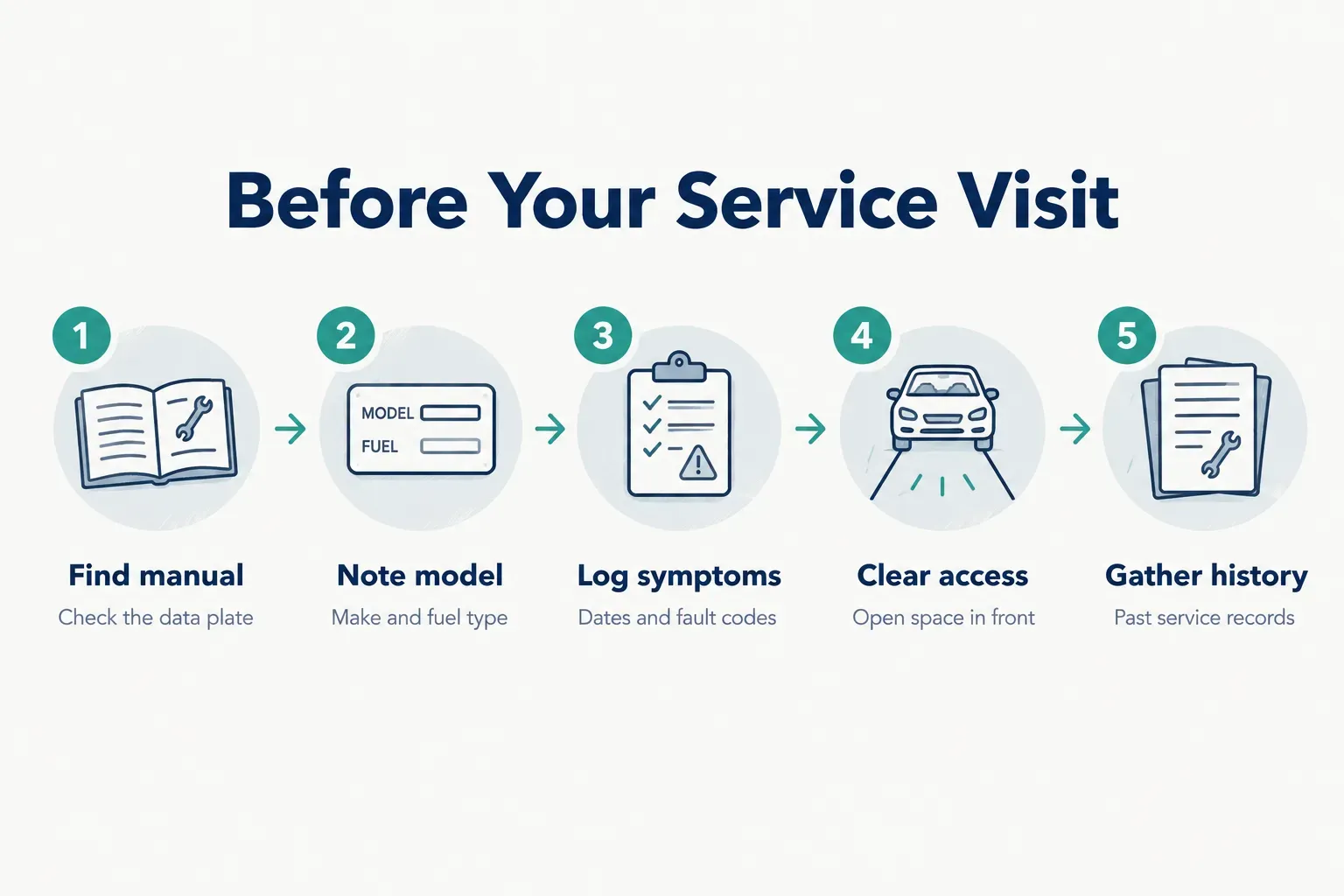
Before the technician arrives
Start by finding the boiler manual.
If you’ve lost it, the model name and serial number are usually printed on a data plate inside the lower panel or on the side of the casing, and most manufacturers publish manuals online.
Note the make, model, and fuel type, then write down any symptoms.
Be specific: “radiators upstairs lukewarm since October,” “pressure drops to 0.6 bar every five days,” or “fault code F28 twice last week.”
Technicians diagnose faster with dates and codes than with “it’s been acting weird.”
Clear the area around the boiler so the engineer has room to work, ideally at least a metre of open space in front.
Finally, gather your previous service records. Past readings help the technician spot trends, like a gradually worsening combustion reading or a recurring pressure issue.
What your service record should include
A service record is only useful if it’s complete. Before the technician leaves, make sure you have a written or digital report that includes:
The date of the service.
The readings taken, including combustion figures, gas pressure, and system pressure.
Any defects found, the parts replaced, and the technician’s recommendations.
The engineer’s license or registration number.
And the next due date.
Why does this paperwork matter so much? Four reasons.
Manufacturers check it before approving warranty claims.
Landlords need it to prove legal compliance.
Buyers and surveyors ask for it during a home sale, where a documented history signals a well-kept system.
And insurers may request it after a claim involving water damage or a heating failure.
No record often means no proof. Keep every service report, digitally and on paper, for the life of the boiler.
Finding a qualified technician
The most important question isn’t price.
It’s credentials.
Verify that your technician holds the right registration for your fuel type and region before they touch the boiler: Gas Safe in the UK, OFTEC for oil, or the relevant state or provincial license in North America.
Platforms like Frendex can make this step easier.
You can find verified local heating professionals with visible credentials, check ratings from completed bookings, and use in-app chat to confirm licensing and availability before you book.
It’s one practical way to vet a technician without phoning around.
Whatever route you use, ask for the registration number and check it against the official register.
A legitimate engineer will never mind.
The one habit that actually prevents breakdowns
If you remember one thing from this guide, make it this.
Check the pressure gauge and look for leaks once a month, and book your annual service before it’s overdue, not after symptoms appear.
That’s it.
Two minutes a month and one appointment a year.
Most breakdowns give warning signs weeks in advance. A pressure reading that creeps down. A drip that becomes a puddle. A noise that wasn’t there last winter…
The owners who avoid emergency call-outs are simply the ones who noticed early.
And keep the safety boundary simple: inspect, don’t intervene.
Looking is your job.
Opening, adjusting, and repairing belong to a licensed technician.
Here’s the decision in one line.
If something looks or smells wrong, stop and call a professional immediately.
If everything reads normal, keep the routine going, keep your records filed, and let your boiler do its job quietly for years to come.
Frequently asked questions
How often should a boiler be maintained?
Most boilers need a professional service once a year, plus monthly homeowner checks of pressure and visible leaks. Oil boilers and older units may need closer attention, as shown in the frequency table above. Always follow your manufacturer's instructions, because warranty terms often specify the required interval.
What is included in a boiler maintenance service?
A standard service covers combustion analysis, inspection and cleaning of key components, safety control testing, and leak checks. The technician will typically check the burner, heat exchanger, flue, seals, pressure relief valve, and expansion vessel. Oil services usually add nozzle and filter replacement.
Can I service my own boiler?
No, you shouldn't service your own boiler beyond basic external checks. Reading pressure, bleeding radiators, spotting leaks, and keeping the flue clear are safe. Opening the casing, touching gas components, or adjusting combustion should only be done by a licensed professional, and in many regions doing otherwise is illegal.
How do I know if my boiler needs servicing?
Your boiler needs servicing if it's been more than 12 months since the last visit or you notice any change in how it performs. Common triggers include pressure that keeps dropping, slow-heating radiators, new noises, fault codes, or lockouts. If anything involves a gas smell or CO alarm, treat it as an emergency instead.
Is boiler maintenance worth it?
Yes, boiler maintenance is worth it for safety, warranty protection, and long-term reliability. An annual service typically costs far less than a major repair or early replacement, and it catches CO risks early. It won't guarantee lower bills, but a well-tuned boiler is more likely to run at its rated efficiency.
What are the signs of a bad boiler?
The clearest signs of a failing boiler are unusual noises, a yellow or orange flame, rising energy bills, and repeated pressure loss. Short cycling (switching on and off frequently) and regular lockouts also point to underlying faults. Soot marks or a CO alarm require immediate shutdown and an emergency call.
Need a hand with something?
The Frendex map shows you who is available near you, in real time.
Get the app free Get the app freeFree, no card needed
Related articles

Pest control cost in 2026: What you'll really pay
Real 2026 pricing for one-time visits, recurring plans, and termite or bed bug jobs. Learn what drives $95 vs $1,400 quotes before you sign.
Rodent control: A homeowner's step-by-step guide
Skip the trap-and-hope cycle. This 8-step IPM method shows why sealing entry points matters more than traps. See the full sequence inside.
Emergency electrician: What to do before help arrives
Smell burning or see sparks? Get the 3-call decision tree (911, utility, or electrician) plus a prep checklist for faster, safer help.