Running errands without losing your day
By Kiss János 14 min read

What errand running actually means
A “quick trip to the pharmacy” rarely takes 15 minutes. Once you add getting dressed, finding your keys, driving, circling for parking, waiting behind three people, and calling back about the insurance code, it often takes closer to an hour.
That gap between the task and its true cost is where most days get lost.
Errand running is best understood as a logistics problem, not a single to-do item. It means handling several time-boxed tasks outside the home, each with its own location, opening hours, deadline, and required documents.
Treat your errand list like a delivery company treats its routes and you start making better decisions almost immediately.
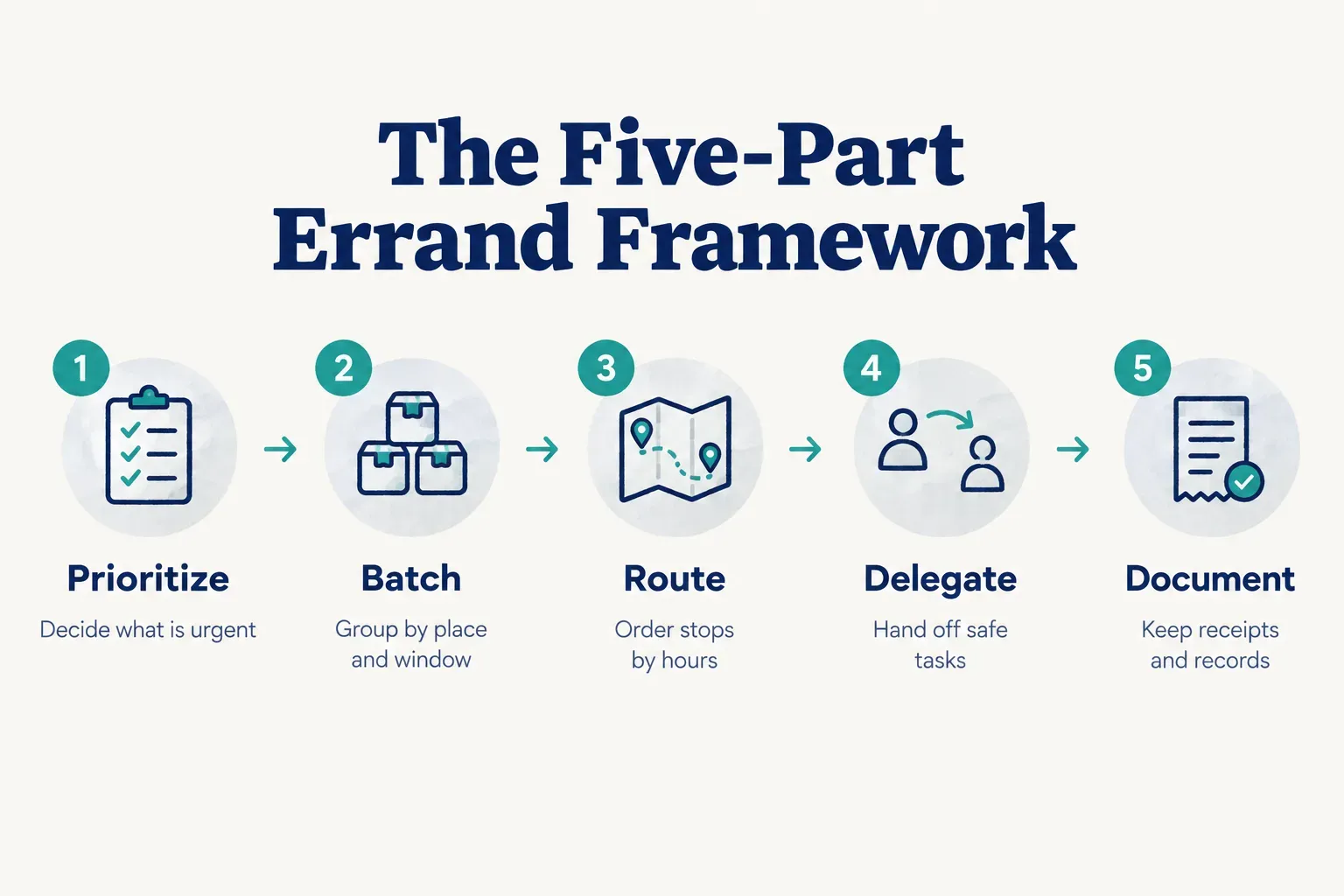
This guide uses a five-part framework you can apply to any week:
Prioritize what must happen today.
Batch errands that share a location or a window.
Route them in an order that respects store hours and perishables.
Delegate what someone else can do safely.
Document everything so the next round goes faster.
The approach works for busy professionals squeezing errands into a lunch break. It also works for caregivers juggling their own lists alongside a parent’s, older adults who want to cut down on trips, people with limited mobility, and households coordinating caregiving support for someone who can’t get out easily.
Most errand advice focuses on the stop itself. The real cost hides in the prep, travel, parking, queues, and follow-up calls that surround it.
Those hidden costs are why a smarter system beats simply “being more organized.” You can’t willpower your way out of a 40-minute line.
But you can plan around it.
Errands vs chores, appointments and deliveries
Why does the category matter? Because each type of task responds to a different fix.
Batching helps errands, automation helps chores, and calendar blocking helps appointments, so mislabeling a task means applying the wrong solution.
An errand is a time-boxed external task with a defined outcome. You go somewhere (or arrange for something to be picked up or dropped off), you complete one specific thing, and you’re done.
Here’s how it compares with its close cousins:
- Errands: Short, outcome-based trips such as mailing a package at the post office, collecting shirts from the dry cleaner, or doing a grocery pickup. They have a clear finish line and usually depend on someone else’s business hours.
- Chores: Recurring home maintenance like dishes, laundry, vacuuming, or taking out the recycling. They happen inside your space and repeat on a cycle, so routines and timers help more than route planning.
- Appointments: Fixed-time commitments such as a doctor visit, a haircut, or a parent-teacher meeting. You can’t batch them freely, but you can schedule errands around them to avoid a second trip.
- Deliveries: Items that come to you, like grocery delivery, a parcel from an online order, or a meal kit. Your main job is managing the delivery window and making sure someone is available if ID or a signature is needed.
- Caregiving tasks: Ongoing responsibility for another person, such as checking on a parent’s medication schedule or coordinating a child’s activities. Individual errands often sit inside caregiving, but the responsibility itself is continuous.
- Online-only tasks: Forms, bill payments, bookings, and renewals completed entirely on a screen. These should never take up a slot on your driving route.
The simplest test: an errand almost always requires leaving a location or coordinating a pickup or drop-off.
If nothing physically moves and nobody has to go anywhere, it’s a general task.
Try classifying a typical mixed list:
- Returning a jacket to a department store is an errand, because it requires a trip, a receipt, and store hours.
- Renewing a library book is an online-only task if the library has an app, and an errand only if it doesn’t.
- A dentist cleaning at 3:00 p.m. is an appointment, but the prescription pickup afterward is an errand you can attach to it.
- Folding laundry is a chore, while dropping a duvet at the laundromat is an errand.
- Waiting for a furniture delivery is a delivery task, and it may block the window you’d otherwise use for errands.
A framework for prioritizing errands
Most people prioritize errands by whichever one feels most annoying. That’s how the medication pickup gets pushed to tomorrow while the low-stakes return gets done today.
Good task prioritization replaces gut feeling with a quick, repeatable test.
Decide what must happen today
Run each item on your errand list through four questions.
If any answer is yes, it’s a must-today errand.
- Check for a hard deadline. Does a penalty, fee, or legal consequence kick in after today? Moving a car before a time-limited parking permit expires or dropping off a signed form before a filing cutoff both qualify.
- Check for a closing time. Will the place you need be closed tomorrow or for the weekend? A pharmacy that shuts at 6:00 p.m. on Saturday and stays closed Sunday turns a “whenever” errand into a time-sensitive one.
- Check for a perishable item. Is something going to spoil, expire, or be released back into inventory? Fresh groceries, a held order with a 48-hour pickup window, and flowers for an event all fall here.
- Check for a health or safety need. Will someone be harmed or seriously inconvenienced if this waits? A prescription pickup, retrieving a pet from the vet or boarding kennel, or replacing a broken car seat belongs at the top of the list.
- Cap the list at three. If more than three errands pass the test, rank them by consequence. Anything that affects health or carries a fee goes first, and everything else becomes tomorrow’s top item.
What can wait or go digital
Errands that fail all four questions aren’t unimportant.
They just don’t deserve today’s limited time.
- Move flexible errands to a batch day. Returns without a near deadline, restocking household basics, and dropping donations can all wait for a single weekly run. Pick one day and protect it.
- Convert anything you can to a screen task. Library renewals via app, subscription cancellations, bill pay, address changes, and many government form submissions no longer require a trip in 2026. If it can be done online in under ten minutes, do it now and delete it from the route.
- Check for a pickup or delivery option. Many pharmacies, hardware stores, and grocers offer curbside pickup or same-day delivery. Paying a small fee can remove an entire stop from a multi-stop trip.
- Weigh delegating against doing it yourself. Estimate what an hour of your time is worth, whether in income, rest, or time with family, then compare it to the cost of help. If a $25 delivery fee saves you 90 minutes on a day you’re already stretched, the math usually favors handing it off.
That last step leads straight into delegation, which gets its own section below. First, the errands you keep need a smart order.
Routing, timing and what to pack
Here’s the trap most route planning falls into.
You group errands by neighborhood, map the shortest loop, and arrive at the pharmacy ten minutes after it closed.
Geography is only half of the problem.
Group errands by location and hours
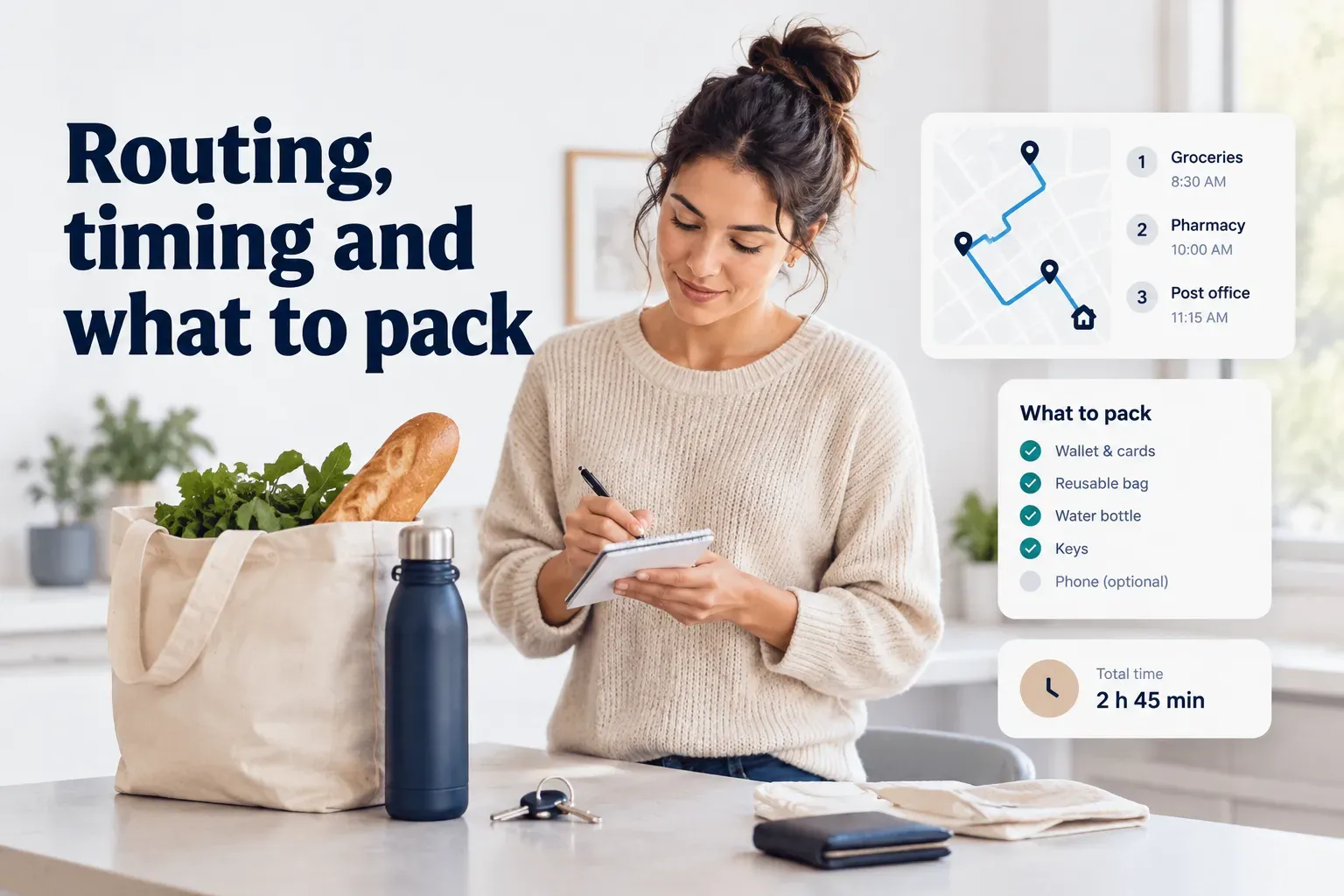
Location-based batching works only when you also account for store hours, peak traffic, and parking. A pharmacy counter often closes earlier than the grocery store in the same plaza, and many post offices close their retail counter before the building itself locks.
Check hours on the day you go, not from memory, because holiday and weekend schedules shift often.
Traffic matters just as much.
In most cities, weekday windows between roughly 7:00 and 9:00 a.m. and 4:00 and 6:30 p.m. add significant drive time, while mid-morning on a weekday tends to be the quietest period for both roads and checkout lines. Saturday late mornings are usually the busiest time for big-box stores.
Parking can quietly wreck a plan in dense areas.
A stop that takes five minutes inside might need fifteen minutes of circling outside, so put downtown or hard-to-park stops at the times you’re most likely to find a space, or pair them with a garage you can walk from.
Then sequence your route with two rules in mind:
Perishables go last.
Refrigerated or frozen groceries, fresh flowers, and medications that require cold storage should be your final stop before home. A warm car can push food into the unsafe temperature zone within an hour.
Deadlines can override geography.
If a return authorization expires Thursday, that store may dictate the day even if it’s out of the way. The same goes for held items with a pickup window or a document that must reach an office before a cutoff.
Pack a go-bag for errands
Forgetting one item can turn a single trip into two.
A small, permanently packed go-bag fixes that.
Keep these essentials in it:
- Photo ID for prescription pickup, package holds, age-restricted purchases, and anything requiring a signature.
- Reusable and insulated bags so cold items survive the trip and you avoid bag fees.
- Receipts for returns, kept in a single envelope or folder rather than scattered across the car.
- A charged phone (plus a small power bank) for QR codes, digital coupons, loyalty cards, and pickup confirmations.
- A running list app holding your shopping list and errand list, ideally shared with anyone else in the household.
Good receipt management deserves extra attention.
Snap a photo of every receipt the moment you get it, then store it in a dedicated album or notes folder.
Paper fades.
Photos don’t.
When an errand goes wrong
Even a perfect route meets reality.
The difference between a minor hiccup and a ruined afternoon is having a fix ready before you need it.
The item is out of stock.
Check inventory in the store’s app before leaving, and ask staff whether a nearby location has it or whether they can hold one for you.
The business closed early.
Call ahead for any stop where you can’t afford a wasted trip, especially on holidays, weekends, or during bad weather.
You missed a pickup window and got hit with a restocking fee.
Set a reminder for the day before the window closes, not the day of. If you’re already late, call and ask for a one-time extension; many stores will grant one if you ask before the deadline passes.
A return is rejected without a receipt.
Ask whether they can look up the purchase by the card you used or your loyalty account. Going forward, that photographed receipt solves this permanently.
A delivery requires ID at the door.
Alcohol, some medications, and high-value electronics often need proof of age or identity. Check the delivery window and make sure the right person is home with ID, or reroute the package to a pickup point.
Small failures like these are where most errand time leaks out.
Plan for them once, and they stop costing you twice.
When and how to delegate
Delegation feels like a luxury until you calculate what doing everything yourself actually costs. A caregiver who spends four hours a week on pickups for a parent is giving up an entire half-day.
The question isn’t whether to get help… it’s which help fits which errand.
A decision tree for help
Walk each errand through these branches in order:
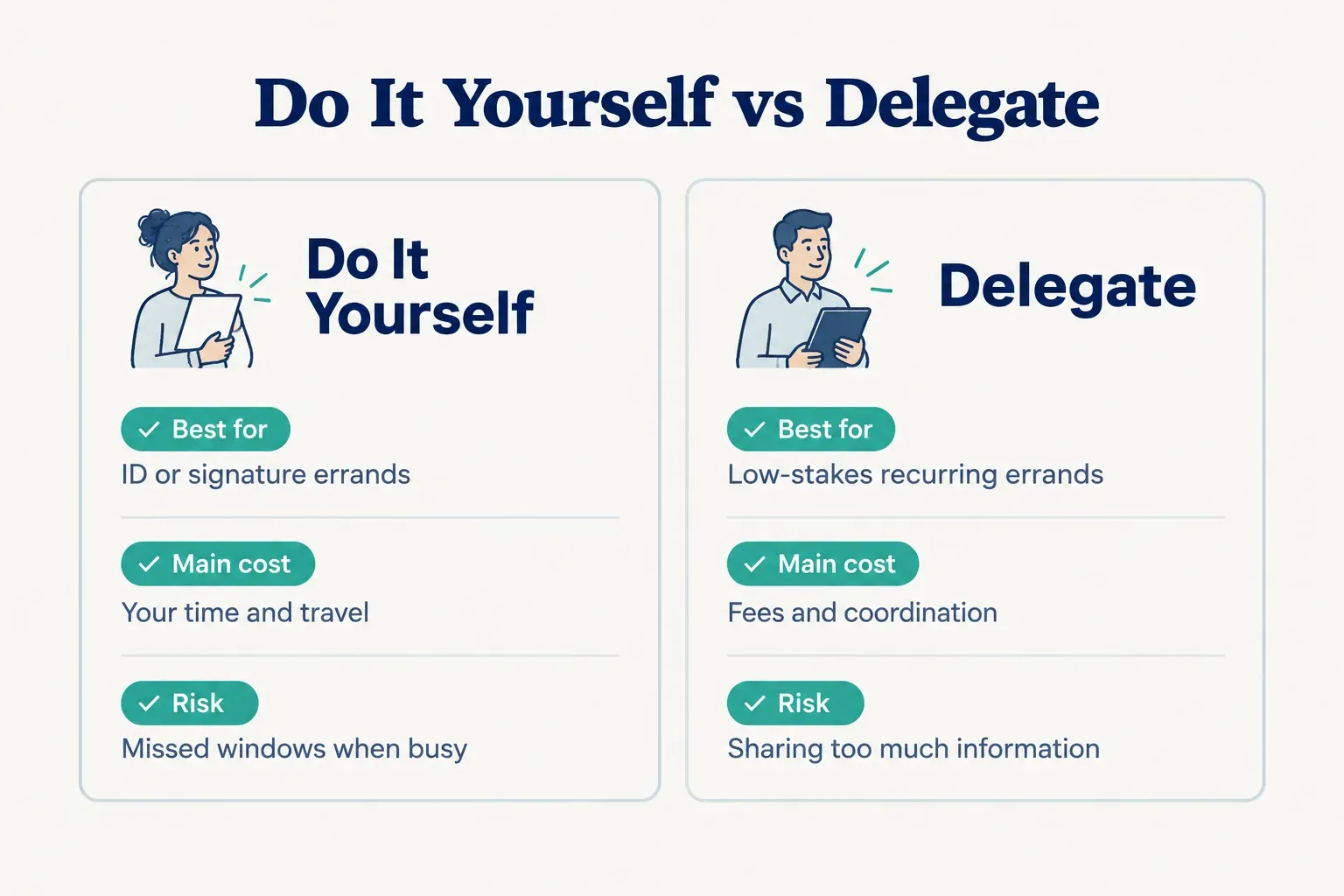
Do it yourself when ID or a signature is required. Certain prescription pickups, certified mail, legal documents, and DMV visits often demand the account holder in person.
Some pharmacies allow an authorized pickup person, so check the rules before assuming you’re stuck.
Ask a trusted friend or family member for low-stakes tasks. Returning a library book, grabbing a few groceries, or dropping off a donation bag are easy asks, especially if they’re already heading that way.
Use a delivery app for retail or grocery items. Grocery delivery and same-day retail services handle the shopping and the trip.
You manage only the order and the delivery window.
Arrange transportation for people-moving needs. When the errand is really about getting a person somewhere, such as an older parent to a pharmacy or a teen to a pickup, a ride service or volunteer driver is the right tool.
Hire a dedicated errand runner for recurring or multi-stop jobs. When the time saved outweighs the cost, a personal assistant or errand service can handle a weekly loop of dry cleaning, post office, pharmacy, and returns in one go.
How to delegate without drama
Vague requests create bad outcomes.
“Grab some milk” can return as the wrong size, wrong fat content, and a receipt for $14.
Precise delegation prevents that.
Before handing off an errand, settle six details:
- Substitutions: Agree in advance on what’s acceptable if your first choice is unavailable, and what should be skipped entirely.
- Spending limit and payment: Set a maximum and decide how the helper will pay, whether through a prepaid card, a delivery app, or reimbursement.
- Access: Give temporary instructions, like a one-time door code or a lockbox, rather than a permanent key.
- Required ID: Tell the helper exactly what identification or authorization the pickup demands so they aren’t turned away at the counter.
- Proof of completion: Ask for a photo or receipt as proof of delivery so you can confirm the job without a follow-up call.
- Escalation: Define what happens if something goes wrong, such as “call me before spending more than $20 extra” or “if the store is closed, bring it back tomorrow.”
Privacy and safety deserve their own rule: share only what the specific errand requires.
Avoid sending full payment card numbers, detailed prescription information, government ID numbers, or broad access to your home address and schedule.
A helper collecting dry cleaning needs a ticket number, not your banking app.
The safest delegation shares the minimum information needed to finish the job, then expires when the job is done.
Turn errands into a routine
One-off delegation saves an afternoon.
A system saves months.
Recurring errands like weekly groceries, monthly prescription refills, or seasonal returns become far easier once they live in a shared household workflow.
That workflow needs four parts. A shared list that everyone can see and edit, deadline-based reminders rather than vague “sometime this week” notes, an assigned helper for each recurring task, and a clear completion status so nobody makes a duplicate trip.
Tools can carry much of that load.
Apps like Frendex let people book and message trusted local providers for different everyday tasks from one place, and the booking history doubles as a built-in record of who did what and when.
For families coordinating care for an older relative, that record alone can prevent missed refills and repeated questions.
Review the routine once a month.
Drop errands that went digital, reassign ones that keep slipping, and adjust timing around store hours that changed.
One decision to make tonight
You don’t need a new system by morning.
You need one good decision.
Use this rule.
If an errand is urgent and personal, do it yourself tonight.
If it’s low-stakes and recurring, delegate it.
If it can be done from a screen, do it digitally right now, before you close this page.
Then pick just one recurring errand this week, maybe the grocery run or the monthly prescription refill, and redesign it with the prioritize, batch, route, delegate approach.
Don’t overhaul everything at once.
One fixed errand tends to show you how to fix the next.
And remember the bigger shift.
Errand running is a logistics skill, not a character trait.
People who seem effortlessly on top of their lists rarely have more discipline than you.
They have a better system.
Build yours one errand at a time.
Frequently asked questions
What is considered an errand?
An errand is a short, time-boxed task outside the home with a defined outcome, such as mailing a package or picking up a prescription. It usually depends on a business's opening hours and ends once the specific job is done.
What is the difference between an errand and a task?
An errand is a task that requires leaving a location or coordinating a pickup or drop-off. A general task, like paying a bill online or answering an email, can be completed without anything physically moving.
How do you run errands efficiently?
Run errands efficiently by prioritizing urgent items, batching stops by location and store hours, routing perishables last, and delegating low-stakes tasks. Moving anything possible online and carrying a packed go-bag removes most repeat trips.
What are examples of personal errands?
Common personal errands include banking, pharmacy pickups, grocery runs, dry cleaning, store returns, post office visits, and DMV trips. Dropping off donations and collecting held online orders also count.
What does an errand runner do?
An errand runner handles shopping, pickups and drop-offs, waiting in line, and delivering documents on a client's behalf. A good one also reports back with proof of completion, such as a photo or receipt.
How much time does the average person spend running errands?
The average American spends roughly 4 to 5 hours a week purchasing goods and services, based on the U.S. Bureau of Labor Statistics' American Time Use Survey. That figure excludes much of the travel time, so the real total for errand running is often higher.
Need a hand with something?
The Frendex map shows you who is available near you, in real time.
Get the app free Get the app freeFree, no card needed
Related articles

Brow lamination: What it does and how to stay safe
What brow lamination actually does to your hair, the overprocessing signs to watch for, and how to spot a risky technician before you book.

Pest control cost in 2026: What you'll really pay
Real 2026 pricing for one-time visits, recurring plans, and termite or bed bug jobs. Learn what drives $95 vs $1,400 quotes before you sign.

Is your car asking for a wheel alignment?
Learn the real symptoms of bad alignment vs tire balance or wear issues. See what a technician checks and how to read your shop report before paying.