Is your car asking for a wheel alignment?
By Kiss János 15 min read
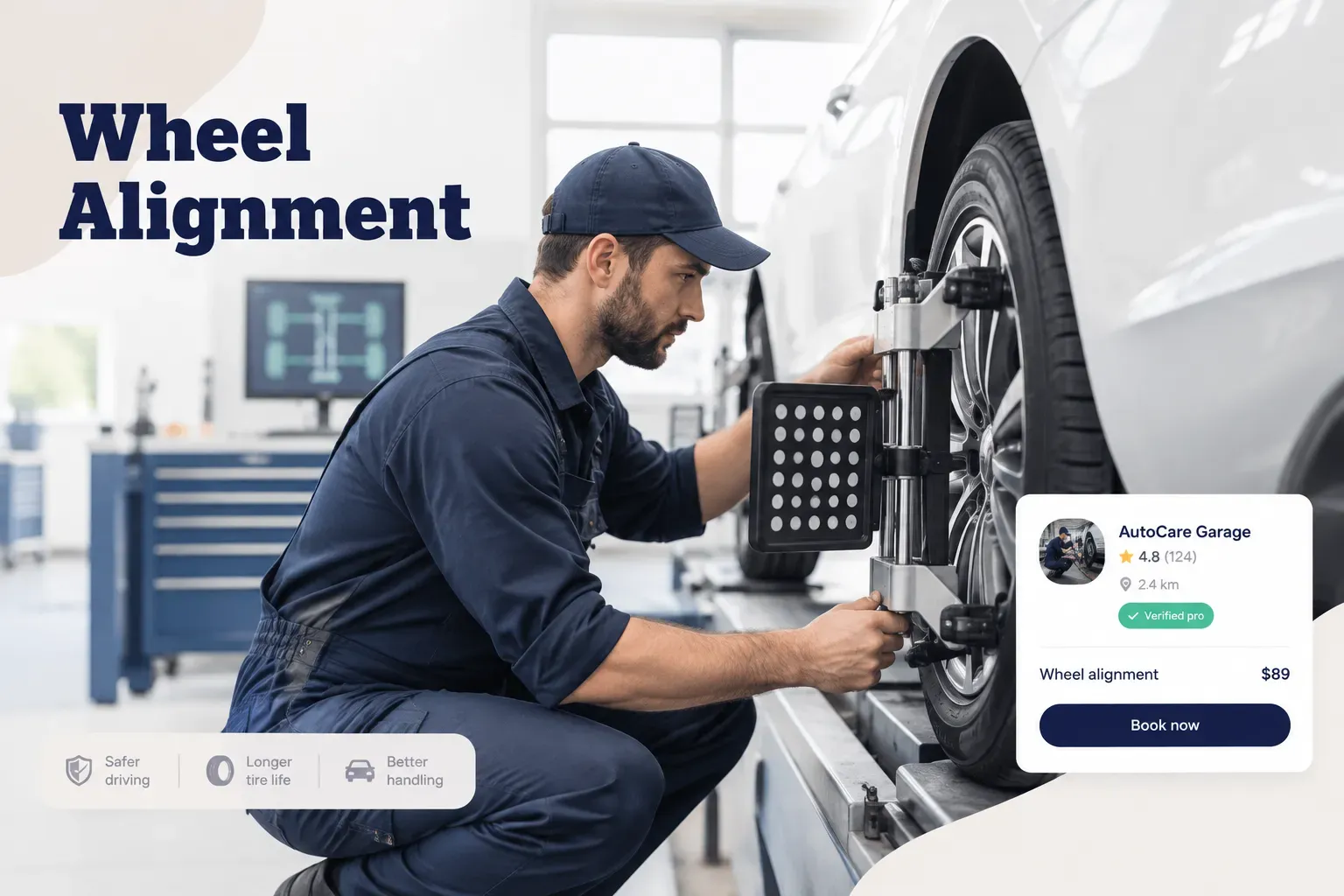
The problem with guessing
Your steering wheel sits a few degrees left of center on a perfectly straight highway. Or the car drifts toward the shoulder the moment you relax your grip.
Most drivers reach the same conclusion: it must need a wheel alignment.
Sometimes that’s right. Often it isn’t.
A vehicle pulling to one side can come from low tire pressure on one corner, tire conicity (a manufacturing quirk inside the tire itself), a bent wheel, a dragging brake caliper, or worn suspension components. Uneven tire wear and vibration have just as many possible causes.
Alignment is only one suspect on a long list.
Then there’s the vocabulary problem. Alignment, tire balancing, and tire rotation are three separate services that get blurred together at the service counter. That confusion drives a large share of unnecessary visits, because an alignment won’t fix an out-of-balance wheel and a rotation won’t correct a bad toe angle.
This guide takes a diagnosis-first approach. You’ll learn which symptoms genuinely point to alignment, what a technician actually adjusts on the alignment rack, and how to read a shop’s report. The goal is simple: to evaluate a recommendation before you pay for the work.
What alignment actually adjusts
Here’s the surprising part.
A wheel alignment doesn’t adjust the wheels themselves. It adjusts the suspension and steering parts that hold each wheel at a precise angle, and those angles are measured in fractions of a degree.
Every vehicle has wheel alignment specifications set by the manufacturer. The technician’s job is to measure where your car sits today and bring each adjustable angle back inside that factory range.
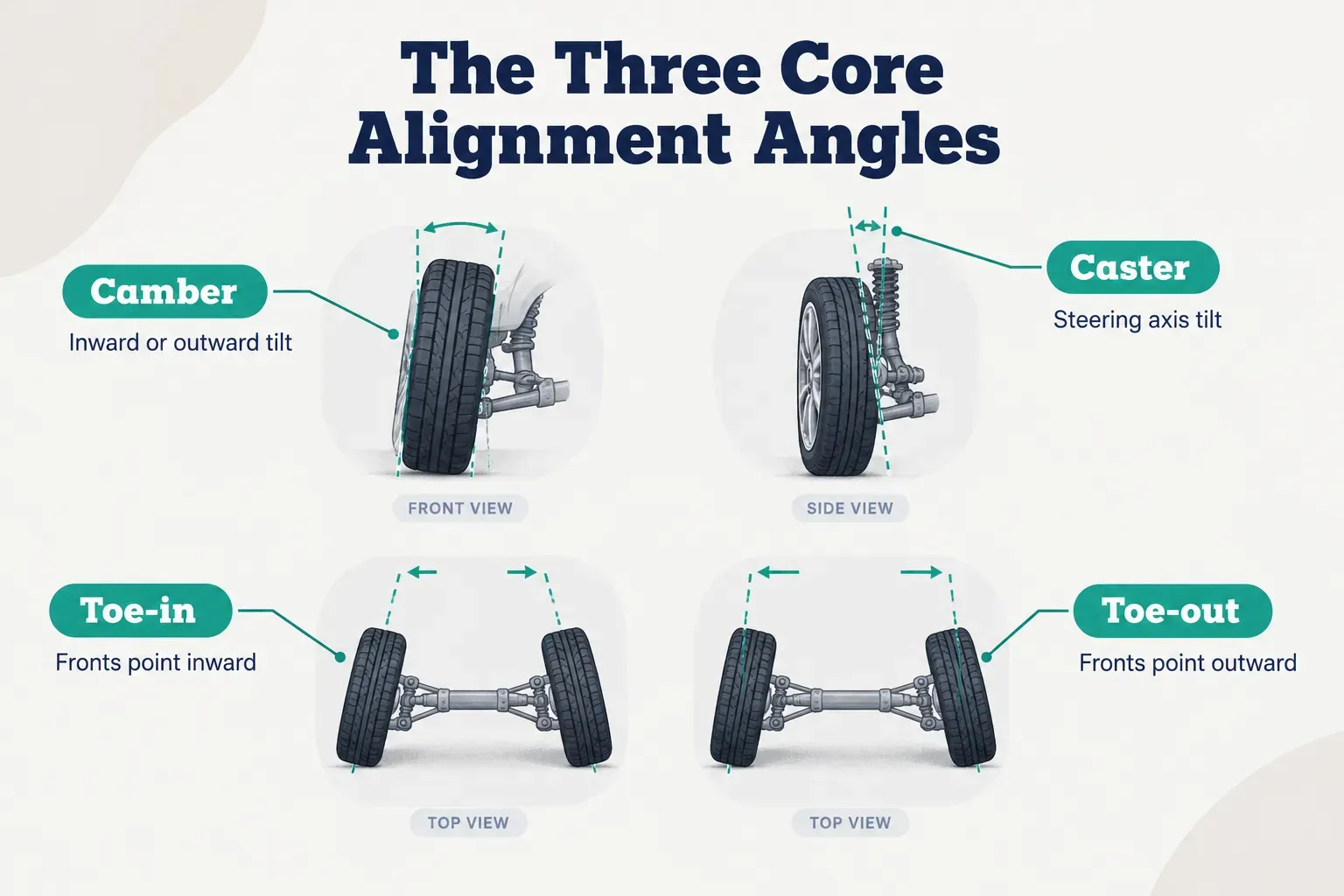
Camber, caster, and toe
The camber angle is the inward or outward tilt of the wheel when you look at the car from the front. If the top of the tire leans toward the engine, that’s negative camber. If it leans away, that’s positive camber.
Many passenger cars are specified with a small amount of negative camber, often somewhere between -0.5 and -1.5 degrees, to improve cornering grip. But too much negative camber loads the inner shoulder of the tire and wears it down early. Excess positive camber does the same to the outer shoulder.
The caster angle is the forward or backward tilt of the steering axis, viewed from the side. Think of the front wheel on a shopping cart: because its pivot sits ahead of the contact point, it naturally trails straight. Positive caster works the same way, giving your car steering stability at highway speed and helping the wheel return to center after a turn.
Caster has little direct effect on tread life. But when caster differs from left to right, the car tends to pull toward the side with less positive caster.
That side-to-side difference matters more than either number alone.
Toe is the angle at which the wheels point relative to each other, viewed from above. With toe-in and toe-out, the fronts of the tires point slightly toward or slightly away from each other.
Picture your feet: pigeon-toed is toe-in, duck-footed is toe-out.
Small errors here cause outsized damage.
A toe setting that’s off by just a fraction of a degree means the tire is being dragged sideways a little with every rotation, thousands of times per mile. The result is tire feathering, where each tread block wears smooth on one edge and sharp on the other, plus accelerated wear along one edge of the tire.
Thrust angle and centerline
Ever had an alignment and still driven away with a crooked steering wheel? The rear axle is a common reason.
The thrust angle is the direction the rear wheels point relative to the vehicle’s geometric centerline, an imaginary line running from the middle of the front axle to the middle of the rear. Ideally the thrust line and centerline match. When they don’t, the rear wheels are effectively steering the car slightly to one side.
Your hands compensate without thinking.
You hold the steering wheel off-center to keep the car tracking straight, which means a steering wheel off-center complaint can exist even when the front toe is set perfectly. The car may also “dog track,” moving down the road slightly sideways like a dog trotting at an angle.
Correcting this requires measuring the rear axle, not just the front.
On cars with adjustable rear suspension, the technician sets rear toe to bring the thrust angle near zero. On solid rear axles with no adjustment, the front toe is set relative to the thrust line so the steering wheel ends up centered.
Symptoms with more than one cause
Three symptoms send most drivers to a shop: pulling, uneven tire wear, and vibration. Only one of them is a reliable alignment signal on its own, and even that one needs interpretation.
Before you assume the angles are off, it helps to know what else produces the same feeling behind the wheel. Here’s how to separate the suspects.
Pulling and a crooked wheel
A car that drifts or pulls is reporting an imbalance somewhere in the system. Alignment is one possibility, but these causes are just as common and often cheaper to fix:
- Uneven tire pressure: A tire that’s even a few psi lower than its partner on the same axle has a larger contact patch and more rolling resistance. The car drifts toward the low side, and the fix costs nothing but a minute at the air pump.
- Tire conicity: Small variations in how a tire’s internal belts are laid during manufacturing can make it roll like a slight cone. A telltale sign is that the pull switches direction when the two front tires are swapped side to side.
- A dragging brake caliper: A seized caliper piston or slide pin keeps one brake partly applied. Look for a wheel that’s noticeably hotter than the others after a drive, a burning smell, or a pull that gets worse when you brake.
- A bent wheel or damaged tire: Pothole damage can bend a rim or shift a tire’s internal structure, creating a pull that no alignment adjustment will remove.
- Genuine alignment problems: Unequal camber or caster from side to side, or incorrect toe, will cause a steady pull and often a crooked steering wheel.
- Road crown: Most roads slope slightly toward the edges for drainage, so a gentle drift toward the shoulder on some roads is normal and not a fault.
What tire wear reveals
Your tread is the most honest diagnostic tool on the car. It records months of behavior that a quick test drive can’t, and each pattern points to a different cause:
- Feathering across the tread: Run your hand across the tire. If the blocks feel smooth in one direction and sharp in the other, toe is the likely culprit.
- One-sided shoulder wear: Heavy wear on only the inner or outer shoulder usually points to excessive negative or positive camber, often combined with toe error.
- Wear on both edges: When both shoulders wear faster than the center, the tire has been running underinflated. That’s a pressure problem, not an alignment one.
- Wear down the center: A bald strip in the middle with healthy shoulders signals overinflation, which makes the tread bulge and carry the load on a narrow band.
- Irregular, patchy wear or cupping: Scalloped dips around the tire typically come from missed tire rotations, worn shocks or struts, or imbalance rather than alignment angles.
Why vibration is often something else
A shaking steering wheel or seat is the symptom most often blamed on alignment and the one least likely to be fixed by it.
Misaligned wheels pull and wear tires; they rarely shake.
The usual causes of vibration include:
- Tire imbalance: A wheel and tire assembly with uneven weight distribution vibrates at speed, often most noticeably between 50 and 70 mph. Balancing corrects this with small weights.
- A bent rim: Even a slight bend from a curb or pothole creates a wobble that balancing can only partly mask.
- Internal tire damage: A separated belt or shifted cord produces a bulge or out-of-round spot, a safety issue that requires tire replacement.
- Worn suspension components: Tired bushings, a loose tie rod end, a worn ball joint, or a failing wheel bearing can all transmit vibration and play into the steering.
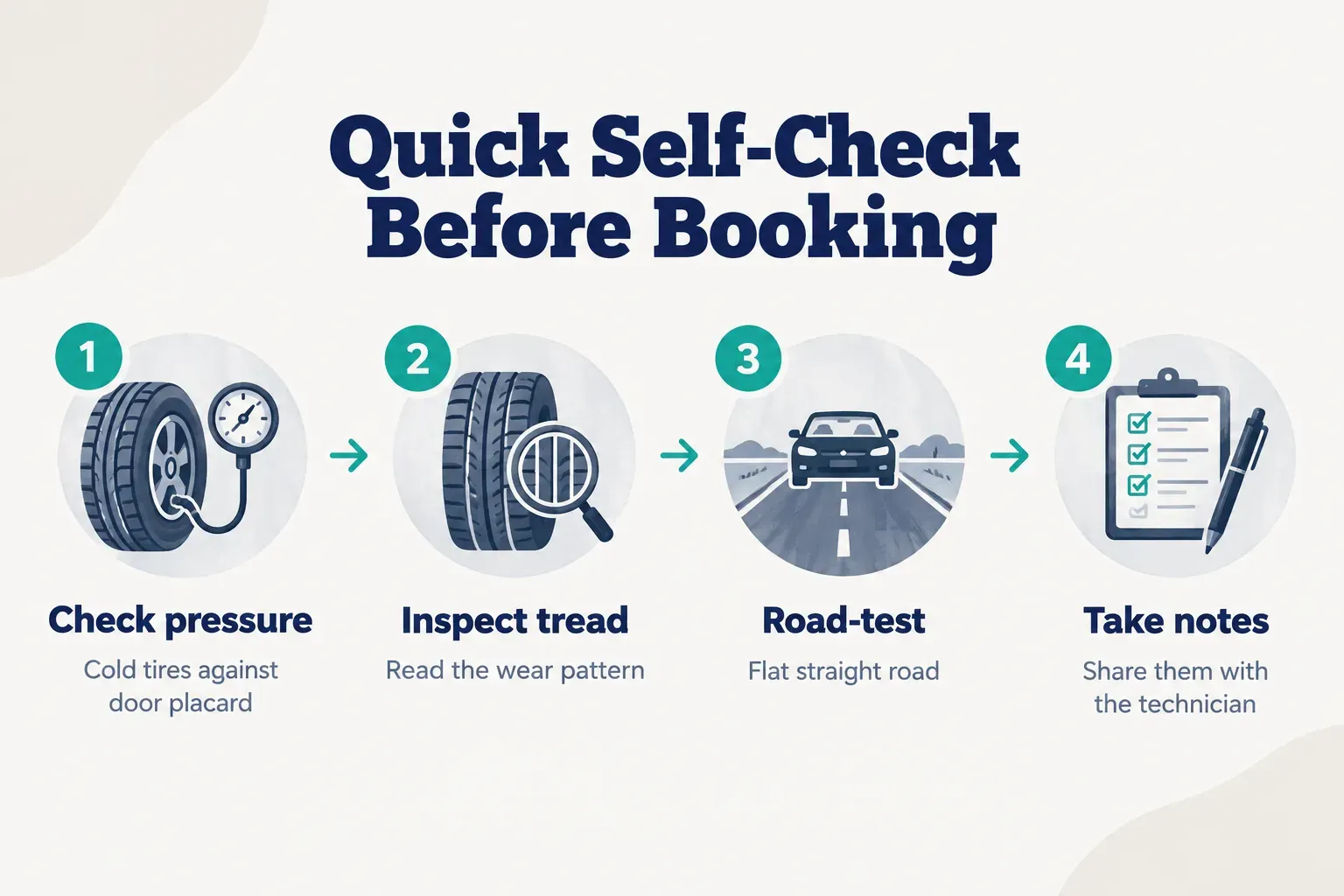
Before booking any service, run through a quick self-check in this order. It rules out the cheap fixes first and gives the shop better information if you do go in:
- Confirm tire pressure: Check all four tires cold against the placard on the driver’s door jamb, not the maximum printed on the sidewall.
- Inspect the tread: Look and feel for the wear patterns above, plus any bulges, cuts, or exposed cords.
- Road-test on a flat, straight road: Note whether the car pulls, whether the wheel is centered, and whether any shake changes with speed or braking.
- Write down what you found: Specific notes help a technician separate an alignment issue from a balance, brake, or suspension problem.
When an alignment is actually needed
Oil changes have intervals.
Alignments mostly don’t.
That single fact explains why so many drivers either pay for alignments they don’t need or skip the one they do.
There’s no fixed schedule
No universal mileage rule exists for alignment, and as of 2026 most vehicle manufacturers still don’t publish one in the maintenance schedule. Instead, they call for periodic inspection and correction when symptoms appear.
You’ll sometimes hear “once a year” or “every 10,000 miles” quoted as rules of thumb, but those are shop conventions, not engineering requirements.
The real need depends on four things. First, your manufacturer’s specifications and how sensitive your suspension design is to small changes. Second, your road conditions, since rough or broken pavement knocks angles out faster than smooth highway.
Third, your driving style.
Hard cornering, aggressive curb parking, and frequent heavy loads all stress suspension parts.
Fourth, your repair history: any work that disconnects steering or suspension parts, such as replacing a tie rod, control arm, or strut, changes the geometry and should be followed by an alignment.
New tires, potholes, and curbs
New tires are an ideal moment to check alignment.
That’s different from automatically needing one.
A good shop will measure the angles and tell you whether anything is out of spec before adjusting it.
The logic for checking is sound.
A set of quality tires is a significant investment, and a toe error can start chewing through fresh tread within a few thousand miles. Spending a few minutes on measurement protects that investment, but if the readings are all in the green, there’s nothing to adjust.
A new set of tires is a reason to inspect alignment, not proof that you need one. Ask to see the measurements before approving the adjustment.
Impacts are a different story.
A hard pothole strike or a solid hit against a curb warrants an inspection, especially if you notice a new pull, a newly crooked steering wheel, or fresh tire wear afterward. The reason goes beyond knocked-out angles.
A serious impact can bend a control arm, tie rod, strut, or wheel.
Bent parts can’t be adjusted back into spec; they have to be replaced first.
That’s why a proper post-impact visit starts with an inspection of suspension components, not just a trip onto the alignment rack.
Two-wheel vs four-wheel alignment
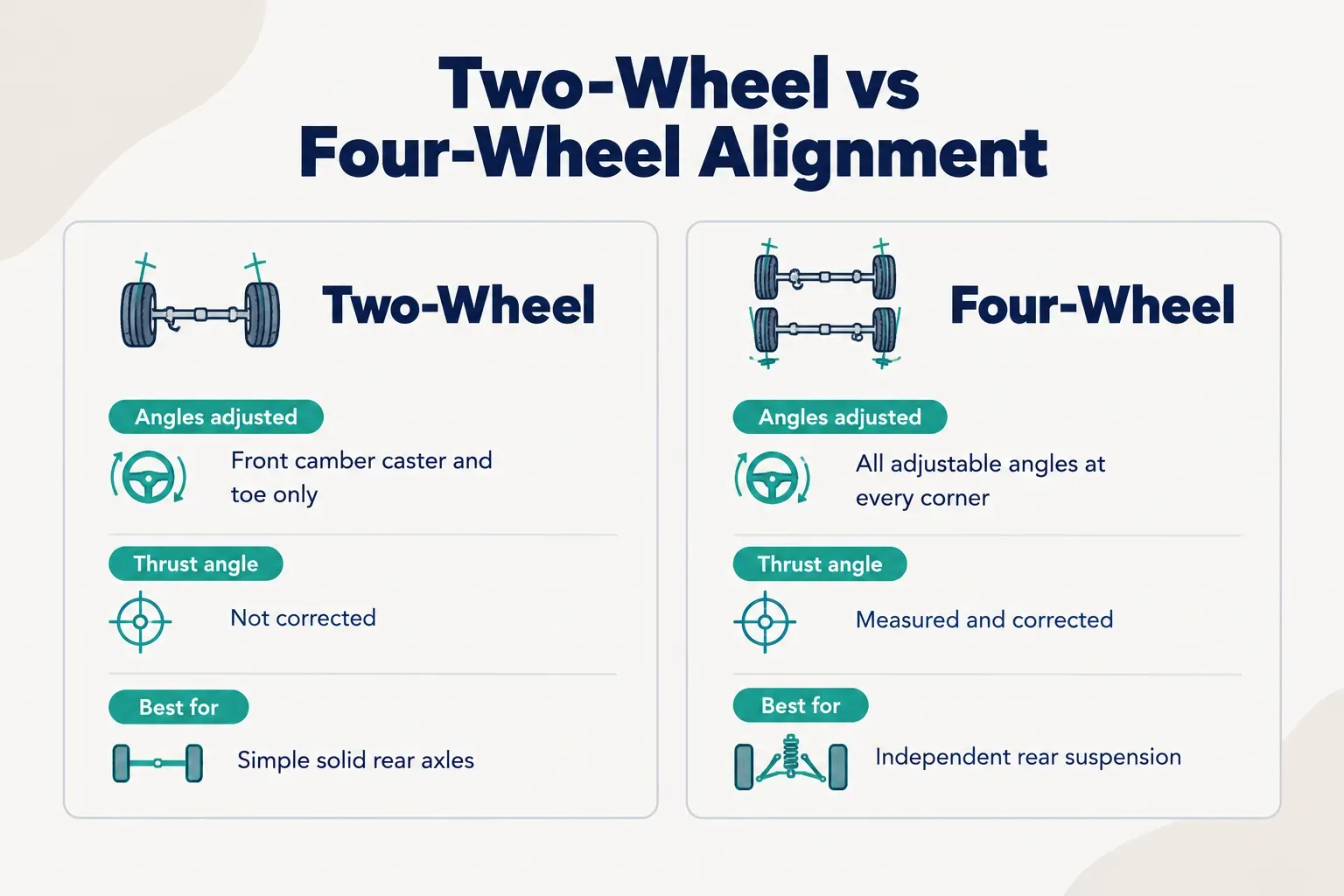
Shops typically offer two levels of service, and the right one depends on your vehicle’s rear suspension.
A front-end alignment, also called a two-wheel alignment, measures and adjusts only the front camber, caster, and toe. It assumes the rear axle is already pointing straight.
A four-wheel alignment measures all four corners. It adjusts rear camber and toe where the design allows, corrects the thrust angle, and then sets the front angles relative to the rear.
The car ends up tracking straight with a centered steering wheel.
For vehicles with independent rear suspension, which today includes most cars, crossovers, and many SUVs, four-wheel alignment is the correct choice. A front-only job on these vehicles can leave a thrust angle problem untouched, and you’ll drive away with the same crooked wheel you came in with.
Making sense of the report and the shop
The alignment printout is your best defense against both bad work and unnecessary work. Yet most drivers glance at the colors and fold it into the glovebox.
A few minutes of reading tells you exactly what was wrong and what was fixed.
Green numbers versus red ones
A modern alignment system produces a report showing each wheel’s measured angles side by side with the manufacturer’s tolerance range. Here’s what to look for:
- Per-wheel readings: You’ll see camber, caster, and toe listed for each front wheel, and usually camber and toe for each rear wheel, with the specified range beside each number.
- Color coding: Green means the reading sits within specification. Red means it’s out of spec, and on most reports that also signals the angle is adjustable on your vehicle.
- Before and after columns: A complete printout shows the readings as the car arrived and the readings after adjustment. Without the “before” column, you can’t tell what was actually wrong.
- Cross-camber and cross-caster: These show the difference between the left and right sides. Many manufacturers want that difference held within roughly half a degree, because a large cross reading makes the car pull even when each individual number is technically in the green.
- Total toe: This is the combined toe of both wheels on an axle. It drives tire wear directly, so a total toe number in the red is one of the clearest justifications for an adjustment.
Why the wheel stays crooked
Picture this: the printout is all green, and the steering wheel still sits off-center.
Frustrating… but explainable.
Common reasons include:
- The wheel wasn’t centered during adjustment: Technicians lock the steering wheel straight before setting front toe. If it shifted, or wasn’t locked, the toe can be correct while the wheel ends up rotated a few degrees.
- A thrust angle that wasn’t addressed: As covered earlier, a front-only alignment on a car with a rear thrust problem often leaves the wheel crooked.
- A bent component: If a tie rod, control arm, or steering knuckle is bent, the technician may run out of adjustment range before the angle reaches spec. The fix is replacing the part, then re-aligning.
- A non-alignment cause: Conicity, mismatched tire pressures, or a dragging brake can still create a pull after a perfect alignment.
- No road test: A proper service ends with a short drive to confirm the car tracks straight and the wheel is centered. If the shop skipped this step, ask them to do it.
What to ask before booking
Not every alignment service is the same, and price alone tells you very little. Ask these questions before you commit:
- Is a pre-alignment inspection included? A qualified automotive technician should check tie rods, ball joints, bushings, and wheel bearings first, because aligning a car with worn parts wastes your money.
- Are all adjustable angles measured? Confirm whether the service is two-wheel or four-wheel, and whether camber and caster are adjusted or only toe.
- Will I get before-and-after printouts? A written report is your proof of what was out of spec and what was corrected.
- Is a road test part of the job? Straight tracking and a centered wheel should be verified before you pay.
- What happens if parts are worn? Ask whether the shop will call you with findings before doing extra work, rather than adding it to the bill.
Finding a shop that answers these questions well is easier when reviews come from real customers. Apps like Frendex let drivers compare verified local providers by ratings left only after completed bookings, and you can message a shop in advance to confirm inspection, measurement, and printout details before you arrive.
Trust the symptoms, not the schedule
The decision logic is simpler than the service menu suggests.
If pulling and uneven tire wear persist after you’ve set correct tire pressure and a visual inspection rules out damage, an alignment check is warranted. If vibration is your main complaint, suspect balance or a bent wheel first.
Some situations shouldn’t wait for an appointment. A pull so strong you’re fighting the wheel, visible cords or sidewall damage, noticeable looseness in the steering, or any problem following a collision means the car should be towed, not driven.
For everything else, book an inspection with a provider who gives you a written before-and-after alignment printout. A verbal “you need an alignment” isn’t evidence.
The numbers are.
Frequently asked questions
How do I know if my car needs an alignment?
Your car likely needs an alignment if it pulls to one side after you've confirmed correct tire pressure, the steering wheel sits off-center on a straight road, or the tires show feathering or one-sided shoulder wear. Vibration alone is usually a balance or wheel problem instead. Run the self-check sequence above before booking.
What happens if you do not get a wheel alignment?
Skipping a needed alignment leads mainly to uneven tire wear and gradually worse handling. Toe and camber errors shorten tread life, sometimes forcing tire replacement thousands of miles early. You may also feel a persistent pull, reduced steering stability, and extra effort to keep the car straight.
How often should you get a wheel alignment?
There's no fixed interval for wheel alignment. Get it checked when symptoms appear, after a hard pothole or curb impact, after suspension or steering repairs, and when you install new tires. Your manufacturer's specifications and your road conditions matter more than any generic mileage rule.
Is wheel alignment the same as tire balancing?
No, they are different services and not interchangeable. Tire balancing corrects weight distribution so each wheel spins smoothly without vibration. Alignment corrects wheel angles so the car tracks straight and tires wear evenly.
Do I need an alignment with new tires?
Not automatically, but new tires are the best time to have the alignment checked. If the measurements are within specification, no adjustment is needed. If they're out of spec, correcting them protects your new tread from premature wear.
How long does a wheel alignment take?
A typical four-wheel alignment takes roughly 45 minutes to an hour. Worn or seized parts can extend the time, since the technician may need to diagnose or replace components before adjustment is possible. Seized adjusters on older vehicles are a common source of delay.
Need a hand with something?
The Frendex map shows you who is available near you, in real time.
Get the app free Get the app freeFree, no card needed
Related articles

Brow lamination: What it does and how to stay safe
What brow lamination actually does to your hair, the overprocessing signs to watch for, and how to spot a risky technician before you book.

Pest control cost in 2026: What you'll really pay
Real 2026 pricing for one-time visits, recurring plans, and termite or bed bug jobs. Learn what drives $95 vs $1,400 quotes before you sign.

Boiler maintenance: A homeowner's safety and service guide
Learn which boiler checks are safe to DIY, which need a pro, and the warning signs that mean call for help now. A homeowner's framework for 2026.