How to find a good plumber (without overpaying or getting burned)
By Kiss János Updated 11 min read
Why ‘just check reviews’ isn’t enough
Almost every article on how to find a good plumber gives the same three tips.
Check the license. Read reviews. Get a few quotes.
That advice isn’t wrong, but it’s incomplete, because none of those guides show you how to verify a license, spot a padded review profile, or compare two quotes that look nothing alike.
And that gap is where homeowners get burned.
A five-star rating can hide an expired license. A “fully insured” claim can mean a policy that lapsed last spring. A quote that looks clean can leave out permits, disposal fees, and the parts that actually fail.
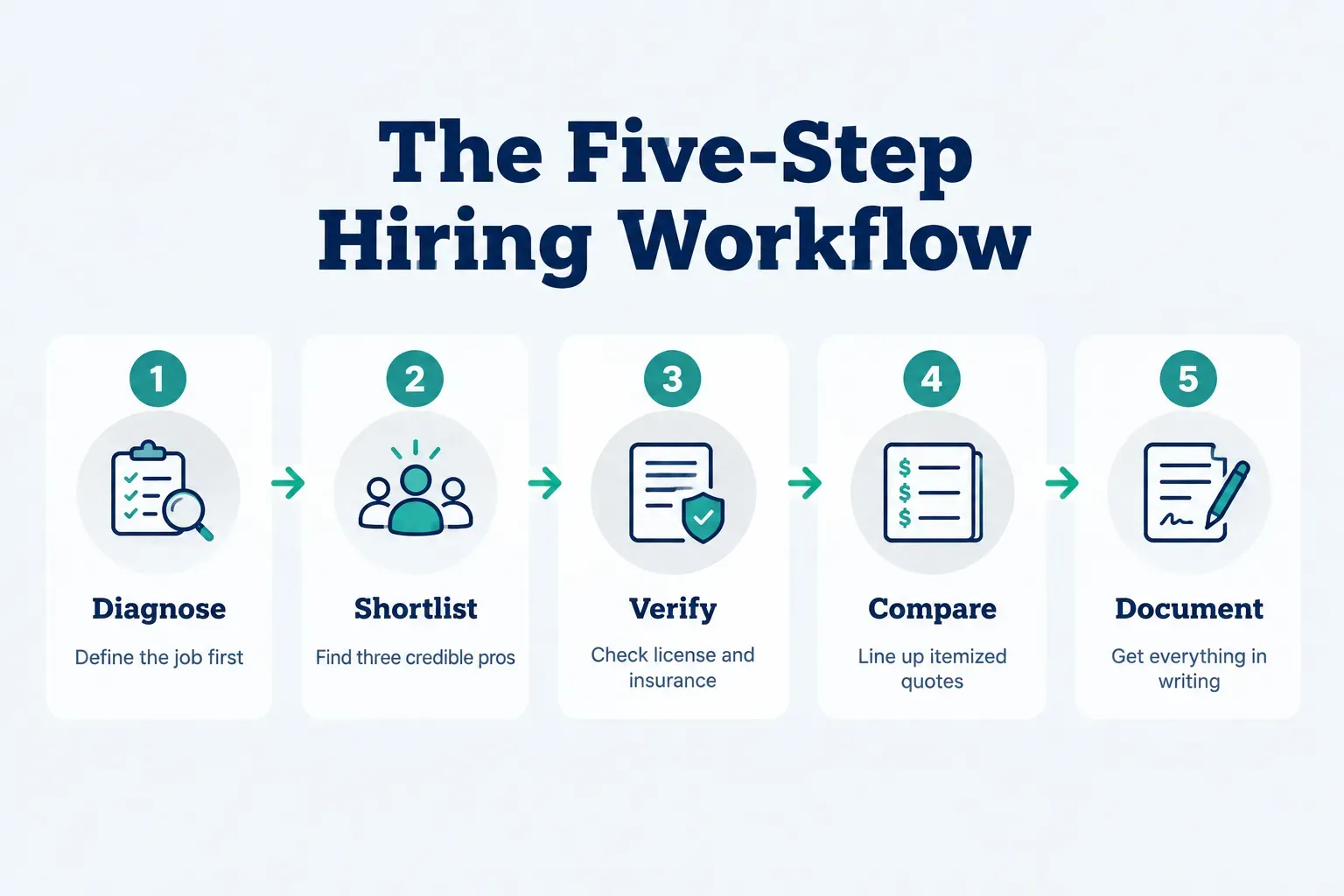
This guide follows a five-step workflow that working contractors and property managers use. You’ll diagnose the job, build a shortlist, verify credentials directly with the source, compare quotes line by line, and document everything before work begins.
One warning before we start.
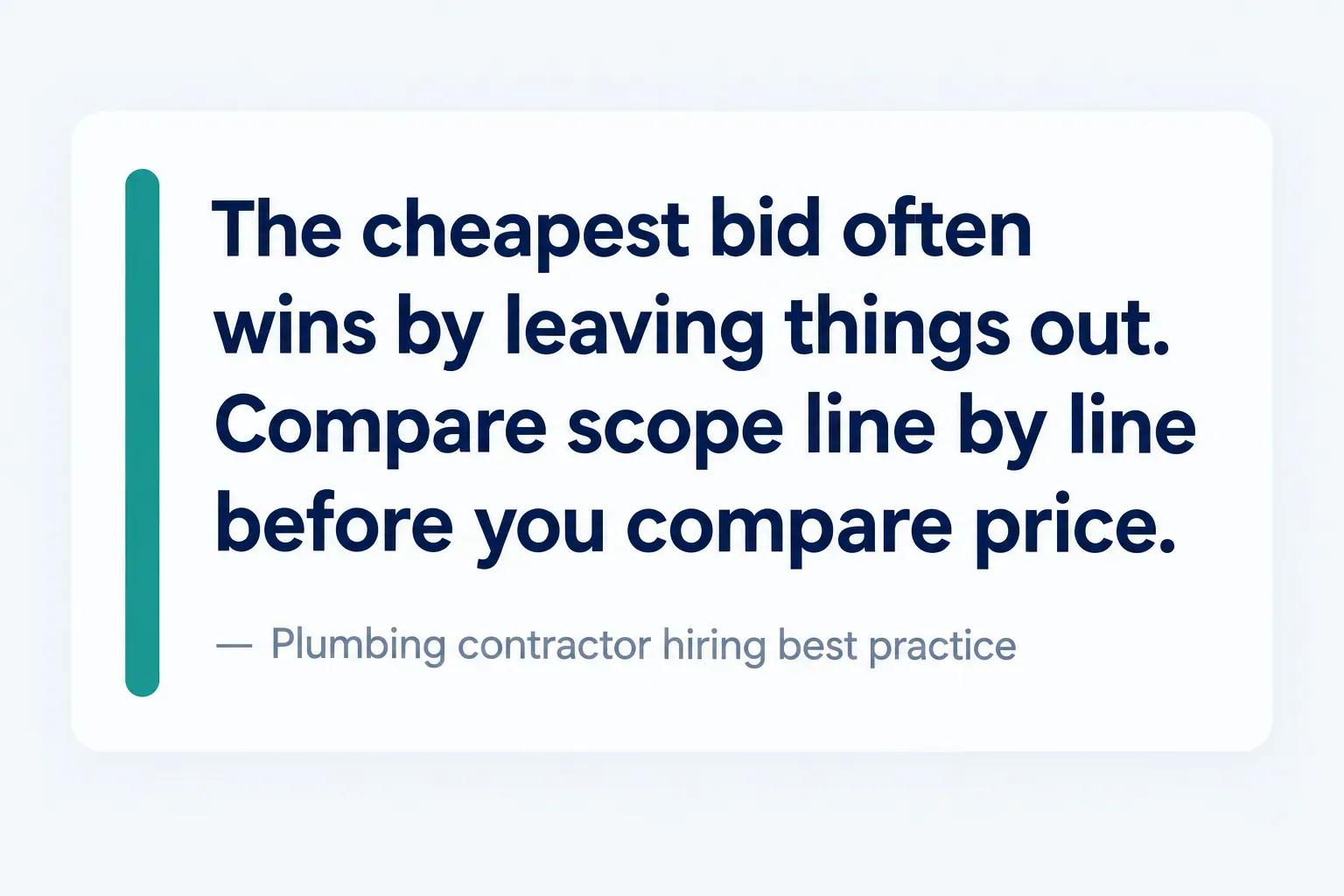
Choosing the cheapest bid is the single biggest mistake homeowners make.
Low bids often win by leaving things out, then recover the difference through change orders, shortcuts, or skipped permits. This guide focuses on value and verification instead, because a $400 savings means nothing if the job has to be redone in 18 months.
Start with the job, not the search
Here’s a counterintuitive truth: the best plumber for a clogged kitchen sink may be the wrong plumber for your sewer line.
Plumbing is a broad trade, and the credentials, equipment, and inspection requirements change dramatically depending on what you need done.
Before you search for anyone, put your job into one of these six categories. Each one changes who you should hire and what you should expect.
- Minor fixture repair. Leaky faucets, running toilets, and worn-out shutoff valves under sinks fall here. These jobs rarely need a building permit, and a like-for-like replacement is often fine for a skilled handyman or confident homeowner.
- Drain clog. A single slow drain usually needs a snake and an hour of labor. Recurring clogs or multiple backed-up fixtures point to a main line problem, so look for a plumber who offers camera inspections and hydro jetting rather than just a quick auger pass.
- Water heater installation. Most jurisdictions require a permit for water heater replacement because the job involves venting, a temperature and pressure relief valve, and gas or high-voltage electrical connections. Some areas also require expansion tanks or seismic strapping to pass code compliance inspections.
- Sewer line work. Repairs and replacements often involve excavation or trenchless lining, plus permits and inspections. Work that crosses into the street can also require a right-of-way permit from your city, which some plumbers simply aren’t set up to pull.
- Gas line or appliance connection. Running a new gas line for a range, dryer, or generator is high-stakes work. Many states require a separate gas fitter license or endorsement, a pressure test, and a final inspection before the utility will turn service on.
- Full remodel. Bathroom and kitchen remodels involve rough-in plumbing, finish work, and multiple inspections at different stages. You’ll often be coordinating the plumbing contractor with a general contractor, so scheduling and communication matter as much as technical skill.
Match the job to the right license class
Most states license plumbers in tiers. The common structure looks like this:
- Apprentice. Learning the trade and legally required to work under the supervision of a licensed plumber.
- Journeyman. Has completed thousands of supervised hours and passed an exam. Can perform most plumbing work independently but often can’t pull permits or run a business alone.
- Master plumber or plumbing contractor. Has additional experience and testing. Typically the license level required to pull permits, own the business, and take legal responsibility for the work.
- Specialty endorsements. Gas fitting, medical gas, backflow testing, and sewer or drain work may require separate certifications depending on your state.
Licensing rules vary a lot by location. Texas licenses plumbers statewide through the State Board of Plumbing Examiners, while New York has no statewide plumbing license and leaves it to localities like New York City.
Check which agency governs your area before you start verifying anyone.
Plumber or handyman?
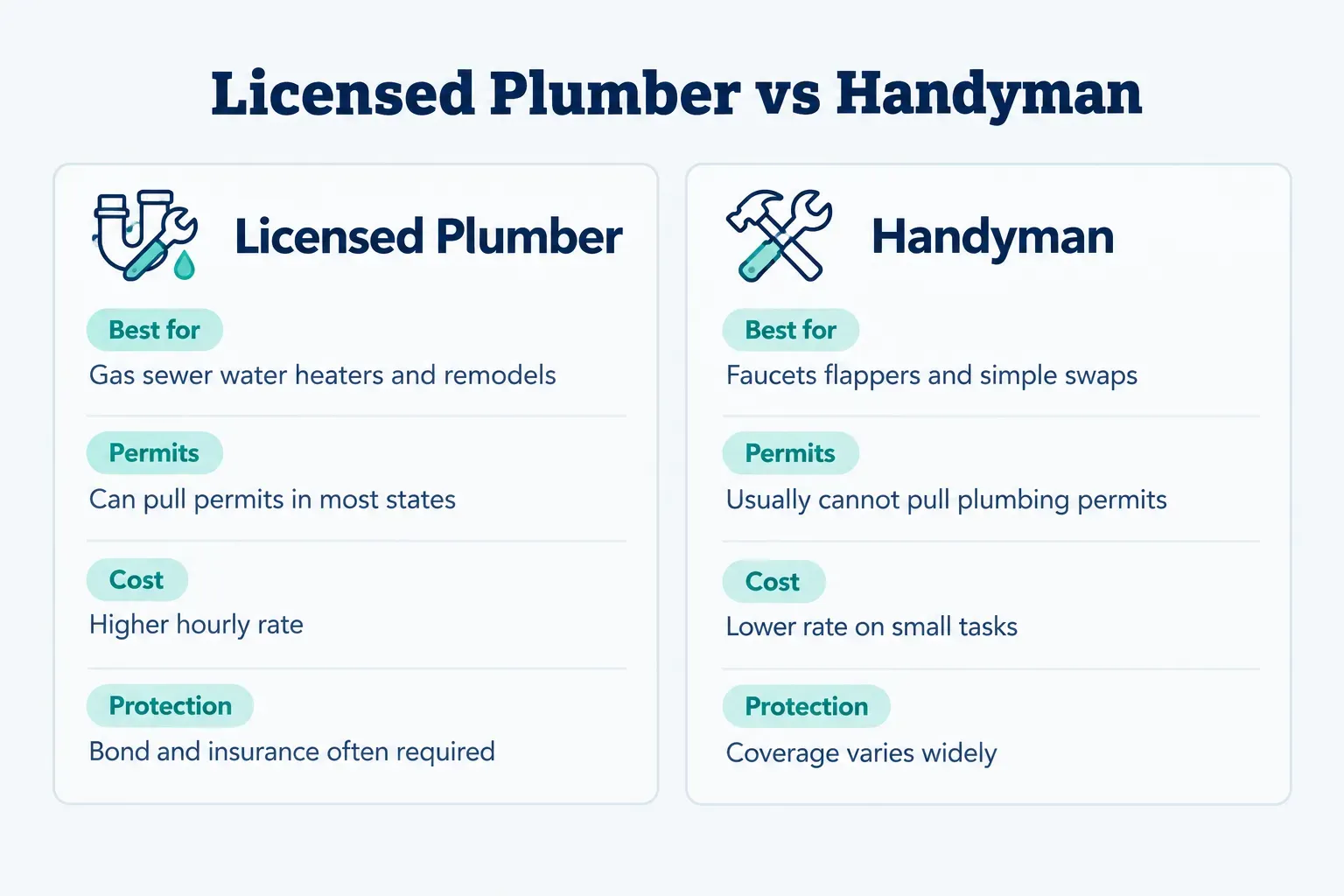
A handyman can save you real money on small jobs.
But the line between “small job” and “licensed work” is sharper than most people realize, and many states cap unlicensed work at a modest dollar amount per job, often in the $500 to $1,000 range including materials.
The rule of thumb is simple.
Anything touching gas lines, the main water supply, sewer connections, or requiring a permit should go to a licensed plumber.
Swapping a faucet or replacing a toilet flapper? A capable handyman is usually fine.
There’s also an insurance angle. If unpermitted work by an unlicensed person causes a leak, your homeowner’s insurer may question the claim.
That’s a costly lesson to learn after the drywall is already soaked.
Build and vet a real shortlist
Three candidates is the magic number. Fewer than that and you have nothing to compare; more than that and you’ll burn a week on estimates without learning anything new.
Where to find credible candidates
The best leads usually don’t come from the top of a search results page. Paid ads and “near me” lead-generation sites often sell your request to whoever pays the most, which isn’t the same as whoever does the best work.
Start with sources that have skin in the game. Local plumbing supply houses are an underrated goldmine, because the counter staff know which plumbers pay their bills, buy quality parts, and keep returning customers.
Ask them directly who they’d call for their own house.
Other strong sources include neighbors who’ve had similar work done, home inspectors, real estate agents, and property managers. Property managers are especially useful.
They hire plumbers constantly, and they drop the bad ones fast.
Neighborhood forums can help too. Just look for specific recommendations (“Maria replaced our water heater in March and pulled the permit”) rather than vague praise.
Confirm license, bond, and insurance separately
“Licensed, bonded, and insured” is a phrase, not proof. Each of those three things is a separate document from a separate source, and each protects you in a different way.
Verify all three yourself.
License. Use your state or local plumber license lookup tool, usually found on the website of the licensing board or building department. Confirm that the status is active, the name matches the business name on the quote, the license class fits your job, and there’s no disciplinary history you should worry about.
Bond. A contractor bond is a financial guarantee that pays out if the contractor fails to meet legal obligations, like abandoning a job or violating code. Bond amounts are often modest (California’s contractor bond requirement is $25,000, for example), so treat it as a backstop, not full protection.
Insurance. You want two policies. General liability insurance covers damage to your property, like a burst pipe that floods your basement during the job. Workers compensation insurance covers employees injured on your property, which keeps that liability from landing on you.
Don’t accept a photo of an insurance certificate. Ask the plumber’s insurance agent to send the certificate of insurance directly to you, then call the insurer to confirm the policy is active for the dates of your job.
This takes about 15 minutes.
It’s the most valuable 15 minutes in the entire hiring process.
Who’s actually showing up?
Here’s a detail most homeowners miss.
The licensed master plumber whose name is on the company may never set foot in your house.
That’s not automatically a problem.
Apprentices and journeymen working under proper supervision are how the trade functions. But you should ask three questions up front: Who will do the work? What license level do they hold? Are they employees or subcontractors?
Subcontractors matter because they need their own insurance. If a sub without workers comp gets injured in your crawlspace, you may have a messy liability situation on your hands.
Ask for the sub’s credentials just as you would for the main company.
Read reviews and check references like a pro
A 4.9-star average tells you surprisingly little. What matters is the shape of the reviews over time, and whether they hold up across platforms.
Start with online review verification. Look at Google, Yelp, the Better Business Bureau, and neighborhood forums side by side.
A company with 300 glowing Google reviews but a string of unresolved BBB complaints deserves a closer look.
Then watch for these patterns:
- Review bursts. Dozens of five-star reviews posted within a few days, followed by silence, can signal purchased or incentivized reviews.
- Repeating complaints. One angry review is noise. Five reviews mentioning surprise fees or no-shows is a pattern.
- Owner responses. A calm, specific reply that offers to fix a problem is a good sign. Defensive or insulting replies tell you how disputes will go.
- Job-type match. Filter for reviews mentioning work like yours. Glowing reviews for drain cleaning don’t prove competence with gas lines.
Next, ask each finalist for two or three customer references from the past year, ideally for similar jobs.
When you call, skip “Were you happy?” and ask sharper questions. Did the final bill match the quote? Did they pull the permit? Did they clean up? Would you hire them again for something bigger?
Finally, search your state licensing board and local court records for complaints or lawsuits.
It’s rare to find anything.
But when you do, it’s usually decisive.
Compare quotes, then put everything in writing
Two quotes for the same water heater replacement can differ by $1,500 and still both be honest. Or one of them can be hiding the expensive parts in fine print.
The only way to tell is to compare them line by line.
Insist on a written plumbing estimate from every candidate, and make sure it’s an itemized quote, not a single lump number. A good itemized quote breaks out labor, materials (with brand and model numbers), permit fees, disposal or haul-away, and any equipment like a camera inspection or excavator.
Ask about fees up front, too. Many companies charge a service call fee or diagnostic fee, commonly somewhere around $50 to $200, just to show up and assess the problem.
Find out whether that fee gets credited toward the repair if you hire them.
Some do.
Many don’t.
Then line the quotes up and look for what’s missing. Does the low bid include the permit? An expansion tank? New supply lines and a fresh shutoff valve? Removal of the old unit?
When you add back the missing items, the “cheap” quote often lands right in the middle of the pack… or above it.
Pay attention to pricing models as well. Flat-rate pricing gives you a fixed number for a defined scope, which protects you from slow work.
Time-and-materials pricing can be fair for unpredictable jobs like tracking down a hidden leak, but ask for a not-to-exceed cap in writing.
Red flags at this stage are hard to miss once you know them.
Watch for cash-only payment, pressure to sign today, door-to-door offers using “leftover materials,” or a claim that your water heater “doesn’t need a permit.”
These are classic markers of a home repair scam, and the Federal Trade Commission has warned about them for years.
Once you’ve picked a winner, the quote becomes a contract.
It should spell out the full scope of work, start and completion dates, who pulls the building permit, cleanup expectations, and the plumbing warranty. Labor warranties of one year are common, while parts carry separate manufacturer warranties, so ask which covers what.
Set a payment schedule tied to milestones, not calendar dates.
A small deposit, a progress payment after rough-in or inspection, and a final payment after the job passes and you’ve tested everything is a sensible structure.
Some states cap deposits by law; California, for example, limits most home improvement down payments to 10% of the contract price or $1,000, whichever is less.
And plan for surprises.
Opening a wall sometimes reveals corroded pipe nobody could have seen. Your contract should require a written change order, with price and scope, signed by you before any extra work starts.
Verbal “we’ll sort it out later” agreements are how a $3,000 job becomes a $6,000 argument.
Document the job as it happens.
Take photos before work begins and at each stage, especially before walls close up. Keep the final invoice, permit record, inspection sign-off, and warranty paperwork in one folder.
You’ll want all of it when you sell the house.
One last move pays off for years.
Once you’ve found a plumber you trust, save their number and know where your main water shutoff valve is located.
When a pipe bursts at 2 a.m., you won’t have time to vet anyone, and emergency plumbing service after hours often costs 1.5 to 2 times the standard rate.
That’s the real answer to how to find a good plumber in 2026.
Not luck, and not the lowest bid.
A clear job definition, verified credentials, an itemized quote, and a paper trail.
Do it once, carefully, and you’ll have a plumber worth calling for the next decade.
Need a hand with something?
The Frendex map shows you who is available near you, in real time.
Get the app free Get the app freeFree, no card needed
Related articles

Pest control cost in 2026: What you'll really pay
Real 2026 pricing for one-time visits, recurring plans, and termite or bed bug jobs. Learn what drives $95 vs $1,400 quotes before you sign.
Boiler maintenance: A homeowner's safety and service guide
Learn which boiler checks are safe to DIY, which need a pro, and the warning signs that mean call for help now. A homeowner's framework for 2026.
Rodent control: A homeowner's step-by-step guide
Skip the trap-and-hope cycle. This 8-step IPM method shows why sealing entry points matters more than traps. See the full sequence inside.