Toilet blockage: The complete fix-it and know-when-to-call guide
By Kiss János Updated 15 min read
When the toilet won’t flush right
Most advice about a toilet blockage starts and ends with “grab a plunger.”
That’s fine until the plunger makes things worse.
Plunging a toilet that’s backed up because of a main sewer problem can push dirty water into your bathtub, or onto your floor.
The better approach is a simple decision tree.
First, stop the water so nothing overflows. Then figure out where the clog actually sits and how serious it is, pick the right tool for that location, and know exactly when to stop and call for help.
Here’s the reassuring part.
The vast majority of clogs are simple obstructions lodged in the toilet trapway, the curved channel built into the porcelain.
A flange plunger or a closet auger clears them in minutes.
But some symptoms point somewhere else entirely. Gurgling drains, water rising in the shower, or clogs that return every few weeks suggest a problem in the branch drain, the plumbing vent, or the main sewer line.
Those aren’t plunger jobs.
This guide, updated for 2026, walks you through each stage in order. Follow it from the top and you’ll fix what’s fixable, avoid making a mess worse, and recognize the moment DIY stops being smart.
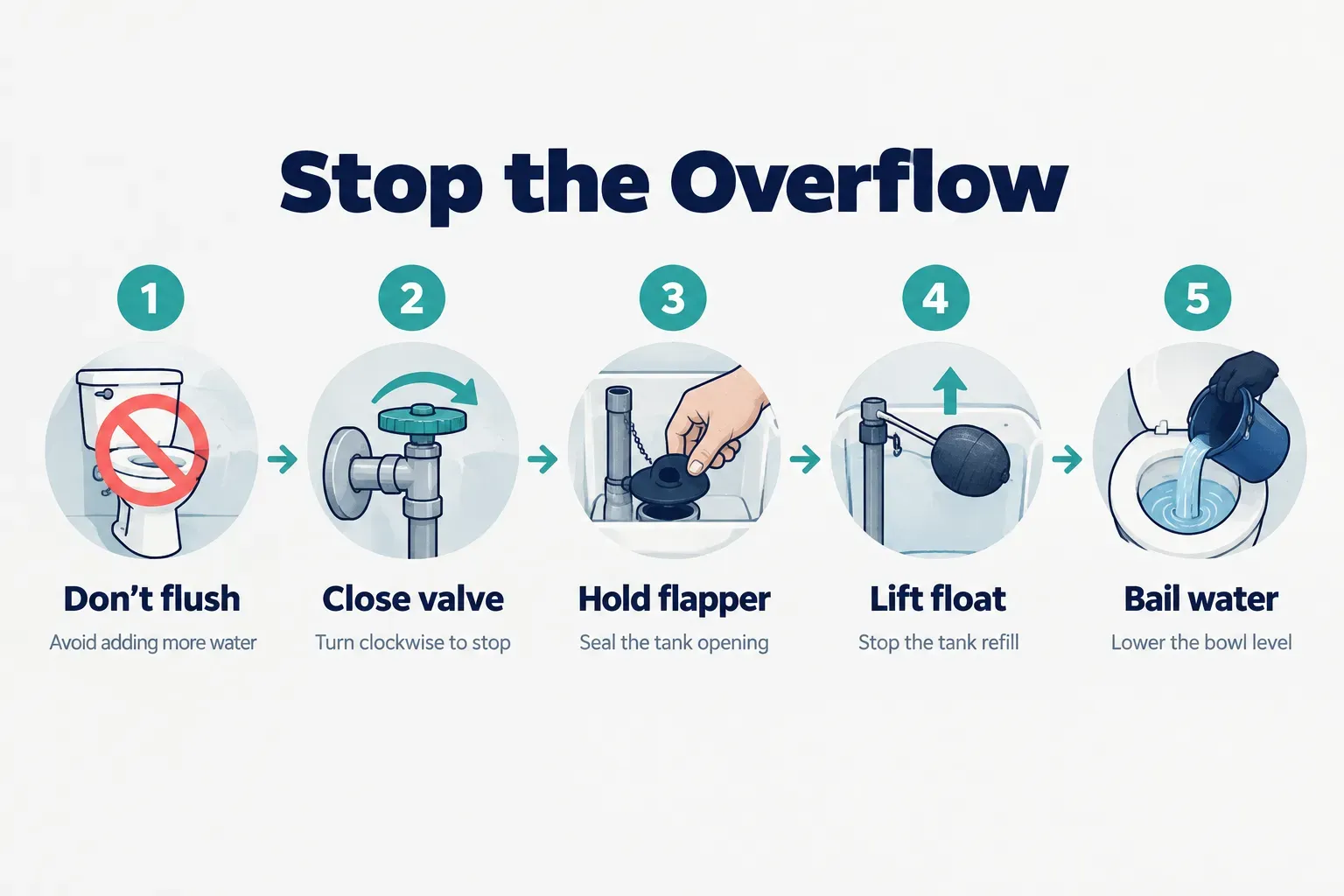
Stop the overflow first
The bowl is rising and you have maybe ten seconds.
Don’t flush again.
A second flush sends another 1.6 gallons (or more, in older toilets) into a bowl that already can’t drain, and that water has only one place to go.
Work through these steps in order before you touch a plunger.
- Find the toilet shut-off valve. Look behind or beside the base of the toilet, near the floor or wall, for a small oval or round handle on the supply line. Turn it clockwise until it stops, which cuts off fresh water to the tank.
- Check that the valve actually worked. Older multi-turn valves can seize from mineral deposits, so turn firmly but don’t use pliers with full force, since a snapped valve stem creates a second leak. If the tank keeps refilling after you’ve closed it, move to the next step.
- Lift the tank lid and close the flapper by hand. The flapper is the rubber seal at the bottom of the tank. Push it down onto the flush valve opening to stop water from draining into the bowl.
- Raise the float to stop the refill. Lift the float cup or float ball attached to the fill valve and hold it up. This tricks the valve into thinking the tank is full, so it stops pouring water in while you work.
- Stop the source before cleaning anything. If water is already on the floor, resist the urge to mop or plunge immediately. Secure the water supply first, then lay down old towels to contain the spread.
- Remove excess water from the bowl if it’s near the rim. Use a small cup or container to bail some water into a bucket. A bowl filled to the brim will splash over the moment you start plunging.
- Escalate immediately in two scenarios. If the toilet is in a basement and keeps filling with water you didn’t flush, or you cannot reach or close any valve and water keeps coming, call a plumber now. A basement toilet filling on its own usually signals a sewage backup from the main line, not a local clog.
If the house-wide water main is easier to reach than the toilet valve, close that instead. It’s a blunt tool, but it works when the toilet valve is buried behind a vanity or completely frozen.
Once the water is stable, you’ve bought yourself time.
Now you can figure out what you’re dealing with.
Diagnose before you plunge
A clogged toilet is a symptom, not a diagnosis.
The same slow bowl can come from a wad of paper six inches into the trap or a root mass forty feet out in the yard. Spending two minutes on diagnosis tells you which tool to reach for, and whether to reach for one at all.
Toilet-only blockage
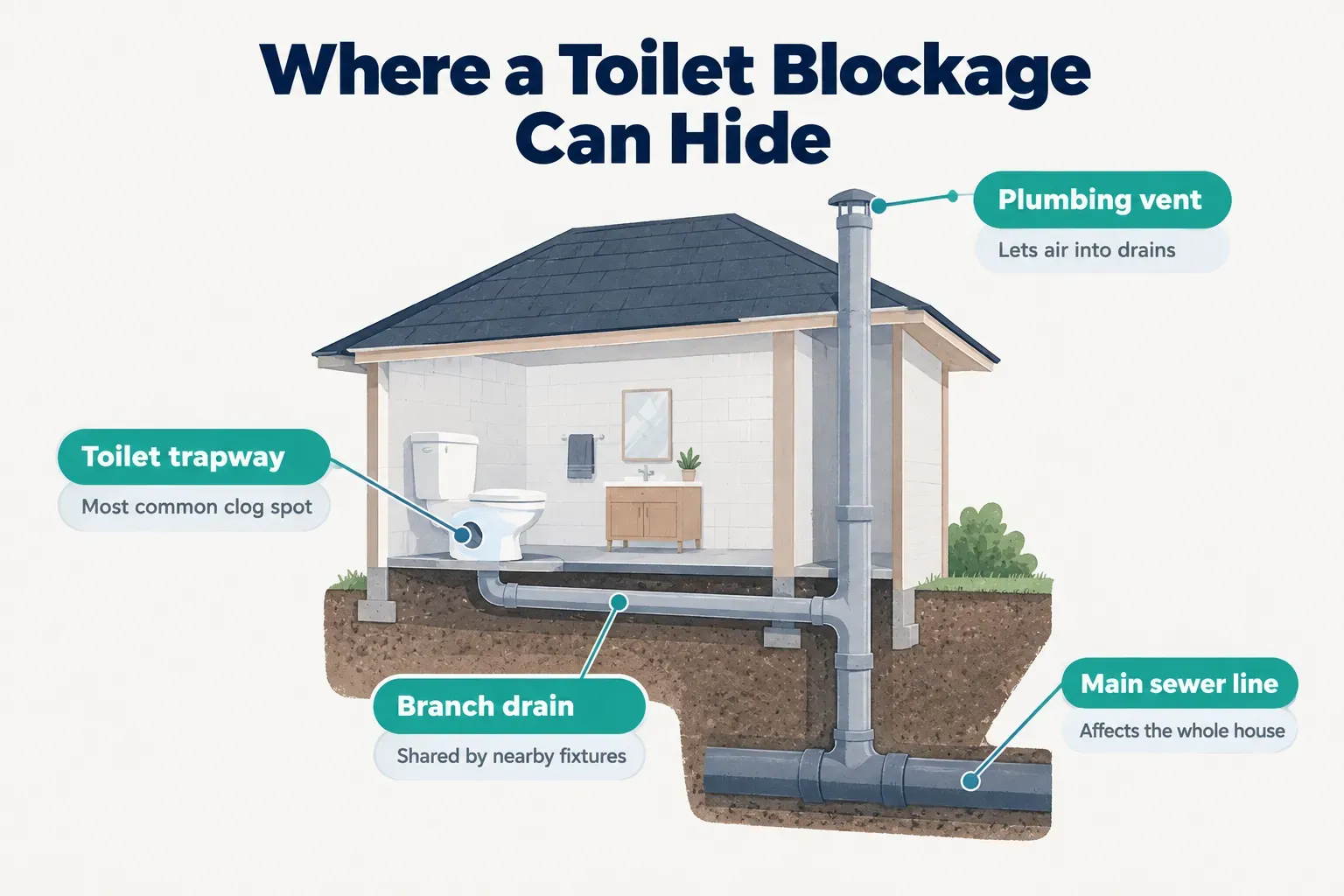
If one toilet drains slowly or backs up and everything else in the house behaves normally, the clog is almost certainly in that toilet. The usual suspect is the toilet trapway, the S-shaped channel molded into the porcelain that holds water and blocks sewer gas.
Trapways are narrow, often around 2 inches in diameter, and they have tight bends. Excess toilet paper, a “flushable” wipe, or a small object can catch at the first curve.
A toilet paper blockage in this spot is the single most common clog homeowners face, and it responds well to a plunger.
Test the other fixtures.
Run the bathroom sink for 30 seconds, then the shower. If both drain freely with no gurgling, you’re looking at a local clog.
Branch drain or main line signs
Things change when the problem spreads.
Every fixture in your home feeds into a branch drain, and those branches merge into the main sewer line that carries waste to the municipal sewer or septic tank.
A clog downstream affects everything upstream of it.
Watch for these warning signs:
- Multiple fixtures draining slowly at the same time, especially toilets, tubs, and floor drains on the lowest level.
- Gurgling from the toilet when you run the sink, shower, or washing machine.
- Water backing up into the bathtub or shower when you flush.
- Sewage smells near floor drains or the cleanout cap outside.
That gurgling deserves attention.
It’s the sound of air trying to escape through water because its normal path is blocked, either a partially obstructed drain line or a clogged plumbing vent on the roof.
Gurgling isn’t a toilet problem. It’s a drain system problem that happens to be audible at the toilet.
Vents let air into the drain system so water flows smoothly. When leaves, a bird’s nest, or ice block the vent, drains slow down and toilets flush weakly, even with no physical clog in the pipe.
Blocked or just broken?
Sometimes the toilet isn’t clogged at all.
It just isn’t flushing properly.
The difference matters, because plunging a toilet with a broken chain accomplishes nothing.
Lift the tank lid and flush.
If the handle moves but nothing happens, the chain may be disconnected or the handle arm snapped. If the tank empties weakly, check the water level; it should sit about an inch below the top of the overflow tube.
Look for these mechanical culprits:
- A warped or worn flapper that closes too early, cutting the flush short.
- A faulty fill valve that leaves the tank underfilled.
- Blocked rim jets and siphon jets, the small openings under the bowl rim and at the bottom of the bowl that drive the flush.
In hard-water areas, mineral scale buildup narrows those jets over time. The result is a toilet that flushes sluggishly and leaves waste behind, which looks exactly like a partial clog… but no plunger will ever fix it.
A small mirror under the rim will show you crusty white deposits if this is your problem.
The right tool for the job
Two tools solve the overwhelming majority of toilet clogs, and most homes own the wrong version of one of them. Here’s how to pick and use each correctly, plus what to keep far away from your toilet.
Plunger first
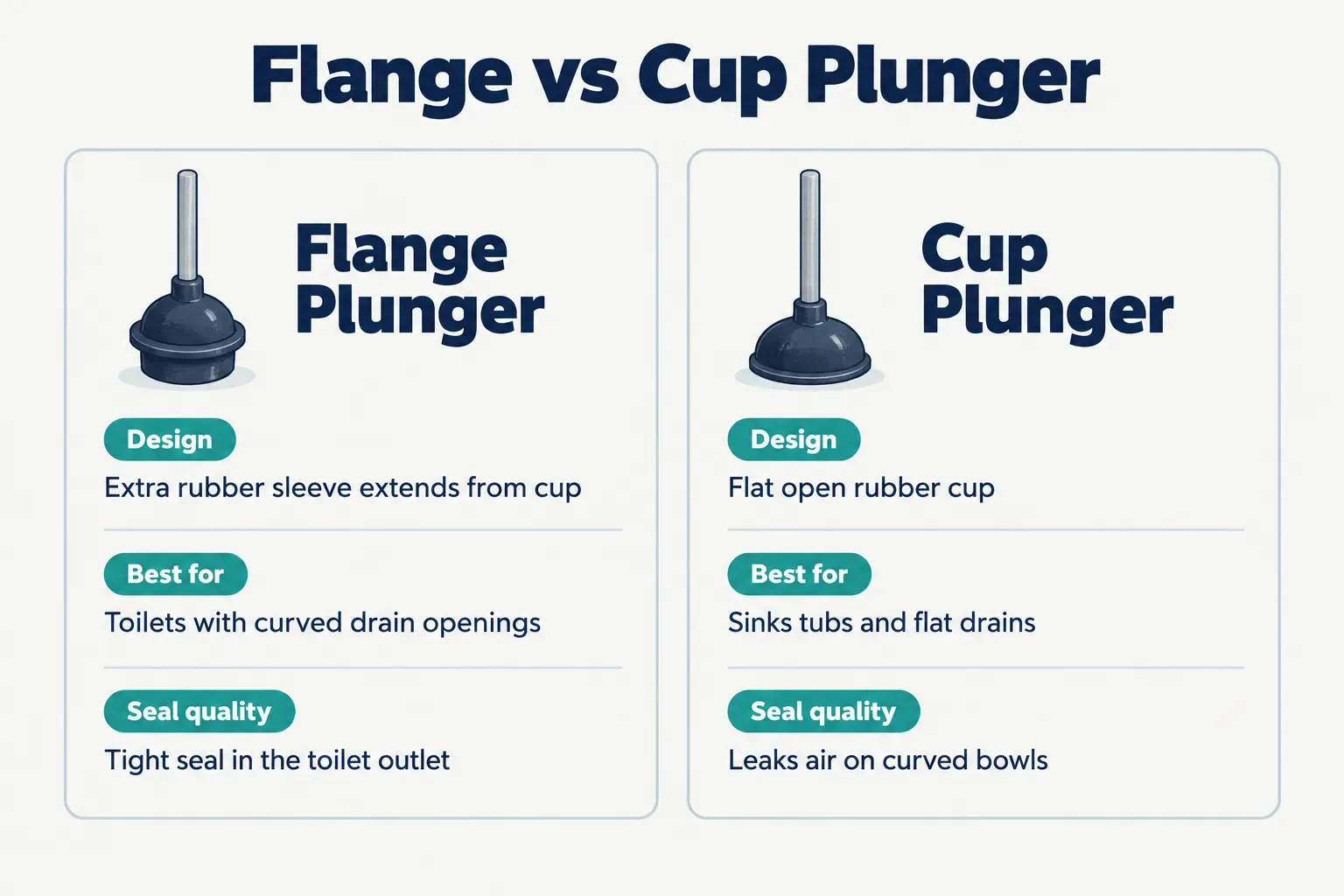
The flat, red cup plunger hanging in many garages is designed for sinks and tubs. On a toilet, it can’t seal the curved drain opening, so most of your effort escapes as splash.
A flange toilet plunger has an extra rubber sleeve that folds out from the cup and fits snugly into the drain hole.
- Check the water level. You need enough water in the bowl to cover the rubber head completely, since plungers move water, not air. Add a little from a bucket if the bowl is nearly empty.
- Seat the flange in the drain. Insert the plunger at an angle so trapped air escapes, then fit the flange squarely into the outlet. Press gently at first to form the seal.
- Use a steady push-pull rhythm. Push down firmly, then pull up sharply without lifting the cup off the opening. The pull stroke often does more work than the push, because the suction loosens the clog.
- Keep the seal for 15 to 20 strokes. Breaking the seal every few pumps resets your progress. Stay consistent, then lift away and watch whether the water drains.
- Test with a partial flush. Once the bowl drains, turn the water back on and hold the flapper ready to drop. If the water swirls down normally, flush fully.
Closet auger for stubborn clogs
If two or three rounds of plunging don’t work, switch to a closet auger (also called a toilet auger). It’s a short cable, typically 3 to 6 feet long, housed in a rigid tube with a rubber or vinyl sleeve that protects the porcelain from scratches.
- Retract the cable fully. Pull the handle up so the cable tip sits just inside the curved end of the tube.
- Position the bend in the bowl outlet. Place the curved end into the drain opening with the protective sleeve resting against the porcelain.
- Feed the cable gently. Push the handle down slowly while cranking clockwise, letting the cable follow the trapway’s curves. You’ll feel resistance when you reach the obstruction.
- Break up or hook the clog. Continue cranking clockwise to bore through soft clogs or snag fibrous ones like wipes. Then retract while still turning, which often pulls the material back into the bowl.
- Clean and test. Remove any debris, rinse the auger in the bowl, and test with a careful flush.
Never push a standard sink drain snake down a toilet. The bare steel cable can scratch or chip the glazed porcelain, permanently roughening the surface so future clogs grab more easily.
What to avoid (and when not to force it)
Dish soap and warm water make a reasonable first attempt on soft paper clogs.
Squirt a few tablespoons of liquid dish soap into the bowl, add warm tap water (around 120°F, roughly hot shower temperature), and wait 15 to 30 minutes. The soap lubricates the clog and the warmth helps break down paper.
Treat it as a softening aid, not a guaranteed fix. Two rules apply:
- Never use boiling water. Pouring boiling water into cold porcelain creates thermal shock that can crack the bowl, and a cracked toilet means a full replacement. It can also soften the wax ring seal at the base.
- Watch the water level. Adding water to a bowl that’s already full and not draining causes overflow. Bail first if needed.
- Skip chemical drain cleaners entirely. Caustic products can splash back during plunging and cause chemical burns, may damage older pipes, and generate heat that stresses porcelain. They also endanger the plumber who later opens the line and gets a face full of lye-laced water.
- Stop if you flushed an object. If a toy, phone, sanitary product, paper towel, or wipe went down, stop flushing immediately. Forcing an auger deeper can push the item past the trap and into the branch line, where retrieval often means pulling the toilet or cutting pipe.
For flushed objects, gentle retrieval is the goal. If you can’t hook the item with an auger in the first few inches, call a professional who can remove the toilet and pull it out from below.
Recurring clogs and bigger problems
One clog is bad luck.
Three clogs in two months is a pattern, and patterns have causes. If you’re plunging every week, the toilet is telling you something about your plumbing system that a plunger can’t answer.
Why it keeps happening
Recurring clogs usually trace back to one of a handful of root causes. Some live inside the toilet itself, while others sit far beyond it.
Mineral scale buildup narrows the trapway and jets gradually in hard-water homes, shrinking the passage until normal waste catches. Blocked vents starve the drain of air, weakening every flush.
And in older neighborhoods, tree root intrusion is a leading cause of main line trouble, since roots seek out moisture and enter through tiny joint gaps in clay or cast-iron pipe.
Pipe condition matters too.
A “bellied” pipe sags in the middle, creating a low spot where waste settles instead of flowing. Cracked, offset, or collapsed sections catch paper the same way.
The toilet’s design can play a role.
Some early low-flow toilet models from the 1990s, built to the federal 1.6-gallons-per-flush limit, had undersized trapways and weak flush performance. Modern WaterSense models using 1.28 gallons or less have largely solved this through better engineering, but an older unit may simply not move enough water.
Homes on septic systems face their own limits. A full tank or saturated drain field slows the entire system, and toilets are usually the first fixture to show it.
Pinning down which cause you have usually requires a sewer camera inspection. A plumber feeds a waterproof camera through a cleanout and shows you, in real time, whether you’re dealing with roots, a belly, or a crushed section of pipe.
Cleaning up after an overflow
Clear water from the tank is a nuisance.
Water from the bowl, or anything that backed up from the drain, is a health hazard carrying bacteria, viruses, and parasites.
Treat it accordingly.
Keep children and pets out of the area until cleanup is done. Wear waterproof gloves and protective footwear such as rubber boots, and consider eye protection if you’ll be scrubbing.
Remove standing water first, then clean all hard surfaces with detergent and hot water. Follow with a disinfectant, such as a diluted bleach solution (the CDC suggests about 1 cup of household bleach per 5 gallons of water) or an EPA-registered product, letting it sit for the labeled contact time.
Bag contaminated paper, cardboard, and fabric items that can’t be laundered on hot. Rugs and carpet pads soaked in sewage usually need to be discarded.
If sewage reached drywall or subfloor, professional remediation is the safer route.
When to call a professional
Some situations aren’t judgment calls.
They’re emergencies.
Call a plumber immediately if sewage is backing up into a bathtub, shower, or floor drain; if you can’t shut off the water; or if a basement toilet is flooding.
Also watch for signs of a blocked public sewer, such as neighbors reporting backups at the same time or sewage rising from a street manhole. The EPA has estimated that the US experiences tens of thousands of sanitary sewer overflow events each year, and these should be reported to your local utility rather than handled by your own plumber.
Renters should notify property management or the building’s maintenance provider before booking any private plumbing work. Many leases make the landlord responsible for drain repairs, and unauthorized work can complicate reimbursement.
When the problem is a main line issue, a recurring clog, or contaminated cleanup beyond DIY scope, a platform like Frendex lets you find and book a vetted local plumber on a live map. That’s especially useful after hours, when calling down a list of numbers wastes time you don’t have.
Prevention keeps you out of this section entirely.
Use toilet paper in moderation and flush twice for heavy loads rather than once. Never flush wipes (including products labeled flushable wipes, which don’t break down the way toilet paper does), paper towels, cotton swabs, or sanitary products.
Teach young children what belongs in the toilet, since toys are a frequent culprit in homes with toddlers. Inspect your toilet’s flush and jets once a year, and if you’re on septic, follow your local pumping schedule and disposal rules.
Know when to stop dIYing
Here’s the one rule worth remembering.
Try the plunger and the auger once or twice, safely and with the water shut off, but stop the moment you see a main line or sewage symptom.
Pushing harder past that point rarely helps.
It just turns a plumbing call into a plumbing call plus a cleanup bill.
The quick decision summary:
Single slow toilet, no gurgling, other drains normal? Keep troubleshooting. Plunge, auger, and check the tank mechanics.
Multiple fixtures affected, water rising elsewhere, or clogs that keep coming back? Call a plumber. Those problems live in the branch drain or main sewer line, and they need a camera inspection and professional equipment to fix properly.
Most toilet blockages are a five-minute job.
Knowing which ones aren’t is what saves your floors.
Frequently asked questions
How do you unblock a badly blocked toilet?
Start with a flange plunger, and if that fails after a few rounds, use a closet auger to break up or hook the obstruction. Shut off the water first to prevent overflow. If neither tool works, or other drains are also slow, the blockage is likely beyond the toilet and needs professional equipment such as a sewer machine.
What is the fastest way to unclog a toilet?
A flange plunger used with a steady push-pull motion is the fastest fix for most clogs, often clearing them in under two minutes. The key is covering the rubber head with water and maintaining the seal throughout. See the "Plunger First" steps above for the full technique.
Will a toilet eventually unclog itself?
Yes, sometimes, but only when the clog is made of soft, water-soluble material like toilet paper. Given several hours, the paper may break down enough to pass. Clogs from wipes, sanitary products, or solid objects will not dissolve and require manual removal.
Can hot water and dish soap unclog a toilet?
Hot water and dish soap can loosen mild paper or organic clogs, but they aren't a reliable fix. Use warm tap water, never boiling, since boiling water can crack porcelain. Wait 15 to 30 minutes, then follow up with a plunger if the bowl still won't drain.
Why does my toilet keep clogging with normal use?
Frequent clogs with normal use usually point to mineral scale in the trapway, a blocked plumbing vent, an older low-flow toilet with weak flush power, or a problem in the drain line such as roots or a sagging pipe. Check the rim jets and tank water level first. If those look fine, a sewer camera inspection is the most efficient way to find the cause.
How do you know if a toilet blockage is in the main sewer line?
A main sewer line blockage affects multiple fixtures, not just one toilet. Telltale signs include water backing into the tub when you flush, gurgling when the washing machine drains, and slow drains on the lowest floor. These symptoms call for a plumber with a camera and a sewer machine, not a plunger.
Need a hand with something?
The Frendex map shows you who is available near you, in real time.
Get the app free Get the app freeFree, no card needed
Related articles
Pest control cost in 2026: What you'll really pay
Real 2026 pricing for one-time visits, recurring plans, and termite or bed bug jobs. Learn what drives $95 vs $1,400 quotes before you sign.
Boiler maintenance: A homeowner's safety and service guide
Learn which boiler checks are safe to DIY, which need a pro, and the warning signs that mean call for help now. A homeowner's framework for 2026.
Rodent control: A homeowner's step-by-step guide
Skip the trap-and-hope cycle. This 8-step IPM method shows why sealing entry points matters more than traps. See the full sequence inside.